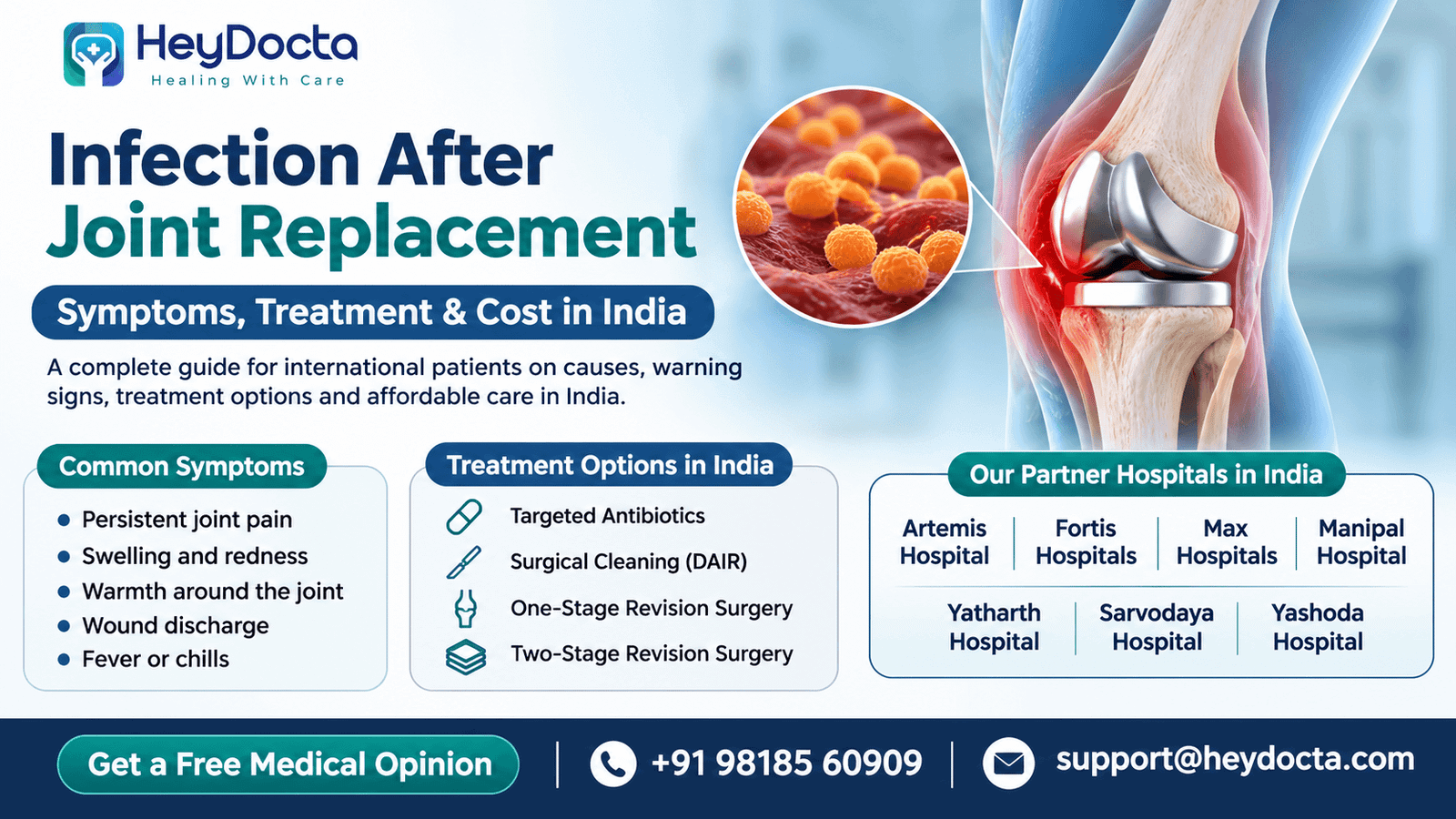
Infection after joint replacement is a serious complication that can occur following hip or knee replacement surgery. Although joint replacement procedures generally help reduce pain and improve mobility, bacteria can sometimes enter the surgical area and infect the artificial joint. This condition is known as a periprosthetic joint infection (PJI).
Patients may experience persistent pain, swelling, redness, warmth around the joint, wound discharge or fever. In some cases, infection develops months or even years after surgery. Early diagnosis and appropriate treatment are important to protect the artificial joint and reduce the risk of further complications.
For international patients considering treatment in India, understanding the available treatment options, revision surgery and associated costs can help with informed decision-making.
Get a Free Medical Opinion : Contact HeyDocta for assistance with medical opinions, hospital coordination, treatment estimates and travel arrangements.
Why International Patients Consider India for Joint Infection Treatment
India is an established destination for orthopaedic treatment and complex joint revision procedures. International patients from Africa, the Caribbean, the USA, Europe and the Middle East consider Indian hospitals for several reasons:
- Access to experienced orthopaedic and joint replacement specialists.
- Availability of diagnostic facilities, microbiology laboratories and advanced surgical infrastructure.
- Treatment options for infected hip and knee replacements.
- Access to revision joint replacement and reconstructive procedures.
- Treatment estimates that may be lower than those in several high-cost healthcare markets.
- Support with appointments, medical documentation and travel arrangements.
HeyDocta helps international patients connect with its partner hospitals, including Artemis Hospital, Fortis Hospitals, Max Hospitals, Manipal Hospital, Yatharth Hospital, Sarvodaya Hospital and Yashoda Hospital.
Get a Medical Opinion: Share your previous surgery reports, investigation results and current symptoms with HeyDocta to begin exploring suitable treatment options in India.
What Is an Infection After Joint Replacement?
A joint replacement involves replacing damaged joint surfaces with artificial components made from materials such as metal, ceramic and medical-grade plastic. An infection can develop when bacteria attach to the artificial implant or infect the surrounding tissues.
Unlike some ordinary infections, bacteria can form a protective layer called a biofilm on implant surfaces. This can make the infection more difficult to eliminate with antibiotics alone.
Types of Joint Replacement Infection
- Early infection: Develops within the first few weeks after surgery, often around the surgical wound.
- Delayed infection: Develops several weeks or months after the procedure.
- Late infection: Can occur years after replacement surgery, sometimes when bacteria travel through the bloodstream from an infection elsewhere in the body.
Symptoms of Infection After Hip or Knee Replacement
Recognising the warning signs is essential. Common symptoms include:
- Persistent or increasing joint pain.
- Swelling around the operated joint.
- Redness and warmth near the surgical site.
- Fluid, pus or discharge from the wound.
- Fever or chills.
- Difficulty walking or bearing weight.
- Reduced joint movement or stiffness.
- A wound that does not heal properly.
Some patients may experience pain without fever or visible wound changes. Anyone with suspected infection should seek prompt medical assessment. Fever with severe illness, rapidly worsening pain or significant wound discharge requires urgent medical attention.
Causes and Risk Factors
Infection may occur during surgery, shortly after the procedure or later through the bloodstream.
Potential risk factors include:
- Previous infection around the joint.
- Diabetes or poorly controlled blood sugar.
- Obesity.
- Weakened immune system.
- Long-term use of immunosuppressive medicines.
- Previous joint replacement or revision surgery.
- Wound-healing complications.
- Infections elsewhere in the body.
Having a risk factor does not mean that a patient will develop an infection.
Diagnosis of Infection After Joint Replacement
Doctors use a combination of clinical assessment, laboratory tests and imaging to identify an infection and plan treatment.
Common investigations include:
| Investigation | Purpose |
| ESR and CRP blood tests | Identify signs of inflammation |
| Joint aspiration | Collect joint fluid for analysis |
| Synovial fluid culture | Help identify the infecting organism |
| X-ray | Assess implant position and surrounding bone |
| Advanced imaging | Used in selected cases to evaluate complications |
| Tissue cultures | Identify bacteria during surgery |
Identifying the responsible bacteria and their antibiotic sensitivity is important when planning treatment.
Treatment Options for Infection After Joint Replacement in India
Treatment depends on the infection’s duration, severity, bacterial cause, implant stability, bone condition and the patient’s overall health.
1. Antibiotic Treatment
Antibiotics are selected according to culture results wherever possible. Treatment may involve intravenous antibiotics followed by oral medication. Antibiotics alone are generally insufficient for an established infection involving an artificial joint, particularly when biofilm is present.
2. Debridement, Antibiotics and Implant Retention (DAIR)
This procedure may be considered in selected patients with an acute infection, a stable implant and suitable surrounding tissues.
The surgeon cleans the infected area, removes infected or damaged tissue and replaces accessible modular components, such as the plastic liner or femoral head where appropriate. Antibiotic treatment is provided alongside surgery.
3. One-Stage Revision Surgery
In carefully selected cases, the infected implant is removed, the area is thoroughly cleaned and a new implant is placed during the same operation. Patient selection depends on factors such as the identified organism, tissue condition and surgical circumstances.
4. Two-Stage Revision Surgery
Two-stage revision is commonly considered for chronic or complex infections.
The process generally involves:
- Removing the infected artificial joint.
- Cleaning infected tissue and taking samples for cultures.
- Placing an antibiotic-loaded temporary spacer in suitable cases.
- Giving a course of targeted antibiotics.
- Reassessing the infection and patient’s condition.
- Performing a second operation to insert a new joint replacement when appropriate.
Not every patient is suitable for reimplantation, and the timing depends on individual clinical findings.
5. Long-Term Antibiotic Suppression
For selected patients who cannot undergo further surgery or have persistent infection, long-term suppressive antibiotics may be considered. This approach aims to control infection rather than necessarily eliminate it.
Specialist and Partner Hospitals in India
Treatment should be planned by an orthopaedic surgeon experienced in revision joint replacement and periprosthetic joint infection. The care team may also include infectious disease specialists, microbiologists and rehabilitation professionals.
Dr. Dhananjay Sabat at Yatharth Hospital can be considered for an orthopaedic consultation. Patients should confirm his current clinical role, experience with infected joint revision and availability directly with the hospital before making treatment arrangements.
HeyDocta can coordinate enquiries with its partner hospitals:
- Yatharth Hospital
- Artemis Hospital
- Fortis Hospitals
- Max Hospitals
- Manipal Hospital
- Sarvodaya Hospital
- Yashoda Hospital
The appropriate hospital depends on the patient’s diagnosis, specialist availability, required procedure and individual medical needs.
Infection After Joint Replacement Treatment Cost in India vs Other Countries
The cost of treating an infected artificial joint depends on whether the patient needs antibiotics, surgical cleaning, implant retention, one-stage revision or a more complex two-stage revision. A two-stage procedure can cost considerably more because it may involve two operations, a temporary spacer, prolonged antibiotics and additional hospital care.
Estimated Revision Knee Replacement Cost Comparison
The following figures are indicative planning estimates for revision knee replacement, which may be required in some cases of infected knee implants. They are not fixed prices for infection treatment.
| Country | Estimated Cost (USD) |
| India | $9,000–$18,000 |
| United States | $50,000–$100,000 |
| United Kingdom | $29,500–$54,000 |
| Germany | $34,000–$61,000 |
| Singapore | $38,000–$65,000 |
Important cost considerations: These estimates do not represent a guaranteed package for infected joint replacement. The final quotation may change according to:
- Whether the infection requires one or two operations.
- Hip or knee implant type and complexity.
- Implant removal and replacement requirements.
- Antibiotic spacer, bone graft or specialised revision implants.
- Microbiology tests and infectious disease consultations.
- Length of hospital stay and rehabilitation.
- Medical conditions requiring additional care.
Patients should request an itemised estimate covering both surgical stages, if applicable, medicines, investigations, hospitalisation and rehabilitation.
Step-by-Step Treatment Process for International Patients
International patients can begin the treatment planning process remotely before travelling to India.
- Initial medical consultation: Share medical history, symptoms and previous joint replacement records.
- Medical report evaluation: The specialist reviews X-rays, blood tests, joint aspiration results and previous surgical notes.
- Treatment recommendation: The medical team determines whether further investigations, antibiotics or revision surgery may be appropriate.
- Cost estimate: The hospital provides a proposed treatment plan and an estimate based on the available medical information.
- Medical visa and travel planning: Patients arrange their visa, flights and accommodation after receiving medical advice and hospital confirmation.
- Hospital admission and treatment: The patient undergoes the required investigations and planned treatment.
- Rehabilitation and follow-up: Physiotherapy, wound care, antibiotic monitoring and follow-up appointments are arranged according to the treating team’s instructions.
Need help coordinating your treatment? HeyDocta can assist with medical record sharing, hospital appointments, treatment estimates and travel coordination.
Medical Visa and Travel Support for Treatment in India
International patients travelling to India for joint infection treatment may need an appropriate medical visa, depending on their nationality and circumstances.
HeyDocta can help coordinate:
- Hospital appointment and admission documentation.
- Medical invitation letters, where provided by the hospital.
- Guidance on the medical visa application process.
- Airport pickup and local transportation arrangements.
- Accommodation assistance for patients and attendants.
- Communication with hospital international patient departments.
Visa approval is determined by the relevant Indian authorities. Patients should check the latest requirements for their country before booking travel.
Recovery Time and Recommended Stay in India
Recovery depends on infection severity, the surgical procedure, the patient’s general health and the response to treatment.
| Treatment | General Recovery Considerations |
| Antibiotic treatment | Duration depends on the organism and clinical response. |
| DAIR procedure | Wound healing, antibiotics and progressive rehabilitation are required. |
| One-stage revision | Recovery includes wound care, mobility training and follow-up. |
| Two-stage revision | Requires recovery after both operations and monitoring between stages. |
Patients undergoing two-stage revision may need to remain in India for an extended period or return for the second operation. The interval between procedures varies and cannot be fixed for every patient.
Patients should not book return flights until the treating surgeon confirms that they are medically fit to travel. Long-distance travel may require additional precautions to reduce the risk of blood clots.
FAQs About Infection After Joint Replacement
1. What are the first signs of infection after joint replacement?
Early signs may include increasing pain, swelling, redness, warmth, wound discharge, fever or chills. Some infections cause persistent pain without obvious external symptoms.
2. Can an infected knee or hip replacement be treated without removing the implant?
Yes, in selected cases. A procedure called DAIR may allow the surgeon to clean the infected area and retain a stable implant. However, implant removal or revision may be necessary in other cases.
3. How much does infected joint replacement treatment cost in India?
The cost depends on the treatment approach. Revision knee replacement planning estimates are approximately $9,000–$18,000 in India. Complex infection treatment, especially two-stage revision, may require a separate customised estimate.
4. Is two-stage revision surgery always necessary?
No. Some patients may be suitable for DAIR or one-stage revision. Two-stage revision is considered when clinical, microbiological and surgical factors make it more appropriate.
5. How long does recovery take after infected joint replacement surgery?
Recovery varies according to infection severity, surgical procedure, antibiotic treatment and rehabilitation progress. Two-stage revision generally requires a longer treatment pathway than a single procedure.
6. Can international patients travel to India for infected joint replacement treatment?
Yes, patients can seek medical evaluation and treatment in India. However, travel should be planned only after a specialist reviews the medical records and confirms that travelling is clinically appropriate.
7. Which documents should I share before travelling to India?
Patients should ideally provide previous surgery reports, implant details, X-rays, MRI or CT scans if available, ESR and CRP results, joint aspiration reports, culture and sensitivity results, and current medication details.
Why Choose HeyDocta for Joint Infection Treatment in India?
Managing an infection after joint replacement requires careful diagnosis, appropriate surgical planning and coordinated follow-up. For international patients, arranging these services in another country can be challenging.
HeyDocta supports patients by helping them connect with its partner hospitals in India, including Artemis Hospital, Fortis Hospitals, Max Hospitals, Manipal Hospital, Yatharth Hospital, Sarvodaya Hospital and Yashoda Hospital.
Our assistance includes:
- Coordination with relevant orthopaedic specialists.
- Medical record review and consultation arrangements.
- Treatment planning and hospital cost estimates.
- Medical visa documentation guidance.
- Airport transfers and accommodation coordination.
- Assistance for patients and accompanying family members.
- Follow-up coordination after treatment.
HeyDocta provides medical tourism facilitation and coordination. Medical decisions, treatment recommendations and clinical outcomes remain the responsibility of the treating medical team. Our coordination services are offered without an additional facilitation fee to patients; hospital and medical treatment charges are separate.
Get Expert Assistance for Infection After Joint Replacement Treatment in India
If you are experiencing persistent pain, swelling or other symptoms after hip or knee replacement surgery, do not ignore them. Early medical assessment can help identify the cause and determine the appropriate treatment.
Whether you are from Nigeria, Ghana, Zimbabwe, Cameroon, Kenya, Guyana, Jamaica, the USA, Europe or the Middle East, HeyDocta can help you explore treatment options at its partner hospitals in India.
Contact HeyDocta.com today to get a medical opinion, discuss treatment costs and coordinate your journey to India.