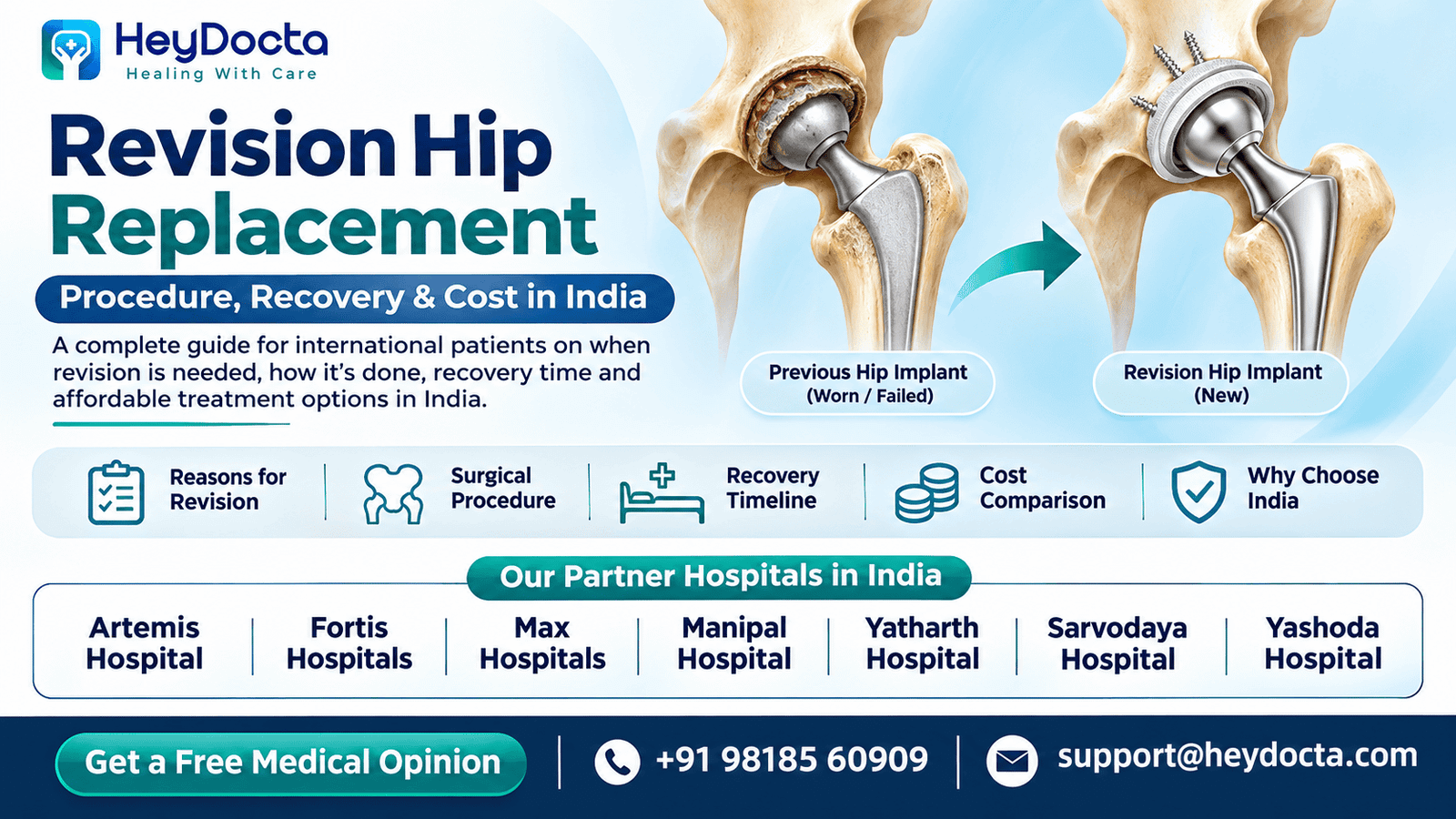
Revision hip replacement is a specialised orthopaedic procedure performed when a previously implanted artificial hip joint becomes damaged, loose, infected or fails to function properly. Although most hip replacements provide long-term pain relief and improved mobility, some patients may require another operation due to implant wear, infection, dislocation or other complications.
For patients experiencing persistent hip pain, difficulty walking, stiffness or instability after an earlier hip replacement, revision surgery may help address the underlying problem and improve joint function. However, revision hip replacement is generally more complex than primary hip replacement because the surgeon must manage the existing implant, surrounding bone and soft tissues.
India is an important destination for international patients seeking specialised orthopaedic treatment, including revision hip replacement, with treatment options that may be more affordable than those in several Western countries.
Get a Free Medical Opinion: Contact HeyDocta to get a medical opinion, explore treatment options and request a personalised cost estimate from our partner hospitals.
Why International Patients Choose India for Revision Hip Replacement
Patients from Nigeria, Ghana, Kenya, Zimbabwe, Cameroon, Guyana, Jamaica, the USA, Europe and the Middle East consider India for complex orthopaedic procedures because of:
- Access to experienced orthopaedic and joint replacement specialists.
- Hospitals equipped to manage complex revision procedures.
- Availability of specialised revision implants and surgical techniques.
- Diagnostic facilities, rehabilitation and physiotherapy services.
- Treatment estimates that may be lower than those in several high-cost healthcare markets.
- Assistance with international patient coordination and travel arrangements.
HeyDocta helps international patients coordinate treatment enquiries with its partner hospitals:
- Artemis Hospital
- Fortis Hospitals
- Max Hospitals
- Manipal Hospital
- Yatharth Hospital
- Sarvodaya Hospital
- Yashoda Hospital
What Is Revision Hip Replacement Surgery?
Revision hip replacement involves removing, repairing or replacing one or more components of an existing artificial hip joint. Depending on the condition of the implant and surrounding tissues, the surgeon may replace the socket, femoral stem, artificial ball or multiple components.
Unlike primary hip replacement, revision surgery may involve managing scar tissue, bone loss, damaged tissues or infection. Specialised implants, bone grafts or reconstructive components may be required.
Common Reasons for Revision Hip Replacement
Revision surgery may be recommended for several reasons:
- Implant loosening: The artificial joint becomes loose from the surrounding bone.
- Implant wear: The bearing surfaces wear down over time, potentially causing inflammation and bone loss.
- Hip dislocation: The artificial joint repeatedly moves out of its normal position.
- Infection: Bacteria infect the artificial joint or surrounding tissues.
- Periprosthetic fracture: A fracture develops around the artificial hip implant.
- Persistent pain: Pain continues because of implant-related or other identifiable problems.
- Component failure: One or more implant components become damaged or break.
Not every painful hip replacement requires revision surgery. A specialist must identify the cause before recommending another operation.
Symptoms That May Indicate a Failed Hip Replacement
Patients should seek medical assessment if they experience:
- Persistent or increasing hip or groin pain.
- Pain while standing, walking or climbing stairs.
- Difficulty bearing weight.
- Repeated hip dislocation or instability.
- Swelling, redness or warmth around the joint.
- Reduced mobility or stiffness.
- Clicking or unusual noises accompanied by pain.
- Fever or wound discharge, which may indicate infection.
Sudden severe pain, inability to bear weight, a suspected dislocation or fever with a painful artificial joint requires urgent medical attention.
Revision Hip Replacement Procedure: Step-by-Step
The exact surgical approach depends on the failed implant, bone condition, infection status and patient’s health.
1. Preoperative Assessment
The orthopaedic surgeon reviews medical history, previous operation records and implant details. Investigations may include:
- X-rays to assess implant position and loosening.
- CT scans to evaluate bone loss and reconstruction requirements.
- ESR and CRP blood tests to investigate possible infection.
- Joint aspiration and cultures when infection is suspected.
- General health assessment before anaesthesia.
2. Anaesthesia and Surgical Preparation
Revision hip replacement is generally performed under spinal or general anaesthesia. The surgical team prepares the patient and plans the procedure based on the implant and bone findings.
3. Removal of the Failed Implant
The surgeon exposes the hip joint and removes the failed or damaged components. Care is taken to preserve as much healthy bone and soft tissue as possible.
4. Bone Reconstruction and Implant Placement
If bone loss is present, the surgeon may use bone grafts, metal augments or specialised revision implants. The new components are selected to provide appropriate stability and joint function.
5. Closure and Rehabilitation
After checking joint stability and movement, the surgical wound is closed. Physiotherapy and supervised mobilisation begin according to the surgeon’s instructions.
Revision Hip Replacement Cost in India vs Other Countries
Cost is a major consideration for international patients. Revision hip replacement is generally more expensive than primary hip replacement because it may involve specialised implants, longer operating time, bone reconstruction and additional hospital care.
Estimated Cost Comparison
| Country | Estimated Cost (USD) |
| India | $6,600–$20,000 |
| USA | $55,000–$110,000 |
| UK | $33,000–$60,000 |
| Germany | $37,500–$67,500 |
| Singapore | $42,000–$72,000 |
Indicative planning estimates, not directly comparable hospital quotations. The India range combines published planning and provider-reported quote ranges. The USA range is a self-pay reference; UK, Germany and Singapore estimates are modelled planning figures. Actual prices depend on hospital, implant, complexity and inclusions.
Factors That Affect Revision Hip Surgery Cost
- Partial or complete implant replacement.
- Type and manufacturer of revision implant.
- Extent of bone loss and need for bone grafting.
- Infection treatment and antibiotic requirements.
- Surgeon, anaesthesia and operating theatre charges.
- Hospital room category and length of stay.
- Physiotherapy and rehabilitation.
- Additional medical conditions requiring treatment.
A complex revision involving infection, fracture or major bone reconstruction may cost more than a straightforward component exchange. Patients should request an itemised estimate that clearly states what is included and excluded.
Get Treatment Cost from Indian Hospitals: HeyDocta can help you share your medical reports with partner hospitals and request an estimate based on your individual treatment requirements.
Orthopaedic Specialist and Partner Hospitals in India
Revision hip replacement should be evaluated by an orthopaedic surgeon experienced in complex joint replacement and revision arthroplasty.
Dr. Dhananjay Sabat at Yatharth Hospital can be included for specialist consultation enquiries. Patients should confirm his current designation, experience in revision hip replacement and appointment availability directly with the hospital before finalising treatment.
HeyDocta coordinates international patient enquiries with its partner hospitals:
- Artemis Hospital
- Fortis Hospitals
- Max Hospitals
- Manipal Hospital
- Yatharth Hospital
- Sarvodaya Hospital
- Yashoda Hospital
Hospital selection should consider the surgeon’s experience, availability of revision implants, infection management facilities, rehabilitation services and the patient’s clinical requirements.
Recovery After Revision Hip Replacement
Recovery after revision hip replacement is usually longer than recovery after primary hip replacement. The timeline depends on the extent of surgery, bone quality, implant stability and the patient’s overall health.
| Recovery Stage | General Expectations |
| Hospital stay | Often around 5–10 nights, depending on recovery |
| First few weeks | Wound care, walking assistance and supervised physiotherapy |
| 4–6 weeks | Gradual improvement in mobility; restrictions may continue |
| 3 months | Continued strengthening and functional rehabilitation |
| 6–12 months | Further recovery and improvement in daily activities |
Some patients may need a walker or crutches for several weeks. Weight-bearing instructions vary according to the reconstruction and must be followed carefully.
How Long Should International Patients Stay in India?
A hospital stay of approximately 5–10 nights may be used for initial travel planning, but this is not suitable for every patient. The total stay in India may be longer because patients need wound assessment, mobility training and postoperative review before travelling.
Patients undergoing complex reconstruction, infection treatment or staged surgery may require an extended stay or more than one trip.
Long-distance travel should take place only after the treating surgeon confirms that the patient is medically fit to fly. Follow-up care and physiotherapy should also be arranged in the patient’s home country.
Medical Visa and Travel Assistance
International patients travelling from Africa, the Caribbean, the USA, Europe and the Middle East may require an appropriate medical visa to receive treatment in India.
HeyDocta can assist with:
- Hospital appointment coordination.
- Medical invitation documentation, where provided by the hospital.
- Medical visa application guidance.
- Airport transfers and local transportation.
- Accommodation arrangements for patients and attendants.
- Communication with hospital international patient departments.
- Follow-up consultation coordination.
Visa approval is determined by the relevant Indian authorities. Patients should check current visa requirements for their nationality before booking travel.
Step-by-Step Treatment Journey with HeyDocta
International patients can begin the treatment planning process remotely.
- Share medical records: Submit previous hip replacement reports, X-rays, CT scans and current symptoms.
- Specialist evaluation: The orthopaedic team reviews the case and may request additional investigations.
- Treatment recommendation: The surgeon determines whether partial or complete revision is appropriate.
- Cost estimate: Request an itemised estimate covering surgery, implants, hospitalisation and rehabilitation.
- Travel planning: Coordinate medical documentation, visa guidance, flights and accommodation.
- Hospital admission: Complete preoperative assessment and undergo the recommended treatment.
- Recovery and follow-up: Begin physiotherapy and arrange postoperative monitoring.
Talk to Our Medical Tourism Expert: HeyDocta can help coordinate your medical records and consultation enquiries with its partner hospitals in India.
Frequently Asked Questions About Revision Hip Replacement
1. What is revision hip replacement surgery?
Revision hip replacement is an operation to repair or replace components of a previously implanted artificial hip joint when they become loose, damaged, infected or unstable.
2. When is revision hip replacement necessary?
It may be recommended for implant loosening, infection, repeated dislocation, component wear, fractures around the implant or persistent implant-related pain.
3. How much does revision hip replacement cost in India?
Indicative planning estimates range from approximately $6,600 to $20,000. The final cost depends on implant requirements, bone reconstruction, infection status, hospital and surgical complexity.
4. Is revision hip replacement more complicated than primary hip replacement?
Yes. Revision surgery is generally more complex because the surgeon must manage the previous implant, scar tissue, possible bone loss and soft-tissue damage.
5. How long does recovery take after revision hip replacement?
Recovery varies by patient and procedure. Many patients need several weeks of walking assistance and rehabilitation, with further functional recovery continuing over 6–12 months.
6. Can an infected hip replacement be revised?
Yes. Depending on the infection, treatment may involve surgical cleaning, implant retention in selected cases, or one-stage or two-stage revision with appropriate antibiotics.
7. Can international patients travel to India for revision hip replacement?
Yes. International patients can seek evaluation and treatment in India. Medical records should be reviewed before travel, and the treating surgeon should confirm that the patient is fit to fly.
Why Choose HeyDocta for Revision Hip Replacement in India?
Planning complex orthopaedic treatment abroad involves more than selecting a hospital. Patients also need medical coordination, clear cost estimates, travel planning and continuity of care.
HeyDocta supports international patients by helping them connect with its partner hospitals in India, including Artemis Hospital, Fortis Hospitals, Max Hospitals, Manipal Hospital, Yatharth Hospital, Sarvodaya Hospital and Yashoda Hospital.
Our coordination services include:
- Specialist consultation assistance.
- Medical report sharing and hospital coordination.
- Treatment planning and cost estimates.
- Medical visa documentation guidance.
- Airport pickup and accommodation assistance.
- Support for accompanying family members.
- Follow-up coordination after treatment.
HeyDocta provides its patient coordination services without an additional facilitation fee. Hospital, doctor, investigation, treatment, accommodation and travel charges remain separate.
Get Expert Assistance for Revision Hip Replacement in India
Persistent pain, instability or difficulty walking after hip replacement can affect everyday activities and quality of life. A specialist evaluation can help identify the cause and determine whether revision surgery is appropriate.
Whether you are travelling from Nigeria, Ghana, Kenya, Zimbabwe, Cameroon, Guyana, Jamaica, the USA, Europe or the Middle East, HeyDocta can help you explore treatment options at its partner hospitals in India.
Contact HeyDocta.com today to get a free medical opinion, request a personalised treatment estimate and coordinate your medical journey to India.