A shoulder replacement can significantly improve pain and movement for people with severe shoulder joint damage. However, some patients experience problems with their artificial shoulder joint months or years after the first operation. Persistent pain, implant loosening, infection or repeated dislocation may indicate that another procedure is needed. This second operation is called Revision Shoulder Replacement.
For international patients from Nigeria, Ghana, Zimbabwe, Cameroon, Kenya, Guyana, Jamaica, the Middle East, Europe and the USA, India offers access to orthopaedic specialists, modern hospitals and treatment options at comparatively affordable costs. The right treatment depends on the cause of implant failure, bone condition, overall health and previous surgery.
HeyDocta helps international patients connect with Indian hospitals, obtain medical opinions and coordinate treatment and travel arrangements.
Get a Free Medical Opinion: Share your previous surgery reports and recent shoulder scans with HeyDocta to understand your treatment options in India.
What Is Revision Shoulder Replacement?
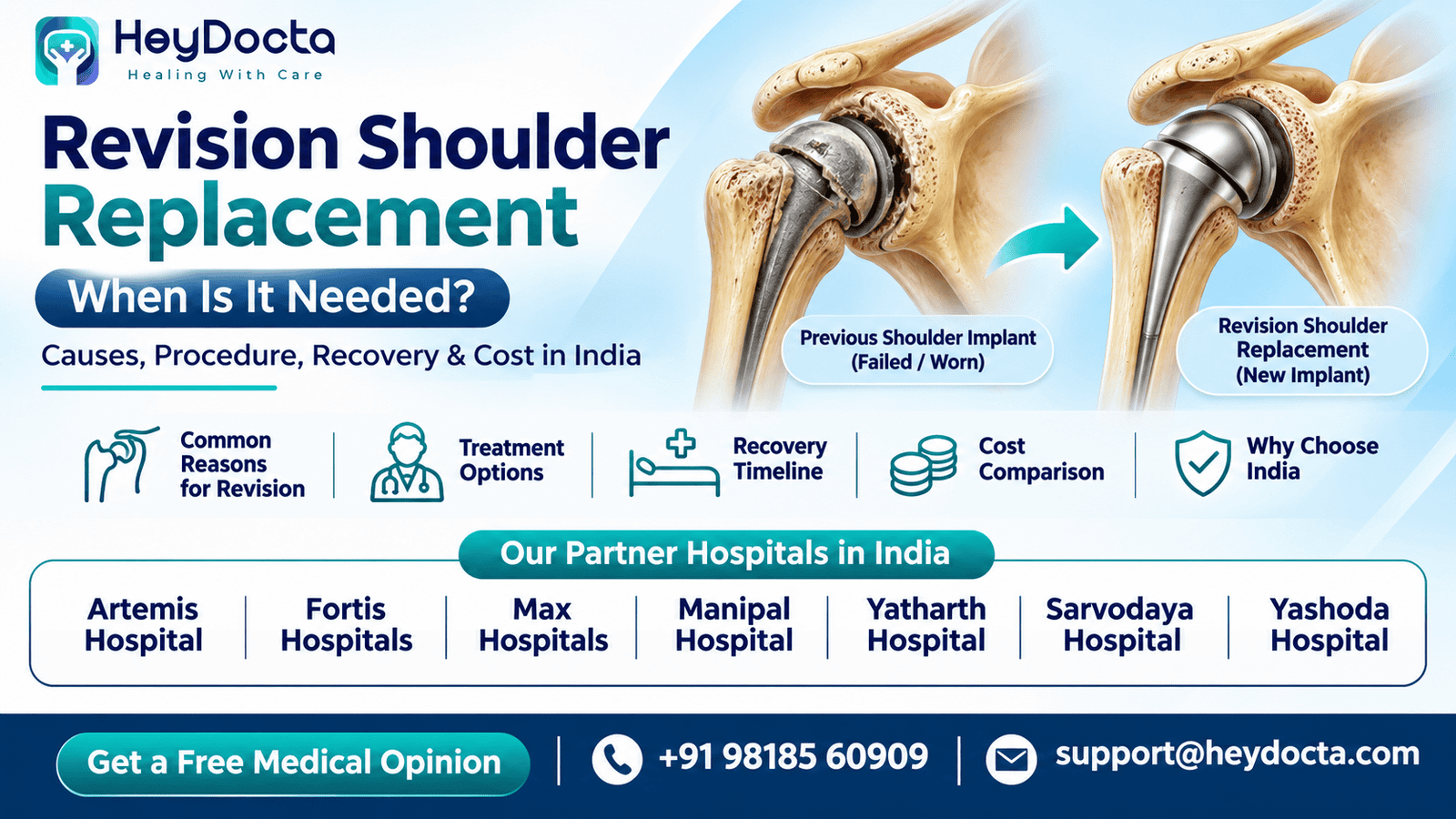
Revision shoulder replacement is a second operation performed to repair or replace some or all components of an existing artificial shoulder joint. It may be recommended when the original implant becomes damaged, loose, infected or unstable.
In a primary shoulder replacement, damaged parts of the shoulder joint are replaced with artificial components. During revision surgery, the surgeon evaluates the existing implant, surrounding bones, muscles and soft tissues before deciding which components need to be removed, repaired or replaced.
Revision surgery is generally more complex than the first operation because the surgeon may need to manage scar tissue, bone loss, weakened muscles or infection. The procedure is planned according to each patient’s condition.
When Is Revision Shoulder Replacement Needed?
Not every patient with shoulder pain after replacement needs another operation. However, an orthopaedic surgeon may recommend revision surgery when investigations confirm a significant implant-related problem.
Common reasons include:
1. Implant Loosening
The artificial components may gradually lose their attachment to the surrounding bone. This can cause pain, reduced movement and difficulty using the arm.
2. Infection Around the Implant
Bacteria can sometimes develop around the artificial joint. Depending on the infection’s severity and duration, treatment may involve antibiotics, surgical cleaning or removal and replacement of the implant.
3. Repeated Shoulder Dislocation
If the artificial joint repeatedly moves out of its normal position, the shoulder may become unstable. Revision surgery may be considered to correct implant positioning or address damaged supporting tissues.
4. Implant Wear or Damage
Artificial components can wear down or become damaged over time. This may affect shoulder movement and cause discomfort.
5. Fracture Around the Implant
A fracture in the bone surrounding the artificial joint may affect implant stability. Revision surgery may be required when the implant is loose or the fracture cannot be managed adequately without changing the replacement.
6. Rotator Cuff or Soft-Tissue Failure
Damage to the rotator cuff or other supporting tissues can affect shoulder function after replacement. Depending on the type of previous implant and the extent of damage, a different replacement design may be considered.
These problems should be assessed through clinical examination and imaging rather than symptoms alone.
Symptoms That May Indicate a Failed Shoulder Replacement
Patients should consult an orthopaedic specialist if they experience:
- Persistent or increasing shoulder pain.
- Reduced arm movement or stiffness.
- Weakness while lifting or rotating the arm.
- Repeated shoulder dislocation or a feeling of instability.
- Grinding, clicking or unusual movement.
- Swelling, redness or discharge around the surgical wound.
- Fever or other signs that may indicate infection.
Sudden severe pain, fever, wound discharge or a suspected dislocation requires prompt medical assessment. Do not delay evaluation while arranging international travel.
Revision Shoulder Replacement Treatment Options in India
The treatment plan depends on the reason the original replacement failed. Available options may include:
- Partial revision: Only the damaged or loose implant component is replaced.
- Total revision: Both the ball and socket components may need replacement.
- Revision to reverse shoulder replacement: A reverse implant may be considered when the rotator cuff is severely damaged or the existing shoulder replacement cannot provide adequate function.
- Infection-related revision: Treatment may involve antibiotics, surgical cleaning and, in selected cases, implant removal followed by staged replacement.
- Bone reconstruction: Bone grafts or specialised implants may be required when there is significant bone loss.
The surgeon decides the appropriate procedure after reviewing the implant type, bone quality, soft tissues and infection status. Not every patient is suitable for revision surgery, and non-surgical management may be considered in selected cases.
Revision Shoulder Replacement Specialist in India
International patients should consult an orthopaedic surgeon experienced in shoulder replacement and complex revision procedures. Relevant expertise includes implant assessment, shoulder reconstruction, rotator cuff problems and management of bone loss.
Dr. (Prof.) Dhananjay Sabat is listed by Yatharth Hospital as Director – Orthopaedics & Joint Replacement. His qualifications include MBBS, MS (Orthopaedics) and DNB (Orthopaedics). His stated areas of professional interest include joint replacement, shoulder arthroscopy and replacement, arthroscopy and sports medicine.
Patients considering revision shoulder replacement should confirm directly with the hospital whether their specific revision procedure is within the surgeon’s current clinical practice.
Revision Shoulder Replacement Cost in India vs Other Countries
The cost of revision shoulder replacement varies according to the complexity of the surgery. It is generally more difficult to estimate than primary shoulder replacement because patients may require specialised implants, bone grafting, infection treatment or longer hospital stays.
The following figures are indicative budgeting estimates in USD, not confirmed hospital quotations. Published international cost data for revision shoulder replacement is limited, and available country estimates may use different pricing methods.
| Country | Indicative cost in USD |
| India | $10,000–$20,000 |
| USA | $55,000–$99,000 |
| UK | $21,000–$38,000 |
| Germany | $18,500–$40,350 |
| Singapore | $26,500–$45,500 |
Important cost note: India’s range is a provisional planning estimate for complex revision care, not a published fixed package. The USA range is a revision-surgery benchmark; the UK, Germany and Singapore figures are general shoulder replacement planning references, not verified revision-specific quotations. Actual costs may differ substantially.
What Affects the Cost of Revision Shoulder Surgery?
The final treatment estimate may depend on:
- Type and brand of shoulder implant.
- Partial or complete implant replacement.
- Bone grafting or specialised reconstruction.
- Infection investigations and antibiotic treatment.
- Surgeon, anaesthesia and hospital charges.
- Length of hospital stay and rehabilitation.
- Medical complications and additional procedures.
Patients should request an itemised estimate that clearly explains what is included and what may be charged separately.
Talk to HeyDocta: Get assistance in requesting treatment opinions and cost estimates from Indian hospitals based on your medical records.
Partner Hospitals in India
HeyDocta coordinates international patient enquiries with its partner hospital network:
- Artemis Hospital
- Fortis Hospitals
- Max Hospitals
- Manipal Hospital
- Yatharth Hospital
- Sarvodaya Hospital
- Yashoda Hospital
The appropriate hospital and surgeon depend on the patient’s diagnosis, implant requirements, clinical needs and specialist availability.
Step-by-Step Treatment Process for International Patients
The treatment journey generally follows these steps:
- Share medical records: Send previous operation reports, implant details, X-rays, CT scans, MRI reports and current medical information.
- Specialist evaluation: The hospital’s orthopaedic team reviews the case and may request additional investigations.
- Treatment recommendation: The surgeon explains whether revision surgery or another treatment is appropriate.
- Cost estimate: The hospital provides a treatment plan and estimated expenses.
- Travel and admission planning: Once the patient decides to proceed, travel dates and hospital admission are coordinated.
- Surgery and hospital care: The patient undergoes the recommended procedure and post-operative monitoring.
- Rehabilitation and discharge: The medical team provides a physiotherapy plan, medication instructions and follow-up guidance.
Medical Visa and Travel Assistance
International patients travelling to India for revision shoulder replacement may need a medical visa, depending on their nationality and applicable immigration rules. Patients should check the latest requirements through official Indian visa channels.
HeyDocta can assist with:
- Hospital appointment coordination.
- Medical invitation letter coordination, where applicable.
- Treatment estimate and medical record sharing.
- Visa application guidance.
- Airport transfers and accommodation coordination.
- Communication with the hospital during treatment.
Patients should travel only after receiving medical advice and a suitable treatment plan.
Recovery After Revision Shoulder Replacement
Recovery after revision surgery can take longer than recovery after a first shoulder replacement. The timeline depends on the procedure, bone quality, soft-tissue condition and whether infection or other complications were present.
Patients may need to wear a shoulder sling for a period recommended by the surgeon. Physiotherapy is introduced according to the stability of the reconstruction and the surgeon’s instructions.
Some patients require several months of rehabilitation, and full functional recovery may take considerably longer. The American Academy of Orthopaedic Surgeons notes that recovery following revision can be challenging and may take one to two years in some cases.
International patients should discuss their expected hospital stay, accommodation and safe return-flight timing with their treating team before booking travel. Follow-up can often be coordinated through medical reports, video consultations and communication with the local treating doctor, depending on the hospital’s arrangements.
Frequently Asked Questions
1. When is revision shoulder replacement necessary?
It may be necessary when the existing implant becomes loose, infected, unstable, damaged or associated with significant pain and loss of function. A specialist assessment is required before deciding on surgery.
2. Is revision shoulder replacement more complicated than the first surgery?
Yes. Revision surgery can be more complex because of scar tissue, bone loss, infection or damage to surrounding muscles and tissues.
3. What is the cost of revision shoulder replacement in India?
A provisional planning estimate is approximately $10,000–$20,000. The actual cost depends on implant requirements, surgical complexity, hospital charges and additional treatment.
4. How long does recovery take?
Recovery varies by patient and procedure. Rehabilitation may continue for several months, and some patients require one to two years to achieve their best possible functional recovery.
5. Can an infected shoulder implant be replaced?
In selected cases, yes. Treatment may involve antibiotics, surgical cleaning and either one-stage or staged implant replacement. The approach depends on the infection and patient’s overall condition.
6. Can revision shoulder replacement restore normal movement?
The aim is to reduce pain and improve function, but complete restoration of normal movement cannot be guaranteed. Results depend on the condition of the bone, muscles, nerves and implant.
7. Can international patients arrange revision shoulder surgery in India through HeyDocta?
Yes. HeyDocta assists with medical record coordination, specialist opinions, hospital estimates, visa guidance, travel arrangements and treatment coordination with its partner hospitals.
Why Choose HeyDocta for Revision Shoulder Replacement in India?
Planning complex orthopaedic surgery in another country can be challenging. HeyDocta supports international patients throughout the treatment journey by helping them connect with suitable Indian hospitals and coordinate essential arrangements.
Our support includes medical record sharing, hospital coordination, treatment estimates, travel and visa assistance, accommodation guidance and follow-up coordination. HeyDocta does not charge patients an additional facilitation fee for its coordination support. Hospital, surgeon, implant, investigation, treatment, travel and accommodation expenses remain separate and are payable as applicable.
Get a Free Medical Opinion for Revision Shoulder Replacement in India
If you are experiencing pain, stiffness, implant loosening or other problems after shoulder replacement surgery, an expert evaluation can help you understand the available treatment options. Contact HeyDocta.com to share your medical reports and explore revision shoulder replacement treatment in India. Our team can help coordinate specialist opinions, hospital estimates and travel arrangements so you can plan your treatment with greater clarity and confidence.