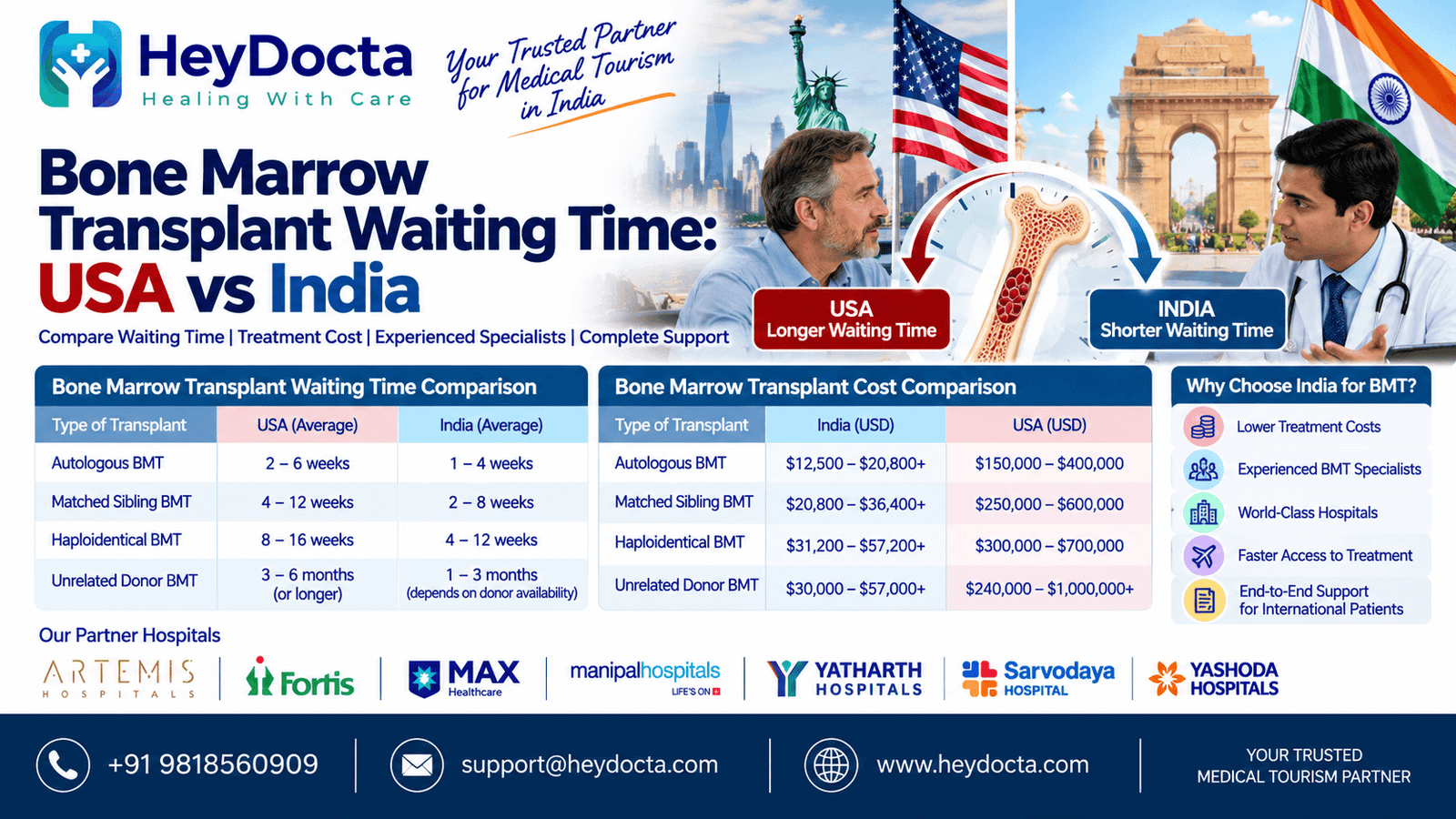
For patients considering a bone marrow transplant, bone marrow transplant waiting time in the USA vs India can be an important part of treatment planning. However, there is no single standard waiting period for either country. The timeline depends on the type of transplant, donor availability, HLA matching, medical urgency, pre-transplant testing and hospital capacity. For international patients, India can also offer potentially lower treatment costs and access to transplant centres experienced in autologous, matched-related, haploidentical and unrelated-donor transplantation.
Get a Free Medical Opinion: HeyDocta can coordinate your medical records with Indian BMT specialists, help you understand the possible treatment timeline and obtain an estimated hospital cost before you travel.
What Determines Bone Marrow Transplant Waiting Time?
A BMT journey generally involves several stages:
- Medical evaluation and diagnosis review
- HLA typing and donor assessment
- Selection of the transplant type
- Donor search, if required
- Additional donor testing
- Pre-transplant investigations
- Conditioning treatment
- Stem cell collection and transplantation
- Engraftment and early recovery
The waiting period is therefore not simply the time spent “on a waiting list.”
For an autologous transplant, the patient’s own stem cells are collected, so there is no unrelated-donor search. For an allogeneic transplant, donor identification and HLA matching can become a major part of the timeline. The NCI explains that allogeneic transplants may use a related or unrelated donor whose HLA characteristics are sufficiently matched.
Bone Marrow Transplant Waiting Time in the USA
In the United States, donor-search timelines vary significantly.
According to the NMDP, for many patients, the initial donor testing process can take 1–2 weeks, while the overall period from starting a donor search to transplantation is often around three months. Some patients may find a donor sooner, while others can take longer.
Another NMDP patient resource states that finding the right donor can take a few weeks to several months, depending on the patient’s HLA characteristics and donor availability.
This means a US patient requiring an unrelated donor may experience a longer preparation period than someone who already has a suitable family donor.
Factors that can affect US waiting time
- Availability of a matched sibling
- HLA characteristics
- Availability of an unrelated donor
- Disease type and urgency
- Donor medical clearance
- Confirmatory HLA testing
- Pre-transplant investigations
- Hospital scheduling
- Insurance and financial approvals
- Need for additional treatment before transplantation
The NMDP recommends beginning the donor search early because finding an appropriate donor can take time.
Bone Marrow Transplant Waiting Time in India
India does not have one national BMT waiting-time standard. The timeline varies between hospitals and individual patients.
For patients with a suitable family donor, the process may be more straightforward because the transplant team does not need to wait for an unrelated donor search. For patients requiring a matched unrelated donor, donor search, confirmatory testing and donor clearance can take several weeks or longer.
An Indian Society of Hematology and Blood Transfusion review notes that matched-unrelated-donor transplantation can require several weeks for donor search, confirmatory typing, donor availability, apheresis and delivery of the stem-cell product. It also notes that a readily available haploidentical family donor can reduce the need to wait for an unrelated donor.
India also has access to international donor-search systems. DKMS’s Hap-E Search allows eligible transplant centres in India to search donor databases that include millions of unrelated stem-cell donors.
Therefore, patients should not assume that BMT is automatically faster in India or the USA. The patient’s donor situation and medical urgency are often more important than the country itself.
USA vs India: BMT Waiting Time Comparison
| Factor | USA | India |
| Autologous BMT | No donor search required | No donor search required |
| Matched sibling BMT | Family HLA testing required | Family HLA testing required |
| Unrelated donor BMT | Often several weeks to months | Often several weeks or longer |
| Haploidentical BMT | Can use partially matched family donor | Can use partially matched family donor |
| Donor registry search | Large national/international registry access | Indian and international registry access |
| Waiting-time standard | No fixed national timeline | No fixed national timeline |
| Main factors | HLA match, urgency, donor and centre | HLA match, urgency, donor and centre |
The key point is that BMT waiting time cannot be accurately predicted from country alone.
Why Some International Patients Consider India
Waiting time is only one consideration. Treatment affordability is another major factor.
Some Hospitals currently lists the general cost of bone marrow transplantation in India at approximately USD15,700–31,500, with the final amount varying according to hospital, location, room type and complications.
By comparison, the US HRSA states that an unrelated bone marrow or cord blood transplant can range from USD 240,000 to more than USD 1 million for the transplant and up to six months of care. Donor-search costs may also range from approximately USD 10,000 to more than USD 50,000 in some circumstances.
Indicative BMT Cost Comparison
| Treatment | India | USA |
| General BMT range | USD 15,600–31,300+ | Varies substantially |
| Unrelated donor BMT | Case-specific | USD 240,000 to $1M+ including transplant and up to 6 months care |
| Autologous BMT | Generally lower than allogeneic | Generally lower than unrelated-donor BMT |
| Complex cases | Can increase significantly | Can exceed standard estimates |
These figures are not directly equivalent package prices. US figures may include substantially longer periods of post-transplant care, while Indian quotations can differ in what is included.
Types of BMT Available in India
Indian transplant centres may provide several transplant approaches.
Autologous Transplant
The patient’s own stem cells are collected and returned after high-dose treatment. This eliminates the need to find an unrelated donor.
Matched Sibling Allogeneic Transplant
Stem cells are obtained from a suitably matched family donor.
Haploidentical Transplant
A partially matched family donor may be used. This approach can expand donor availability when a fully matched donor is unavailable.
Matched Unrelated Donor Transplant
Stem cells come from a suitable unrelated donor identified through donor registries.
The appropriate approach depends on the patient’s disease, treatment history, HLA profile and transplant specialist’s assessment.
BMT Specialist in India
International patients can seek opinions from specialised hematology and BMT teams in India.
Dr. Gaurav Dixit is Head – Haematology Oncology & Bone Marrow Transplant at Artemis Hospitals, Gurugram. His listed specialties include BMT, hematopoietic stem cell transplant, hematology and oncology. His profile lists experience with autologous, matched-sibling allogeneic, haploidentical and matched-unrelated donor transplantation.
Artemis also lists a multidisciplinary BMT team managing malignant and non-malignant blood disorders.
Patients should select a transplant centre based on disease-specific expertise, donor options, transplant infrastructure, infection-control facilities, follow-up arrangements and the treating team’s assessment.
Partner Hospitals Available Through HeyDocta
Depending on the patient’s diagnosis and medical requirements, HeyDocta can coordinate enquiries with partner hospitals including:
- Artemis Hospitals
- Fortis Hospitals
- Max Hospitals
- Manipal Hospitals
- Yatharth Hospitals
- Sarvodaya Hospital
- Yashoda Hospitals
The final hospital recommendation should be based on the patient’s medical records and specialist opinion rather than waiting time or cost alone.
Step-by-Step BMT Process in India
Step 1: Send Medical Records
Share pathology reports, diagnosis, previous treatment details, blood tests, imaging and other relevant records.
Step 2: Specialist Review
A BMT specialist reviews the case and determines whether transplantation is appropriate and which donor strategy may be considered.
Step 3: HLA and Donor Assessment
The patient and potential family donors may undergo HLA testing. If required, an unrelated donor search can be initiated.
Step 4: Treatment Planning
The hospital provides a treatment plan, estimated admission period and indicative cost.
Step 5: Medical Visa and Travel
India’s official e-Visa system includes e-Medical and e-Medical Attendant categories. The current government portal lists e-Medical Visa validity of one year from arrival with multiple entries and requires a hospital letter for the medical application.
Step 6: Transplant and Recovery
The patient undergoes conditioning, stem-cell infusion and close monitoring. Recovery and engraftment periods vary considerably.
Need help understanding your BMT timeline? Send your medical records to HeyDocta for specialist opinion, hospital coordination and an estimated treatment plan.
Recovery and Follow-Up After BMT
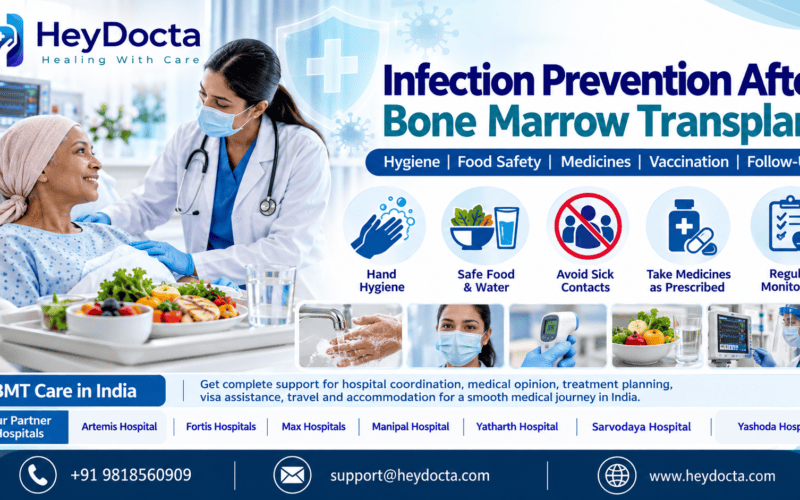
The transplant itself is only one stage of treatment. Patients may require:
- Regular blood tests
- Infection monitoring
- Medicines
- Blood or platelet support
- Monitoring for graft-versus-host disease after allogeneic transplantation
- Nutritional support
- Frequent specialist follow-ups
International patients should plan their accommodation and return travel around their treating team’s recommendations. Early discharge does not necessarily mean complete recovery.
Frequently Asked Questions
Is BMT faster in India than the USA?
There is no universal answer. Waiting time depends mainly on transplant type, donor availability, HLA matching, medical urgency and hospital preparation. Unrelated-donor searches can take weeks to months in both countries.
How long does it take to find a bone marrow donor in the USA?
NMDP says many donor searches take about 1–2 weeks for initial testing, while the overall process from starting a search to transplant is often around three months. Some searches take longer.
How long does an unrelated donor search take in India?
It varies. Indian transplant literature describes several weeks for donor search, confirmatory testing, donor availability and collection, with some cases taking longer.
Does autologous BMT require a donor?
No. Autologous transplantation uses the patient’s own stem cells, so an unrelated donor search is not required.
Is BMT cheaper in India than the USA?
Treatment costs can be substantially lower in India. Currently published lists USD15,700–31,500 as a general Indian BMT range, while HRSA reports USD 240,000 to over USD 1 million for an unrelated transplant in the US including up to six months of care. The two figures should not be treated as identical package definitions.
Can international patients travel to India for BMT?
Eligible international patients can travel to India for planned medical treatment. The Indian e-Visa system provides an e-Medical Visa route for eligible nationalities, subject to current requirements.
Can HeyDocta help with BMT treatment in India?
Yes. HeyDocta can assist with medical-opinion coordination, hospital enquiries, estimated treatment costs, appointment scheduling, medical visa assistance, travel planning and follow-up coordination. Patients do not pay HeyDocta an additional service fee for its medical-tourism facilitation.
Conclusion
When comparing bone marrow transplant waiting time in the USA vs India, patients should look beyond the country and consider the factors that actually determine the timeline: transplant type, HLA matching, donor availability, medical urgency, pre-transplant testing and hospital readiness.
India can also be considered by international patients because of its specialised BMT services and potentially lower treatment costs. However, the correct transplant centre should be selected after a detailed medical review, and no hospital should guarantee a particular waiting period before evaluating the patient’s case.
Get a Free Medical Opinion and BMT Cost Estimate: Contact HeyDocta.com to compare suitable Indian hospitals, understand the potential donor and treatment timeline, coordinate your medical visa and plan your medical journey from consultation through follow-up care.