
India has become an important destination for medical tourism, offering international patients access to a wide range of specialised treatments, experienced medical professionals and modern hospital infrastructure. Patients from Nigeria, Kenya, Ghana, Zimbabwe, Cameroon, Guyana, Jamaica, the Middle East, Europe and the USA often consider India when they need specialised treatment or a second medical opinion.
For many patients, the decision is also financial. Treatment costs in India can be considerably lower than in several developed healthcare markets, although the actual difference depends on the procedure, hospital, doctor, medical complexity and what is included in the treatment package.
Get a Free Medical Opinion: Share your medical reports with HeyDocta to understand your treatment options, suitable hospitals and estimated treatment costs in India.
What Is Medical Tourism?
Medical tourism means travelling to another country to receive planned medical treatment. Patients may travel for procedures ranging from routine specialist consultations and diagnostic services to complex surgeries, cancer treatment, cardiac procedures, orthopaedic surgery, neurosurgery, fertility treatment and organ transplantation.
Medical travel is different from ordinary tourism because the patient’s health, treatment schedule and follow-up requirements must be considered throughout the journey.
India’s medical tourism sector has grown substantially. India’s Economic Survey 2025–26 reported more than 600,000 medical tourist arrivals during 2022–2024, with medical tourism accounting for approximately 6.5% of foreign tourist arrivals in 2024. The survey identified cost competitiveness, skilled medical professionals and established healthcare infrastructure as important advantages.
Why Choose India for Medical Tourism?
1. Affordable Treatment Costs
Affordability is one of the main reasons international patients consider India.
Published hospital comparisons show that several major procedures can cost significantly less in India than in the USA and other developed markets.
The treatment costs in India can be substantially lower than in developed countries, while offering international-patient services and specialised medical care.
However, patients should avoid choosing a hospital based only on the lowest quotation. The complete package, surgeon’s expertise, hospital facilities, implants, medicines, investigations, length of stay and follow-up arrangements should all be considered.
2. Experienced Medical Specialists
India has specialists across multiple disciplines, including:
- Cardiology and cardiac surgery
- Oncology
- Neurosurgery and spine surgery
- Orthopaedics and joint replacement
- Gastroenterology
- Urology and nephrology
- Organ transplantation
- Fertility and reproductive medicine
- Paediatric surgery
- Robotic and minimally invasive surgery
Major Indian hospitals also provide specialist second opinions for international patients before they travel.
3. Advanced Hospital Infrastructure
Large Indian hospitals provide modern diagnostic facilities, intensive care units, operating theatres and specialised departments.
Patients can also check hospital accreditation and quality credentials before making a decision. NABH, India’s national hospital accreditation body, focuses on areas including patient safety, quality improvement, infection control, patient rights, facilities management and clinical care.
NABH also maintains a directory that allows patients to search healthcare organisations by location, accreditation and specialty.
4. Multiple Treatment Options
International patients may have access to both conventional and minimally invasive treatment approaches, depending on their diagnosis.
For example, suitable patients may be evaluated for:
- Robotic surgery
- Endoscopic surgery
- Laparoscopic surgery
- Image-guided procedures
- Minimally invasive surgery
- Conventional open surgery
- Non-surgical treatment
- Rehabilitation and physiotherapy
The availability of a technology does not automatically mean it is appropriate for every patient. The treatment should be selected according to the diagnosis and medical evidence.
5. International Patient Services
Many major hospitals have dedicated international-patient departments to coordinate appointments, documentation, accommodation, travel and hospital admission.
For patients travelling from Africa, the Middle East, the Caribbean, Europe or the USA, having a single point of coordination can make the process easier.
Popular Treatments for International Patients in India
India provides treatment across a wide range of medical specialties.
Cardiac Care
International patients may travel for:
- Angioplasty
- Bypass surgery
- Valve replacement
- TAVR
- Electrophysiology procedures
- Heart transplantation
Cancer Treatment
Depending on the cancer type and stage, treatment may include:
- Surgery
- Chemotherapy
- Radiation therapy
- Immunotherapy
- Targeted therapy
- Proton therapy
- Bone marrow or stem-cell transplantation
Orthopaedic Treatment
Common procedures include:
- Knee replacement
- Hip replacement
- Robotic joint replacement
- Spine surgery
- Fracture treatment
- Sports injury treatment
Neurosurgery and Spine Care
Patients may seek treatment for:
- Brain tumours
- Spinal disorders
- Slipped or herniated discs
- Spinal stenosis
- Epilepsy
- Hydrocephalus
- Brain aneurysms
- Parkinson’s disease
Other Specialties
International patients also travel to India for:
- Kidney and liver transplantation
- Urology
- Gastroenterology
- Fertility treatment
- Bariatric surgery
- Paediatric treatment
- Dental care
- Ophthalmology
The appropriate treatment depends on the patient’s medical condition and specialist assessment.
Medical Treatment Cost in India vs Other Countries
Cost comparison is an important part of planning medical travel.
However, there is no single medical tourism price for India. Costs differ according to the hospital, city, surgeon, procedure, medical condition and treatment complexity.
A Healthcare survey guide specifically recommends considering not only medical costs but also travel, accommodation and other expenses when calculating the total cost of treatment in India.
Indicative Cost Comparison
| Treatment | Approx. India Cost | Typical Cost in USA/Western Markets |
| Knee replacement | $5,000–$8,000+ | $30,000–$60,000+ |
| Hip replacement | $5,000–$8,000+ | $30,000–$60,000+ |
| CABG | $2,500–$8,500+ | $40,000–$80,000+ |
| Angioplasty | $3,000–$5,000+ | $15,000–$50,000+ |
| Selected spine surgery | $3,500–$10,000+ | $25,000–$70,000+ |
| Selected cancer procedures | Varies significantly | Varies significantly |
These are indicative planning ranges only, not quotations. Procedure-specific published prices can vary considerably.
What Can Change the Final Cost?
Your final treatment estimate may depend on:
- Type of procedure
- Medical condition and severity
- Number of procedures required
- Surgeon and specialist team
- Hospital selected
- Room category
- Diagnostic tests
- ICU requirements
- Implants or medical devices
- Medicines
- Length of hospitalisation
- Rehabilitation
- Follow-up treatment
International patients should request an itemised treatment estimate before booking flights.
Talk to a Medical Tourism Expert: HeyDocta can help you compare suitable hospitals and obtain a treatment cost estimate based on your medical reports.
How to Choose a Hospital in India
There is no single hospital that is appropriate for every patient.
When comparing hospitals, consider:
Hospital Accreditation
Check whether the hospital has relevant accreditation and quality certifications. NABH accreditation focuses on patient safety and quality systems and is one useful factor when evaluating Indian hospitals.
Specialist Experience
Look at the doctor’s experience with the specific procedure—not simply the number of years they have worked as a doctor.
Technology and Infrastructure
For complex procedures, check whether the hospital has the required diagnostic equipment, ICU facilities, operating-room infrastructure and specialist support.
International Patient Services
Ask whether the hospital provides:
- International patient coordinators
- Airport assistance
- Medical visa documentation
- Interpreter services
- Accommodation assistance
- Billing support
- Follow-up coordination
Transparent Pricing
Request written information about what the quoted price includes and excludes.
HeyDocta Partner Hospitals
HeyDocta coordinates international patients with a network of partner hospitals, including:
- Artemis Hospital
- Fortis Hospitals
- Max Hospitals
- Manipal Hospital
- Yatharth Hospital
- Sarvodaya Hospitals
The appropriate hospital is selected according to the patient’s medical specialty, treatment requirements, location, budget and doctor availability.
Step-by-Step Medical Tourism Process in India
Step 1: Share Your Medical Reports
Send your diagnosis, medical history, MRI/CT scans, laboratory reports and previous treatment details.
Step 2: Get a Medical Opinion
The case can be coordinated with an appropriate specialist for assessment and treatment recommendations.
Step 3: Compare Treatment Options
Patients can understand:
- Recommended treatment
- Alternative options
- Expected hospital stay
- Approximate recovery period
- Estimated treatment cost
Step 4: Select Hospital and Doctor
After reviewing the available options, the patient can choose the hospital and specialist that best fits their medical requirements.
Step 5: Arrange the Medical Visa
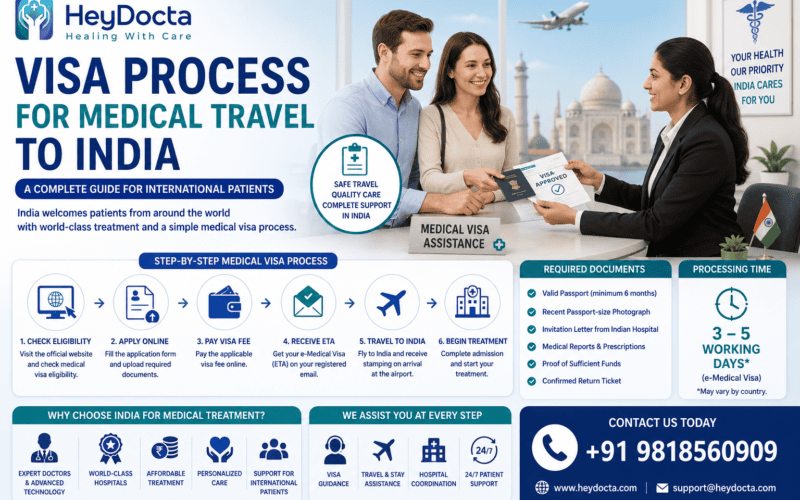
India provides an e-Medical Visa and e-Medical Attendant Visa for eligible international travellers. The official Indian e-Visa portal currently states that eligible applicants can apply online and that the e-Medical Visa is available for medical treatment.
Patients should always check the latest eligibility, documentation and visa requirements on the official government portal before travelling.
Step 6: Plan Travel and Accommodation
The patient’s itinerary should allow sufficient time for consultation, investigations, treatment and recovery.
Step 7: Hospital Treatment
On arrival, the patient undergoes the required consultation and investigations. The treating doctor confirms the final treatment plan.
Step 8: Recovery and Follow-Up
Before returning home, patients should receive discharge instructions, medication information and a follow-up plan.
Medical Visa and Travel Support
Travelling for treatment requires careful coordination.
HeyDocta can assist international patients with:
- Medical opinion coordination
- Hospital appointment scheduling
- Treatment cost estimates
- Medical visa assistance
- Airport pickup coordination
- Accommodation assistance
- Local transportation
- Hospital admission coordination
- Follow-up arrangements
The Indian government also provides an e-Medical Attendant Visa for eligible accompanying persons. The official e-Visa portal currently states that up to two e-Medical Attendant Visas may be granted against one e-Medical Visa.
Visa requirements can change, so patients should verify current requirements before travel.
How Long Should You Stay in India?
The duration depends entirely on the treatment.
A diagnostic consultation may require only a few days, while complex surgery can require several weeks including recovery and follow-up.
Before travelling, ask your hospital about:
- Expected admission date
- Expected hospital stay
- Recovery period
- Follow-up appointments
- When you can safely fly home
- Whether additional treatment may be required
Do not book a non-refundable return ticket before understanding the expected recovery timeline.
Why Use a Medical Tourism Facilitator?
International patients often need to coordinate several services at the same time.
A medical tourism facilitator can help connect these stages:
Medical reports → Specialist opinion → Hospital selection → Cost estimate → Visa assistance → Travel → Hospital admission → Treatment → Follow-up
HeyDocta’s role is to simplify this process and provide one point of coordination for international patients.
Patients can also use a facilitator to compare treatment plans and understand the practical aspects of travelling to India for healthcare.
Cost-Saving Tips for International Patients
To manage your medical travel budget:
- Obtain a medical opinion before booking flights.
- Request an itemised hospital quotation.
- Ask what the package includes.
- Confirm whether medicines and investigations are included.
- Check whether implants or special devices are charged separately.
- Compare at least two suitable treatment options where clinically appropriate.
- Budget separately for flights, accommodation, food and local transportation.
- Keep funds available for unexpected medical requirements.
- Confirm the follow-up plan before travelling home.
- Do not select a hospital based solely on the lowest price.
FAQs About Medical Tourism in India
1. Why do international patients choose India for medical treatment?
International patients may consider India because of its specialist medical services, established hospital infrastructure, treatment options and comparatively lower costs for many procedures. India’s Economic Survey identifies cost competitiveness, skilled professionals and healthcare infrastructure as important factors behind the country’s medical-tourism sector.
2. Is medical treatment cheaper in India than in the USA and UK?
For many procedures, published hospital estimates show substantially lower costs in India. However, the actual difference depends on the procedure, hospital, complexity and services included.
3. Which treatments are popular among medical tourists in India?
Common areas include cardiac care, cancer treatment, orthopaedics, joint replacement, spine surgery, neurosurgery, transplantation, fertility treatment and minimally invasive surgery.
4. Can I get a medical opinion before travelling to India?
Yes. Patients can share their medical reports and imaging for a preliminary specialist review before making travel arrangements.
5. Can international patients apply for an Indian medical visa?
Eligible travellers can apply for an Indian e-Medical Visa through the official government e-Visa system. An e-Medical Attendant Visa is also available for eligible accompanying persons.
6. How much money should I budget for medical treatment in India?
There is no universal amount. Your budget should include the hospital treatment package plus flights, accommodation, food, local transportation, visa fees and possible additional medical expenses.
7. Does HeyDocta charge patients for its medical tourism support?
HeyDocta facilitates hospital coordination and international-patient support. Where the applicable hospital/service arrangement provides the facilitation at no additional patient service fee, patients are not charged separately by HeyDocta. Specific arrangements should be confirmed before travel.
Conclusion
Medical tourism in India can provide international patients with access to a wide range of medical specialties, experienced healthcare professionals, modern hospital infrastructure and potentially significant cost savings compared with several developed healthcare markets.
However, affordable treatment should not mean compromising on medical suitability or safety. Patients should compare specialist expertise, hospital quality, accreditation, treatment plans, total costs and follow-up arrangements before making a decision.
For patients travelling from Nigeria, Kenya, Ghana, Zimbabwe, Cameroon, Guyana, Jamaica, the Middle East, Europe or the USA, proper planning can make the medical travel process more organised and transparent.
HeyDocta.com helps international patients coordinate their healthcare journey in India—from medical opinion and hospital selection to treatment-cost estimates, medical visa assistance, travel coordination and follow-up support.
Get a Free Medical Opinion from HeyDocta. Share your medical reports with our team to explore suitable Indian hospitals and specialists, understand your treatment options and receive a personalised cost estimate for your planned medical treatment in India.