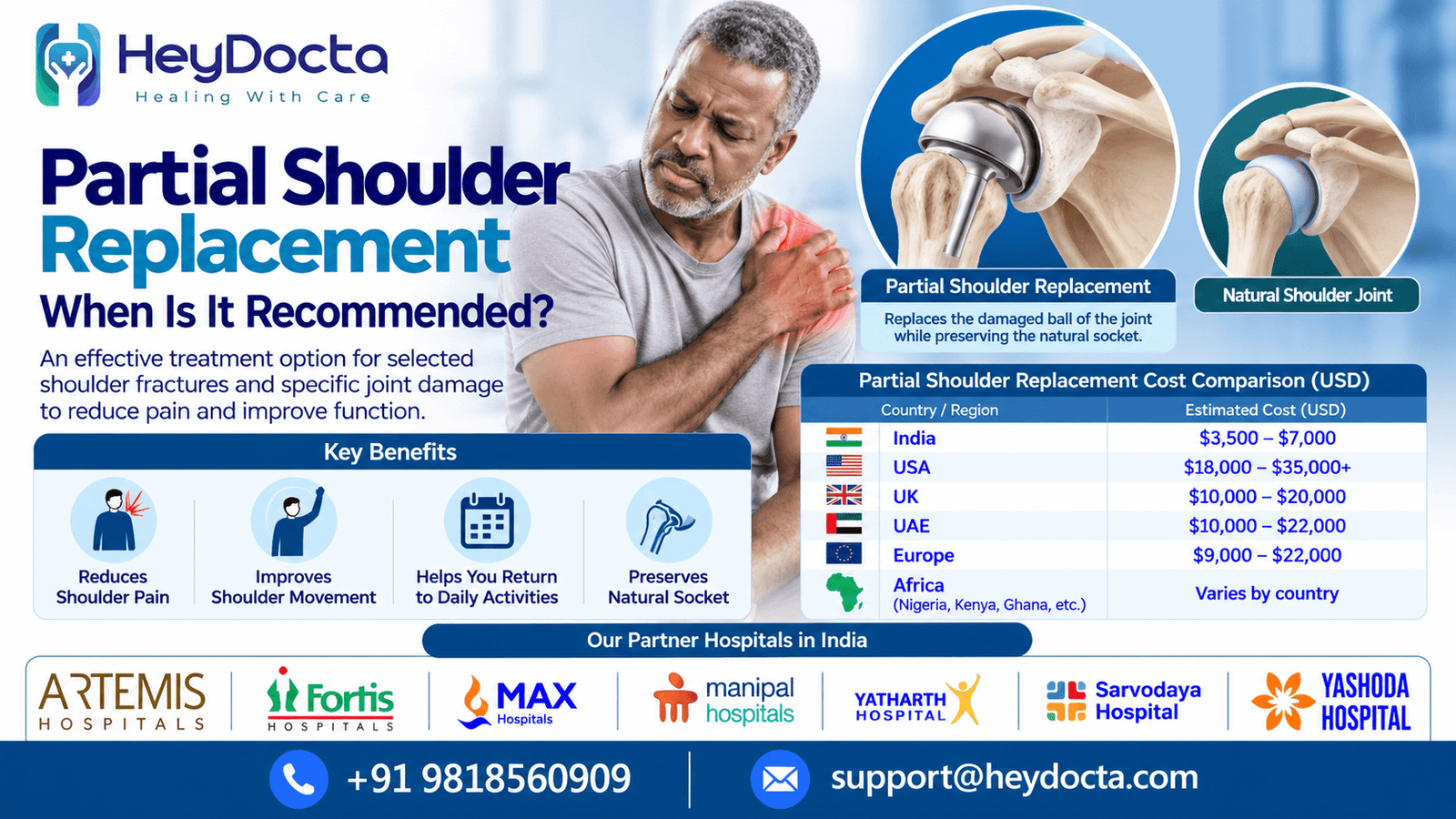
Partial shoulder replacement, also known as shoulder hemiarthroplasty, is an orthopaedic procedure in which the damaged ball of the shoulder joint is replaced with an artificial component while the natural socket is preserved. It may be recommended for selected shoulder fractures and certain types of joint damage when the remaining shoulder structures are suitable.
For international patients from Nigeria, Ghana, Kenya, Zimbabwe, Cameroon, Guyana, Jamaica, the USA, Europe and the Middle East, India may provide access to orthopaedic treatment at comparatively affordable prices. However, partial shoulder replacement is not suitable for every patient. The decision depends on the cause of shoulder damage, the condition of the socket, rotator cuff function and expected long-term results.
Get a Free Medical Opinion : Contact HeyDocta to coordinate a medical opinion, explore treatment options at partner hospitals and request an individualised cost estimate. HeyDocta’s facilitation service carries no additional fee for patients; hospital treatment, travel and other third-party expenses are payable separately.
What Is Partial Shoulder Replacement?
The shoulder is a ball-and-socket joint. The rounded head of the upper arm bone fits into a shallow socket in the shoulder blade. Cartilage allows the joint surfaces to move smoothly.
In partial shoulder replacement, the surgeon replaces the damaged ball of the upper arm bone with an artificial component. The natural socket remains in place.
The goal is to reduce pain and improve shoulder function while preserving the socket when appropriate. The procedure may be considered when the ball is severely damaged but the socket cartilage and other shoulder structures remain suitable.
Partial replacement differs from total shoulder replacement, in which both the ball and socket are replaced. The choice depends on the patient’s diagnosis and the condition of the entire joint.
When Is Partial Shoulder Replacement Recommended?
1. Selected Complex Shoulder Fractures
A complex fracture of the upper arm bone may damage the ball of the shoulder joint so severely that repair is unlikely to provide a reliable result. In selected cases, partial shoulder replacement may be considered instead of fixing the broken bone with plates and screws.
The decision depends on the fracture pattern, bone quality, rotator cuff condition, age, activity level and whether the socket is intact. Some patients may be better suited to reverse shoulder replacement or another treatment.
2. Severe Damage to the Humeral Head
The humeral head is the rounded upper end of the arm bone. Severe damage from trauma or certain bone conditions may make replacement necessary. If the natural socket remains healthy and other structures function adequately, a partial replacement may be an option.
3. Selected Cases of Avascular Necrosis
Avascular necrosis occurs when reduced blood supply damages bone tissue. If the condition progresses and the humeral head collapses, surgery may be considered. Partial replacement is an option only in selected cases; the extent of socket damage and the condition of the rotator cuff are important factors.
4. Other Specific Joint Conditions
Some patients with localised joint damage may be considered for partial replacement after specialist assessment. It is generally not the default treatment for widespread shoulder arthritis, especially when the socket is also significantly damaged.
Partial vs Total vs Reverse Shoulder Replacement
Understanding the differences can help patients prepare questions for their orthopaedic consultation.
| Feature | Partial shoulder replacement | Total shoulder replacement | Reverse shoulder replacement |
| What is replaced? | Ball of the joint | Ball and socket | Ball-and-socket arrangement is reversed |
| Natural socket | Preserved | Replaced or resurfaced | Reconstructed with reverse components |
| Common use | Selected fractures and specific humeral head damage | Arthritis with a functional rotator cuff | Severe rotator cuff damage and selected complex cases |
| Main consideration | Socket must be suitable | Rotator cuff generally needs to function adequately | Deltoid function and bone support are important |
| Suitability | Depends on damage and remaining joint structures | Depends on joint condition and anatomy | Depends on rotator cuff, bone and muscle function |
No procedure is best for every patient. A specialist should explain why a particular operation is appropriate and whether alternatives could offer better long-term function.
Benefits and Risks of Partial Shoulder Replacement
Potential Benefits
For appropriately selected patients, partial shoulder replacement may:
- Reduce pain associated with severe damage to the humeral head.
- Preserve the natural shoulder socket.
- Provide a treatment option for certain complex fractures.
- Improve the ability to perform daily activities when recovery progresses well.
The degree of improvement varies, and surgery cannot guarantee normal shoulder movement or complete pain relief.
Possible Risks
Potential complications include infection, bleeding, blood clots, nerve injury, stiffness, instability, implant loosening and persistent pain. The natural socket may deteriorate over time in some patients, potentially leading to further treatment or conversion to total shoulder replacement.
Patients should discuss the expected benefits, limitations, implant lifespan and possibility of future surgery with their surgeon.
Partial Shoulder Replacement Cost in India vs Other Countries
For international patients, treatment affordability is an important consideration. India may offer lower private-treatment costs than several high-cost healthcare markets, but the final price depends on the hospital, implant, surgeon, complexity of surgery and length of stay.
The following figures are illustrative planning estimates in USD, not verified quotations from individual hospitals or guaranteed treatment packages. Partial shoulder replacement prices are not consistently published across countries, so these ranges should be confirmed before making financial or travel decisions.
| Country or region | Indicative planning range |
| India | $3,500–$7,000 |
| USA | $18,000–$35,000+ |
| UK, private treatment | $10,000–$20,000 |
| UAE | $10,000–$22,000 |
| Europe, selected private hospitals | $9,000–$22,000 |
| African countries | Varies by country and hospital |
These are broad budgeting estimates rather than a like-for-like price survey. Actual costs may fall outside these ranges, and quotations for total or reverse shoulder replacement should not be treated as exact prices for partial replacement.
What Affects the Cost in India?
The final treatment estimate may depend on:
- Implant type, brand and material.
- Surgeon, anaesthesia and operating theatre fees.
- Hospital category and room selection.
- Pre-operative tests and medical clearance.
- Length of hospital stay and medication requirements.
- Physiotherapy and follow-up appointments.
- Additional procedures or treatment for complications.
International patients should also budget for flights, accommodation, local transport, visa expenses and time for post-operative review.
Request a personalised estimate: HeyDocta can help coordinate hospital quotations and clarify what is included. Ask for a written breakdown of the implant, hospital stay, rehabilitation and exclusions before booking travel.
Orthopaedic Consultation at Partner Hospitals in India
The right surgeon should have relevant experience in shoulder conditions and be able to explain the benefits and limitations of each suitable procedure.
Patients interested in Yatharth Hospital may enquire about consultation availability with Dr. Dhananjay Sabat. Confirm his current designation, experience with the proposed shoulder procedure and suitability for the patient’s condition directly with the hospital.
HeyDocta can help coordinate enquiries with its partner hospitals:
- Artemis Hospital
- Fortis Hospitals
- Max Hospitals
- Manipal Hospital
- Yatharth Hospital
- Sarvodaya Hospital
- Yashoda Hospital
The availability of a particular surgeon or procedure must be confirmed with the hospital. Patients should compare clinical recommendations and written estimates rather than choosing on price alone.
Treatment Process for International Patients
Step 1: Share Medical Reports
Provide available shoulder X-rays, CT or MRI scans, medical history, current medicines and details of previous treatments.
Step 2: Obtain a Specialist Opinion
The orthopaedic team reviews the records and may request further imaging or an in-person examination to assess the socket, humeral head and rotator cuff.
Step 3: Confirm the Procedure and Cost
Ask why partial replacement is recommended instead of total or reverse replacement. Confirm the implant, expected hospital stay, rehabilitation plan and possible risks.
Step 4: Arrange Travel and Visa Documentation
Check current Indian visa requirements through official government channels. The hospital may provide supporting medical documents where required.
Step 5: Undergo Surgery and Begin Rehabilitation
The clinical team monitors pain, wound healing and arm function. Exercises and movement begin according to the surgeon’s instructions.
Step 6: Plan Follow-Up Care
Before returning home, obtain your discharge summary, implant details, medication instructions, rehabilitation plan and follow-up schedule.
HeyDocta can assist with hospital coordination, appointment planning and travel guidance. Medical decisions and visa approvals remain the responsibility of the treating professionals and relevant authorities.
Recovery After Partial Shoulder Replacement
Recovery depends on the reason for surgery, the patient’s health, bone quality and the condition of the surrounding muscles and tendons. Patients treated for fractures may need a different rehabilitation plan from those undergoing replacement for other joint conditions.
| Recovery stage | General expectations |
| First few days | Pain management, wound care and initial movement instructions |
| First 2–6 weeks | Sling use and protected exercises as directed |
| Weeks 6–12 | Gradual progression of movement when approved |
| Three to six months | Continued improvement in function and strength for many patients |
| Six months and beyond | Further progress may occur depending on the individual case |
These are general estimates, not guaranteed milestones. Follow the surgeon’s instructions regarding sling use, lifting, driving and physiotherapy. International patients should remain in India long enough for recommended reviews and medical clearance before flying home.
Frequently Asked Questions
1. When is partial shoulder replacement recommended?
It may be recommended for selected complex shoulder fractures or severe damage to the humeral head when the natural socket and other shoulder structures remain suitable.
2. Is partial shoulder replacement better than total shoulder replacement?
Not necessarily. Partial replacement preserves the natural socket, but total replacement may be more appropriate when both sides of the joint are damaged. The choice depends on the diagnosis and joint condition.
3. How long does partial shoulder replacement last?
Implant longevity varies with implant design, activity, bone quality and other factors. Some patients may develop socket wear or require additional surgery over time.
4. How long does recovery take?
Recovery generally progresses over several months. The timeline depends on the procedure, the original injury or condition and the rehabilitation plan.
5. Is partial shoulder replacement affordable in India?
India may offer lower private-treatment costs than some countries, but patients should obtain current written quotations and include travel, accommodation and rehabilitation expenses in their budget.
6. Can international patients arrange shoulder replacement in India?
Eligible international patients can seek treatment in India. They should arrange a specialist opinion, confirm the treatment estimate and plan for follow-up before travelling.
7. What reports are needed for a cost estimate?
Share available shoulder X-rays or scans, medical reports, previous surgery details, current medicines and a brief description of symptoms. The hospital may require additional investigations before confirming the procedure and cost.
Conclusion: Is Partial Shoulder Replacement Right for You?
Partial shoulder replacement may be appropriate when the ball of the shoulder joint is severely damaged but the natural socket and surrounding structures remain suitable. A careful specialist assessment is essential to determine whether partial, total or reverse shoulder replacement offers the most appropriate option.
For international patients considering treatment in India, HeyDocta can help coordinate medical opinions, compare treatment estimates from partner hospitals and organise treatment-related travel support. Contact HeyDocta.com to discuss your medical reports and request a personalised estimate before making your travel decision.