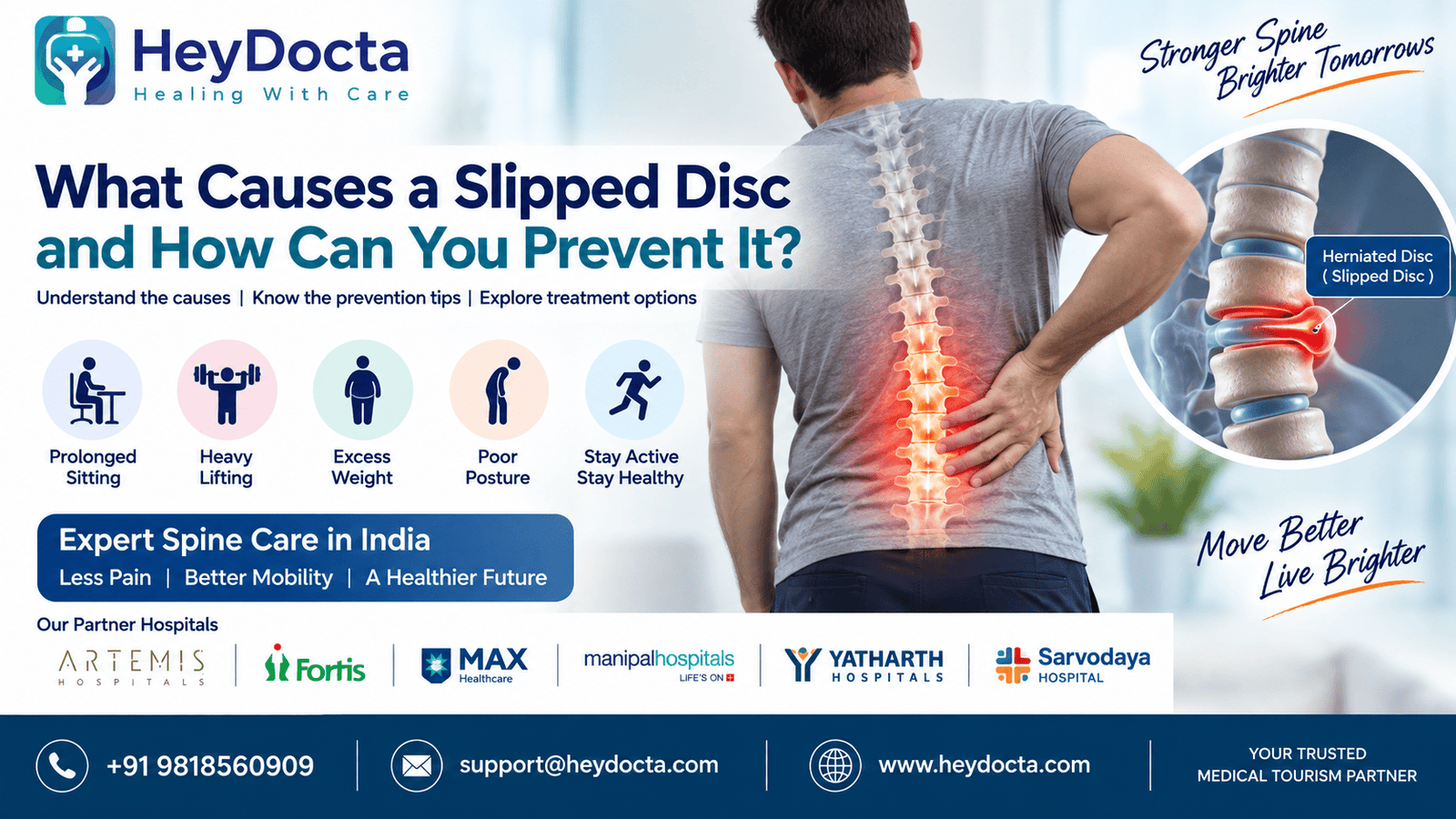
A slipped disc is a common spinal condition that can cause back pain, leg pain, numbness or weakness. It occurs when the soft inner material of a spinal disc pushes through a weakened or damaged outer layer and may irritate nearby nerves. For international patients from Nigeria, Kenya, Ghana, Zimbabwe, Cameroon, Guyana, Jamaica, the Middle East, Europe and the USA, India offers access to experienced spine specialists and comparatively affordable treatment options.
Get a Free Medical Opinion: Share your MRI and medical reports with HeyDocta to understand whether conservative treatment or spine surgery may be appropriate for your condition.
What Is a Slipped Disc?
A slipped disc, also called a herniated or prolapsed disc, occurs when one of the cushions between the spinal bones becomes damaged and its inner material bulges outward. The condition most commonly affects the lower back but can also occur in the neck.
Common symptoms include:
- Lower back or neck pain
- Pain travelling into the leg or arm
- Tingling or numbness
- Muscle weakness
- Difficulty sitting, standing or walking comfortably
Not every slipped disc requires surgery. Many patients improve with medicines, activity modification and physiotherapy.
What Causes a Slipped Disc?
Several factors can increase the risk of disc herniation:
Age-Related Disc Wear
As people age, spinal discs gradually lose water and flexibility. This makes them more vulnerable to tearing or herniation.
Improper Lifting
Lifting heavy objects while bending or twisting the spine can place excessive stress on a disc.
Prolonged Sitting
Long periods of sitting, particularly with poor posture, may contribute to back problems and can aggravate existing disc symptoms.
Lack of Physical Activity
Weak core and back muscles may provide less support to the spine.
Excess Weight
Being overweight can increase mechanical stress on the spine.
Smoking
Smoking can weaken disc tissue and is associated with increased risk of disc problems.
How Can You Prevent a Slipped Disc?
A slipped disc cannot always be prevented, but several lifestyle measures can reduce the risk:
- Exercise regularly and maintain core strength.
- Use proper lifting techniques.
- Avoid lifting heavy objects with a bent or twisted back.
- Maintain a healthy body weight.
- Take regular breaks from prolonged sitting.
- Maintain good posture while working.
- Stop smoking.
- Gradually increase exercise intensity instead of sudden heavy workouts.
Slipped Disc Treatment Options in India
Treatment depends on the location and severity of the disc problem and whether nerves are being compressed.
Non-Surgical Treatment
Many patients can initially be treated with:
- Pain-relieving medicines
- Activity modification
- Physiotherapy
- Core-strengthening exercises
- Selected injections or nerve-root procedures
Minimally Invasive and Surgical Treatment
When symptoms persist despite appropriate conservative treatment, or when significant neurological problems develop, a spine specialist may consider procedures such as:
- Microdiscectomy
- Endoscopic discectomy
- Lumbar decompression
- Cervical discectomy
- Spinal fusion in selected cases
Surgery is not routinely required for every slipped disc. Progressive weakness, persistent disabling symptoms or other neurological findings may require specialist assessment. (
Slipped Disc Surgery Cost in India vs Other Countries
For international patients, slipped disc surgery in India can be considerably more affordable than private treatment in several Western healthcare markets. Indicative 2026 sources place microdiscectomy costs in India in the range of approximately USD 3,000–7,500, while US self-pay estimates can be around USD 20,000–45,000. Exact prices vary according to hospital, surgeon, spinal level, technique and medical complexity.
| Country | Indicative Microdiscectomy Cost |
| India | USD 3,000–7,500 |
| USA | USD 20,000–45,000 |
| UK | Approximately USD 15,000–28,000 |
| UAE | Approximately USD 12,000–20,000 |
These are planning ranges rather than fixed quotations. A like-for-like comparison should consider surgeon fees, hospital charges, anaesthesia, imaging, implants or consumables, hospital stay and follow-up care.
Talk to Our Medical Tourism Expert: HeyDocta can help international patients obtain a case-specific treatment estimate from an appropriate Indian hospital after medical-record review.
Leading Spine Specialists and Hospitals in India
India has several hospitals offering specialised spine care, including Artemis Hospitals, Fortis Hospitals, Max Hospitals, Manipal Hospitals, Yatharth Hospitals and Sarvodaya Hospitals.
Among the specialists available through partner hospitals are:
Dr. Hitesh Garg – Artemis Hospitals, Gurugram: Head of Ortho Spine Surgery, with more than 15 years of spine-surgery experience. His Artemis profile reports more than 5,000 spine surgeries, including spinal fusions, deformity corrections, disc replacements and complex procedures.
Dr. Jitesh Manghwani – Max Healthcare: Associate Director & Unit Head – Orthopaedic Spine Surgery, with 11+ years of experience. His areas of interest include conservative spine care, microscopic keyhole surgery, endoscopic spine surgery, disc herniation and navigated spine surgery.
Step-by-Step Treatment Journey for International Patients
1. Share Your Medical Reports
Send your MRI, CT scans, X-rays, previous treatment records and medical history to HeyDocta.
2. Specialist Review
The selected spine specialist reviews the available information and advises whether further tests, conservative treatment or surgery should be considered.
3. Treatment and Cost Planning
HeyDocta coordinates with the hospital to obtain treatment details, estimated costs and scheduling information.
4. Travel and Hospital Coordination
International patients receive assistance with appointments, hospital coordination, visa documentation and travel planning.
5. Treatment in India
The patient undergoes the recommended treatment under the supervision of the spine team.
6. Recovery and Follow-Up
After discharge, patients receive guidance regarding medicines, physiotherapy, activity restrictions and follow-up. Patients travelling home should discuss their travel timing with their treating specialist.
Medical Visa, Stay and Travel Support
HeyDocta supports international patients with the practical aspects of travelling to India for medical treatment, including hospital coordination, appointment scheduling, visa guidance and travel-related assistance.
The required stay depends on the diagnosis and treatment. Patients undergoing surgery may need a hospital stay followed by additional recovery time in India before travelling home. The treating specialist should confirm when air travel is appropriate.
Frequently Asked Questions
Can a slipped disc heal without surgery?
Yes. Many patients improve with conservative treatment such as medication, physiotherapy and activity modification. Surgery is considered when symptoms persist or significant neurological problems develop.
What is the main cause of a slipped disc?
Age-related disc degeneration is a common factor. Heavy lifting, improper lifting technique, prolonged sitting, inactivity, excess weight and smoking can also increase risk.
How much does slipped disc surgery cost in India?
Indicative international-patient estimates for microdiscectomy are approximately USD 3,000–7,500, but the final price depends on the hospital, surgeon, procedure and individual medical requirements.
Is microdiscectomy the same as spinal fusion?
No. Microdiscectomy removes the portion of a herniated disc compressing a nerve. Fusion is a different operation used for selected spinal conditions requiring stabilisation.
How long does it take to recover after slipped disc surgery?
Recovery varies according to the procedure, spinal level, general health and individual healing. Your spine surgeon will provide personalised guidance about walking, physiotherapy, work and travel.
When should I see a spine specialist?
Seek medical assessment if back or neck pain is persistent, travels into an arm or leg, or is associated with numbness or weakness. Urgent medical attention is particularly important if there are new bowel/bladder control problems or significant progressive weakness.
Get Slipped Disc Treatment in India with HeyDocta
For international patients considering slipped disc treatment in India, HeyDocta provides end-to-end medical tourism coordination, including specialist consultation, hospital coordination, treatment-cost estimates, visa assistance and travel support. There is no additional facilitator fee charged to patients for HeyDocta’s coordination, while hospital, treatment, travel and other third-party charges remain applicable.
Get Treatment Cost from Top Indian Spine Hospitals: Share your medical reports with HeyDocta.com and receive guidance on suitable treatment options and an estimated treatment cost in India.