Navigation-guided revision spine surgery in India is an advanced option for patients who continue to experience pain, numbness, weakness, instability, or other spinal problems after previous surgery. Revision procedures are often more complex because the surgeon has to work around scar tissue, previous implants, altered anatomy, or failed fusion. Computer-assisted navigation uses detailed imaging and real-time guidance to help the surgeon plan and place instruments and implants with greater anatomical precision.
For international patients from Nigeria, Ghana, Kenya, Zimbabwe, Cameroon, Guyana, Jamaica, the USA, Europe, and the Middle East, India offers access to advanced spine hospitals and experienced specialists at comparatively affordable costs. The final treatment plan depends on your previous surgery, current symptoms, MRI or CT findings, and overall health.
Get a Free Medical Opinion: Share your previous spine surgery reports and scans with HeyDocta to explore suitable revision treatment options in India before planning your travel.
What Is Navigation-Guided Revision Spine Surgery?
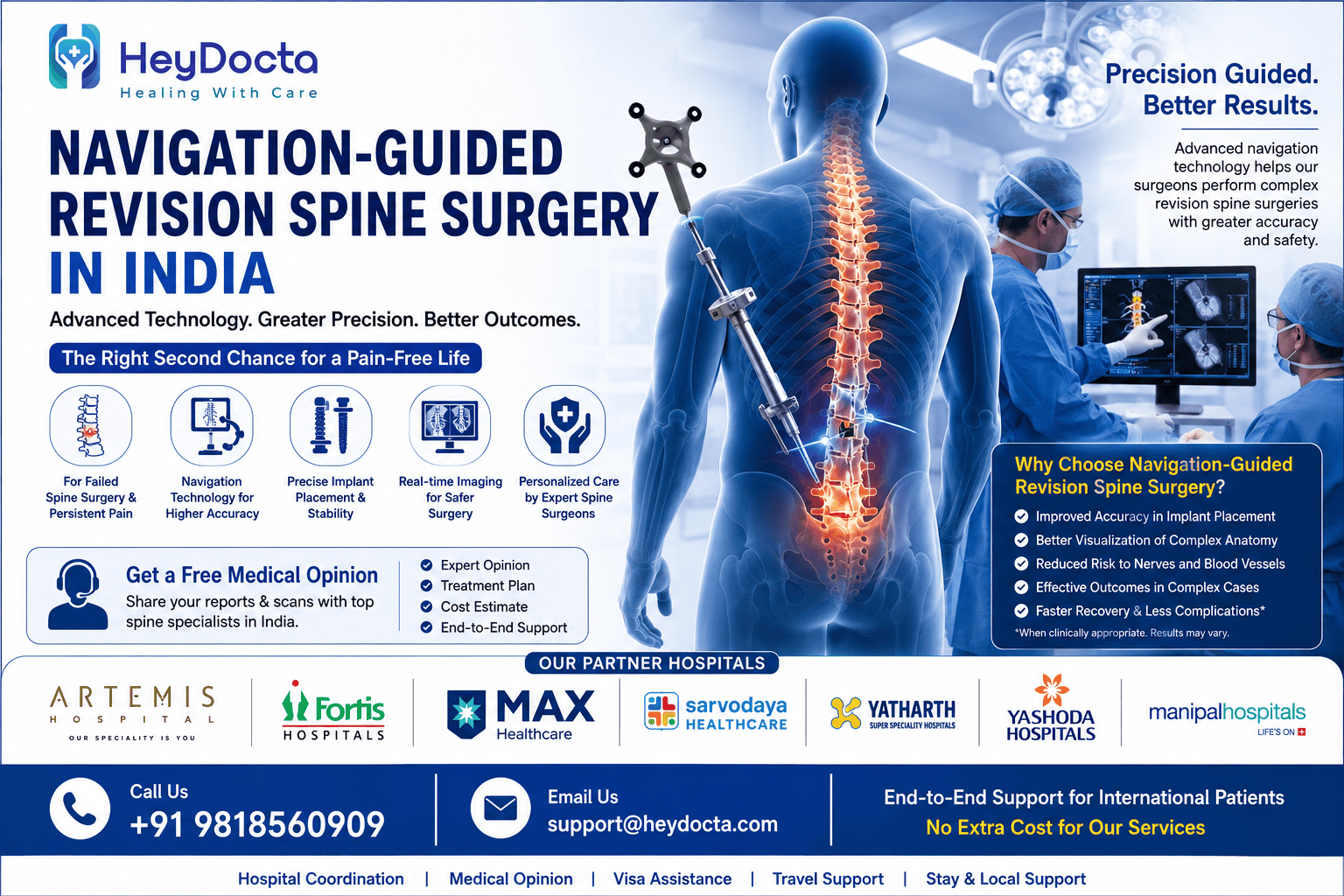
Navigation-guided revision spine surgery combines revision spinal surgery with computer-assisted image guidance. Before or during surgery, the navigation system uses CT or other imaging data to create a detailed representation of the patient’s spinal anatomy. The surgeon then uses this information to guide instruments, screws, implants, and other surgical steps.
This technology is particularly useful when normal anatomical landmarks have been altered by previous surgery.
Navigation does not replace the surgeon’s experience. It is a surgical guidance tool used alongside clinical assessment, imaging, surgical planning, and intraoperative decision-making. Research suggests that image-guided navigation can improve instrumentation accuracy, although the benefits and outcomes vary according to the procedure and patient.
Why Is Revision Spine Surgery More Complex?
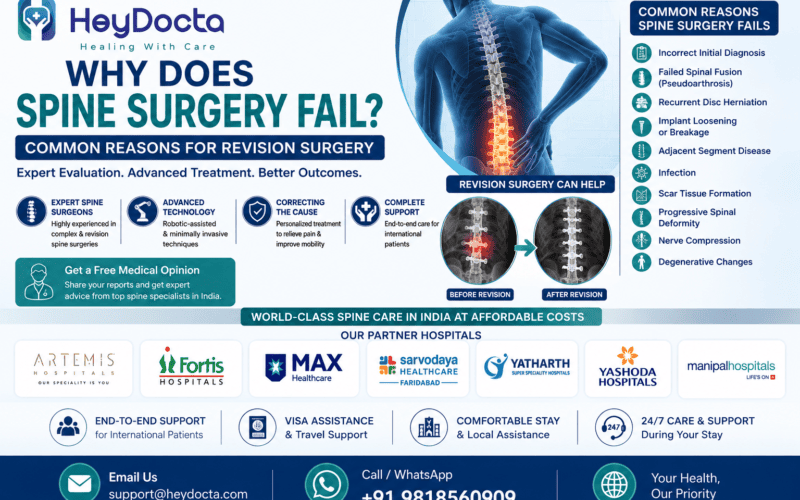
A second spine operation is different from a first-time procedure. Previous surgery can result in:
- Scar tissue around nerves
- Changes in normal spinal anatomy
- Existing screws, rods, cages, or other implants
- Failed or incomplete spinal fusion
- Bone loss or reduced bone quality
- Recurrent disc problems
- Spinal instability
- Postoperative deformity
- Adjacent-segment degeneration
The surgeon first needs to identify the reason for persistent or recurrent symptoms. Revision surgery should not be performed solely because a previous operation was unsuccessful. In some patients, non-surgical treatment or pain management remains the more appropriate approach.
How Does Navigation Help During Revision Spine Surgery?
Navigation provides the surgeon with three-dimensional anatomical information during the procedure. This is particularly valuable when previous surgery has changed the normal anatomy.
Potential advantages include:
More Precise Implant Placement
Navigation helps the surgeon plan the trajectory and position of spinal screws and other implants. Studies comparing navigated and conventional techniques have reported improved accuracy in several types of spinal instrumentation.
Better Understanding of Altered Anatomy
Revision cases often have scar tissue and existing hardware. Image guidance provides additional anatomical information during surgery.
Assistance With Complex Spinal Reconstruction
Navigation is useful in selected complex and multilevel procedures where accurate implant positioning is important.
Intraoperative Verification
Some navigation systems use intraoperative imaging to check implant positioning during the operation. This gives the surgical team an opportunity to identify and address certain positioning issues before the procedure is completed.
Potential Reduction in Radiation Exposure
Depending on the navigation system and surgical technique, image-guided approaches can reduce reliance on repeated conventional fluoroscopic imaging. A recent meta-analysis of image-guided endoscopic lumbar procedures reported lower fluoroscopy use and radiation exposure compared with conventional C-arm techniques.
Navigation does not guarantee a successful outcome or eliminate surgical risks. The evidence also shows that improved technical accuracy does not automatically translate into better pain or functional outcomes for every patient.
Who Might Need Navigation-Guided Revision Spine Surgery?
A spine specialist might consider navigation-guided revision surgery for selected patients with:
- Failed spinal fusion
- Loose or displaced implants
- Broken screws or rods
- Recurrent disc herniation
- Persistent nerve compression
- Spinal stenosis after previous surgery
- Postoperative spinal instability
- Spinal deformity after previous surgery
- Multilevel spinal disease
- Complex revision fusion
- Recurrent symptoms associated with previous instrumentation
Not every revision procedure requires navigation. The technology used depends on the diagnosis, spinal level, previous operation, surgical plan, and hospital facilities.
Navigation-Guided Revision Spine Surgery Options in India
Treatment varies according to the underlying problem.
Revision Decompression
If nerves remain compressed after previous surgery, the surgeon might perform another decompression to relieve pressure.
Revision Discectomy
A recurrent disc herniation causing nerve compression might require removal of the problematic disc material.
Revision Spinal Fusion
Failed fusion or spinal instability might require additional fixation, bone grafting, replacement of implants, or extension of the fusion.
Hardware Revision
Loose, broken, misplaced, or problematic implants might need removal, replacement, or repositioning.
Complex Spinal Reconstruction
Patients with significant deformity, failed multilevel fusion, or extensive previous surgery might require a more complex reconstruction.
Navigation can be incorporated into selected procedures where accurate instrumentation is important.
Navigation-Guided Revision Spine Surgery Cost in India
The navigation-guided revision spine surgery cost in India varies significantly. There is no single fixed price because revision surgery ranges from relatively limited procedures to complex multilevel reconstruction.
Current published Indian estimates place complex revision spine surgery broadly around ₹5 lakh to ₹15 lakh or more, depending on the hospital and complexity. Some medical-tourism estimates place international-patient revision surgery around USD 6,000–18,000+. These are planning ranges rather than guaranteed prices.
Navigation and intraoperative imaging can add to the cost depending on the hospital and equipment used. The final quotation should therefore specify whether navigation, imaging, implants, ICU care, investigations, and postoperative rehabilitation are included.
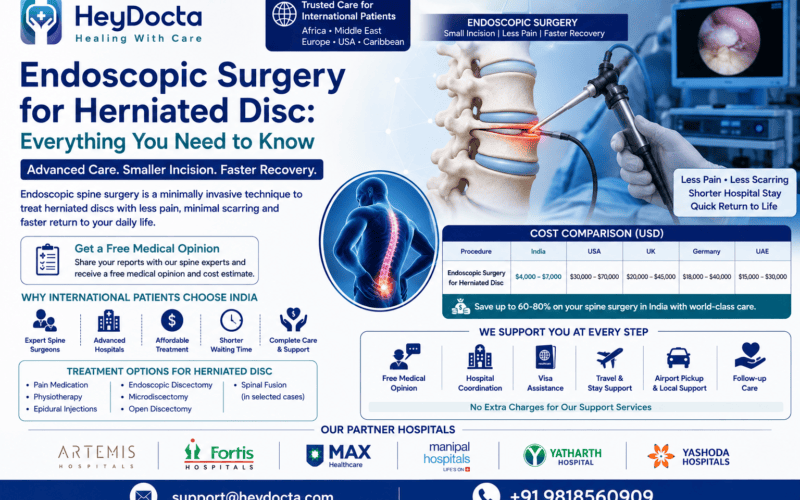
Navigation-Guided Revision Spine Surgery Cost Comparison
| Country | Indicative Cost Range | General Cost Position |
| India | USD 6,000–18,000+ | Comparatively affordable |
| USA | USD 25,000–60,000+ | Higher |
| UK | USD 27,000–68,000+ | Higher |
| Europe | USD 20,000–60,000+ | Varies by country |
| Middle East | USD 15,000–35,000+ | Varies by country |
| Africa | Varies significantly | Depends on country and facility |
These figures are broad estimates for medical-tourism planning. They should not be treated as quotations. Complex reconstruction, multiple spinal levels, specialised implants, ICU care, complications, and longer hospital stays can increase the total cost.
For international patients, India can be financially attractive because the total private-hospital treatment cost is often lower than comparable treatment in the USA, UK, and several other high-cost healthcare markets. However, patients should compare the complete treatment package rather than looking only at the surgeon’s fee.
What Determines the Final Treatment Cost?
Your hospital quotation can vary based on:
- Number of spinal levels
- Type of revision surgery
- Previous implants
- Need for implant removal or replacement
- Navigation and intraoperative imaging
- Type and number of implants
- Bone graft requirements
- Operating time
- Hospital room category
- ICU requirements
- MRI, CT, X-rays, and laboratory tests
- Medicines and blood products
- Physiotherapy and rehabilitation
- Duration of hospitalisation
- Management of complications, if they occur
Talk to a Medical Tourism Expert: HeyDocta can coordinate your medical records with suitable partner hospitals and help you request an individual treatment plan and cost estimate before you travel.
Spine Specialists and Partner Hospitals in India
International patients can explore spine services through HeyDocta’s partner hospital network, including Artemis Hospital, Fortis Hospitals, Max Hospitals, Sarvodaya Hospital, Yatharth Hospital, Yashoda Hospital, and Manipal Hospital.
For patients seeking specialist evaluation for complex or revision spine problems, Dr Hitesh Garg at Artemis Hospital and Dr Jitesh Manghwani at Max Hospital are among the spine specialists who can be considered based on the patient’s medical condition and treatment requirements.
The right specialist should be selected according to the specific diagnosis, previous surgery, imaging findings, required revision procedure, and surgeon’s relevant experience.
Navigation-Guided Revision Spine Surgery: Step-by-Step Process
Step 1: Submit Your Previous Medical Records
Share your previous operation notes, discharge summary, MRI or CT scans, X-rays, medication list, and current symptoms.
Step 2: Preliminary Specialist Review
A spine specialist reviews the available records to understand why the previous surgery did not provide the expected result.
Step 3: Medical Opinion and Treatment Plan
The doctor determines whether additional investigations, non-surgical treatment, or revision surgery should be considered.
Step 4: Hospital and Cost Coordination
HeyDocta can coordinate with partner hospitals to obtain treatment recommendations and an estimated cost.
Step 5: Medical Visa and Travel Planning
Once you decide to proceed, the relevant medical visa process can be initiated. India’s official e-Visa system includes e-Medical Visa and e-Medical Attendant Visa categories. Applicants should check the latest eligibility and documentation requirements on the official government portal.
Step 6: In-Person Evaluation in India
After arrival, the treating surgeon performs a physical examination and reviews your imaging. Additional tests might be requested.
Step 7: Navigation-Guided Surgery, If Recommended
If surgery is appropriate, the surgical team performs the planned revision procedure using navigation and other technologies when clinically indicated.
Step 8: Hospital Recovery and Follow-Up
After surgery, you receive postoperative monitoring, pain management, mobilisation, physiotherapy when required, and follow-up evaluation.
Recovery After Navigation-Guided Revision Spine Surgery
Recovery depends more on the underlying condition and extent of surgery than navigation technology alone.
A patient undergoing limited revision decompression might recover differently from someone requiring multilevel fusion and implant reconstruction.
Recovery usually includes:
- Hospital monitoring
- Pain management
- Gradual mobilisation
- Wound care
- Physiotherapy when recommended
- Activity restrictions
- Follow-up imaging when required
- Gradual return to daily activities
International patients should plan their return journey according to the surgeon’s advice rather than booking a fixed return date immediately after surgery.
How Long Should International Patients Stay in India?
The required stay depends on the complexity of surgery and recovery. Patients undergoing complex revision procedures often need hospitalisation followed by additional recovery time near the treating hospital.
Your medical-tourism schedule should allow time for:
- Specialist consultation
- Preoperative investigations
- Surgery
- Hospital recovery
- Early postoperative review
- Wound assessment
- Travel clearance
Your surgeon should provide individual guidance regarding when it is appropriate to travel home.
Why International Patients Choose India for Revision Spine Surgery
Patients from Nigeria, Ghana, Kenya, Zimbabwe, Cameroon, Guyana, Jamaica, the Middle East, Europe, and the USA often consider India because of several factors:
- Experienced spine specialists
- Multispecialty hospitals
- Advanced imaging and navigation technology
- Availability of complex revision procedures
- Comparatively lower treatment costs
- International patient departments
- English-speaking medical teams
- Medical tourism infrastructure
- Options across different hospital groups
The decision should still be based on medical suitability, hospital quality, surgeon expertise, expected recovery, and total treatment cost.
HeyDocta Support for International Spine Patients
Travelling to another country for revision spine surgery involves more than choosing a surgeon. Patients often need help coordinating medical records, hospital appointments, treatment estimates, visa documentation, airport transfers, accommodation, and follow-up communication.
HeyDocta supports international patients through:
- Medical record coordination
- Specialist opinion coordination
- Hospital coordination
- Treatment cost estimates
- Appointment scheduling
- Medical visa and travel assistance
- Local logistical support
- Post-treatment coordination
HeyDocta acts as a medical tourism facilitator. Medical decisions remain with the qualified treating doctors and hospitals. Patients should confirm the exact services and inclusions before travelling.
Frequently Asked Questions
1. What is navigation-guided revision spine surgery?
It is revision spine surgery performed with computer-assisted image guidance. The system helps the surgeon understand spinal anatomy and guide instruments and implants during selected procedures.
2. Is navigation necessary for every revision spine surgery?
No. Navigation is not required for every case. The surgeon decides whether it is appropriate based on the patient’s anatomy, previous surgery, spinal condition, and planned procedure.
3. How much does navigation-guided revision spine surgery cost in India?
Complex revision spine surgery is broadly estimated at around USD 6,000–18,000 or more in India. Navigation, implants, hospital stay, imaging, and surgical complexity affect the final price.
4. Is revision spine surgery riskier than first-time surgery?
Revision surgery is often technically more challenging because of scar tissue, previous implants, altered anatomy, and possible bone or fusion problems. Your surgeon should explain the individual risks before treatment.
5. Can I get a medical opinion before travelling to India?
Yes. International patients can submit previous medical reports and MRI or CT scans for preliminary review. An in-person consultation is still required before a final diagnosis and treatment decision.
6. How long should I stay in India after revision spine surgery?
The duration varies according to the procedure and recovery. Complex revision surgery usually requires hospital recovery followed by additional time near the hospital for early follow-up.
7. Does HeyDocta help with medical travel?
HeyDocta helps international patients coordinate hospitals, specialist opinions, treatment estimates, appointments, visa assistance, travel logistics, and follow-up support.
Conclusion
Navigation-guided revision spine surgery provides an additional layer of image-based guidance for selected complex spine procedures. It is particularly relevant when previous surgery has altered the anatomy or when accurate placement of spinal implants is important. Evidence supports improvements in technical accuracy and certain perioperative measures, but navigation does not guarantee better outcomes for every patient.
India offers international patients access to advanced hospitals, experienced spine specialists, navigation technology, and comparatively affordable private healthcare. For patients from Africa, the USA, Europe, the Middle East, Guyana, and Jamaica, obtaining a specialist opinion and personalised cost estimate before travelling is an important first step.
If you have persistent symptoms after previous spine surgery, do not assume another operation is automatically required. A detailed review of your previous surgery and current imaging should guide the next decision.
Get a Free Medical Opinion and Treatment Cost from Top Indian Hospitals with HeyDocta.com , Share your MRI/CT scans and previous spine surgery records to explore suitable revision spine treatment options, hospital choices, estimated costs, and end-to-end medical travel support. There is no extra cost to patients for HeyDocta’s facilitation services, subject to the applicable service arrangement.