Failed spine surgery treatment in India is an option for patients who continue to experience back pain, leg pain, weakness, numbness, instability, or other symptoms after previous spine surgery. A previous operation does not always mean the spine problem cannot be treated. In some cases, the original diagnosis needs to be reassessed. In others, there may be recurrent disc problems, nerve compression, implant-related problems, non-union, spinal instability, infection, or adjacent-segment disease. India has experienced spine surgeons, advanced imaging, navigation, neuromonitoring, minimally invasive techniques, and complex revision surgery facilities at comparatively affordable prices. For patients from Nigeria, Ghana, Kenya, Zimbabwe, Cameroon, Guyana, Jamaica, the USA, Europe, and the Middle East, India is therefore an important destination for complex spine care.
Get a Free Medical Opinion from a qualified Indian spine specialist. HeyDocta can help coordinate your medical records, imaging review, hospital consultation, and treatment estimate before you travel.
What Does Failed Spine Surgery Mean?
“Failed spine surgery” is commonly used to describe persistent or recurrent symptoms after a spine operation. The medical term failed back surgery syndrome (FBSS) is also used in some cases, although it does not identify one specific disease or one single reason for pain. A detailed evaluation is needed before deciding whether another operation is appropriate.
Some patients continue to have symptoms because the original pain source was not fully addressed. Others develop a new problem months or years after surgery. In some cases, the previous fusion does not achieve solid bone healing, hardware becomes loose or damaged, or scar tissue contributes to nerve irritation.
Revision surgery should therefore not be considered automatically. The first objective is to identify why the previous treatment did not provide the expected result.
Common Reasons for Failed Spine Surgery
A spine specialist may investigate several possible causes, including:
- Recurrent or residual disc herniation
- Persistent nerve compression
- Spinal stenosis
- Recurrent or worsening spinal instability
- Failed spinal fusion or non-union
- Loose, displaced, or broken implants
- Incorrect implant positioning
- Adjacent-segment degeneration
- Postoperative infection
- Spinal deformity
- Scar tissue around nerves
- Continued degeneration at another spinal level
- A diagnosis that does not fully explain the patient’s symptoms
- Chronic pain that requires non-surgical management rather than another operation
A careful review of the previous surgical records and current imaging is essential. Revision surgery is more technically demanding than many first-time spine procedures because the surgeon is working around previous scar tissue, implants, altered anatomy, and sometimes reduced bone quality.
When Should You Consider Revision Spine Surgery in India?
Revision surgery is considered when investigations identify a structural problem that is reasonably likely to improve with surgery. Examples include significant nerve compression, recurrent disc herniation, failed fusion, hardware failure, spinal instability, or progressive deformity.
However, persistent pain after spine surgery does not always require another operation. A specialist might recommend physiotherapy, medicines, injections, pain management, lifestyle changes, or observation when surgery is not the best option.
For international patients, getting an independent medical opinion before purchasing flights is especially useful. A remote review of MRI or CT scans and previous operative reports helps determine whether an in-person assessment and revision surgery are appropriate.
Failed Spine Surgery Treatment Options Available in India
Treatment depends on the underlying cause rather than the label “failed spine surgery.”
Revision Discectomy
If a disc has herniated again and is compressing a nerve, revision discectomy might be considered. The surgeon removes the material responsible for nerve compression while taking previous surgery into account.
Revision Decompression
Persistent spinal stenosis or recurrent nerve compression might require another decompression procedure. The exact technique depends on the affected spinal level and previous surgery.
Revision Spinal Fusion
Patients with instability, failed fusion, deformity, or significant structural problems might require revision fusion. This procedure can involve removal or replacement of existing implants, additional screws and rods, bone grafting, and reconstruction of the affected spinal segments.
Hardware Revision or Removal
Loose, broken, displaced, or problematic implants sometimes require revision. In selected cases, hardware can be removed. In other cases, new instrumentation is required to restore stability.
Minimally Invasive or Endoscopic Revision Procedures
Selected recurrent disc or nerve compression cases might be suitable for minimally invasive or endoscopic techniques. Not every revision case is suitable for these approaches. The surgeon chooses the technique according to anatomy, previous surgery, imaging findings, and the required correction.
Deformity or Complex Reconstruction
Patients with significant spinal deformity or extensive previous surgery might require complex reconstruction. These cases often require detailed imaging, careful planning, advanced instrumentation, and longer hospital observation.
Failed Spine Surgery Treatment Cost in India
The failed spine surgery treatment cost in India varies substantially because revision surgery is highly individualised. The price depends on the number of spinal levels, type of previous surgery, implants required, complexity of reconstruction, surgeon and hospital, diagnostic tests, ICU requirements, hospital stay, and rehabilitation.
Published Indian hospital estimates for revision spine reconstruction range around ₹7 lakh to ₹15 lakh in private metropolitan hospitals, while other complex revision estimates can fall around ₹5 lakh to ₹12 lakh depending on the case. These figures are indicative rather than fixed package prices.
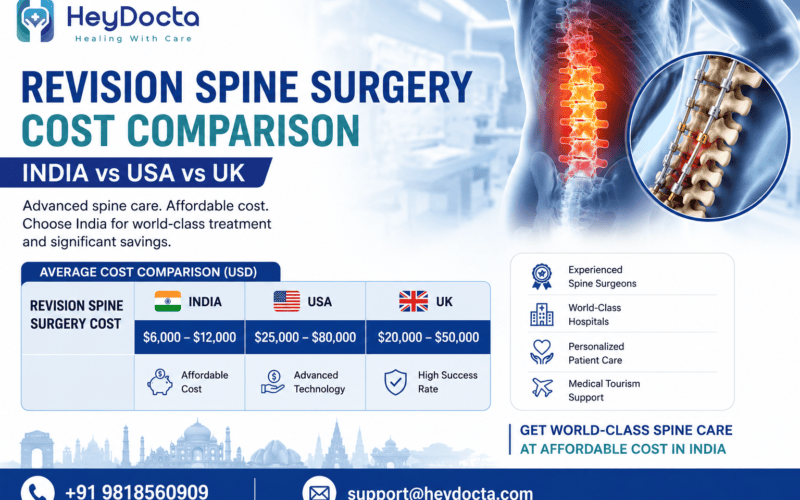
For international planning, an approximate working range of USD 8,000–18,000 is reasonable for many complex revision cases, but highly complicated reconstruction can exceed this range. A personalised hospital quotation should always be obtained after reviewing the patient’s medical records and imaging.
Indicative Failed Spine Surgery Cost in India vs Other Countries
| Country/Region | Approximate Cost for Complex Revision Spine Surgery |
| India | USD 8,000–18,000 |
| USA | USD 25,000–80,000+ |
| UK | USD 20,000–50,000 |
| Europe | USD 18,000–60,000 |
| Middle East | USD 15,000–35,000 |
| Africa | Varies significantly by country and hospital |
These figures are intended for broad medical-tourism planning. They are not guaranteed package prices. Hospital selection, surgical complexity, implants, length of stay, ICU care, investigations, and rehabilitation can change the final estimate. India’s affordability advantage is often strongest for patients requiring complex private-hospital treatment, although patients should compare the complete treatment package rather than the operation fee alone.
Why Revision Spine Surgery Can Cost More Than First-Time Surgery
Revision surgery often requires additional resources because the surgeon must assess and work around previous surgical changes. Costs might increase because of:
- Additional MRI or CT imaging
- Detailed preoperative investigations
- Longer operating time
- Specialised implants
- Removal and replacement of previous hardware
- Bone grafting
- Neuromonitoring
- Navigation or advanced imaging during surgery
- Longer hospitalisation
- ICU observation when required
- Postoperative rehabilitation
Patients should ask for an itemised estimate covering surgeon fees, hospital charges, implants, anaesthesia, investigations, medicines, accommodation, and follow-up.
Get Treatment Cost from Top Indian Hospitals. Share your previous surgery reports, MRI/CT scans, discharge summary, and current medical reports with HeyDocta for coordination with suitable partner hospitals.
Best Hospitals and Spine Specialists in India
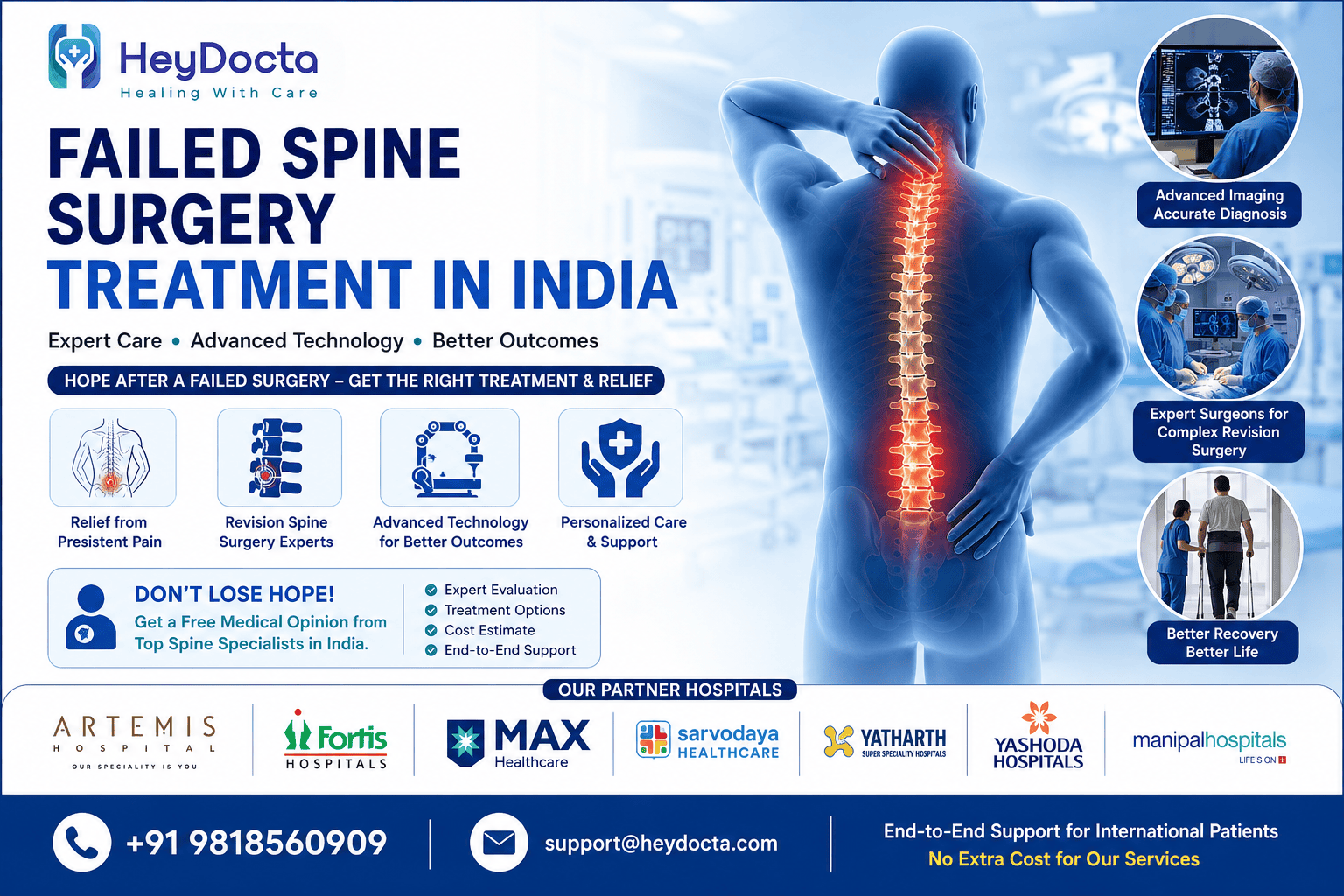
India has several hospitals with dedicated orthopaedic, neurosurgical, and spine departments. HeyDocta works with partner hospitals including Artemis Hospital, Fortis Hospitals, Max Hospitals, Sarvodaya Hospital, Yatharth Hospital, Yashoda Hospital, and Manipal Hospital.
For patients seeking an expert opinion for complex or failed spine surgery, Dr Hitesh Garg at Artemis Hospital and Dr Jitesh Manghwani at Max Hospital are among the spine specialists patients might consider for specialist evaluation. The appropriate surgeon depends on the patient’s diagnosis, previous operation, imaging findings, and required revision procedure.
Patients should compare surgeons based on relevant experience with their specific condition rather than relying only on general rankings or online claims.
Step-by-Step Process for Failed Spine Surgery Treatment in India
Step 1: Send Your Medical Records
International patients can share previous operation reports, discharge summaries, MRI or CT scans, X-rays, medication details, and current symptoms.
Step 2: Specialist Medical Opinion
The case is reviewed by an appropriate spine specialist. The doctor assesses the previous operation and identifies possible causes of persistent or recurrent symptoms.
Step 3: Treatment Recommendation
The specialist might recommend revision surgery, another procedure, conservative treatment, or additional investigations.
Step 4: Hospital and Cost Coordination
HeyDocta can coordinate hospital options and request an estimated treatment plan and cost from the selected hospital.
Step 5: Medical Visa and Travel Planning
After the treatment plan is accepted, international patients can proceed with the relevant medical visa process and travel arrangements. India’s official e-Visa system includes e-Medical and e-Medical Attendant visa categories. The official government portal states that an e-Medical Visa requires a hospital letter containing treatment details and patient identification information.
Step 6: Arrival and Hospital Consultation
After arrival in India, the patient undergoes an in-person evaluation. Additional investigations might be requested before surgery.
Step 7: Revision Surgery, If Recommended
The surgical team performs the planned procedure after discussing the expected benefits, risks, alternatives, and recovery requirements.
Step 8: Recovery and Follow-Up
After discharge, patients continue rehabilitation and follow the surgeon’s instructions. International patients should plan sufficient time in India for early postoperative review before returning home.
Recovery After Revision Spine Surgery
Recovery varies according to the procedure and the patient’s general health. A simple revision procedure might have a shorter recovery period than complex spinal reconstruction involving multiple levels and new instrumentation.
Patients should expect:
- Initial hospital recovery
- Pain management
- Gradual mobilisation
- Wound monitoring
- Physiotherapy when recommended
- Restrictions on lifting and strenuous activities
- Follow-up imaging when required
- Gradual return to normal activities
Patients travelling from Africa, the Middle East, Europe, the USA, Guyana, or Jamaica should discuss their expected hospital stay and recommended time in India before booking their return flight.
How Long Should International Patients Stay in India?
The total stay depends on the complexity of treatment. Patients undergoing complex revision spine surgery might need several days of hospitalisation followed by additional recovery time near the hospital.
A practical medical-tourism plan should include time for:
- Initial consultation
- Preoperative testing
- Surgery
- Hospital recovery
- Early postoperative review
- Wound assessment
- Travel clearance from the treating team
The surgeon should provide individual guidance because recovery differs significantly between patients.
Medical Tourism Support Through HeyDocta
International patients often need more than a hospital appointment. They might require help organising medical records, hospital appointments, treatment estimates, visa documentation, airport transfers, accommodation, local coordination, and follow-up communication.
HeyDocta works as a medical tourism facilitator to help patients coordinate these steps with partner hospitals in India. Patients can receive assistance with hospital coordination, medical appointment scheduling, visa and travel support, and communication during the treatment journey. HeyDocta does not replace the treating doctor’s medical advice, and treatment decisions remain between the patient and qualified medical professionals.
Frequently Asked Questions About Failed Spine Surgery Treatment in India
1. Can failed spine surgery be treated in India?
Yes, some causes of persistent or recurrent symptoms after spine surgery are treatable in India. Treatment depends on the underlying problem. Revision surgery is not appropriate for every patient, so a detailed specialist evaluation is important.
2. How much does failed spine surgery treatment cost in India?
Complex revision spine surgery often falls within an indicative range of about USD 8,000–18,000, although the actual price varies according to surgical complexity, implants, hospital, surgeon, investigations, and length of stay. A personalised quotation is required before treatment.
3. Is revision spine surgery more difficult than the first surgery?
Often, yes. Previous surgery can create scar tissue and alter normal anatomy. Existing implants, fusion status, bone quality, and spinal alignment can also make the procedure more complex.
4. How do I know whether I need another spine surgery?
A spine specialist should review your symptoms, previous operation, physical examination, MRI or CT scans, and other investigations. Another operation should be recommended only when there is a clear medical reason and the expected benefits outweigh the risks.
5. Can I get a second opinion from an Indian spine surgeon before travelling?
Yes. International patients can share their medical records and imaging for preliminary specialist review. An in-person examination is still required before making a final treatment decision.
6. Which hospitals in India treat complex spine conditions?
Patients can explore spine services at partner hospitals such as Artemis Hospital, Fortis Hospitals, Max Hospitals, Sarvodaya Hospital, Yatharth Hospital, Yashoda Hospital, and Manipal Hospital. The most appropriate hospital depends on the patient’s condition, required procedure, surgeon availability, and treatment requirements.
7. Does HeyDocta provide support for international patients?
HeyDocta assists international patients with hospital coordination, medical opinions, treatment estimates, visa and travel assistance, and other logistical aspects of travelling to India for treatment. Patients should confirm the exact services available for their individual case before travel.
Final Thoughts
Failed spine surgery does not automatically mean there are no further treatment options. The first priority is understanding why symptoms have continued or returned. A specialist assessment can help distinguish between problems requiring revision surgery and conditions better managed with non-surgical treatment.
India offers access to experienced spine specialists, advanced hospitals, modern surgical technology, and comparatively affordable treatment for international patients. However, complex revision surgery requires careful patient selection and individual planning. Cost should be considered alongside surgeon experience, hospital infrastructure, implant quality, postoperative care, rehabilitation, and follow-up arrangements.
If you previously underwent spine surgery and continue to experience pain, numbness, weakness, difficulty walking, or other symptoms, consider obtaining an independent specialist opinion before deciding on another operation.
Contact HeyDocta.com today to begin your treatment coordination.