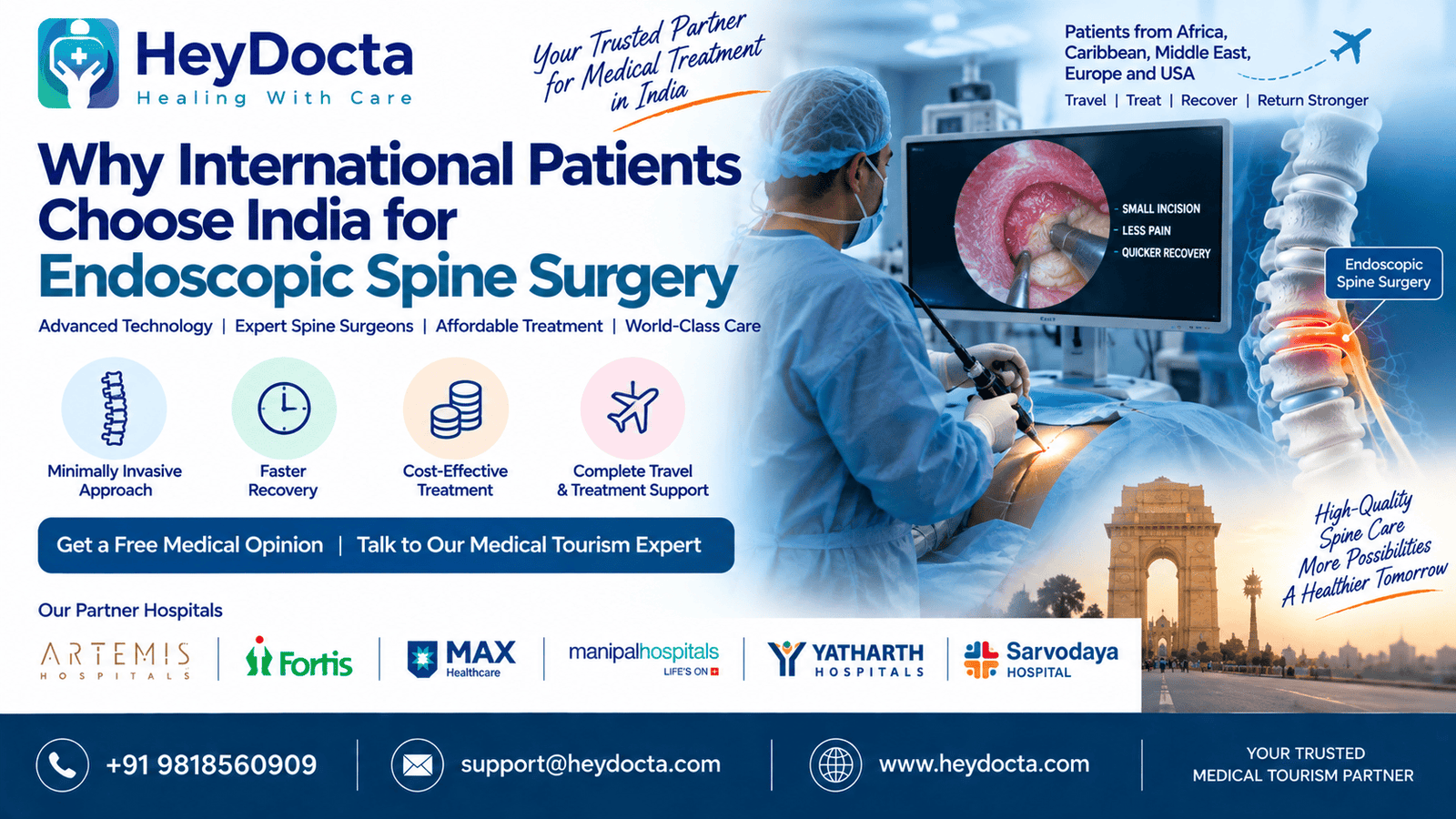
For international patients suffering from persistent back pain, leg pain, sciatica, numbness or nerve compression, endoscopic spine surgery in India has become an important minimally invasive treatment option. The procedure uses specialised instruments and a small access point to treat selected spinal conditions while limiting disruption to surrounding tissues. India combines specialised spine centres, experienced surgeons, advanced technology and comparatively lower treatment costs, making it an option considered by patients from Nigeria, Ghana, Kenya, Zimbabwe, Cameroon, Guyana, Jamaica, the Middle East, Europe and the USA.
Get a Free Medical Opinion: International patients can share their MRI scans and medical reports with HeyDocta to understand whether endoscopic spine surgery may be appropriate and obtain an estimated treatment cost from an Indian hospital.
What Is Endoscopic Spine Surgery?
Endoscopic spine surgery is a minimally invasive technique used to treat selected spinal conditions, including certain types of disc herniation, nerve compression and spinal stenosis.
Instead of using a larger incision, the surgeon introduces a specialised endoscope and instruments through a small access point. A camera provides magnified visualisation of the surgical area, allowing the surgeon to remove or decompress the tissue responsible for nerve compression when the procedure is clinically appropriate.
The exact technique depends on the spinal level, location of the disc problem, anatomy and diagnosis. Endoscopic surgery is not suitable for every spinal condition, so a specialist assessment is essential before choosing this approach.
Why Are International Patients Choosing India for Endoscopic Spine Surgery?
1. Access to Experienced Spine Specialists
India has dedicated spine departments within major multispecialty hospitals. Patients can access orthopaedic spine surgeons and neurosurgeons experienced in minimally invasive and endoscopic procedures.
For international patients, access to a specialist before travelling can also help determine whether surgery is appropriate.
2. Minimally Invasive Treatment Options
One of the reasons patients consider endoscopic surgery is its minimally invasive nature.
Depending on the procedure, potential advantages may include:
- Smaller surgical access
- Less disruption to surrounding tissues
- Reduced hospitalisation in selected cases
- Earlier mobilisation
- Smaller scars
- Potentially faster return to normal activities compared with some conventional approaches
These are potential benefits, not guarantees. Recovery depends on the patient’s condition, procedure and overall health.
Which Conditions Can Be Treated With Endoscopic Spine Surgery?
Endoscopic techniques may be considered for selected patients with:
- Lumbar disc herniation
- Cervical disc problems
- Sciatica caused by nerve compression
- Foraminal stenosis
- Certain forms of spinal stenosis
- Selected recurrent disc herniation
- Certain nerve-compression conditions
The procedure is generally considered only after the surgeon evaluates the patient’s symptoms, neurological examination and MRI findings.
Patients with significant spinal instability, complex deformity, certain tumours, infection or conditions requiring fusion may need a different surgical approach.
Endoscopic Spine Surgery vs Traditional Spine Surgery
| Feature | Endoscopic Spine Surgery | Traditional/Open Surgery |
| Surgical access | Small access point | Larger incision in many procedures |
| Tissue disruption | Generally less | Generally greater |
| Hospital stay | May be same day or short stay in selected cases | May require longer hospitalisation |
| Scarring | Usually smaller | Usually larger |
| Recovery | May be faster for selected procedures | Can require longer recovery |
| Suitability | Depends strongly on diagnosis | Used for a wider range of complex conditions |
The right procedure should be selected according to the patient’s diagnosis rather than simply choosing the least invasive option.
Endoscopic Spine Surgery Cost in India
Cost is one of the most important considerations for international patients travelling to India. The cost of endoscopic spine surgery in India typically ranges from $4,000 to $12,500 USD, depending on the specific procedure and hospital
Published Indian sources show different ranges because hospitals and medical-tourism providers may include different services in their estimates.
Therefore, patients should not compare only the headline surgery price. A written quotation should clarify what is included.
Endoscopic Spine Surgery Cost: India vs Other Countries
| Country/Region | Indicative Cost in USD |
| India | $4,000–$12,860 |
| USA | $25,000–$50,000 |
| UK | $18,000–$35,000 |
| UAE | $14,000–$22,000 |
| Germany | $23,500–$51,940 |
| Thailand | $7,000–$16,000 |
These are indicative 2026 comparison figures from published medical-tourism cost sources and are not fixed hospital quotations. The same sources note that final costs can change according to surgeon, hospital, spinal level, complexity, implants or consumables and length of stay.
For international patients, India can therefore offer a substantial cost difference compared with private treatment in several higher-cost healthcare markets. However, affordability should be assessed together with surgeon expertise, hospital facilities, procedure suitability and what the quotation includes.
What Is Usually Included in an Endoscopic Spine Surgery Package?
Depending on the hospital and package, the quotation may include:
- Spine surgeon consultation
- Pre-operative investigations
- MRI or other diagnostic tests where applicable
- Surgeon and anaesthesia fees
- Operating-room charges
- Hospital stay
- Medicines and consumables
- Post-operative assessment
- Initial physiotherapy where included
Air tickets, hotel accommodation, visa fees and personal expenses may be separate.
Talk to Our Medical Tourism Expert: HeyDocta can help international patients compare treatment plans and obtain a hospital-specific estimate based on their medical reports.
Spine Surgeons International Patients Can Consider in India
Dr Hitesh Garg – Artemis Hospitals, Gurugram
Dr Hitesh Garg is Head – Ortho Spine Surgery at Artemis Hospitals, Gurugram. His official Artemis profile lists spine surgery among his specialties and states that he has more than 15 years of experience in spine surgery, with more than 5,000 spine surgeries to his credit, including spinal fusion, deformity correction and cervical and lumbar artificial disc replacement procedures.
Dr Jitesh Manghwani – Max Healthcare
Dr Jitesh Manghwani is Associate Director & Unit Head – Orthopaedic Spine Surgery at Max Healthcare. Max lists his specialist interests as including disc herniation, microscopic keyhole surgery, endoscopic spine surgery and O-Arm navigated spine surgery.
The appropriate surgeon depends on the patient’s diagnosis, MRI findings and required procedure. These doctors are examples of specialists international patients can consider when exploring spine treatment in India.
Partner Hospitals for Endoscopic Spine Surgery Through HeyDocta
HeyDocta works with partner hospitals including:
- Artemis Hospitals
- Fortis Hospitals
- Max Hospitals
- Manipal Hospitals
- Yatharth Hospitals
- Sarvodaya Hospital
The most suitable hospital depends on the required procedure, specialist availability, location, medical complexity and budget.
How Endoscopic Spine Surgery Is Planned for International Patients
Step 1: Send Your Medical Reports
Patients can send MRI scans, radiology reports, previous treatment records, prescriptions and other relevant medical information to HeyDocta.
Step 2: Specialist Review
HeyDocta can coordinate the reports with an appropriate spine specialist for an initial medical opinion.
Step 3: Treatment Recommendation
The specialist reviews the patient’s symptoms and imaging and determines whether conservative treatment, injections, endoscopic surgery or another procedure should be considered.
Step 4: Cost Estimate
The selected hospital can provide a treatment estimate based on the proposed procedure and patient’s individual requirements.
Step 5: Medical Visa and Travel Assistance
Once the treatment plan is established, HeyDocta can assist with hospital coordination, medical visa guidance and travel arrangements.
Step 6: Consultation in India
After arrival, the patient undergoes an in-person consultation and any additional investigations recommended by the treating specialist.
Step 7: Procedure and Recovery
If surgery is confirmed, the procedure is performed according to the final clinical assessment. The treating team provides discharge instructions and follow-up recommendations.
How Long Should International Patients Stay in India?
The duration varies according to the procedure and individual recovery.
Some Hospitals states that endoscopic spine surgery is usually performed as an outpatient procedure, with many patients able to leave a few hours after surgery.
However, international patients should generally allow additional time for:
- Pre-operative consultation
- Additional investigations
- Surgery
- Initial post-operative review
- Wound assessment
- Follow-up consultation
- Travel clearance
Some international-patient providers suggest approximately 7–10 days in India for selected endoscopic spine procedures, but the treating surgeon should provide the personalised timeline.
Recovery After Endoscopic Spine Surgery
Recovery depends on the type and location of surgery, the severity of nerve compression and the patient’s overall health.
A typical recovery plan may involve:
- Early controlled movement
- Gradual walking
- Pain management
- Avoiding heavy lifting initially
- Maintaining appropriate posture
- Physiotherapy when recommended
- Follow-up consultation
Artemis describes an initial 4–6 week phase focused on gentle mobility, pain control and body mechanics, followed by progressive strengthening and rehabilitation.
Patients should follow the specific instructions provided by their surgeon rather than relying on a standard recovery timeline.
Why India Can Be Cost-Effective for International Patients
The cost advantage of India is particularly relevant for patients paying privately.
A patient from the USA, UK, UAE, Europe or another country may find that the quoted Indian treatment package is substantially lower than a comparable private-care quotation in their home country.
However, lower cost should not mean choosing a provider based only on price. Patients should evaluate:
- Surgeon experience
- Hospital accreditation and infrastructure
- Appropriate technology
- Type of endoscopic procedure
- Package inclusions
- Post-operative care
- Emergency support
- Follow-up arrangements
The goal should be to find a medically appropriate treatment plan with transparent costs.
FAQs About Endoscopic Spine Surgery in India
1. Why do international patients choose India for endoscopic spine surgery?
International patients may consider India because of access to specialised spine surgeons, minimally invasive treatment options, advanced hospitals and comparatively lower private treatment costs.
2. Is endoscopic spine surgery suitable for everyone?
No. Patient selection is important. The surgeon must consider the type and location of the spinal problem, MRI findings, symptoms, neurological status and spinal stability.
3. Is endoscopic spine surgery less invasive than traditional spine surgery?
Generally, yes. Endoscopic techniques use smaller surgical access and may cause less disruption to surrounding tissues. However, the extent of invasiveness depends on the specific procedure.
4. How long will I need to stay in India?
The required stay varies. Some procedures may be performed as day-care or short-stay procedures, but international patients usually need additional time for consultation and follow-up. A personalised schedule should be obtained from the treating hospital.
5. Can I get a treatment opinion before travelling to India?
Yes. Patients can share their MRI and medical records for preliminary specialist review. Some of our partner hospitals offers online spine second opinions for patients who cannot initially travel to India.
6. Does HeyDocta charge patients an additional facilitation fee?
HeyDocta provides medical-tourism coordination and support without an additional facilitation cost to patients. Hospital and treatment charges remain dependent on the selected hospital and treatment plan.
Conclusion
Why international patients choose India for endoscopic spine surgery comes down to a combination of specialised spine care, minimally invasive treatment options, experienced surgeons, advanced hospital infrastructure and potentially significant cost savings compared with private treatment in several international markets.
However, endoscopic spine surgery is not automatically the right treatment for every patient. A detailed review of symptoms, MRI findings and medical history is essential before deciding on surgery.
For patients travelling from Nigeria, Ghana, Kenya, Zimbabwe, Cameroon, Guyana, Jamaica, the Middle East, Europe and the USA, HeyDocta can simplify the process by coordinating specialist opinions, hospital quotations, medical visa guidance, travel arrangements and follow-up care.
Get Treatment Cost from Top Indian Hospitals: Send your MRI and medical reports to HeyDocta.com to explore suitable spine specialists, hospitals and endoscopic treatment options in India. HeyDocta provides end-to-end medical-tourism coordination without an additional facilitation cost to patients.