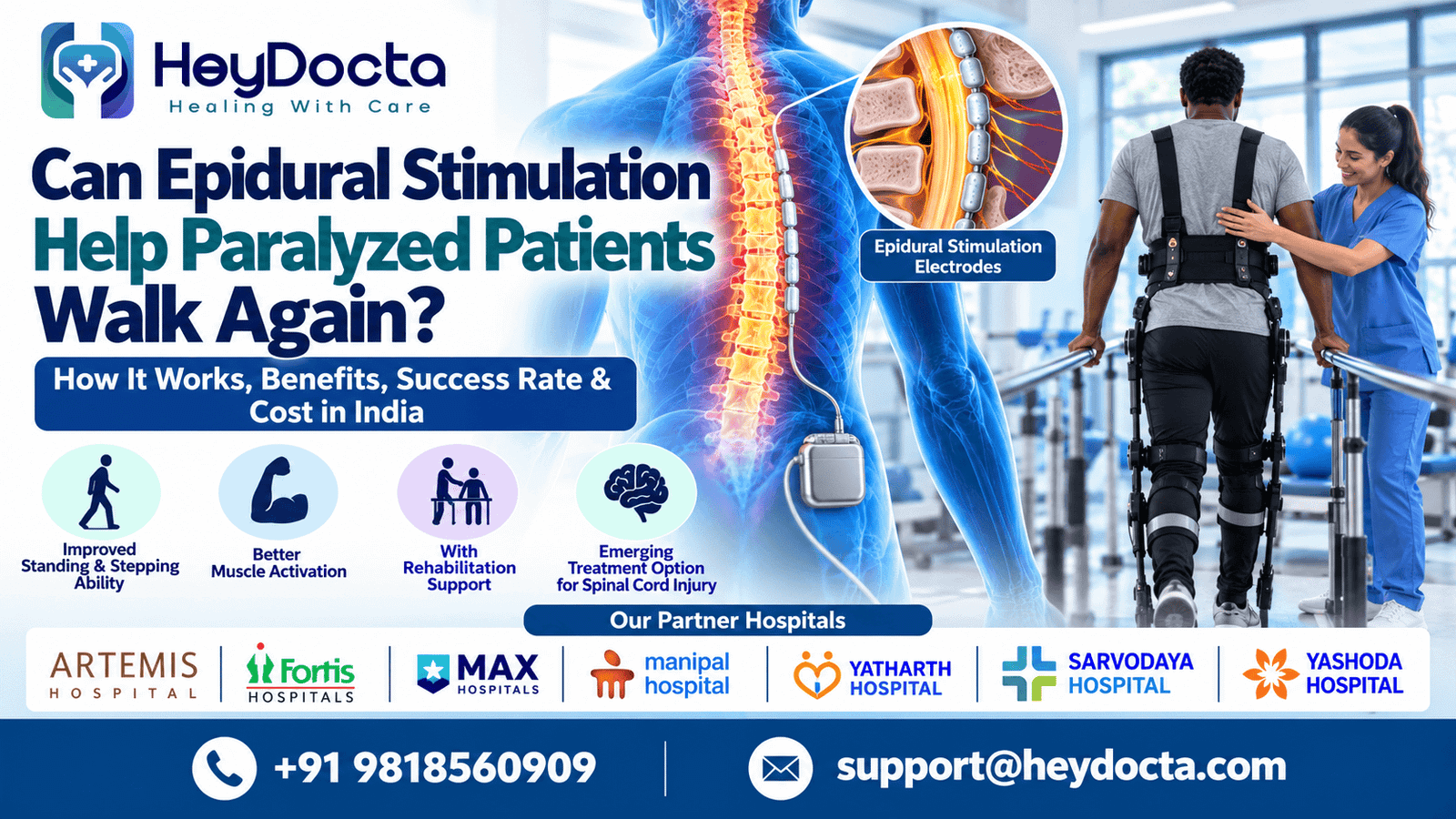
For people living with paralysis after a spinal cord injury, the possibility of standing or walking again can feel life-changing. Can epidural stimulation help paralyzed patients walk again? In selected patients, research suggests that epidural spinal cord stimulation (eSCS) may help activate weakened neural pathways and improve stepping, standing, muscle activity and other functions. However, it is not a guaranteed cure for paralysis, and results vary significantly between patients.
Epidural stimulation is an emerging treatment that is generally used together with intensive, task-specific rehabilitation. A 2024 systematic review covering 64 studies and 306 patients found improvements in several motor outcomes, but the researchers also highlighted variability between patients and the need for further high-quality research.
Get a Free Medical Opinion: Share your MRI scans, neurological reports and previous treatment history with HeyDocta to explore whether specialist evaluation in India may be appropriate .
What Is Epidural Stimulation?
Epidural spinal cord stimulation involves placing electrodes in the epidural space near the spinal cord. An implanted pulse generator delivers controlled electrical stimulation to the spinal cord.
The goal is not to physically repair a completely damaged spinal cord. Instead, stimulation may help modulate spinal neural circuits and make it easier for the brain and spinal cord to produce useful motor responses.
The technology has been studied particularly in people with chronic spinal cord injury. Research protocols vary considerably in electrode position, stimulation settings and rehabilitation programmes, so there is currently no single standard treatment protocol for every patient.
Can Epidural Stimulation Help Paralyzed Patients Walk Again?
In some carefully selected patients, epidural stimulation may help improve standing or stepping ability, but independent walking is not guaranteed.
The 2024 systematic review reported that approximately 44% of patients in the reviewed non-overlapping cohorts achieved assisted or independent stepping or standing. Improvements in muscle activity and overground walking were also reported. However, these figures should not be interpreted as a personal success rate for an individual patient. The studies differed in patient characteristics, stimulation systems and rehabilitation approaches, and many had methodological limitations.
Earlier systematic research was more cautious and concluded that the therapeutic effectiveness of epidural stimulation remained inconclusive because the available studies were small and heterogeneous.
This means the realistic goal may be different for every patient:
- Improved muscle activation
- Better ability to stand with support
- Assisted stepping
- Improved walking practice
- Better trunk or lower-limb control
- Potential improvements in selected autonomic functions
- Greater participation in rehabilitation
For some patients, walking may become possible with assistance. For others, the main benefit may be improved strength, standing tolerance or rehabilitation potential.
Who May Be Considered for Epidural Stimulation?
Eligibility cannot be determined only from the fact that a patient is paralysed. A spine or spinal cord specialist needs to evaluate the individual’s complete medical history.
Assessment may consider:
- Level and severity of spinal cord injury
- Complete versus incomplete injury
- Time since injury
- Remaining sensory or motor function
- Previous spinal surgeries
- MRI and other imaging
- Bone and muscle condition
- General medical fitness for surgery
- Ability to participate in rehabilitation
- Existing infections or other contraindications
The systematic review specifically recommends individualized treatment based on injury characteristics, neurological status, electrode placement and stimulation settings. Intensive physical rehabilitation is also considered an important part of the treatment approach.
Epidural Stimulation in India
International patients considering epidural stimulation can seek evaluation from experienced spine specialists.
Dr Jitesh Manghwani is Associate Director & Unit Head – Orthopaedic Spine Surgery at Max Super Speciality Hospital, Shalimar Bagh, with 11+ years of experience. His listed areas include spine surgery, endoscopic and navigated spine procedures, spinal deformity correction and other complex spine conditions. Max Healthcare has also published educational information on epidural stimulation featuring Dr Manghwani.
A specialist consultation is important because epidural stimulation is not appropriate for every patient with paralysis.
Epidural Stimulation Treatment Process in India
The treatment journey generally involves several stages:
1. Medical Records Review
International patients can share MRI scans, previous surgical reports, neurological assessments and rehabilitation records for an initial medical opinion.
2. Specialist Consultation
A spine or spinal cord specialist evaluates the injury, neurological status and potential treatment options.
3. Detailed Assessment
Additional imaging, neurological examination and other investigations may be recommended before deciding whether implantation is appropriate.
4. Implantation
If the patient is considered suitable, electrodes are surgically positioned near the spinal cord and connected to an implantable pulse generator.
5. Stimulation Programming
The stimulation settings may be adjusted according to the patient’s response and treatment objectives.
6. Intensive Rehabilitation
Rehabilitation is a critical component. Patients may work with physiotherapists and rehabilitation specialists on standing, stepping, balance, muscle activation and task-specific movement.
7. Follow-Up
Programming, rehabilitation progress and possible complications need ongoing medical monitoring.
Epidural Stimulation Cost in India vs USA, UK and Europe
One important reason international patients consider India is the potential difference in treatment costs.
However, there is currently no standardized public price for epidural stimulation specifically for spinal cord injury. Published prices for conventional spinal cord stimulation can therefore be used only as a related planning reference, not as a guaranteed price for eSCS for paralysis.
| Country | Related spinal cord stimulation cost reference |
| India | Approximately USD 16,700–35,170 |
| USA | Approximately USD 21,000–58,000 |
| UK | Approximately USD 19,000–36,000 equivalent |
| Germany | Approximately USD 65,020–139,520 |
The India and Germany figures above come from a 2026 published SCS cost database; the U.S. estimate comes from a current industry cost report, while current UK private neuromodulation estimates place conventional SCS at roughly £15,000–£28,000. These figures relate to conventional SCS and should not be presented as exact eSCS-for-paralysis packages.
For an international patient, the final quotation can depend on:
- Device and electrode system
- Surgical complexity
- Hospital room category
- Diagnostic tests
- Length of hospitalization
- Rehabilitation requirements
- Programming and follow-up
- Complications, if any
- Additional stay in India
Want to know whether India may be financially suitable for your case? Contact HeyDocta for a medical opinion and an individualized treatment-cost estimate from a partner hospital.
Partner Hospitals for International Patients
International patients may explore spine and rehabilitation care through HeyDocta’s partner hospital network, including:
- Artemis Hospital
- Fortis Hospitals
- Max Hospitals
- Manipal Hospital
- Yatharth Hospital
- Sarvodaya Hospital
- Yashoda Hospital
The appropriate hospital and specialist depend on the patient’s medical records, treatment requirements and availability.
Why International Patients Consider India
Patients from Nigeria, Ghana, Zimbabwe, Cameroon, Kenya, Guyana, Jamaica, the Middle East, Europe and the USA may consider India because treatment planning can combine specialist consultation, hospital care and rehabilitation in one medical journey.
For international patients, HeyDocta can assist with:
- Medical record coordination
- Specialist consultation
- Hospital coordination
- Treatment-cost estimates
- Medical visa assistance
- Airport and local travel coordination
- Accommodation support
- Follow-up communication
HeyDocta acts as a medical tourism facilitator to simplify the process. HeyDocta does not add a separate service fee to the patient’s hospital treatment cost.
Medical Visa and Travel Support for India
International patients travelling to India for medical treatment may be eligible for an e-Medical Visa, subject to Indian government eligibility requirements. The official Indian e-Visa portal states that medical treatment is an eligible purpose and requires documents including a passport copy and a letter from the concerned Indian hospital.
Patients should confirm current visa requirements before booking travel because eligibility and documentation requirements can change.
Recovery and Rehabilitation After Epidural Stimulation
Recovery is not simply about completing the implantation procedure. Rehabilitation can be an important part of the overall treatment programme.
Patients may require:
- Physiotherapy
- Gait or stepping training
- Strengthening exercises
- Balance training
- Neurological rehabilitation
- Stimulation programming
- Regular specialist follow-up
The duration of rehabilitation depends on the patient’s injury, neurological status, treatment response and rehabilitation goals.
Patients with paralysis can also have increased risks of falls and fractures when beginning standing or stepping activities, particularly because of reduced bone density. Appropriate supervision is therefore important.
Risks and Limitations of Epidural Stimulation
Like any surgical treatment, epidural stimulation has potential risks.
Reported complications include:
- Infection
- Lead or paddle migration
- Wound complications
- Seroma or hematoma
- Pain or discomfort
- Autonomic dysreflexia in some patients
- Surgical complications
- Falls or fractures during early standing or stepping attempts
The available evidence also has limitations. Studies have used different devices, electrode positions, stimulation settings and rehabilitation protocols. Therefore, patients should be cautious about websites or clinics promising that the procedure will definitely make them walk again.
FAQs About Epidural Stimulation and Paralysis
1. Can epidural stimulation make a completely paralyzed patient walk again?
It may help some selected patients achieve standing or assisted stepping, but independent walking is not guaranteed. Outcomes vary significantly according to injury characteristics and rehabilitation.
2. Is epidural stimulation a cure for spinal cord injury?
No. It should not be described as a cure. It is an emerging treatment intended to improve neurological and functional outcomes in selected patients.
3. Does epidural stimulation work without physiotherapy?
Rehabilitation is an important part of most treatment approaches. Research emphasizes task-specific and intensive rehabilitation alongside stimulation.
4. Is epidural stimulation suitable for complete paralysis?
Some studies have included patients with severe or complete paralysis, but eligibility must be determined individually after specialist assessment.
5. How much does epidural stimulation cost in India?
There is no standardized public price for eSCS specifically for spinal cord injury. Related conventional SCS pricing in India is published at approximately USD 16,700–35,170, but an individualized quotation is required.
6. How long should international patients stay in India?
The required stay depends on assessment, implantation, programming and rehabilitation. The treating hospital should provide an individualized estimate after reviewing the patient’s case.
7. Can I get a medical opinion before travelling to India?
Yes. International patients can share medical records and imaging for an initial specialist opinion before making travel arrangements.
Conclusion
Epidural stimulation may help selected people with spinal cord injury improve standing, stepping, muscle activation and other functions, particularly when combined with intensive rehabilitation. However, it cannot guarantee that a paralyzed patient will walk independently.
The evidence is promising but still evolving, making careful patient selection and realistic expectations essential.
For patients from Africa, the USA, Europe, the Middle East and other countries considering treatment in India, HeyDocta can simplify the medical tourism journey by coordinating specialist opinions, partner hospitals, cost estimates, visa assistance, travel arrangements and follow-up support.
Get a Free Medical Opinion from an Indian Spine Specialist. Contact HeyDocta.com to share your medical records and understand whether epidural stimulation may be appropriate for your condition and what treatment costs you should plan for in India.