For international patients living with spinal cord injury, paralysis or severe loss of movement, epidural stimulation in India is an emerging neuromodulation approach that may be considered as part of a specialist rehabilitation programme. It uses electrical stimulation delivered near the spinal cord and is generally combined with intensive, task-specific rehabilitation. Research has reported improvements in motor activity and other functions in selected patients, but results vary and it should not be presented as a guaranteed treatment or cure.
Patients from Nigeria, Ghana, Kenya, Zimbabwe, Cameroon, Guyana, Jamaica, the Middle East, Europe and the USA often consider India because of its specialist spine-care infrastructure and comparatively lower treatment costs. HeyDocta helps international patients obtain medical opinions, coordinate with partner hospitals and plan the medical-travel process.
Get a Free Medical Opinion: Share your medical reports and spinal cord injury history with HeyDocta to understand whether an Indian specialist consultation may be appropriate.
What Is Epidural Stimulation?
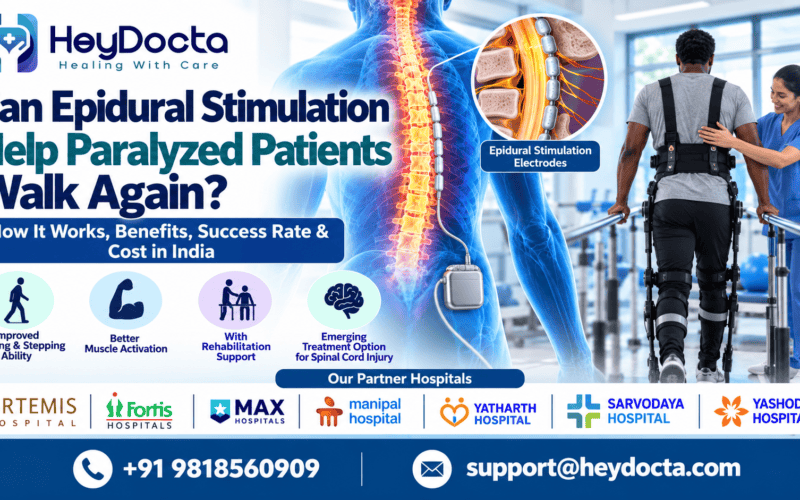
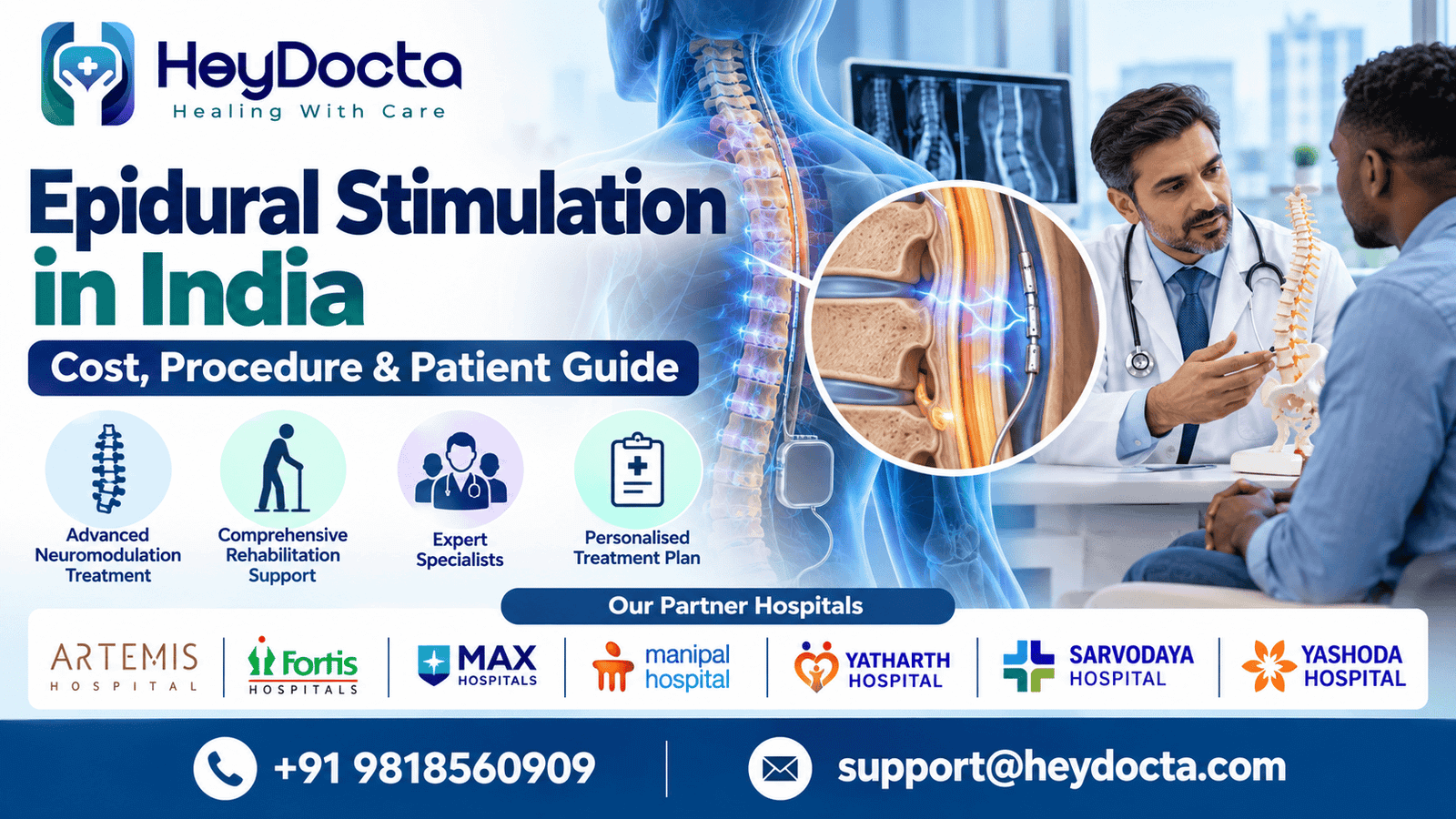
Epidural spinal cord stimulation, also called epidural electrical stimulation (EES) or epidural spinal cord stimulation (eSCS), involves placing electrical stimulation electrodes in the epidural space near the spinal cord.
The electrical signals are designed to modulate spinal cord activity and may help the nervous system respond to rehabilitation exercises. The approach is being studied particularly in people with chronic spinal cord injury and significant motor impairment.
It is important to understand that epidural stimulation is different from conventional spinal cord stimulation used primarily for chronic pain. In spinal cord injury programmes, the objective may include supporting motor rehabilitation and functional recovery rather than simply reducing pain.
Who May Be Considered for Epidural Stimulation?
Eligibility depends on the patient’s neurological condition, injury level, completeness of injury, general health and rehabilitation potential.
A specialist may assess:
- Level and severity of spinal cord injury
- Complete or incomplete paralysis
- Duration since the injury
- Existing voluntary muscle activity
- Neurological examination
- MRI and other imaging
- Previous spinal surgeries
- Cardiovascular and general health
- Ability to participate in intensive rehabilitation
- Expectations and rehabilitation goals
Recent Indian research has investigated spinal epidural electrical stimulation in patients with chronic spinal cord injury, including individuals with severe lower-limb weakness.
Not every patient with paralysis will be a suitable candidate. A detailed evaluation is essential before treatment.
Epidural Stimulation in India: What Does It Aim to Do?
The purpose is not simply to “switch on” the legs. Epidural stimulation is generally used alongside rehabilitation to help the nervous system practise specific movements and functions.
Depending on the individual patient and programme, treatment goals may include:
- Improving lower-limb motor activity
- Supporting standing or stepping practice
- Improving trunk control
- Supporting walking rehabilitation
- Improving muscle activation
- Addressing selected autonomic functions
- Reducing some functional limitations associated with spinal cord injury
A systematic review of human epidural spinal cord stimulation studies found reported improvements in several motor and autonomic outcomes, but the evidence included different devices, stimulation protocols and rehabilitation approaches. This means outcomes cannot be guaranteed for an individual patient.
Epidural Stimulation and Rehabilitation
Rehabilitation is a critical part of the treatment pathway.
Electrical stimulation alone is generally not the complete programme. Patients may undergo structured physiotherapy, task-specific training, gait training, strength exercises, balance training and other neurorehabilitation techniques.
Indian research has also studied epidural stimulation combined with rehabilitation, including prospective work examining motor function in people with severe spinal cord injury.
The rehabilitation plan may continue for weeks or months depending on the patient’s condition and response.
Epidural Stimulation Cost in India
The cost of epidural stimulation in India can be difficult to quote as a single standard figure because this is a highly specialised treatment and the final cost depends on the device, surgical approach, hospital, rehabilitation programme, investigations and duration of care.
Publicly available Indian estimates for conventional spinal cord stimulation are commonly in the range of approximately USD 15,000–25,000, while some sources quote around USD 13,500–16,500 for international patients. These figures should be treated only as planning references because they generally describe spinal cord stimulation rather than specifically epidural stimulation for spinal cord injury.
For an individual epidural stimulation programme, the final quotation may be different.
| Treatment/Location | Indicative Cost in USD |
| Spinal cord stimulation in India* | $15,000–$25,000 |
| International-patient SCS estimate in India* | $13,500–$16,500 |
| USA SCS estimates* | $50,000–$100,000+ |
| UK/private SCS estimates* | Approximately $25,000–$60,000+ |
| Europe/private treatment | Varies substantially by country and centre |
These are planning references for spinal cord stimulation, not a guaranteed price for epidural stimulation for spinal cord injury. Device selection, surgery, rehabilitation and hospital stay can significantly change the final quotation.
For international patients, the treatment estimate should clearly specify whether it includes the implant/device, surgeon’s fee, operating-room charges, anaesthesia, investigations, hospitalisation, programming and rehabilitation.
Why Consider India for Epidural Stimulation?
India has developed specialist centres covering spine surgery, neurology, neurosurgery and neurorehabilitation. Research from Indian centres has also contributed to the clinical evidence around spinal epidural stimulation.
International patients may consider India because of:
- Lower treatment costs compared with many Western private healthcare systems
- Specialist spine and neurosurgical teams
- Access to advanced imaging and rehabilitation
- Multidisciplinary treatment planning
- International patient services
- Options for pre-travel video consultation
However, patients should select treatment based on clinical suitability and specialist assessment rather than cost alone.
Epidural Stimulation in India
Dr Jitesh Manghwani is Associate Director & Unit Head – Orthopaedic Spine Surgery at Max Super Speciality Hospital, Shalimar Bagh. His official profile lists 11+ years of experience and specialist training in spine surgery.
Dr Jitesh Manghwani has also presented information about epidural stimulation for spinal cord injury through Max Healthcare, explaining the use of electrode arrays positioned near the injured spinal cord and the role of stimulation in supporting neurological rehabilitation.
International patients can request a medical opinion to determine whether their reports should be reviewed by a spine, neurosurgery or rehabilitation specialist.
Talk to a Medical Tourism Expert: HeyDocta can help coordinate your reports with an appropriate Indian partner hospital and obtain an indicative treatment plan and cost estimate.
Partner Hospitals for International Patients
Depending on the patient’s medical requirements and specialist availability, HeyDocta can coordinate with its partner hospitals:
- Artemis Hospital
- Fortis Hospitals
- Max Hospitals
- Manipal Hospital
- Yatharth Hospital
- Sarvodaya Hospital
- Yashoda Hospital
The appropriate hospital depends on the patient’s diagnosis, treatment requirements, specialist availability and rehabilitation needs.
Epidural Stimulation Procedure: Step-by-Step
1. Send Medical Reports
The patient shares MRI/CT scans, neurological reports, previous surgery records and rehabilitation history.
2. Specialist Evaluation
A spine, neurosurgery or rehabilitation specialist reviews the patient’s condition and determines whether further assessment is required.
3. Treatment Planning
If the patient appears potentially suitable, the medical team discusses the stimulation approach, rehabilitation programme, expected hospital stay and potential risks.
4. Electrode Placement
During the procedure, stimulation electrodes are positioned in the epidural space near the relevant spinal cord region.
5. Stimulation Programming
The stimulation system is programmed according to the patient’s clinical requirements.
6. Intensive Rehabilitation
The patient participates in structured rehabilitation and movement training. This stage is important because stimulation is generally studied in combination with activity-based rehabilitation.
7. Follow-Up
The medical team monitors neurological function, device performance, rehabilitation progress and any complications.
Risks and Limitations
Like other invasive neuromodulation procedures, epidural stimulation may involve risks. Published literature has reported potential complications such as infection, device migration and autonomic dysreflexia, although these were relatively infrequent in the systematic review.
Patients should also understand that scientific evidence is still developing. Some studies involve small patient groups or specific rehabilitation protocols, so outcomes from research cannot be assumed for every person.
Medical Visa and Travel Support for International Patients
Foreign patients travelling to India for medical treatment may be eligible for an e-Medical Visa, depending on nationality and current Indian visa rules. The official Indian e-Visa portal states that eligible applicants can apply for an e-Medical Visa and require documentation such as a hospital letter for the treatment/admission.
HeyDocta can assist international patients with:
- Hospital coordination
- Medical opinion
- Treatment-cost estimates
- Appointment scheduling
- Medical visa documentation guidance
- Airport and accommodation coordination
- Local assistance during treatment
- Post-treatment follow-up coordination
HeyDocta does not add a separate service fee to the patient’s hospital treatment cost.
How Long Should You Stay in India?
The required stay depends on the procedure, rehabilitation programme and patient’s neurological condition. Unlike a simple day-care procedure, epidural stimulation may require a longer medical journey because assessment, implantation, programming and rehabilitation can form part of the treatment pathway.
International patients should therefore obtain a personalised stay recommendation from the treating hospital before booking flights.
FAQs About Epidural Stimulation in India
Is epidural stimulation available in India?
Yes. Epidural spinal cord stimulation has been studied and used in India as an emerging approach for selected spinal cord injury patients, particularly alongside rehabilitation.
Can epidural stimulation cure paralysis?
No. It should not be described as a cure. Research suggests that selected patients may experience improvements in motor or autonomic function, but outcomes vary considerably.
How much does epidural stimulation cost in India?
There is no single publicly established price for epidural stimulation for spinal cord injury. Related spinal cord stimulation estimates in India are roughly USD 13,500–25,000, but the final epidural stimulation cost can differ substantially based on the device, surgery and rehabilitation requirements.
Is rehabilitation required after epidural stimulation?
Rehabilitation is an important component of many epidural stimulation programmes. Studies have evaluated stimulation together with activity-based or task-specific rehabilitation.
Can patients with complete spinal cord injury be considered?
Some research has included patients with motor-complete spinal cord injury. However, eligibility is highly individual and requires detailed neurological assessment.
How can international patients get an opinion before travelling?
Patients can share their medical reports, MRI/CT scans and previous treatment history with HeyDocta. The team can coordinate the information with an appropriate Indian partner hospital for specialist review.
Does HeyDocta charge an additional service fee?
HeyDocta facilitates hospital coordination and international patient support without adding a separate service fee to the patient’s hospital treatment cost.
Conclusion
Epidural stimulation in India is an emerging option in spinal cord injury rehabilitation that combines neuromodulation with structured physical rehabilitation. Research from India and international centres has shown promising improvements in selected patients, but it remains important to maintain realistic expectations and understand that individual outcomes vary.
For patients from Africa, the USA, Europe, the Middle East and other regions, India can offer access to specialist spine and rehabilitation services at potentially lower costs than many Western private healthcare systems. The right treatment should always be selected after reviewing the patient’s neurological condition, previous treatment and rehabilitation potential.
Get Treatment Cost from Indian Partner Hospitals: Contact HeyDocta.com with your medical reports to request a specialist opinion, understand your treatment options and receive an indicative cost estimate before travelling to India.