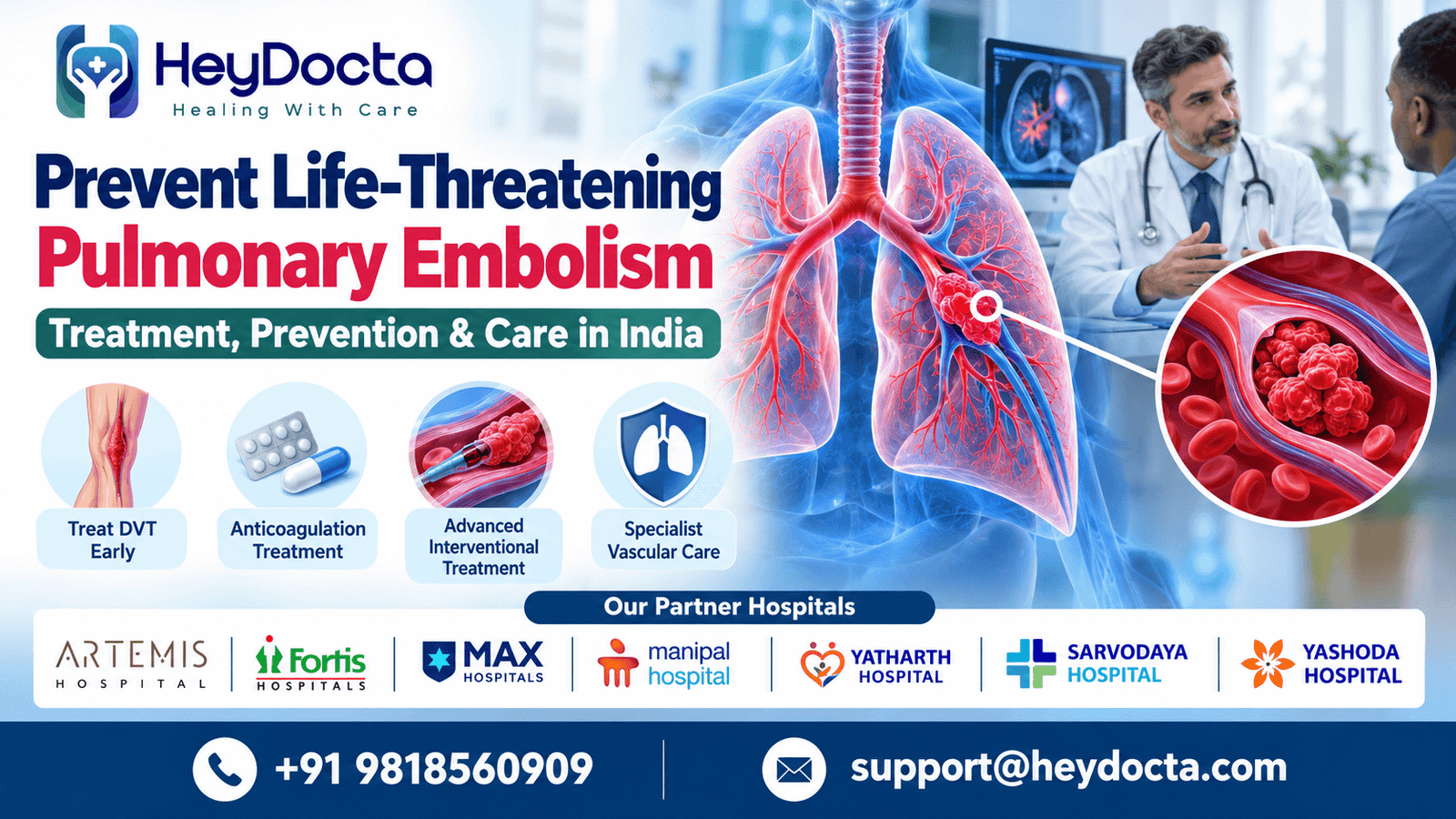
Prevent Life-Threatening Pulmonary Embolism (PE) starts with recognising and treating blood clots before they cause serious complications. Pulmonary embolism occurs when a blood clot, often originating in a deep vein of the leg or pelvis, travels to the lungs and blocks a pulmonary artery. Severe PE can cause low blood pressure, heart strain, shock and cardiopulmonary failure, making rapid medical treatment essential.
For international patients from Nigeria, Ghana, Kenya, Zimbabwe, Cameroon, Guyana, Jamaica, the Middle East, Europe and the USA, India can be considered for specialised evaluation and treatment of DVT and pulmonary embolism. Treatment costs can also be comparatively lower than those in many Western healthcare systems, although the final cost depends heavily on the severity of the clot and treatment required.
Get a Free Medical Opinion: Share your medical reports with HeyDocta to coordinate a specialist review, understand available treatment options and obtain an estimated treatment cost from a partner hospital in India.
What Is Pulmonary Embolism?
Pulmonary embolism is a blockage in one or more arteries of the lungs, usually caused by a blood clot that has travelled from the deep veins of the leg or pelvis.
The condition can range from low-risk PE with minimal symptoms to severe PE associated with cardiopulmonary failure. The 2026 American Heart Association/American College of Cardiology guideline classifies acute PE into five clinical categories to help doctors assess severity and choose appropriate treatment.
Possible symptoms include:
- Sudden shortness of breath
- Chest pain, particularly when breathing deeply
- Rapid heartbeat
- Cough
- Coughing up blood
- Dizziness or lightheadedness
- Fainting
- Low blood pressure in severe cases
Sudden severe breathlessness, chest pain, fainting or signs of shock require emergency medical care, not routine medical travel planning.
Why Can Pulmonary Embolism Become Life-Threatening?
A large clot can obstruct blood flow through the lungs and place sudden strain on the right side of the heart. In the most severe cases, PE can cause persistent low blood pressure, shock, cardiac arrest or cardiopulmonary failure.
The risk is influenced by factors such as:
- Size and location of the clot
- Blood pressure
- Heart function
- Oxygen levels
- Right-heart strain
- Age and general health
- Cancer or other underlying conditions
- Recent surgery or hospitalisation
- Previous DVT or PE
This is why early diagnosis and risk assessment are essential.
How Can Life-Threatening Pulmonary Embolism Be Prevented?
Preventing PE usually means identifying and managing the risk of blood clots before they travel to the lungs.
Important measures can include:
Treating DVT Promptly
DVT is one of the most common sources of pulmonary embolism. Appropriate treatment can reduce the risk of clot progression and recurrence.
Using Anticoagulants When Appropriate
Anticoagulants are the main treatment for most patients with confirmed PE. They help prevent existing clots from growing and reduce the formation of new clots. The 2026 AHA/ACC guideline recommends direct oral anticoagulants for eligible patients over vitamin K antagonists, unless contraindicated.
Managing Immobility
Prolonged immobility after surgery, illness or long-distance travel can increase blood-clot risk. Appropriate movement and preventive measures should be discussed with a doctor, particularly for people with additional risk factors.
Considering an IVC Filter in Selected Patients
An inferior vena cava (IVC) filter can help prevent certain clots from travelling from the lower body to the lungs. However, it is not routinely recommended when anticoagulation can safely be used.
ASH guidance recommends considering an IVC filter mainly when there is a contraindication to anticoagulation, such as significant bleeding risk. When a retrievable filter is used, removal should be considered once anticoagulation can safely be started.
Pulmonary Embolism Treatment Options in India
Treatment depends on the severity of PE and the patient’s clinical condition.
Anticoagulant Treatment
Anticoagulation is the primary treatment for most patients. Medicines may include injectable heparin or low-molecular-weight heparin during the acute phase and oral anticoagulants for longer-term treatment.
Thrombolytic Therapy
Clot-dissolving medicines may be considered for selected high-risk patients, particularly those with severe PE, low blood pressure or life-threatening cardiopulmonary problems.
Because thrombolytics can cause serious bleeding, they are not appropriate for every patient.
Catheter-Directed Thrombolysis
A catheter can be guided into the pulmonary circulation to deliver clot-dissolving medication more directly. This may be considered in selected patients based on PE severity and bleeding risk.
Mechanical Thrombectomy
Mechanical thrombectomy uses a catheter-based device to remove clot from the pulmonary arteries. The 2026 AHA/ACC guideline considers advanced therapies, including mechanical thrombectomy, for selected high-risk PE patients.
Surgical Embolectomy
In selected critical cases, surgeons may remove the clot directly from the pulmonary arteries. This is generally reserved for severe situations where other treatments are unsuitable or unsuccessful.
Artemis Hospitals describes anticoagulation, catheter-directed thrombolysis, mechanical thrombectomy and surgical embolectomy among treatment approaches for pulmonary embolism depending on severity.
Pulmonary Embolism Diagnosis in India
Accurate diagnosis is essential because symptoms can overlap with other heart and lung conditions.
Doctors may use:
- Medical history and physical examination
- D-dimer blood testing when appropriate
- CT pulmonary angiography
- Ultrasound of the leg veins
- ECG and cardiac assessment
- Oxygen saturation measurement
- Echocardiography
- Other blood tests and imaging based on the clinical situation
Max Healthcare lists CT pulmonary angiography, leg-vein ultrasound and blood tests among investigations used in suspected pulmonary embolism.
Pulmonary Embolism Treatment Cost in India
The cost of PE treatment varies substantially because pulmonary embolism is not treated with one standard procedure.
A patient treated with anticoagulant medicines may have a very different cost from someone requiring ICU care, thrombolysis or mechanical thrombectomy.
For international patients, published market estimates place general PE treatment in India around US$3,000–US$5,000 in some cases, while complex interventional treatment can cost considerably more. One current medical-tourism estimate lists an average Indian PE treatment cost of approximately US$3,160, but such third-party estimates should be used only for initial budgeting.
For comparison, published Yashoda Hospitals estimates for related DVT thrombolysis/mechanical thrombectomy procedures range from approximately US$1,700 to US$8,900, depending on the procedure and complexity.
Therefore, a patient-specific quotation is essential.
India vs USA: Pulmonary Embolism Cost
| Treatment factor | India | USA |
| General PE treatment planning estimate | Approximately US$3,000–$5,000 in some published estimates | Often substantially higher |
| Complex catheter-based treatment | Can reach several thousand USD or more | Often considerably higher |
| ICU care | Additional cost depending on duration | Can add substantially to hospital charges |
| Diagnostic imaging | Generally comparatively affordable | Higher healthcare costs |
| Hospitalisation | Generally lower | Generally higher |
| Final cost | Depends on severity and treatment | Depends on hospital, insurance and severity |
A U.S. nationwide analysis found that mean cost per admitted PE patient reached US$47,344 in 2016–2018, illustrating the much higher potential hospital cost environment in the USA.
These figures are not directly equivalent package comparisons. They are provided to show the broad cost difference between healthcare systems. Final hospital quotations can vary considerably.
Talk to Our Medical Tourism Expert: HeyDocta can help you obtain a patient-specific treatment estimate from a partner hospital after reviewing your medical reports.
Specialist for Pulmonary Embolism and Vascular Conditions
Pulmonary embolism may require collaboration between pulmonologists, vascular specialists, interventional specialists, cardiologists, critical-care teams and cardiothoracic surgeons depending on severity.
Dr. Biswarup Purkayastha at Artemis Hospitals, Gurugram, is listed as Consultant – Heart & Lung Transplant and Vascular Surgery. His official profile includes vascular surgery, heart and lung transplantation, adult cardiac surgery and endovascular management in suitable cases.
Artemis also lists Dr. Biswarup Purkayastha among its specialists for DVT and vascular surgery.
Patients should be assessed by the specialist appropriate to their specific condition rather than choosing a doctor based solely on cost.
Partner Hospitals for PE and Vascular Care
HeyDocta can coordinate treatment enquiries with its partner hospitals:
- Artemis Hospital
- Fortis Hospitals
- Max Hospitals
- Manipal Hospital
- Yatharth Hospital
- Sarvodaya Hospital
- Yashoda Hospital
For example, Manipal Hospitals lists catheter-directed thrombectomy/thrombolysis among interventional radiology approaches for pulmonary embolism.Fortis Healthcare also describes thrombolytic therapy and embolectomy as possible interventions for massive or submassive PE in critical-care settings.
The appropriate hospital depends on the patient’s condition, required treatment, specialist availability and emergency-care requirements.
Step-by-Step Treatment Journey for International Patients
1. Medical Report Review
Patients can share previous DVT/PE reports, CT scans, Doppler reports, blood tests, prescriptions and discharge summaries.
2. Specialist Assessment
The medical team reviews the diagnosis, severity, previous treatment and risk factors.
3. Treatment Planning
The specialist determines whether anticoagulation alone is appropriate or whether advanced treatment may be necessary.
4. Cost Estimate
The hospital can provide an estimated treatment cost based on the proposed treatment and expected hospital requirements.
5. Medical Travel Planning
For non-emergency cases, HeyDocta can help coordinate hospital appointments, medical visa documentation, accommodation and travel arrangements.
6. Treatment and Monitoring
Treatment may involve medication, catheter-based intervention, surgery or intensive care depending on the severity of PE.
7. Follow-Up
The 2026 AHA/ACC guideline recommends early follow-up after discharge and further review around three months to reassess treatment duration, symptoms and the need for additional testing.
Medical Visa and Travel Support
International patients travelling to India for planned vascular or pulmonary treatment may need medical visa documentation and hospital-related paperwork.
HeyDocta can assist with:
- Hospital coordination
- Specialist appointment scheduling
- Medical report sharing
- Treatment cost estimates
- Medical visa documentation guidance
- Accommodation coordination
- Airport and local travel support
- Follow-up coordination
However, acute pulmonary embolism is an emergency. A patient experiencing symptoms of suspected PE should seek immediate emergency care locally rather than attempting to arrange international travel first.
HeyDocta does not add a separate service fee to the patient’s hospital treatment cost. Patients should confirm all hospital, medication, travel and accommodation expenses before treatment.
Recovery and Follow-Up After Pulmonary Embolism
Recovery depends on the severity of PE, underlying health and treatment received.
Follow-up may include:
- Continued anticoagulant therapy
- Monitoring for bleeding
- Follow-up imaging when clinically indicated
- Assessment of breathing and exercise tolerance
- Review of recurrent clot risk
- Evaluation for persistent symptoms
- Gradual return to physical activity as advised
The 2026 AHA/ACC guideline recommends monitoring for symptoms that may indicate chronic thromboembolic pulmonary disease during longer-term follow-up.
FAQs About Preventing Pulmonary Embolism
Can pulmonary embolism be prevented?
The risk can often be reduced by preventing and appropriately treating DVT, using anticoagulants when indicated and addressing individual risk factors. However, not every PE can be prevented.
What is the main treatment for pulmonary embolism?
Anticoagulants are the main treatment for most patients. Severe or high-risk PE may require thrombolysis, catheter-based clot removal or surgical treatment.
Is an IVC filter needed for every DVT patient?
No. IVC filters are not routinely recommended when anticoagulation can safely be used. They may be considered when anticoagulation is contraindicated or in selected circumstances.
How much does pulmonary embolism treatment cost in India?
Published estimates vary. General PE treatment may be around US$3,000–$5,000 in some cases, while complex interventions can cost considerably more. The final price depends on severity, treatment method, ICU requirements and hospital stay.
Is pulmonary embolism treatment cheaper in India than the USA?
Treatment can be substantially less expensive in India. U.S. data showed mean hospital costs of approximately US$47,344 per admitted PE patient during 2016–2018. However, these figures are not direct package-to-package comparisons.
Can international patients come to India for PE treatment?
Yes, patients can seek planned specialist evaluation in India. However, acute or unstable PE requires immediate emergency treatment and should not be delayed for international travel.
How long does recovery after PE take?
Recovery varies. Some patients recover relatively quickly, while others need months of anticoagulation, follow-up and gradual return to normal activity.
Conclusion
Preventing a life-threatening pulmonary embolism starts with recognising blood-clot risk, diagnosing DVT or PE promptly and selecting treatment according to the patient’s clinical condition. Anticoagulation remains the main treatment for most patients, while thrombolysis, catheter-based thrombectomy and surgical embolectomy are reserved for selected higher-risk situations.
India can be an affordable option for international patients seeking specialist vascular and pulmonary care, particularly when compared with the higher hospital costs reported in the USA. However, treatment should be selected based on medical need, specialist expertise, hospital facilities and expected follow-up, rather than cost alone.
Get a Free Medical Opinion and Treatment Cost Estimate: Share your medical reports with HeyDocta.com to begin the hospital coordination process. Our team can help connect international patients with appropriate specialists at partner hospitals in India and assist with medical travel planning.