Epidural stimulation vs spinal cord stimulation can be confusing for patients considering advanced neuromodulation treatment in India. Although both involve electrical stimulation delivered through electrodes placed near the spinal cord, their clinical goals, patient selection and treatment protocols can be very different. Conventional spinal cord stimulation (SCS) is widely used for selected chronic pain conditions, while epidural spinal cord stimulation (eSCS) is increasingly being investigated for spinal cord injury, particularly to support motor and autonomic function alongside rehabilitation.
For international patients from Nigeria, Ghana, Kenya, Zimbabwe, Cameroon, Guyana, Jamaica, the USA, Europe and the Middle East, understanding this difference is important before travelling for treatment.
Get a Free Medical Opinion: Share your medical records with HeyDocta to understand which type of spinal stimulation may be relevant to your condition and what treatment options are available in India.
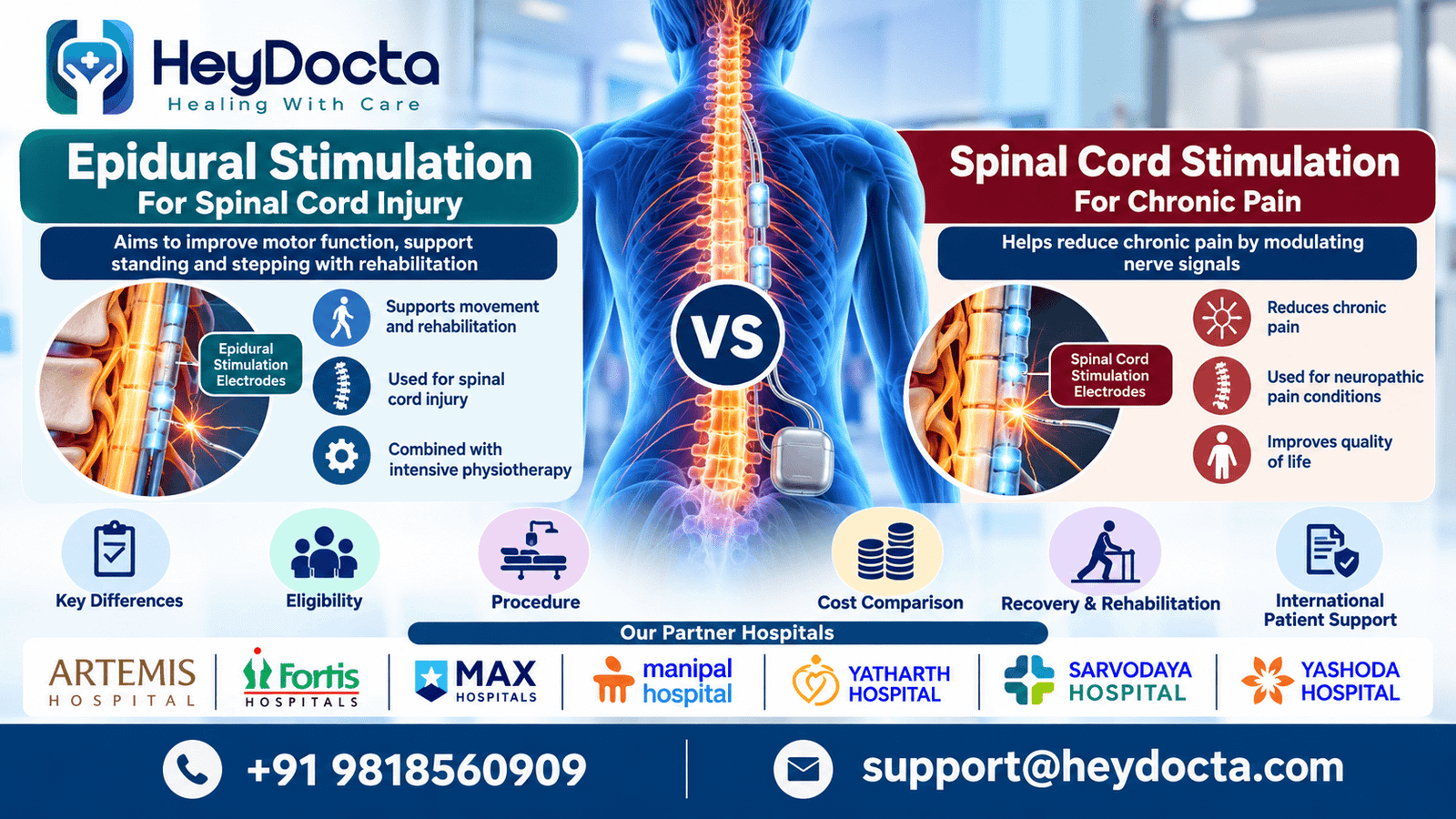
Epidural Stimulation vs Spinal Cord Stimulation: Quick Comparison
| Feature | Epidural Stimulation (eSCS) | Conventional Spinal Cord Stimulation (SCS) |
| Main area of use | Spinal cord injury research and rehabilitation | Chronic pain management |
| Primary goal | Modulate spinal circuits and support motor/autonomic function | Reduce perception of chronic pain |
| Electrode location | Epidural space near targeted spinal cord segments | Epidural space over targeted spinal cord regions |
| Rehabilitation | Usually an important part of treatment | May be included depending on condition |
| Patient selection | Neurological status and spinal cord injury characteristics | Pain diagnosis, previous treatment and response to trial stimulation |
| Evidence | Emerging and still developing for SCI | Established treatment option for selected chronic pain conditions |
| Expected outcome | May improve standing, stepping, muscle activity or selected functions | Pain reduction and improved function in appropriate patients |
The key point is that epidural stimulation is not simply another name for conventional SCS. The hardware and implantation concepts can overlap, but the therapeutic objective and patient population may differ significantly.
What Is Epidural Spinal Cord Stimulation?
Epidural spinal cord stimulation uses surgically implanted electrodes positioned in the epidural space near the spinal cord. A pulse generator delivers controlled electrical stimulation.
For spinal cord injury, researchers are investigating whether stimulation can help modulate neural circuits below the injury and make voluntary movement and rehabilitation more effective.
A 2024 systematic review identified 64 studies involving 306 patients with spinal cord injury. It reported improvements in several motor outcomes, including assisted or independent stepping or standing in some patients, while also emphasizing differences between studies and the need for standardized treatment approaches.
Importantly, these research results do not mean that every patient will regain walking ability.
What Is Conventional Spinal Cord Stimulation?
Conventional SCS is an implantable neuromodulation treatment most commonly used for selected chronic pain conditions.
It involves placing electrodes in the epidural space and delivering electrical stimulation to influence how pain signals are processed.
SCS may be considered for certain patients with conditions such as:
- Failed back surgery syndrome
- Chronic neuropathic pain
- Complex regional pain syndrome
- Certain persistent nerve-related pain conditions
- Other selected chronic pain conditions
The treatment may involve a temporary trial before permanent implantation, depending on the clinical situation and treatment protocol.
Therefore, when someone searches for “spinal cord stimulation,” they are often referring to pain-management neuromodulation rather than the newer spinal cord injury applications of epidural stimulation.
The Biggest Difference: Treatment Goal
The most important distinction is the reason for using stimulation.
Epidural Stimulation for Spinal Cord Injury
The goal is generally to influence spinal neural networks and support functions such as:
- Muscle activation
- Standing
- Stepping
- Walking practice
- Trunk control
- Selected autonomic functions
It is usually combined with intensive rehabilitation.
Conventional SCS for Chronic Pain
The goal is primarily to reduce the perception and impact of chronic pain.
It is not generally intended to restore walking in people with paralysis.
This distinction is particularly important for international patients because choosing a treatment based only on the words “spinal cord stimulation” can create unrealistic expectations.
Is Epidural Stimulation Suitable for Paralysis?
Potential suitability depends on the patient’s spinal cord injury characteristics.
Doctors may assess:
- Level of spinal cord injury
- Complete or incomplete injury
- AIS grade
- Remaining motor function
- Remaining sensory function
- Time since injury
- MRI findings
- Previous spinal operations
- Muscle and bone condition
- General medical fitness
- Rehabilitation potential
The systematic review included patients with different degrees of spinal cord injury, but the studies varied substantially in their protocols and patient characteristics.
Consequently, there is no universal eligibility rule based only on whether an injury is complete or incomplete.
Can Epidural Stimulation Restore Walking?
Some patients in research studies have achieved improvements in standing, stepping and walking-related functions. However, independent walking is not guaranteed.
The 2024 systematic review reported that 44% of patients in the identified non-overlapping cohorts achieved assisted or independent stepping or standing. This should not be interpreted as an individual success rate because the studies involved different devices, patient populations, stimulation settings and rehabilitation programmes.
The treatment should therefore be viewed as an emerging therapeutic approach rather than a guaranteed cure for paralysis.
Spine Care in India
International patients considering spinal stimulation can seek assessment from experienced spine specialists.
Dr Jitesh Manghwani is Associate Director & Unit Head – Orthopaedic Spine Surgery at Max Super Speciality Hospital, Shalimar Bagh, with 11+ years of experience. His listed interests include spine surgery, endoscopic and navigated spine surgery, spinal deformity correction, spinal infections and other complex spinal conditions. Max Healthcare also offers video consultations and second opinions through his profile.
A specialist evaluation is essential before deciding between conventional SCS, epidural stimulation, rehabilitation or another treatment approach.
Epidural Stimulation vs SCS Cost in India
Cost is a major consideration for international patients, but there is an important limitation: there is no standardized public price specifically for epidural stimulation for spinal cord injury.
Published conventional SCS prices can therefore be used only as a planning benchmark.
A 2026 published estimate places conventional SCS in India at approximately USD 16,700–35,170. The same source reports approximately USD 65,020–139,520 in Germany.
Another 2026 estimate places conventional SCS at approximately USD 15,000–35,000 in India compared with USD 50,000–100,000 in the USA.
| Country | Conventional SCS planning range |
| India | USD 15,000–35,170 |
| USA | USD 50,000–100,000 |
| Thailand | USD 19,740–41,860 |
| UAE | USD 36,670–77,230 |
| Singapore | USD 43,150–87,780 |
| Germany | USD 65,020–139,520 |
Important: These are conventional SCS cost references and not exact prices for epidural stimulation for spinal cord injury. An eSCS treatment plan may involve different devices, rehabilitation requirements and hospital charges.
The final cost can depend on:
- Device and electrode system
- Surgical complexity
- Surgeon and anaesthesia fees
- Hospital and room category
- Diagnostic tests
- Length of stay
- Programming
- Rehabilitation
- Follow-up care
- Complications, if any
Talk to a Medical Tourism Expert: HeyDocta can coordinate your medical records with partner hospitals and help you obtain an individualized treatment-cost estimate before travelling to India.
Partner Hospitals for International Patients
HeyDocta works with partner hospitals where international patients can explore specialist treatment options, including:
- Artemis Hospital
- Fortis Hospitals
- Max Hospitals
- Manipal Hospital
- Yatharth Hospital
- Sarvodaya Hospital
- Yashoda Hospital
The appropriate hospital depends on the patient’s medical condition, specialist assessment, treatment availability and overall care plan.
Epidural Stimulation Treatment Process in India
For patients considering eSCS for spinal cord injury, the treatment journey may include:
1. Medical Record Review
MRI scans, neurological reports, previous surgery records and rehabilitation history are reviewed.
2. Specialist Consultation
The specialist determines whether stimulation could reasonably be considered and discusses alternative treatments.
3. Preoperative Assessment
Additional neurological examinations, imaging, blood tests and other investigations may be required.
4. Electrode Implantation
If appropriate, electrodes are surgically placed in the epidural space near the targeted spinal cord region and connected to an implanted pulse generator.
5. Stimulation Programming
The stimulation parameters are adjusted based on the patient’s response and functional goals.
6. Rehabilitation
Physiotherapy and task-specific rehabilitation are integrated with stimulation. Research particularly emphasizes the importance of rehabilitation alongside eSCS.
7. Follow-Up
Programming, neurological progress, device function and rehabilitation outcomes require ongoing monitoring.
Recovery and Stay in India
The required stay depends on the patient’s condition and treatment plan.
International patients may need time for:
- Specialist assessment
- Preoperative investigations
- Surgery
- Initial recovery
- Device programming
- Rehabilitation
- Follow-up review
Patients should not book travel based on a fixed number of days without first obtaining an individualized plan from the treating hospital.
Medical Visa and Travel Support
Eligible international patients can apply for India’s e-Medical Visa for medical treatment. The official Indian e-Visa portal currently lists e-Medical Visa categories with one-year validity and multiple entries, subject to eligibility and applicable requirements. A hospital letter is among the listed documentation requirements.
HeyDocta can assist with:
- Medical record coordination
- Specialist consultations
- Hospital coordination
- Indicative cost estimates
- Medical visa guidance
- Airport and local travel assistance
- Accommodation coordination
- Follow-up communication
HeyDocta acts as a medical tourism facilitator and does not add a separate service fee to the patient’s hospital treatment cost.
FAQs
1. Is epidural stimulation the same as spinal cord stimulation?
Not exactly. Both can use electrodes placed in the epidural space, but conventional SCS is mainly used for pain management, while eSCS for spinal cord injury is being studied to influence motor and autonomic functions alongside rehabilitation.
2. Can conventional SCS help paralyzed patients walk?
Conventional SCS for chronic pain should not be confused with experimental or emerging eSCS approaches for spinal cord injury. Their treatment objectives are different.
3. Is epidural stimulation a cure for spinal cord injury?
No. It is an evolving treatment approach. Research has reported functional improvements in some patients, but it cannot guarantee neurological recovery or independent walking.
4. Which treatment is cheaper in India?
There is no standardized public price for eSCS for spinal cord injury. Conventional SCS estimates can range around USD 15,000–35,170 in India, but these figures should not be used as an exact eSCS quotation.
5. Is rehabilitation required after epidural stimulation?
Rehabilitation is generally a major component of eSCS programmes for spinal cord injury and is used to practise functional movements alongside stimulation.
6. Can international patients get a medical opinion before travelling?
Yes. Patients can share their MRI scans, medical history and previous treatment records for preliminary specialist assessment.
7. How do doctors decide between epidural stimulation and conventional SCS?
The decision depends primarily on the patient’s diagnosis and treatment goal. A patient with spinal cord injury and paralysis requires a different assessment from someone seeking SCS for chronic neuropathic pain.
Conclusion
Understanding epidural stimulation vs spinal cord stimulation is essential before choosing treatment.
Although both technologies involve electrical stimulation near the spinal cord, conventional SCS is primarily associated with chronic pain management, while epidural stimulation for spinal cord injury is an emerging approach focused on modulating spinal neural circuits and supporting functional rehabilitation.
For international patients considering treatment in India, affordability can be an important advantage, but the decision should be based on medical suitability, specialist assessment, device requirements, rehabilitation needs and the complete treatment cost.
Get a Free Medical Opinion: Share your medical records and imaging with Heydocta.com, We can help coordinate a specialist opinion, connect you with partner hospitals, obtain an indicative treatment-cost estimate and assist with medical travel to India.