For patients living with paralysis after a spinal cord injury, epidural stimulation for complete vs incomplete spinal cord injury is an important area of emerging treatment research. Epidural spinal cord stimulation (eSCS) uses implanted electrodes to deliver electrical stimulation near the spinal cord and is generally combined with intensive rehabilitation. Some studies have reported improvements in standing, stepping and muscle activation, but results vary considerably and the treatment does not guarantee recovery of independent walking.
For international patients from Nigeria, Ghana, Kenya, Zimbabwe, Cameroon, Guyana, Jamaica, the USA, Europe and the Middle East, India may provide access to specialist spine care at potentially lower costs than many Western countries.
Get a Free Medical Opinion: Share your medical records with HeyDocta to understand whether epidural stimulation may be worth considering for your spinal cord injury before travelling to India.
What Is Epidural Stimulation?
Epidural spinal cord stimulation involves placing electrodes in the epidural space near the spinal cord. The electrodes are connected to an implanted pulse generator that delivers controlled electrical stimulation.
The objective is to modulate spinal neural circuits and potentially help the nervous system produce more useful motor responses. It does not physically repair a completely damaged spinal cord.
Epidural stimulation is usually considered alongside rehabilitation rather than as a standalone treatment. A 2024 systematic review of 64 studies involving 306 patients found improvements in several motor and functional outcomes, while also highlighting differences between studies and the need for more standardized research.
Complete vs Incomplete Spinal Cord Injury: What Is the Difference?
The distinction between complete and incomplete spinal cord injury is important when discussing epidural stimulation.
The American Spinal Injury Association Impairment Scale (AIS) is commonly used to classify neurological impairment.
Complete Spinal Cord Injury
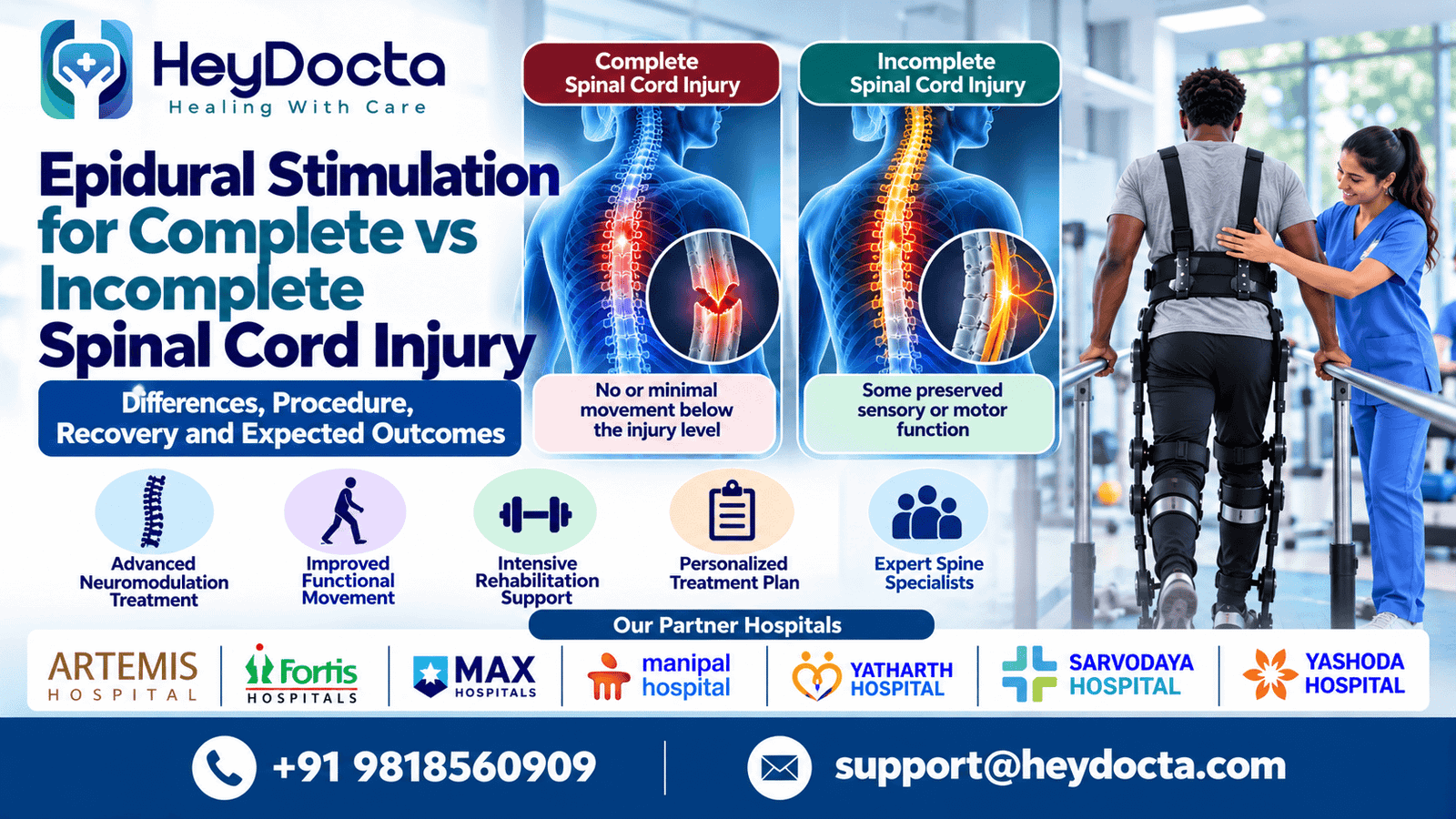
A clinically complete spinal cord injury generally means that there is no preserved sensory or motor function in the lowest sacral segments. AIS-A represents a motor- and sensory-complete injury.
Patients with complete injuries may have severe paralysis below the level of injury. However, “complete” does not mean that every neural pathway has necessarily been anatomically destroyed. This distinction is one reason researchers continue to investigate neuromodulation techniques such as epidural stimulation.
Incomplete Spinal Cord Injury
An incomplete spinal cord injury means that some sensory or motor function remains below the neurological level of injury.
AIS-B represents sensory-incomplete injury, while AIS-C and AIS-D represent motor-incomplete injuries with varying degrees of preserved muscle function.
Because some neural pathways remain functional, patients with incomplete injuries may have different rehabilitation and stimulation goals.
Is Epidural Stimulation Better for Complete or Incomplete Injury?
There is no simple answer.
Research has included patients with both severe and less severe spinal cord injuries, and some studies have reported functional improvements in people with very limited movement. However, the available evidence does not establish that epidural stimulation works better for every patient with complete or incomplete injury.
For an individual patient, important factors may include:
- Level of spinal cord injury
- AIS grade
- Time since injury
- Remaining motor function
- Remaining sensory function
- Muscle strength
- Previous spinal surgery
- Overall health
- Bone and muscle condition
- Rehabilitation potential
- Ability to participate in intensive therapy
Therefore, the AIS grade alone should not determine whether a patient travels for epidural stimulation.
What Outcomes Can Patients Expect?
Expected outcomes should be discussed carefully because epidural stimulation is still an evolving treatment.
Potential goals may include:
- Improved muscle activation
- Supported standing
- Assisted stepping
- Improved trunk control
- Better lower-limb movement
- Improved ability to participate in rehabilitation
- Selected improvements in autonomic function
The 2024 systematic review reported that 44% of patients in the identified non-overlapping cohorts achieved assisted or independent stepping or standing. However, this percentage should not be interpreted as an individual success rate, because studies differed in patient selection, stimulation systems and rehabilitation protocols.
The realistic objective for one patient may be standing, while another may work toward assisted walking or improved muscle activation.
Epidural Stimulation for Complete Spinal Cord Injury
Patients with complete spinal cord injury may naturally ask whether epidural stimulation can help them walk again.
Some research has investigated eSCS in people with severe or clinically complete paralysis. The underlying concept is that electrical stimulation may help activate spinal neural networks below the injury and potentially make voluntary movement or rehabilitation exercises more effective.
However, patients should be cautious about claims that epidural stimulation can “restore the spinal cord” or guarantee walking.
For complete injuries, realistic counselling is especially important. A specialist should review the neurological examination, MRI findings, injury history and rehabilitation potential before recommending treatment.
Epidural Stimulation for Incomplete Spinal Cord Injury
Patients with incomplete spinal cord injury have some preserved neurological function below the injury level.
This can provide a different starting point for rehabilitation. If residual motor pathways exist, stimulation combined with task-specific training may potentially help improve functional movement.
However, incomplete injury also covers a broad range of disability. A patient with substantial remaining leg strength is very different from someone with only minimal preserved function.
Therefore, treatment planning must be individualized rather than based solely on the term “incomplete.”
Spine Care in India
International patients considering epidural stimulation can seek evaluation from experienced spine specialists.
Dr Jitesh Manghwani is Associate Director & Unit Head – Orthopaedic Spine Surgery at Max Super Speciality Hospital, Shalimar Bagh, with 11+ years of experience. His profile includes spine surgery and complex spinal conditions, and Max Healthcare lists video consultation and second-opinion options.
Max Healthcare has also published educational material featuring Dr Manghwani discussing epidural stimulation for spinal cord injury and the use of multiple electrodes positioned near the damaged spinal cord.
A consultation does not automatically mean that implantation will be recommended. The patient’s medical suitability must be established first.
Epidural Stimulation Cost in India vs Other Countries
Cost is an important consideration for international patients. However, there is currently no standardized public price specifically for epidural stimulation for spinal cord injury.
Published prices for conventional spinal cord stimulation can be used only as a related planning benchmark.
A 2026 international pricing database reports conventional spinal cord stimulator costs of approximately USD 16,700–35,170 in India, compared with USD 65,020–139,520 in Germany.
| Country | Related SCS planning range |
| India | USD 16,700–35,170 |
| Thailand | USD 19,740–41,860 |
| Turkey | USD 22,710–47,850 |
| UAE | USD 36,670–77,230 |
| Singapore | USD 43,150–87,780 |
| Germany | USD 65,020–139,520 |
These figures are not exact prices for epidural stimulation for paralysis. They are published conventional spinal cord stimulation price references and may differ substantially from an eSCS treatment plan.
The final cost can depend on:
- Electrode and stimulation system
- Implantable pulse generator
- Surgical complexity
- Surgeon and anaesthesia fees
- Hospital room category
- Diagnostic investigations
- Hospital stay
- Programming
- Rehabilitation
- Additional treatment or complications
Talk to a Medical Tourism Expert: HeyDocta can help international patients obtain an individualized treatment estimate after their medical records are reviewed.
Partner Hospitals for International Patients
HeyDocta can coordinate treatment enquiries with its partner hospital network, including:
- Artemis Hospital
- Fortis Hospitals
- Max Hospitals
- Manipal Hospital
- Yatharth Hospital
- Sarvodaya Hospital
- Yashoda Hospital
The appropriate hospital depends on the patient’s condition, specialist recommendation, treatment availability and overall care requirements.
Epidural Stimulation Treatment Process
For an international patient, the journey may involve:
1. Medical Records Review
Share MRI scans, neurological reports, previous treatment records and rehabilitation history.
2. Specialist Consultation
A spine specialist assesses the injury level, neurological function and potential treatment options.
3. Preoperative Evaluation
Additional imaging, neurological assessment, blood tests and other investigations may be required.
4. Electrode Implantation
If the patient is considered suitable, electrodes are surgically positioned near the targeted spinal cord region and connected to an implanted pulse generator.
5. Programming
Stimulation settings are adjusted according to the patient’s clinical response and rehabilitation objectives.
6. Rehabilitation
Physiotherapy and task-specific training are integrated with stimulation.
7. Follow-Up
The patient requires ongoing monitoring, programming and rehabilitation after returning home.
Recovery and Rehabilitation
Epidural stimulation should not be viewed as a procedure followed by immediate walking.
Rehabilitation can be a major part of the treatment programme. Patients may work on:
- Standing
- Balance
- Lower-limb activation
- Stepping
- Gait training
- Muscle strengthening
- Functional movement
Research suggests that intensive physical rehabilitation is an important component of eSCS-based treatment.
The length of stay in India varies according to the patient’s evaluation, procedure, programming and rehabilitation requirements. International patients should obtain an individualized travel plan rather than booking a fixed short stay.
Medical Visa and Travel Support for India
Eligible international patients can use India’s e-Medical Visa route for medical treatment. Current official information lists e-Medical Visa categories with one-year validity and multiple entries.
HeyDocta can assist with:
- Medical record coordination
- Specialist consultation
- Hospital coordination
- Indicative treatment-cost estimates
- Medical visa guidance
- Airport and local travel assistance
- Accommodation coordination
- Follow-up communication
HeyDocta acts as a medical tourism facilitator and does not add a separate service fee to the patient’s hospital treatment cost.
Risks and Limitations
Epidural stimulation is an evolving treatment and is not suitable for everyone.
Potential complications reported in the literature include:
- Infection
- Electrode or device migration
- Surgical complications
- Pain or discomfort
- Wound complications
- Autonomic dysreflexia in some patients
- Falls or fractures during rehabilitation
The evidence base also has limitations because studies have used different devices, stimulation settings, patient groups and rehabilitation protocols.
Patients should therefore avoid clinics or websites that guarantee walking recovery.
FAQs
1. Can epidural stimulation work for complete spinal cord injury?
Research has included patients with severe and complete injuries, and some have experienced functional improvements. However, outcomes vary and walking recovery is not guaranteed.
2. Is epidural stimulation more effective for incomplete spinal cord injury?
Incomplete injuries preserve some neurological function, which may provide a different rehabilitation starting point. However, there is no universal rule that incomplete injuries will respond better.
3. Can epidural stimulation make a paralyzed patient walk?
Some patients in research have achieved assisted or independent standing or stepping, but independent walking is not guaranteed.
4. How much does epidural stimulation cost in India?
There is no standardized public price specifically for eSCS for spinal cord injury. Related conventional SCS prices in India are approximately USD 16,700–35,170 in a 2026 published database.
5. Is rehabilitation necessary after epidural stimulation?
Rehabilitation is generally a critical part of the treatment approach and is used alongside stimulation to practise functional movements.
6. How do doctors determine eligibility?
Doctors consider the injury level, AIS grade, remaining motor and sensory function, imaging, general health and rehabilitation potential.
7. Can international patients get an opinion before travelling to India?
Yes. Patients can submit their medical records and imaging for preliminary specialist review before making travel arrangements.
Conclusion
Epidural stimulation for complete vs incomplete spinal cord injury requires careful medical assessment because patients can have very different levels of neurological impairment.
Both complete and incomplete spinal cord injuries have been investigated in epidural stimulation research. Some patients may experience improvements in muscle activation, standing or stepping, particularly when stimulation is combined with intensive rehabilitation. However, the treatment remains an evolving field, and no responsible provider can guarantee independent walking.
For international patients from Africa, the USA, Europe and the Middle East, India may offer a potentially more affordable treatment pathway with access to specialist spine care and rehabilitation services.
Get a Free Medical Opinion: Share your MRI scans, neurological reports and previous treatment details with Heydocta.com, We can help coordinate a specialist opinion, connect you with partner hospitals, provide an indicative treatment-cost estimate and assist with your medical travel to India.