For patients living with paralysis or significant movement problems after a spinal cord injury, who is eligible for epidural stimulation is one of the most important questions to answer before considering treatment in India. Epidural spinal cord stimulation is an emerging neuromodulation approach that has been studied in people with chronic spinal cord injury, including some patients with severe or motor-complete injuries. However, eligibility is highly individual and depends on neurological status, injury characteristics, general health and the ability to participate in rehabilitation.
Patients from Nigeria, Ghana, Kenya, Zimbabwe, Cameroon, Guyana, Jamaica, the Middle East, Europe and the USA may consider India for specialist evaluation because treatment and rehabilitation can be more affordable than private care in some Western countries.
Get a Free Medical Opinion: Share your MRI scans, medical reports and previous treatment history with HeyDocta to explore whether an Indian specialist evaluation may be appropriate.
What Is Epidural Stimulation?
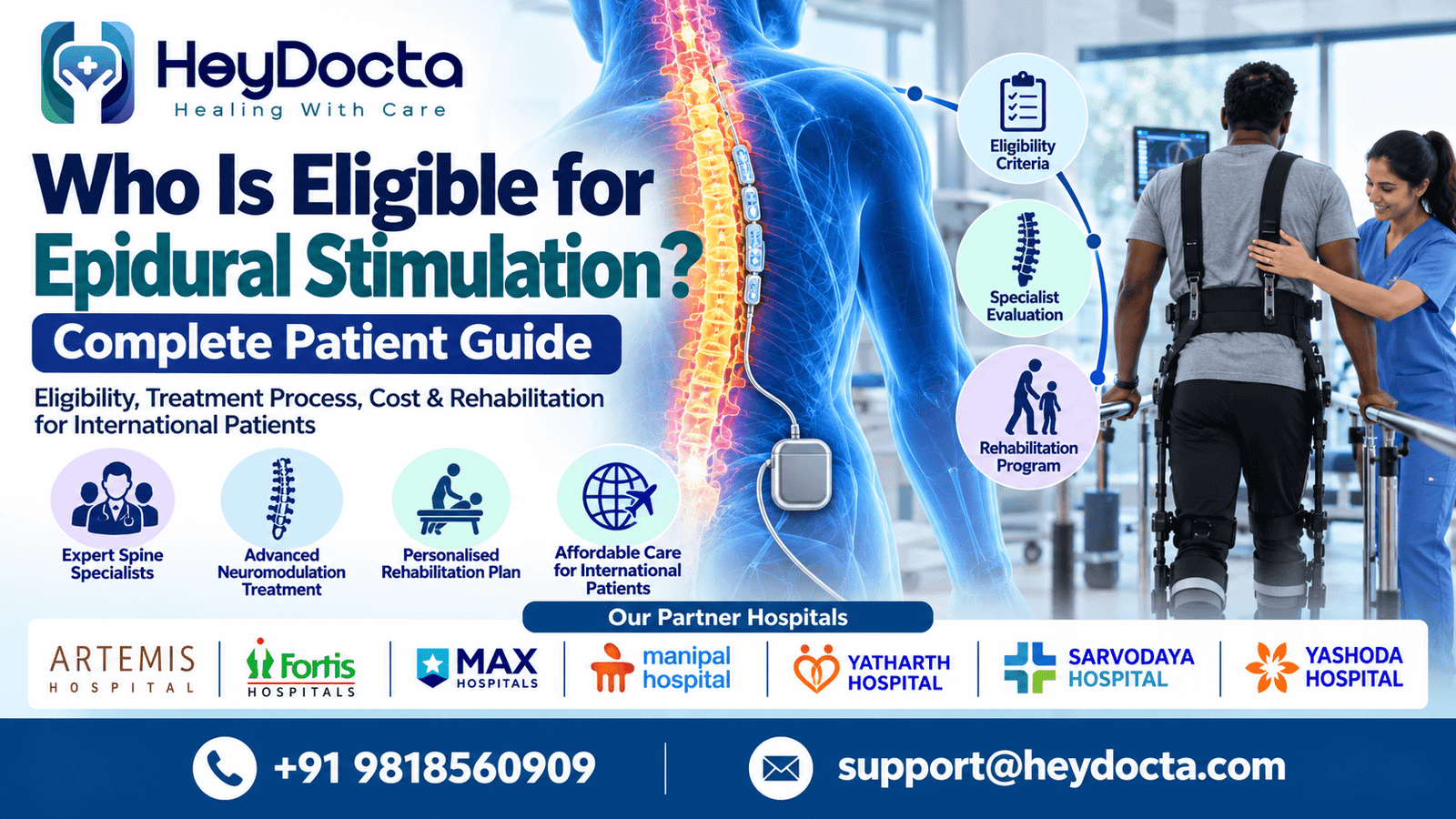
Epidural spinal cord stimulation, also known as epidural electrical stimulation (EES) or epidural spinal cord stimulation (eSCS), uses implanted electrodes positioned in the epidural space near the spinal cord.
Electrical stimulation is used to modulate spinal cord activity and may help selected patients generate or improve movement when combined with intensive, task-specific rehabilitation.
A 2024 systematic review identified 64 studies involving 306 patients with spinal cord injury. The studies reported improvements in motor activity and some autonomic functions, although different devices, stimulation settings and rehabilitation programmes were used. The review also reported complications such as infection, device migration and autonomic dysreflexia, although these were infrequent.
Importantly, epidural stimulation is not a guaranteed cure for paralysis. The evidence continues to develop, and individual results can differ significantly.
Who May Be Eligible for Epidural Stimulation?
There is no single checklist that automatically makes someone eligible. A specialist generally considers several factors before recommending the treatment.
Potentially relevant factors include:
- A confirmed spinal cord injury
- Chronic or established spinal cord injury in appropriate cases
- Level of spinal cord injury
- Complete or incomplete injury
- Remaining neurological function
- Motor and sensory examination
- Time since injury
- MRI and other imaging findings
- Previous spine surgery or treatment
- Overall medical condition
- Ability to participate in intensive rehabilitation
- Realistic treatment goals
Research has included adults with both incomplete and complete spinal cord injuries. The 2024 systematic review specifically included adults with SCI who underwent surgically implanted epidural stimulation and were assessed for motor or autonomic outcomes.
Therefore, having complete paralysis does not automatically mean a patient is excluded, but it also does not mean the treatment will necessarily produce functional recovery.
Complete vs Incomplete Spinal Cord Injury
Spinal cord injuries are commonly classified using the ASIA Impairment Scale (AIS).
Patients with incomplete injuries may retain some sensory or motor pathways below the injury level. Patients with motor-complete injuries have much more severe loss of voluntary motor function.
Interestingly, research has investigated epidural stimulation in both groups. A study from India reported epidural stimulation combined with intensive activity-based rehabilitation in patients with complete motor paralysis.
A 2025/2026 Indian pilot study also evaluated spinal epidural electrical stimulation in five people with chronic severe spinal cord injury who had an absence of useful lower-limb power and met the study’s eligibility criteria.
These findings are encouraging for research, but they should not be interpreted as evidence that every patient with complete paralysis will benefit.
What Tests Are Used to Determine Eligibility?
Before travelling to India, patients should ideally undergo a detailed medical-record review.
A specialist may request:
Neurological Examination
Doctors assess:
- Muscle strength
- Sensory function
- Reflexes
- Muscle tone
- Voluntary movement
- Functional ability
MRI and Imaging
Existing MRI scans can help the medical team understand the location and nature of the spinal cord injury and previous structural changes.
Injury History
Doctors may review:
- Cause of injury
- Date of injury
- Previous surgeries
- Previous rehabilitation
- Complications
- Current medications
- Other medical conditions
Rehabilitation Assessment
Because epidural stimulation is commonly studied alongside rehabilitation, the patient’s ability to participate in structured physical training is an important consideration.
When Might Epidural Stimulation Not Be Appropriate?
A patient may not be considered suitable if the medical team identifies factors that make implantation or intensive rehabilitation unsafe or unlikely to provide a reasonable benefit.
Potential concerns may include:
- Active infection
- Serious uncontrolled medical illness
- Surgical risks that outweigh potential benefits
- Inability to undergo the required procedure
- Inability to participate in rehabilitation
- Anatomical factors affecting electrode placement
- Unrealistic expectations about treatment outcomes
The exact reasons for exclusion vary according to the patient’s condition and the treatment centre. Patients should not self-assess eligibility based only on an online article.
Epidural Stimulation and Rehabilitation
Epidural stimulation should generally be understood as part of a broader rehabilitation strategy rather than a standalone treatment.
Rehabilitation may involve:
- Physiotherapy
- Strength training
- Standing practice
- Gait training
- Task-specific movement exercises
- Balance training
- Functional electrical stimulation
- Neurological rehabilitation
The 2024 systematic review concluded that epidural stimulation appears particularly promising when combined with intensive physical rehabilitation.
The duration and intensity of rehabilitation depend on the patient’s baseline function and treatment goals.
Epidural Stimulation Cost in India
The cost of epidural stimulation in India is not standardised because dedicated treatment for spinal cord injury is specialised and may involve different devices, surgical approaches and rehabilitation programmes.
For planning purposes, publicly available 2026 pricing for conventional spinal cord stimulation in India is approximately USD 16,700–35,170 across tracked hospital packages. This is not a fixed price for epidural stimulation for spinal cord injury and should only be used as a related neuromodulation reference.
The final quotation may depend on:
| Cost Factor | Possible Impact |
| Device/electrode system | Major cost component |
| Surgery | Depends on complexity |
| Hospital stay | Varies by recovery |
| Diagnostic tests | Depends on existing reports |
| Programming | May require follow-up sessions |
| Rehabilitation | Can significantly affect total cost |
| Complications | May increase treatment expenses |
| Length of stay in India | Affects overall medical-tourism budget |
India vs Other Countries
Related spinal cord stimulation prices can be substantially different internationally. For example, current private UK neuromodulation estimates place conventional SCS around £15,000–£28,000, while a U.S. self-pay database reports an average of about USD 52,702 for insertion or replacement of a spinal cord stimulator, with substantial variation. These figures relate to conventional SCS rather than specifically epidural stimulation for spinal cord injury.
For this reason, international patients should compare complete treatment quotations rather than simply comparing the device price.
Epidural Stimulation in India
Dr Jitesh Manghwani is Associate Director & Unit Head – Orthopaedic Spine Surgery at Max Super Speciality Hospital, Shalimar Bagh, with 11+ years of experience according to his current official profile. His training includes fellowships in spine surgery and robotic spine surgery.
His clinical focus includes spine surgery, and Max Healthcare has also published educational material by Dr Jitesh Manghwani discussing epidural stimulation for spinal cord injury.
International patients can request a remote medical review before travelling, allowing the treating team to examine available records and determine whether an in-person evaluation is appropriate.
Talk to Our Medical Tourism Expert: HeyDocta can coordinate your reports with an appropriate partner hospital and help you understand possible treatment options and indicative costs.
Partner Hospitals for International Patients
Depending on medical requirements and specialist availability, HeyDocta can coordinate patients with its partner hospitals:
- Artemis Hospital
- Fortis Hospitals
- Max Hospitals
- Manipal Hospital
- Yatharth Hospital
- Sarvodaya Hospital
- Yashoda Hospital
The appropriate hospital should be selected after specialist review rather than simply choosing a hospital based on price.
Step-by-Step Eligibility and Treatment Process
1. Submit Medical Records
Send MRI scans, neurological reports, previous surgical records and rehabilitation history.
2. Specialist Review
The spine or rehabilitation team evaluates the patient’s condition and available medical information.
3. Eligibility Assessment
The team considers injury level, neurological function, general health and rehabilitation potential.
4. In-Person Evaluation
If appropriate, the patient travels to India for detailed examination and additional investigations.
5. Treatment Planning
The medical team discusses whether epidural stimulation is appropriate, what rehabilitation may be required and what risks are involved.
6. Procedure and Programming
If treatment is recommended, electrodes are surgically positioned and the stimulation system is programmed.
7. Rehabilitation
Structured rehabilitation is undertaken alongside stimulation.
8. Follow-Up
Progress, neurological function, device performance and rehabilitation goals are monitored.
Medical Visa and Travel Support
International patients travelling to India for medical treatment may be eligible for an e-Medical Visa depending on nationality and current Indian visa rules. The Government of India’s e-Visa portal states that eligible medical travellers can apply for an e-Medical Visa and that a hospital letter containing proposed admission/treatment information is required.
HeyDocta can assist with:
- Medical-record coordination
- Hospital appointments
- Specialist opinions
- Indicative treatment estimates
- Medical visa documentation guidance
- Airport and accommodation coordination
- Local assistance
- Follow-up coordination
HeyDocta does not add a separate service fee to the patient’s hospital treatment cost.
How Long Should Patients Stay in India?
The duration depends on the patient’s treatment plan. A patient travelling for epidural stimulation may require time for:
- Initial assessment
- Investigations
- Procedure
- Recovery
- Device programming
- Rehabilitation
- Follow-up
International patients should obtain an individualised stay recommendation before booking flights.
FAQs About Epidural Stimulation Eligibility
Can completely paralyzed patients undergo epidural stimulation?
Some studies have included patients with complete motor paralysis, so complete paralysis does not automatically exclude someone. However, eligibility must be assessed individually.
Is epidural stimulation suitable for every spinal cord injury patient?
No. Injury characteristics, neurological status, general health, surgical suitability and rehabilitation potential all influence eligibility.
Is epidural stimulation a cure for paralysis?
No. It is an emerging treatment approach, and functional improvement cannot be guaranteed. Research evidence is still developing.
Does epidural stimulation require physiotherapy?
Rehabilitation is an important part of many treatment programmes and clinical studies involving epidural stimulation.
How much does epidural stimulation cost in India?
There is no single standard price. Related conventional spinal cord stimulation packages are currently reported around USD 16,700–35,170 in India, but the actual cost for spinal cord injury treatment may differ.
Can international patients get an opinion before travelling?
Yes. Patients can submit their medical reports and imaging to HeyDocta for coordination with an appropriate Indian partner hospital.
How can I find out if I am eligible?
A specialist needs to review your spinal cord injury level, neurological function, imaging, previous treatment and overall health. A remote medical opinion can be a useful first step.
Conclusion
Understanding who is eligible for epidural stimulation requires much more than knowing whether a patient has paralysis. Injury level, completeness, neurological function, general health, previous treatment and ability to participate in rehabilitation all need to be considered.
Research from India and internationally has demonstrated potential benefits in selected spinal cord injury patients, including people with severe injuries. However, epidural stimulation remains an evolving treatment, and patients should approach it with realistic expectations rather than promises of guaranteed walking or complete recovery.
For international patients from Africa, the Middle East, Europe, the USA and the Caribbean, India may provide access to specialist spine and rehabilitation services with potentially lower treatment costs than some Western private healthcare systems.
Get Treatment Cost and Eligibility Assessment: Contact HeyDocta.com with your MRI scans and medical reports. Our team can coordinate a specialist opinion, partner hospital options, indicative treatment costs and medical-travel support for your treatment journey in India.