
For patients considering endoscopic spine surgery, one of the most important questions is: “Am I the right candidate?” Endoscopic spine surgery is a minimally invasive technique that uses a small working channel and camera to access the affected part of the spine. It is commonly used for selected disc herniations and spinal stenosis, but it is not suitable for every patient. Proper patient selection based on symptoms, MRI/CT findings, spinal stability and the required procedure is essential.
For international patients from Nigeria, Ghana, Kenya, Zimbabwe, Cameroon, Guyana, Jamaica, the Middle East, Europe and the USA, India offers access to specialist spine centres and minimally invasive techniques at major private hospitals.
Get a Free Medical Opinion: Send your MRI/CT reports to HeyDocta to find out whether endoscopic spine surgery may be an appropriate option for your condition and receive an estimated treatment cost in India.
What Is Endoscopic Spine Surgery?
Endoscopic spine surgery is a minimally invasive technique performed through a small incision using an endoscope, a thin camera-equipped instrument.
Depending on the condition, surgeons may perform:
- Endoscopic discectomy
- Endoscopic decompression
- Foraminotomy
- Endoscopic treatment of selected spinal stenosis
- Selected endoscopic fusion procedures
Current literature describes endoscopic techniques for lumbar disc herniation, spinal stenosis and selected fusion procedures. Potential benefits include smaller incisions, less tissue disruption, reduced blood loss and shorter hospital stays, although results depend on the procedure and patient selection.
Who Is a Good Candidate for Endoscopic Spine Surgery?
There is no single checklist that determines eligibility. A spine specialist generally considers the following factors.
1. Patients With a Clearly Identified Spinal Problem
Endoscopic surgery works best when the patient’s symptoms and imaging identify a specific problem that can be reached through an endoscopic approach.
Common examples include:
- Lumbar disc herniation
- Selected cervical disc herniation
- Foraminal stenosis
- Selected lumbar spinal stenosis
- Nerve compression caused by a disc or bone
Research reviews identify disc herniation and spinal stenosis among the most established applications of endoscopic spine surgery.
2. Patients With Nerve-Related Symptoms
Patients experiencing symptoms such as:
- Sciatica
- Radiating leg pain
- Arm pain from cervical nerve compression
- Numbness or tingling
- Certain patterns of weakness
may be considered for endoscopic decompression when imaging confirms the corresponding nerve compression.
The symptoms must match the MRI or CT findings. Treating an imaging abnormality alone is not enough.
3. Patients Who Have Not Improved With Conservative Treatment
Many spinal conditions can initially be managed without surgery.
Depending on the diagnosis, conservative treatment may include:
- Physiotherapy
- Activity modification
- Medicines
- Epidural or other injections
- Rehabilitation
When symptoms continue despite appropriate non-surgical treatment and surgery is indicated, endoscopic surgery may be considered.
4. Patients With Selected Disc Herniation
Lumbar disc herniation is one of the best-established indications for endoscopic discectomy.
A specialist may consider endoscopic treatment when:
- The disc is compressing a nerve
- Symptoms correspond with the affected level
- Pain remains significant despite conservative treatment
- The disc can be safely accessed endoscopically
Evidence reviews report endoscopic discectomy as an effective minimally invasive option for appropriately selected disc-herniation patients.
5. Selected Patients With Spinal Stenosis
Some patients with lumbar spinal stenosis may be suitable for endoscopic decompression.
However, the exact type and location of stenosis matters. A systematic review found that certain patterns of central or complex stenosis may not be appropriate for particular endoscopic approaches.
This is why an MRI review by an experienced spine surgeon is essential.
Who May Not Be the Right Candidate?
Endoscopic spine surgery is not appropriate for every patient.
Depending on the specific technique, a surgeon may recommend another approach when there is:
- Significant spinal instability
- Deformity requiring stabilization
- Severe or complex stenosis
- Certain extensive or migrated disc herniations
- Severe spinal deformity
- Some recurrent or revision cases
- Conditions requiring extensive reconstruction
- Severe neurological compression requiring a different surgical approach
For example, a systematic review of endoscopic lumbar decompression reported that pure back pain without neurogenic symptoms and instability or deformity requiring stabilization can be contraindications to certain full-endoscopic procedures.
Therefore, having back pain does not automatically make someone a candidate for endoscopic surgery.
Endoscopic Spine Surgery vs Open Spine Surgery
| Feature | Endoscopic Spine Surgery | Conventional/Open Surgery |
| Incision | Usually smaller | Usually larger |
| Tissue disruption | Generally less | Generally more |
| Hospital stay | May be shorter for selected procedures | May be longer |
| Recovery | May be quicker in selected cases | Depends on procedure |
| Suitable for | Selected spinal conditions | Broad range of conditions |
| Complex reconstruction | May not be suitable | Often more appropriate |
| Cost | Varies | Varies |
Current reviews suggest potential advantages such as reduced postoperative pain and shorter hospital stays, but endoscopic surgery has limitations and requires appropriate patient selection and surgeon expertise.
How Much Does Endoscopic Spine Surgery Cost in India?
Affordability is one of the main reasons international patients consider India for endoscopic and minimally invasive spine surgery.
Based on published Indian hospital pricing, spine surgery costs can vary substantially according to the exact procedure. Current hospital-published pricing shows broader spine surgery costs in India at approximately $3000–$6000 confirming that the final amount depends heavily on the procedure and hospital.
For easier international comparison, patients can use the following approximate USD ranges for planning:
| Treatment | India – Indicative Cost (USD) |
| Endoscopic discectomy | $2,500–$4,500 |
| Endoscopic decompression | $3,000–$5,000 |
| Minimally invasive spine surgery | $3,500–$7,000 |
| Spinal fusion | $5,000–$10,000+ |
| Complex or multi-level spine surgery | $7,000–$15,000+ |
These are indicative medical-travel planning ranges, not fixed hospital quotations. The final cost may be lower or higher depending on the patient’s diagnosis, number of spinal levels, surgeon, hospital, implants, investigations and length of stay.
Endoscopic Spine Surgery Cost in India vs Other Countries
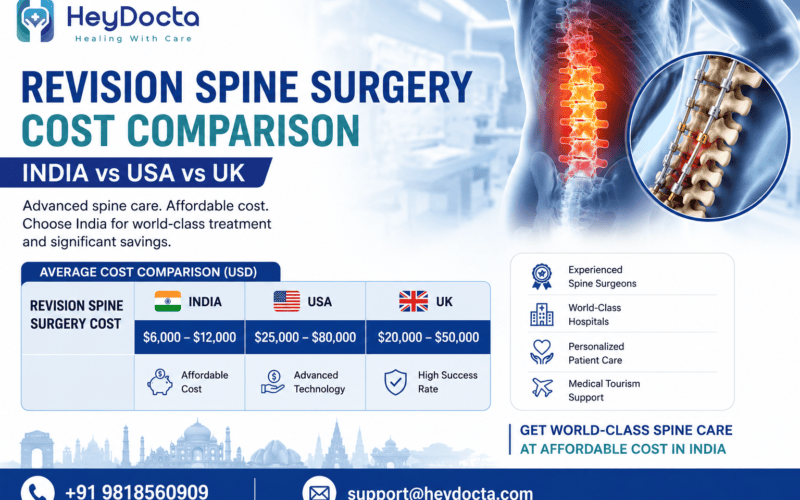
One of India’s advantages for self-paying international patients is the potential difference in treatment costs compared with private healthcare in countries such as the USA and UK.
| Treatment | India | USA | UK/Europe |
| Endoscopic spine surgery | $2,500–$5,000 | $15,000–$35,000+ | $10,000–$25,000+ |
| Minimally invasive spine surgery | $3,500–$7,000 | $25,000–$60,000+ | $15,000–$35,000+ |
| Spinal fusion | $5,000–$10,000+ | $40,000–$100,000+ | $20,000–$45,000+ |
| Complex spine surgery | $7,000–$15,000+ | $60,000–$150,000+ | $30,000–$60,000+ |
International figures should be treated as broad planning estimates because hospital billing structures vary significantly between countries. For India specifically, current hospital-published pricing also shows substantial variation between different spine procedures.
For someone travelling from Africa, Guyana, Jamaica, Europe or the Middle East, the total budget may also include flights, accommodation, local transportation and accompanying-family expenses.
Why International Patients Consider India for Endoscopic Spine Surgery
India has developed specialist spine services offering minimally invasive and endoscopic procedures.
Potential advantages for international patients include:
- Specialist spine surgeons
- Advanced imaging
- Minimally invasive surgical facilities
- Modern private hospitals
- International patient departments
- Competitive treatment costs
- English-speaking medical teams
- Medical travel coordination
HeyDocta’s partner hospitals include Artemis Hospital, Fortis Hospitals, Max Hospitals, Manipal Hospitals, Yatharth Hospital and Sarvodaya Hospital.
HeyDocta’s partner hospitals provide access to specialist spine-care facilities, experienced surgeons, modern technology and coordinated support for international patients throughout their treatment journey in India.
Spine Specialists in India
Dr Hitesh Garg – Artemis Hospital
Dr Hitesh Garg as Head – Ortho Spine Surgery at Artemis Hospital, Gurugram. His profile lists fellowships in spine surgery from Yale University and paediatric spine surgery from Shriners Hospitals for Children in the USA.
Dr Jitesh Manghwani – Max Hospital
Dr Jitesh Manghwani is listed by Max Healthcare as Associate Director & Unit Head – Orthopaedic Spine Surgery at Max Super Speciality Hospital, Shalimar Bagh. His listed interests include endoscopic and O-arm navigated spine surgeries, spinal stenosis and disc herniation. He also completed a fellowship in robotic spine surgery in the USA.
Talk to Our Medical Tourism Expert: HeyDocta can coordinate your medical records with suitable partner hospitals, help obtain a specialist opinion and assist with treatment-cost estimates before you travel to India.
How to Find Out If You Are a Candidate
For an international patient, the process generally starts before travelling.
Step 1: Share Your Reports
Provide:
- MRI scans
- CT scans, if available
- X-rays
- Previous surgery reports
- Medical history
- Current symptoms
- Previous treatment details
Step 2: Specialist Review
A spine specialist reviews the symptoms and imaging to determine whether surgery is indicated.
Step 3: Determine the Surgical Approach
The surgeon may recommend:
- Endoscopic surgery
- Microscopic surgery
- Minimally invasive surgery
- Conventional surgery
- Fusion
- Non-surgical treatment
Step 4: Receive the Treatment Estimate
Once the procedure is identified, the hospital can provide an estimated cost and expected hospital stay.
Step 5: Plan Your Medical Trip
HeyDocta can assist with:
- Hospital coordination
- Appointment scheduling
- Medical visa assistance
- Airport transfers
- Accommodation
- Local transportation
- Follow-up coordination
Recovery After Endoscopic Spine Surgery
Recovery depends on the exact procedure and individual health.
Patients may be able to mobilise relatively early after selected endoscopic procedures. However, recovery following endoscopic decompression can be very different from recovery after an endoscopic fusion or another complex procedure.
Patients should follow their surgeon’s instructions regarding:
- Wound care
- Physical activity
- Physiotherapy
- Driving
- Lifting restrictions
- Follow-up appointments
- Air travel
A surgeon should confirm when an international patient is medically fit to return home.
FAQs About Endoscopic Spine Surgery
1. Who is the right candidate for endoscopic spine surgery?
Patients with specific spinal conditions such as selected disc herniations or spinal stenosis, matching symptoms and imaging findings, may be candidates. The final decision requires specialist evaluation.
2. Is endoscopic spine surgery suitable for severe spinal problems?
Not always. Severe instability, deformity, complex stenosis or conditions requiring extensive reconstruction may require another surgical approach.
3. Is endoscopic spine surgery less invasive?
Generally, yes. Endoscopic procedures use small access points and aim to reduce disruption to surrounding tissues. However, the extent of invasiveness depends on the exact procedure.
4. How much does endoscopic spine surgery cost in India?
Indian hospital information places the cost broadly around $1045-$3132, with some hospitals citing approximately $2610. The actual quotation depends on the patient’s condition and procedure.
5. Can international patients get endoscopic spine surgery in India?
Yes. International patients can seek evaluation and treatment at Indian hospitals offering appropriate minimally invasive spine procedures, subject to specialist assessment and travel requirements.
6. Can I know if I am eligible before travelling to India?
In many cases, a preliminary assessment can be performed using your medical history and imaging. The final decision is made after specialist evaluation.
Conclusion
The right candidate for endoscopic spine surgery is generally someone whose symptoms and imaging identify a spinal problem that can be safely and effectively addressed through an endoscopic approach. Disc herniation and selected forms of spinal stenosis are among the established applications, while significant instability, deformity and some complex conditions may require conventional or other minimally invasive techniques.
For international patients, India offers access to specialist spine surgeons, modern hospitals and minimally invasive treatment options at costs that may be considerably lower than private treatment in many Western countries.
Get Treatment Cost from Top Indian Hospitals: Send your MRI/CT scans and medical history to HeyDocta.com, Our team can coordinate a specialist opinion, discuss suitable treatment options, provide an estimated hospital cost and assist with visa, travel and treatment coordination in India.