
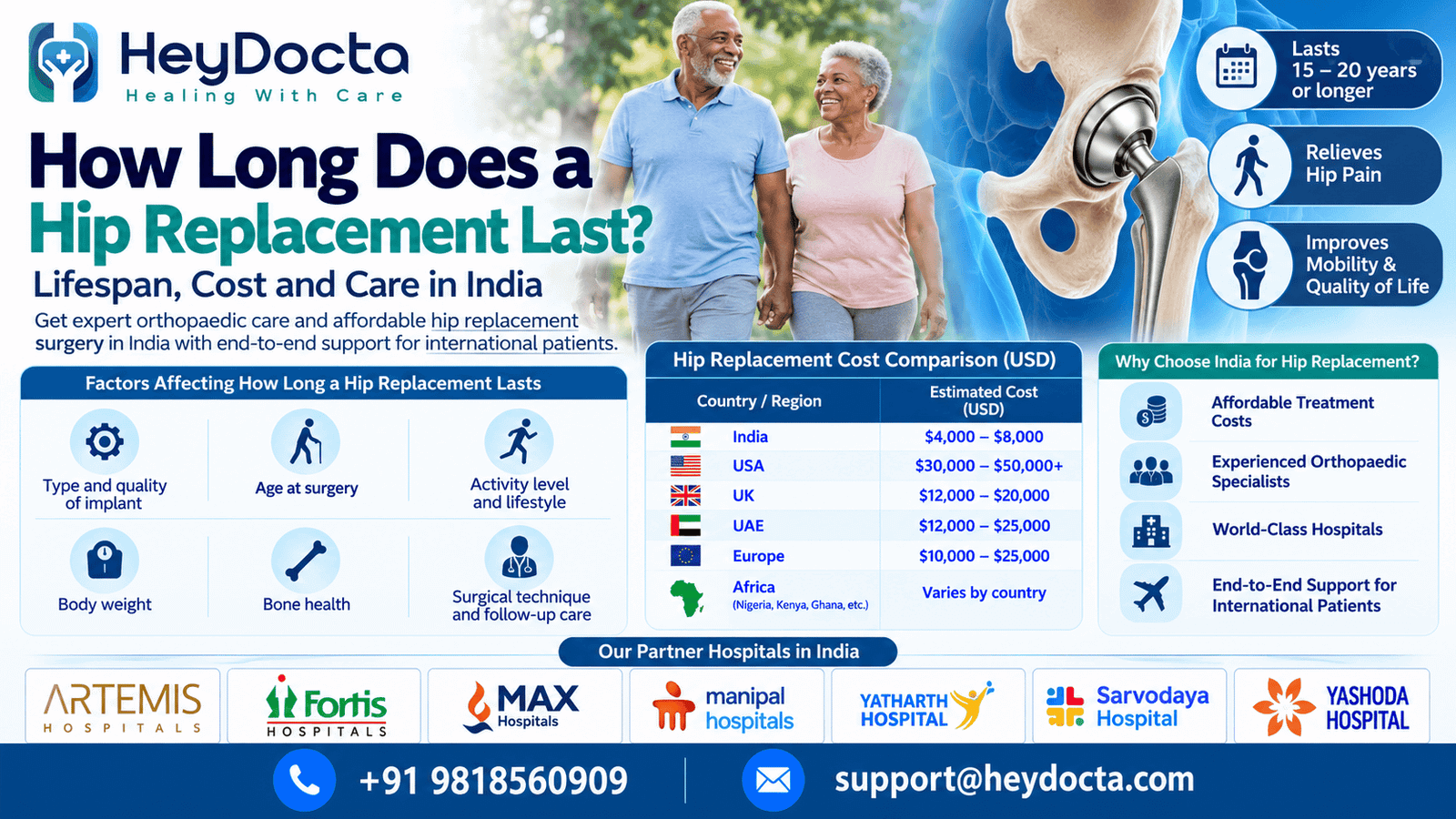
Hip replacement surgery can relieve persistent hip pain and help patients return to everyday activities. However, one of the most common questions patients ask is: How long does a hip replacement last? For international patients considering treatment in India, understanding implant lifespan, long-term maintenance, revision surgery and overall costs is essential before making a decision.
Modern hip replacements often last 15–20 years or longer, although the lifespan varies depending on the implant, surgical technique, activity level, bone health and other medical factors. India may offer a more affordable option for eligible international patients, with access to orthopaedic specialists and established hospitals.
Get a Free Medical Opinion : Contact HeyDocta for help coordinating a medical opinion, comparing hospital estimates and understanding your treatment and travel requirements.
How Long Does a Hip Replacement Last?
A hip replacement commonly lasts 15–20 years or longer. Many patients continue using their artificial hip beyond 20 years, while others may experience implant wear, loosening or other complications earlier.
The lifespan of a hip replacement is not the same for every patient. It depends on several factors, including:
- Implant quality: Different implant materials and designs have different wear characteristics.
- Age at surgery: Younger patients may place more cumulative demands on their implants because they tend to live longer and remain more active.
- Activity level: Regular low-impact exercise supports general health, while repeated high-impact activities may increase implant stress.
- Weight and joint loading: Higher body weight can increase the forces acting on the artificial joint.
- Bone health: Bone quality and conditions affecting bone strength may influence implant stability.
- Surgical technique and rehabilitation: Correct implant positioning and appropriate recovery support can contribute to good long-term function.
An implant lasting 20 years does not mean every patient will experience the same result. Regular clinical follow-up helps doctors assess symptoms, mobility and possible changes around the implant.
What Happens to a Hip Replacement Over Time?
A hip replacement replaces damaged joint surfaces with artificial components. Over time, these components may experience wear, and the bone around the implant may change.
Common long-term concerns include:
- Wear of the bearing surfaces.
- Loosening of the implant from the bone.
- Dislocation or instability.
- Infection, which can occur at different stages after surgery.
- Bone loss or fractures around the implant.
Not every patient develops these problems. If an artificial hip remains stable, comfortable and functional, revision surgery may not be necessary simply because a certain number of years have passed.
Patients should seek medical assessment for new or worsening hip pain, swelling, reduced movement, instability or difficulty bearing weight. Sudden severe pain, fever with joint symptoms or inability to walk warrants urgent medical attention.
Does Age Affect How Long a Hip Replacement Lasts?
Age can influence both implant lifespan and the likelihood of needing another operation.
Younger patients may place more cumulative demands on the implant over their lifetime. Older patients may have lower activity demands, but other health conditions, bone quality and fall risk can affect outcomes.
There is no single ideal age for hip replacement. Doctors generally consider surgery when hip pain and stiffness significantly affect daily life and appropriate non-surgical treatments no longer provide enough relief.
The decision should be based on symptoms, imaging, overall health, functional limitations and individual treatment goals rather than age alone.
How Can You Make a Hip Replacement Last Longer?
Patients can take practical steps to support the long-term performance of an artificial hip.
Follow Your Rehabilitation Plan
Physiotherapy helps improve strength, balance, flexibility and walking ability. Follow your surgeon’s instructions and increase activity gradually.
Maintain a Healthy Weight
Managing body weight can reduce unnecessary stress on the artificial joint and support general health.
Choose Suitable Physical Activities
Walking, swimming and stationary cycling may be suitable for many patients after recovery, depending on their doctor’s advice. High-impact activities and heavy repetitive loading should be discussed with the treating surgeon.
Attend Follow-Up Appointments
Follow-up visits allow the medical team to review recovery and identify possible implant problems. The schedule varies according to the patient’s condition, implant and surgeon’s recommendations.
Reduce the Risk of Falls and Infection
Use recommended mobility aids during recovery, improve home safety and follow medical advice for wound care and infection prevention.
Hip Replacement Cost in India vs Other Countries
For international patients, the cost of hip replacement is an important consideration. India is often considered because private hospitals may offer lower treatment prices than those in the USA, the UK and some Middle Eastern and European markets.
The following figures are broad indicative planning estimates in USD, not verified quotations from individual hospitals. Actual prices vary by hospital, implant, procedure complexity, length of stay and package inclusions.
| Country or region | Indicative cost for primary hip replacement |
| India | $4,000–$8,000 |
| USA | $30,000–$50,000+ |
| UK, private treatment | $12,000–$20,000 |
| UAE | $12,000–$25,000 |
| Europe, private treatment | $10,000–$25,000 |
| African countries | Varies significantly by country and facility |
These ranges are not directly equivalent: some prices may cover only hospital treatment, while others may include the implant, surgeon, anaesthesia, hospital stay and rehabilitation. Patients should request itemised quotations before comparing destinations.
For patients travelling from Nigeria, Ghana, Kenya, Zimbabwe, Cameroon, the Middle East, Europe or the USA, the total budget should also include flights, accommodation, local transport, medical visa expenses where applicable, and the cost of staying in India during recovery.
Want to compare your options? HeyDocta can help coordinate consultations with its partner hospitals, including Yatharth Hospital, Artemis Hospitals, Fortis Hospitals, Max Hospitals, Manipal Hospital, Sarvodaya Hospital and Yashoda Hospital. Final treatment recommendations and prices depend on the hospital’s assessment and quotation.
Why Consider Hip Replacement Surgery in India?
International patients may consider India for several reasons:
- Treatment affordability: Surgical treatment may cost less than comparable private care in several other countries.
- Orthopaedic expertise: Patients can seek assessments from specialists experienced in joint replacement.
- Implant choices: Suitable implant options depend on clinical needs, availability and the surgeon’s recommendation.
- Hospital facilities: Patients can compare surgical services, inpatient care, diagnostic facilities and rehabilitation arrangements.
- International patient coordination: Travel planning and hospital appointments can be organised before departure.
Cost should not be the only deciding factor. Patients should also assess the surgeon’s experience, hospital infection-control practices, implant details, rehabilitation support and arrangements for follow-up after returning home.
Hip Replacement Treatment Options and Specialist Care
Total hip replacement replaces the damaged ball and socket surfaces of the hip joint. It is commonly considered for severe osteoarthritis, avascular necrosis, certain fractures and other conditions causing substantial pain and functional limitations.
Partial hip replacement replaces the femoral head but preserves the natural socket. It is used for selected conditions, particularly certain hip fractures, rather than as the standard option for every patient with arthritis.
Dr Dhananjay Sabat at Yatharth Hospital can be included in your initial enquiry for orthopaedic treatment coordination. The appropriate specialist and procedure should be confirmed with the hospital based on the patient’s diagnosis, current role of the doctor and clinical requirements.
Before travelling, patients should share relevant X-rays, medical reports, medication lists and details of existing health conditions. The treating team can then advise whether further investigations or an in-person examination are necessary.
What If a Hip Replacement Needs Revision Surgery?
Revision hip replacement is an operation to replace or repair some or all components of an existing artificial hip. It may be required because of loosening, wear, infection, dislocation or a fracture around the implant.
Revision surgery can be more complex than the first operation and may involve longer recovery, additional investigations and higher costs.
For international patients, revision surgery should be planned carefully. Obtain an itemised estimate covering the procedure, implant components, hospital stay, medicines, rehabilitation and possible additional procedures. If you have already had hip replacement surgery, bring your previous operative notes and implant information whenever available.
Step-by-Step Guide for International Patients
- Share medical records: Send recent imaging and clinical reports for an initial review.
- Obtain a medical opinion: Discuss the diagnosis, suitable treatment options and potential risks with the treating specialist.
- Compare written estimates: Confirm the implant, hospital stay, inclusions and exclusions.
- Plan travel: Arrange the appropriate visa, flights, accommodation and any required medical attendant.
- Complete hospital assessment: Undergo the necessary examination and pre-operative tests.
- Proceed with treatment and rehabilitation: Follow the surgical team’s instructions and physiotherapy plan.
- Arrange follow-up: Confirm when it is safe to travel home and how postoperative reviews will be managed remotely.
Recovery and travel timing depend on the patient’s progress and the treating team’s assessment. Do not book a return flight until the surgeon confirms that travel is appropriate.
Medical Visa and Travel Support
Patients travelling to India for hip replacement should check the latest Indian visa requirements applicable to their nationality and treatment. Depending on eligibility, a medical visa and documentation from the treating hospital may be required.
HeyDocta can assist with hospital coordination, appointment planning, treatment estimate requests and guidance on travel arrangements. Its facilitation service is offered without an additional facilitation fee to patients; hospital charges, surgery, travel, accommodation and other third-party expenses remain payable as applicable. Visa approval and treatment decisions remain with the relevant authorities and medical providers.
Frequently Asked Questions
1. Can a hip replacement last 25 years?
Yes, some hip replacements last 25 years or longer. However, this is not guaranteed, and implant survival depends on individual health, implant characteristics, activity and other factors.
2. Does a hip replacement need to be replaced after 20 years?
Not necessarily. If the implant remains stable and functions well, replacement may not be required. Doctors assess symptoms, examination findings and imaging before recommending revision surgery.
3. Is hip replacement in India more affordable than in the USA?
It can be considerably less expensive in many cases. However, compare written estimates carefully and include flights, accommodation, rehabilitation and follow-up costs.
4. Can I exercise after hip replacement?
Most patients are encouraged to become active gradually. Walking and other low-impact activities may be appropriate, but the type and intensity of exercise should follow the surgeon’s advice.
5. How long should I stay in India after surgery?
The required stay varies with recovery, wound healing, mobility, complications and fitness to travel. Your surgeon should provide an individual travel clearance plan.
6. Can a hip replacement wear out earlier than expected?
Yes. Wear, loosening, infection, dislocation or other complications can affect an implant earlier than expected. New or worsening symptoms should be assessed by a qualified clinician.
7. How much does revision hip replacement cost in India?
Revision surgery often costs more than primary hip replacement because it can require specialised implants, additional procedures and longer hospital care. Request a personalised written estimate after clinical review.
Conclusion: Plan for Long-Term Hip Health
A hip replacement can last 15–20 years or longer, but no implant has a guaranteed lifespan. Good rehabilitation, appropriate activity, follow-up care and timely medical assessment can help patients protect their mobility and identify potential problems early.
For international patients, India may offer a cost-effective treatment option when hospital quality, specialist expertise, total travel expenses and long-term follow-up are considered together.
Contact Heydocta.com to request a medical opinion and compare hip replacement treatment estimates from partner hospitals in India. Our team can help coordinate hospital appointments and provide guidance on medical travel planning so you can make an informed decision.