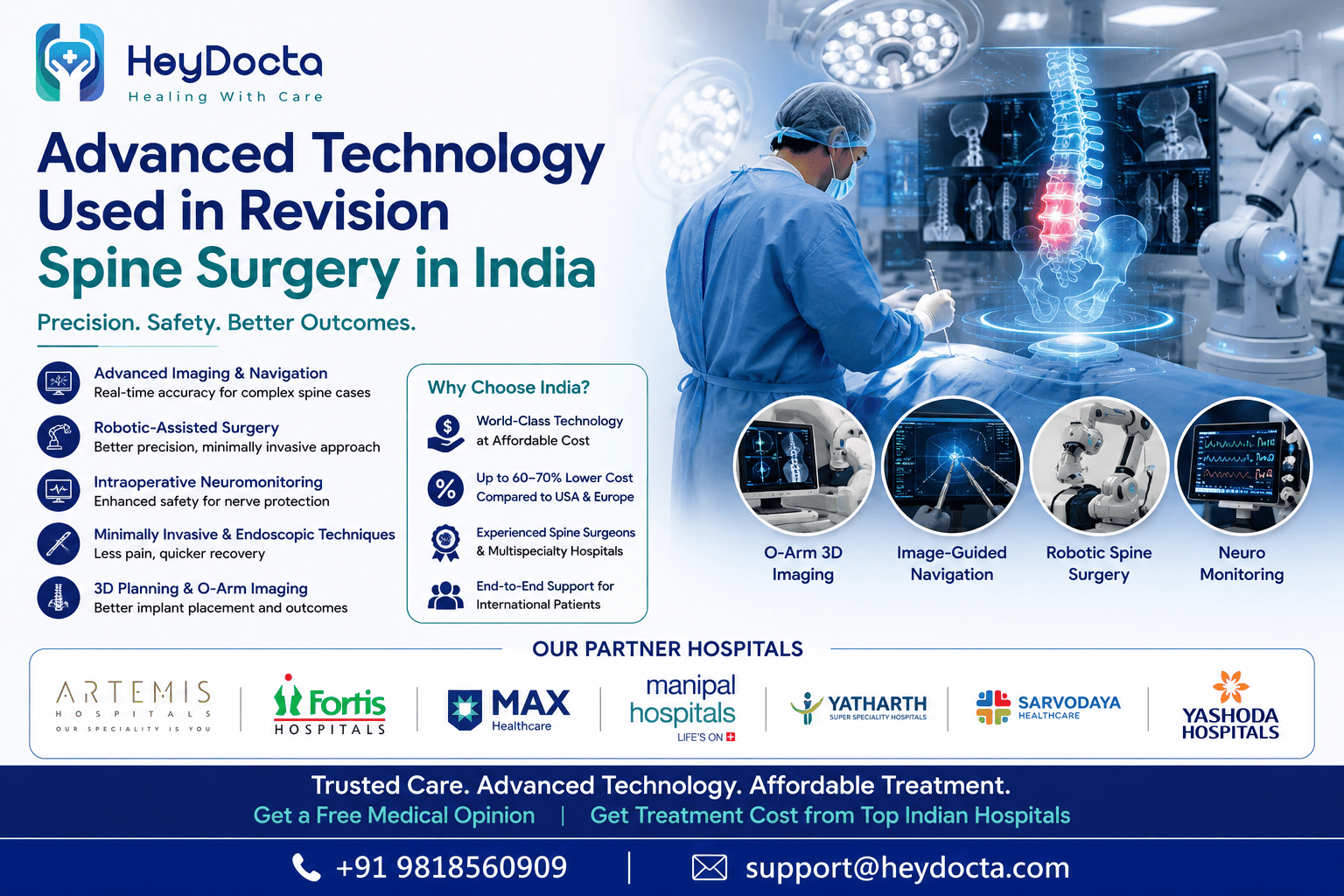
Revision spine surgery can be more complex than an initial spine operation because surgeons may have to work around scar tissue, previous implants, altered anatomy, bone-healing problems or changes in spinal alignment. For international patients from Nigeria, Ghana, Kenya, Zimbabwe, Cameroon, Jamaica, Guyana, the Middle East, Europe and the USA, India offers access to specialised spine centres using modern imaging, navigation, neuromonitoring, minimally invasive techniques and, in selected cases, robotic assistance. The advanced technology used in revision spine surgery in India is selected according to the patient’s diagnosis and surgical requirements rather than simply because a technology is available.
If you are considering revision spine surgery in India, HeyDocta can help you obtain a specialist medical opinion, compare hospital options and receive an indicative treatment estimate before travelling.
What Is Revision Spine Surgery?
Revision spine surgery is a second or subsequent spinal operation performed after a patient has already undergone spine surgery. It may be required when the original problem returns, when fusion does not heal properly, when implants become loose or damaged, when spinal alignment changes, or when persistent nerve compression or instability develops.
Revision procedures can include revision decompression, spinal fusion, implant replacement, correction of spinal deformity, treatment of non-union, removal of problematic hardware and reconstruction of previously operated spinal levels.
Because every revision case is different, surgeons normally review previous operative reports, MRI scans, CT scans, X-rays and other medical records before recommending surgery.
Why Is Advanced Technology Important in Revision Spine Surgery?
Revision surgery may involve challenging anatomy and existing metal implants. Advanced technology can help surgeons plan the operation, identify spinal structures and verify implant positioning during surgery.
However, technology is an aid to clinical decision-making, not a replacement for an experienced spine surgeon. The appropriate technology depends on the patient’s condition, the spinal level being treated and the complexity of the revision.
Advanced Technologies Used in Revision Spine Surgery in India
1. 3D Imaging and CT-Based Surgical Planning
CT and three-dimensional imaging can provide detailed information about vertebral anatomy, previous fusion, bone quality and existing implants. This can be particularly useful when a patient has undergone previous spinal instrumentation.
For revision surgery, imaging may help the surgical team understand the existing hardware and plan the safest surgical approach.
2. Intraoperative Navigation
Image-guided navigation allows surgeons to use real-time or near-real-time imaging information during surgery. Navigation can assist with the positioning of screws and other spinal implants.
This can be especially valuable in revision procedures where normal anatomical landmarks may have been altered by previous surgery.
Modern spine centres in India use image-guided navigation in selected complex procedures. Max Healthcare states that its spine services include image-guided navigation and other advanced technologies.
3. O-Arm and Intraoperative 3D Imaging
An O-Arm-type intraoperative imaging system can generate three-dimensional images during surgery. The images may allow the surgical team to check spinal anatomy and implant placement before completing the operation.
This can be useful in complex instrumentation and revision cases where accurate screw placement is particularly important. Research also highlights the usefulness of metal-artifact reduction approaches in intraoperative imaging for revision cases containing existing spinal hardware.
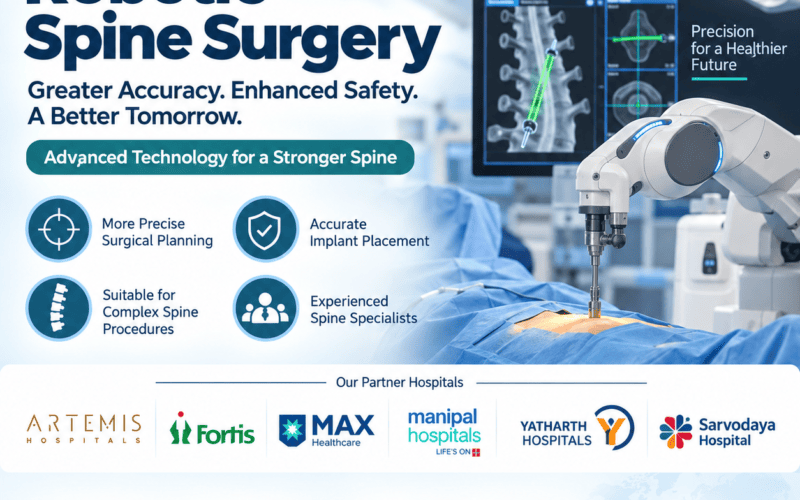
4. Robotic-Assisted Spine Surgery
Robotic systems can assist with pre-operative planning and the placement of spinal implants in selected cases. The surgeon remains responsible for deciding whether robotic assistance is appropriate and for performing the operation.
Dr. Jitesh Manghwani of Max Super Speciality Hospital, Shalimar Bagh, has specific training in robotic spine surgery and lists robotic, endoscopic and O-Arm navigated spine surgery among his areas of interest. The technology is most useful when it addresses a specific surgical planning or implant-placement requirement.
5. Intraoperative Neuromonitoring
Neuromonitoring can track selected neurological signals during surgery. In complex spine procedures, this can provide the surgical team with additional information about neural function while the operation is underway.
6. Minimally Invasive Spine Surgery
Minimally invasive techniques use smaller access points and aim to reduce disruption to surrounding muscles and tissues. They may be appropriate for selected revision procedures, but they are not suitable for every patient.
Some revision operations require traditional open exposure because the surgeon needs adequate access to existing implants, scar tissue, deformity or multiple spinal levels.
The decision should therefore be based on the complexity of the case rather than the patient’s preference for a particular technology.
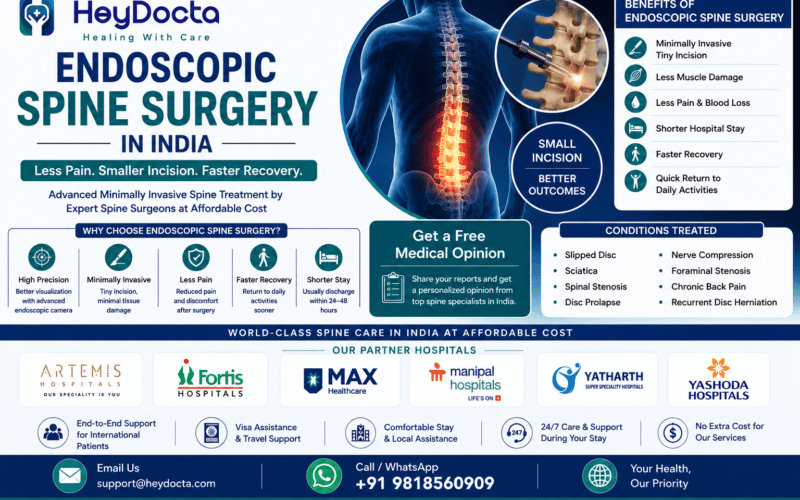
7. Endoscopic Spine Surgery
Endoscopic techniques use a small access route and a camera-based system to visualise the surgical area. They may be used for selected decompression or disc-related procedures.
Dr. Hitesh Garg at Artemis Hospitals
International patients considering complex spine treatment in India may request an opinion from experienced spine surgeon like Dr. Hitesh Garg at Artemis Hospitals, Gurugram. Artemis currently lists Dr. Garg as Director – Spine Surgery with 17+ years of experience. The hospital’s Spine Centre describes its services as covering spinal disorders, back pain, slipped discs, spinal deformities and traumatic injuries, with advanced technology and minimally invasive techniques.
For international patients, the important consideration is whether the surgeon’s experience and available technology match the specific revision problem. A remote review of previous scans and operative records can help determine whether an in-person assessment in India is appropriate.
Dr. Jitesh Manghwani at Max Healthcare
Dr. Jitesh Manghwani is listed by Max Healthcare as Associate Director and Unit Head – Orthopaedic Spine Surgery at Max Super Speciality Hospital, Shalimar Bagh. He is having 11+ years of experience, a fellowship in robotic spine surgery in the USA, and interests including endoscopic and O-Arm navigated spine surgery.
Why International Patients Choose India for Advanced Spine Treatment
Patients travelling from Africa, the Middle East, Europe, the Caribbean and the USA often consider India because of the combination of specialist medical expertise, established private hospitals and comparatively lower treatment costs.
India also has multiple hospital groups with dedicated spine and orthopaedic services. HeyDocta’s partner-hospital network includes Artemis Hospitals, Fortis Hospitals, Max Hospitals, Manipal Hospitals, Yatharth Hospitals, Sarvodaya Hospitals and Yashoda Hospitals.
The right hospital should be selected based on the patient’s diagnosis, required procedure, surgeon expertise, available technology, implant requirements, hospital facilities and overall treatment estimate.
Advanced Revision Spine Surgery Cost in India
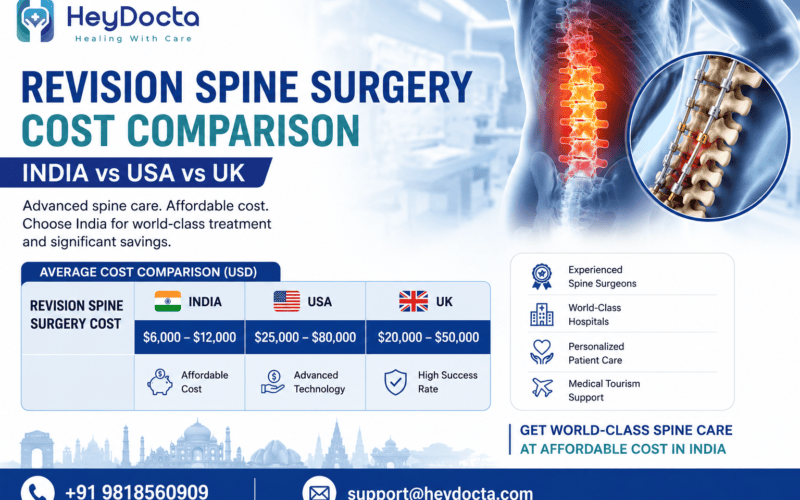
There is no single price for revision spine surgery. A limited revision procedure and a complex multi-level reconstruction may have very different costs.
Published Indian hospital information provides useful reference points for related spine procedures. These figures should not be interpreted as a fixed price for revision surgery. Revision cases may require additional implants, navigation, longer operating time, extended hospitalisation, bone grafting or staged procedures.
| Country/Region | Cost Perspective | Key Point |
| India | Generally more affordable | Cost depends on surgery and implants |
| USA | Higher | Hospital and self-pay costs vary |
| UK/Europe | Higher | Private treatment can be costly |
| Middle East | Varies | Depends on country and hospital |
| Africa | Varies | Specialist availability differs |
| Caribbean | Varies | Advanced revision care may be limited |
The cost difference is therefore best viewed as a broad affordability consideration rather than a direct like-for-like price comparison. International patients should obtain a personalised quotation from the hospital before travelling.
What Determines the Cost of Advanced Revision Spine Surgery?
The final treatment cost may depend on:
- Number of spinal levels involved
- Type of revision procedure
- Existing implants and whether they need replacement
- Type and quantity of new implants
- Use of navigation or intraoperative imaging
- Robotic assistance, where clinically indicated
- Bone graft requirements
- Operating-room time
- Surgeon and hospital charges
- Anaesthesia
- ICU or high-dependency monitoring
- Diagnostic tests
- Hospital stay
- Physiotherapy and rehabilitation
- Treatment of infection or other complications
Benefits of Advanced Technology in Revision Spine Surgery
Depending on the case, advanced technology may provide several potential advantages:
- More detailed surgical planning
- Better visualisation of spinal anatomy
- Assistance with implant positioning
- Intraoperative verification of hardware placement
- Additional neurological monitoring
- Potentially smaller surgical approaches in selected patients
- Better planning for complex spinal reconstruction
These technologies do not eliminate surgical risks and do not guarantee a successful outcome. Their value depends on appropriate patient selection, equipment, surgical expertise and comprehensive perioperative care.
Is Advanced Technology Suitable for Every Patient?
No. A technology should be selected because it provides a clinical benefit for a particular patient.
For example, a patient requiring a straightforward decompression may not need robotic assistance, while a complex revision involving multiple implants may benefit from navigation or intraoperative 3D imaging.
An experienced spine specialist should explain which technologies are relevant to the proposed operation and why.
Step-by-Step Process for International Patients
Step 1: Send Your Medical Records
Share MRI and CT scans, X-rays, previous surgical reports, discharge summaries, implant information and current medical history with HeyDocta.
Step 2: Obtain a Specialist Opinion
The medical team reviews the available information and determines whether further investigation, conservative treatment or revision surgery should be considered.
Step 3: Discuss Technology Options
If surgery is recommended, the surgeon can explain whether navigation, O-Arm imaging, neuromonitoring, minimally invasive surgery or robotic assistance may be relevant.
Step 4: Receive a Treatment Estimate
HeyDocta can coordinate with the selected partner hospital to obtain an indicative treatment estimate based on the proposed procedure.
Step 5: Plan Your Medical Trip
Once the patient decides to proceed, HeyDocta can assist with hospital coordination, medical visa documentation, travel arrangements and accommodation planning.
Step 6: In-Person Evaluation in India
The treating surgeon performs an examination and may request additional imaging or laboratory tests before confirming the final surgical plan.
Step 7: Surgery and Recovery
The procedure is performed using the technique considered most appropriate for the individual case. Post-operative monitoring, pain management, mobilisation and rehabilitation follow the hospital’s clinical protocol.
Step 8: Follow-Up and Return Home
International patients should obtain operative notes, imaging, discharge documents, prescriptions and follow-up instructions before travelling home.
Medical Visa and Travel Support
Eligible international patients travelling to India for medical treatment may use the applicable Indian medical-visa process. Government visa requirements can change, so patients should verify current requirements before making travel arrangements.
HeyDocta can assist with hospital coordination and practical travel support, including communication with the hospital, appointment scheduling and assistance with medical documentation. Visa approval remains subject to applicable Government of India requirements.
Recovery and Stay Duration
Recovery after revision spine surgery depends on the procedure, number of levels treated, overall health and whether complications occur.
International patients should allow sufficient time in India for the initial post-operative review rather than planning an immediate return after discharge. The treating surgeon should determine when the patient is medically fit to travel.
Patients may require physiotherapy, activity restrictions and scheduled follow-up after returning home. A clear communication plan between the Indian hospital and the patient’s local doctor can be useful for longer-term care.
How HeyDocta Supports International Spine Patients
HeyDocta helps international patients coordinate treatment in India from their home country. Services may include:
- Medical record collection and organisation
- Specialist medical opinion coordination
- Hospital appointment scheduling
- Treatment-cost estimates
- Hospital communication
- Medical visa assistance
- Travel and accommodation coordination
- Local support during the treatment journey
- Post-treatment follow-up coordination
HeyDocta’s role is to facilitate medical travel and communication. Diagnosis, treatment decisions and clinical care remain the responsibility of the treating doctors and hospitals.
Frequently Asked Questions
What advanced technology is used in revision spine surgery in India?
Depending on the case, technology may include 3D CT planning, image-guided navigation, O-Arm or intraoperative 3D imaging, neuromonitoring, robotic assistance, endoscopic techniques and minimally invasive surgical systems.
Is robotic spine surgery better for revision surgery?
Not necessarily for every patient. Robotic assistance can help with planning and implant positioning in selected procedures, but the surgeon determines whether it is clinically appropriate.
How much does revision spine surgery cost in India?
There is no fixed price. Published prices for related spine procedures commonly range from around INR 3 lakh to 10 lakh rupees, while complex revision surgery can cost more depending on implants, surgical complexity, hospital stay and other requirements.
Is spine surgery cheaper in India than the USA?
India is generally more affordable for many private healthcare procedures. However, published US Medicare payment data and private hospital charges are not directly comparable with Indian hospital quotations, so patients should compare detailed treatment estimates rather than headline prices.
Can I get a medical opinion before travelling to India?
Yes. International patients can share previous scans and medical reports for an initial specialist review. An in-person examination may still be necessary before the final treatment decision.
Does every revision spine surgery require advanced technology?
No. The technology used depends on the diagnosis, previous surgery, implants, spinal anatomy and complexity of the planned procedure.
How can HeyDocta help me arrange revision spine surgery in India?
HeyDocta can coordinate medical opinions, hospital appointments, treatment estimates, medical visa assistance and travel-related support for international patients considering treatment in India.
Conclusion
Advanced technology has changed the way complex spine procedures can be planned and performed. Navigation, intraoperative imaging, neuromonitoring, robotic assistance, endoscopic techniques and minimally invasive approaches may provide useful tools for selected revision spine cases.
For international patients from Nigeria, Ghana, Kenya, Zimbabwe, Cameroon, other African countries, Jamaica, Guyana, the Middle East, Europe and the USA, India can offer access to experienced spine specialists and advanced private hospitals while potentially providing a significant cost advantage compared with many Western healthcare markets.
However, technology should never be the only reason to select a hospital or surgeon. Patients should consider clinical expertise, previous surgical experience, hospital infrastructure, implant quality, technology relevant to their case, rehabilitation services, follow-up arrangements and total treatment cost.
HeyDocta.com can help international patients begin this process before travelling by coordinating medical records, specialist opinions, hospital consultations and treatment estimates.
If you have already undergone spine surgery and are considering revision surgery, send your medical reports and imaging to HeyDocta for coordination with an appropriate Indian spine specialist. You can also request treatment-cost information from partner hospitals and understand your options before making travel arrangements.
Talk to a HeyDocta Medical Tourism Expert to explore revision spine surgery options in India and get an indicative treatment cost.