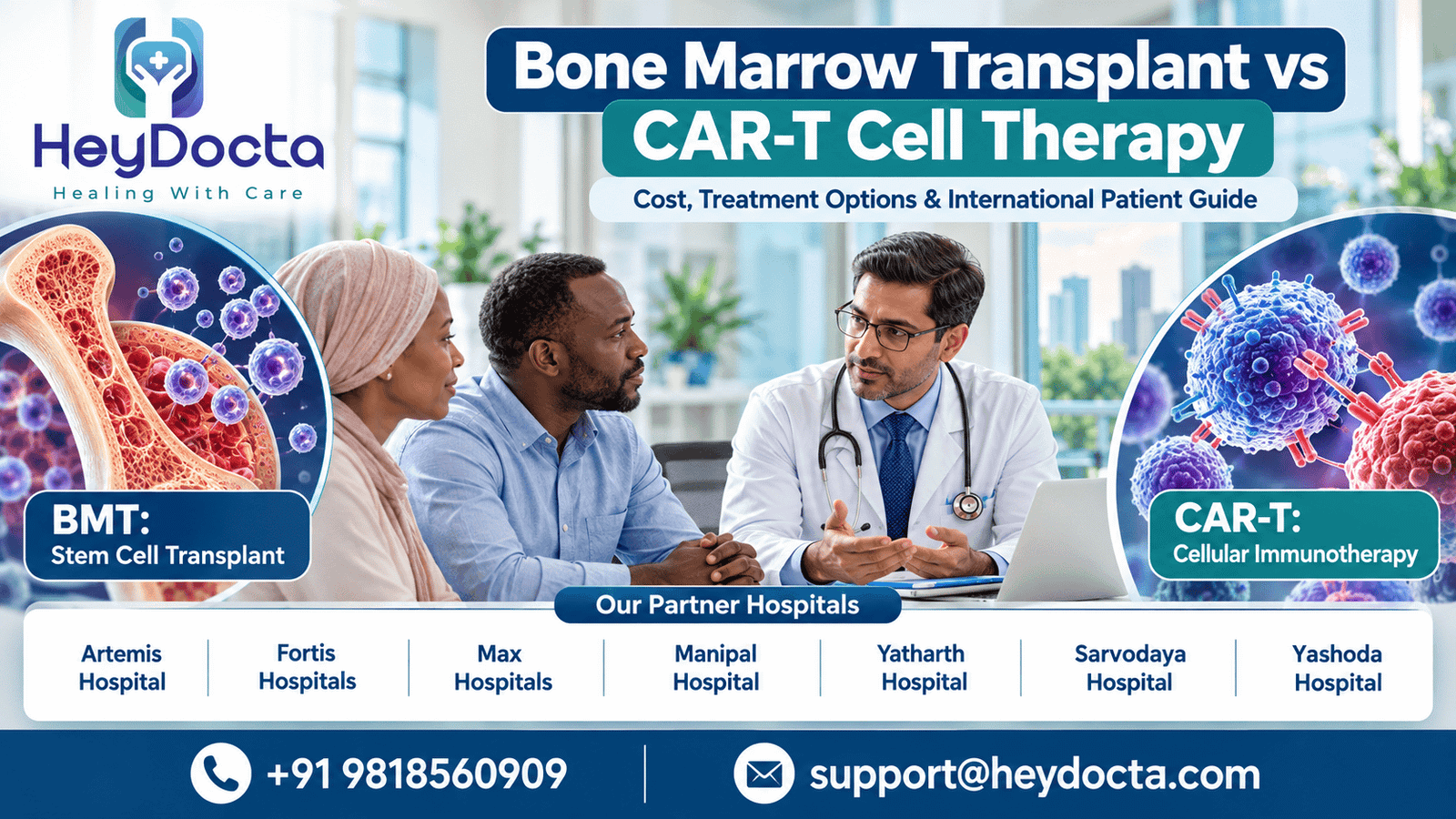
Choosing between bone marrow transplant (BMT) and CAR-T cell therapy can be confusing for international patients with blood cancers. Both are advanced cellular therapies, but they work differently and are suitable for different diseases and clinical situations. For patients travelling from Nigeria, Ghana, Kenya, Zimbabwe, Cameroon, Guyana, Jamaica, the Middle East, Europe or the USA, the decision should be based on medical suitability, expected benefits, risks, availability and the total treatment cost.
India has developed specialised hematology, bone marrow transplant and cellular therapy programmes, making it an option worth discussing with a qualified specialist. However, neither BMT nor CAR-T should be selected based on price alone.
Get a free Medical Opinion : HeyDocta can coordinate your medical records with partner hospitals, help you obtain a specialist opinion and provide an estimated treatment plan and cost before travel.
What Is the Difference Between Bone Marrow Transplant and CAR-T Cell Therapy?
Although both involve cells of the immune or blood-forming system, BMT and CAR-T are fundamentally different treatments.
Bone marrow transplant, more accurately called hematopoietic stem cell transplantation (HSCT), replaces or restores blood-forming stem cells after intensive treatment. The stem cells may come from the patient (autologous transplant) or a donor (allogeneic transplant).
CAR-T cell therapy is a form of cellular immunotherapy in which a patient’s T cells are collected and genetically modified in a laboratory so they can recognise specific targets on cancer cells. The modified cells are then expanded and returned to the patient.
CAR-T is currently used for selected blood cancers, including certain leukemias, lymphomas and multiple myeloma, depending on the specific product, disease and treatment history. U.S. FDA-approved CAR-T products include therapies directed at CD19 or BCMA targets.
Bone Marrow Transplant vs CAR-T: Key Differences
| Feature | Bone Marrow Transplant | CAR-T Cell Therapy |
| Basic approach | Replaces blood-forming stem cells | Modifies patient’s T cells to attack cancer |
| Cells used | Patient’s or donor stem cells | Patient’s own T cells |
| Donor required | Sometimes, for allogeneic BMT | Usually no donor |
| Common uses | Leukemia, lymphoma, myeloma, aplastic anemia and other disorders | Selected relapsed/refractory blood cancers |
| Treatment pathway | Conditioning + stem-cell infusion + engraftment | T-cell collection + laboratory manufacturing + conditioning + CAR-T infusion |
| Major concerns | Infection, graft-versus-host disease in donor transplants, organ complications | Cytokine release syndrome, neurological toxicity and infections |
| Cost | Generally lower in India than CAR-T | Usually higher because of personalised cell manufacturing |
| Suitability | Depends on disease, donor and patient condition | Depends heavily on cancer type, target and previous treatments |
The two treatments are not interchangeable. A hematologist must determine which treatment, if any, is appropriate for an individual patient.
When Is Bone Marrow Transplant Considered?
BMT may be considered for several blood and bone-marrow disorders, including certain forms of:
- Acute myeloid leukemia (AML)
- Acute lymphoblastic leukemia (ALL)
- Lymphoma
- Multiple myeloma
- Myelodysplastic syndromes
- Aplastic anemia
- Other bone-marrow failure or blood disorders
The transplant type depends on the diagnosis, disease status, previous treatment, patient’s age and overall health, donor availability and other clinical factors.
Autologous transplantation uses the patient’s own collected stem cells, while allogeneic transplantation uses stem cells from a donor. Donor transplantation introduces additional considerations such as HLA matching and graft-versus-host disease.
When Is CAR-T Cell Therapy Considered?
CAR-T is generally considered for specific cancers and specific clinical situations, often when the disease has returned or has not responded adequately to previous treatment.
For example, current U.S. indications include certain relapsed or refractory B-cell leukemias, lymphomas and multiple myeloma, depending on the CAR-T product.
This means a patient should not assume that CAR-T is automatically a better or newer alternative to BMT. The cancer’s exact diagnosis and treatment history are critical.
Bone Marrow Transplant and CAR-T Therapy in India
India has specialised hematology and cellular therapy centres offering BMT and, at selected centres, CAR-T therapy.
For example, Dr. Gaurav Dixit, Head – Haematology Oncology & Bone Marrow Transplant at Artemis Hospitals, Gurugram, specialises in BMT, hematopoietic stem cell transplantation, hematology and oncology. His listed procedures include autologous, matched sibling allogeneic, haploidentical, matched unrelated donor transplantation and CAR-T cell therapy.
Artemis Hospitals also lists CAR-T cell therapy in Gurgaon and identifies Dr. Gaurav Dixit as the reviewing physician for the service page.
For an international patient, the most important step is obtaining a specialist review before deciding whether BMT, CAR-T or another treatment pathway is appropriate.
Talk to a medical tourism expert before travelling. HeyDocta can help coordinate your reports with suitable partner hospitals and obtain treatment options and estimated costs.
Bone Marrow Transplant Cost vs CAR-T Cost in India
Cost is one of the biggest differences between the two treatments.
Some Hospitals currently publishes an indicative BMT cost of approximately USD15000 to 31000 in India. The hospital notes that the final cost varies according to hospital, location, room type and complications.
For CAR-T, costs are more variable because the therapy involves personalised cell collection, laboratory processing/manufacturing, conditioning, infusion and intensive monitoring. Recent published Indian planning information reports approximately USD 30000–47000 for the India-manufactured CAR-T cell product alone, with testing, hospitalisation and monitoring potentially additional. These figures are indicative rather than a universal hospital package price.
Indicative Cost Comparison
| Treatment | India Planning Range | Key Cost Factors |
| Autologous/allogeneic BMT | USD15000–31000+ | Transplant type, donor, medicines, stay and complications |
| CAR-T cell therapy | USD 30000–47000+ for some India-manufactured products | Cell manufacturing, testing, collection, conditioning, monitoring and complications |
International comparisons can be even more significant. For example, the U.S. NCI reported a list price of US$419,500 for idecabtagene vicleucel (ide-cel) when it was approved for multiple myeloma; the patient’s actual cost depends on insurance and other healthcare expenses.
Therefore, international patients should compare the complete treatment pathway, not just the headline price of the cell therapy.
Why Can CAR-T Be More Expensive?
CAR-T is personalised for each patient. The patient’s T cells are collected, sent through a manufacturing process, modified and expanded before being returned to the patient. NCI notes that this manufacturing process can take weeks to about a month and contributes to the treatment’s complexity and expense.
Additional expenses can include:
- Diagnostic testing
- T-cell collection
- Cell manufacturing
- Conditioning chemotherapy
- Hospitalisation
- Medicines
- Intensive monitoring
- Management of complications
- Follow-up consultations
The exact package varies between hospitals and products.
Risks and Side Effects: BMT vs CAR-T
Both treatments require specialised monitoring.
BMT can involve infections, bleeding, fatigue, organ complications and, with allogeneic transplantation, graft-versus-host disease.
CAR-T has distinctive risks. Cytokine release syndrome (CRS) can cause fever, nausea, headache, rapid heartbeat, low blood pressure and breathing difficulties. Neurological complications, including immune effector cell-associated neurotoxicity syndrome (ICANS), can also occur.
The FDA continues to require prominent safety warnings for approved CAR-T products regarding CRS and neurological toxicities, and it has also issued warnings concerning rare T-cell malignancies following certain CAR-T therapies.
This is why CAR-T should be performed in centres equipped to monitor and manage these complications.
Treatment Process for International Patients
Step 1: Medical records review
Patients should provide pathology reports, bone marrow biopsy results, imaging, previous chemotherapy details, genetic or molecular reports and other relevant records.
Step 2: Specialist assessment
A hematologist or cellular-therapy specialist determines whether BMT, CAR-T or another treatment is appropriate.
Step 3: Treatment and cost comparison
The patient receives information about:
- Recommended therapy
- Expected treatment duration
- Hospital stay
- Estimated treatment cost
- Possible additional expenses
- Follow-up requirements
Step 4: Visa and travel planning
Once a treatment plan is confirmed, international patients can arrange medical visas, flights, accommodation and attendant travel.
Step 5: Treatment in India
Depending on the treatment, this may involve conditioning, cell collection, transplantation or CAR-T infusion followed by close monitoring.
Step 6: Recovery and follow-up
Patients may need to remain in India after discharge for follow-up, blood tests and medical clearance before returning home. The treating team should determine when international travel is medically appropriate.
Partner Hospitals for International Patients
HeyDocta works with the following partner hospitals for medical treatment coordination:
- Artemis Hospital
- Fortis Hospitals
- Max Hospitals
- Manipal Hospital
- Yatharth Hospital
- Sarvodaya Hospital
- Yashoda Hospital
Patients should select a hospital based on their diagnosis, treatment availability, specialist expertise, facilities and complete cost estimate rather than simply choosing the lowest price.
Medical Visa and International Patient Support
International patients from Africa, the Middle East, Europe, the USA and other regions may need assistance coordinating multiple aspects of treatment in India.
HeyDocta can support patients with:
- Medical report coordination
- Specialist consultation
- Hospital coordination
- Treatment-cost estimates
- Medical visa guidance
- Airport and accommodation coordination
- Travel planning
- Post-treatment follow-up coordination
HeyDocta does not add a separate service fee to the patient’s hospital treatment cost.
FAQs
Is CAR-T better than bone marrow transplant?
Not necessarily. They are different treatments used for different clinical situations. A specialist should determine which option is appropriate based on the cancer type, treatment history and patient’s overall condition.
Is CAR-T more expensive than BMT in India?
Generally, CAR-T can be more expensive because it involves personalised cell collection and manufacturing. Indicative Indian figures can vary significantly, so patients should request a complete written estimate.
What is the cost of BMT in India?
A commonly published range is approximately USD 15000–31000, although the final amount depends on transplant type, hospital, patient condition, stay and complications.
How much does CAR-T therapy cost in India?
Recent Indian planning information reports approximately USD 30000–47000 for some India-manufactured CAR-T cell products, with additional treatment and monitoring costs potentially applying.
Can international patients receive CAR-T therapy in India?
CAR-T is available at selected specialised centres, but eligibility depends on the cancer type, treatment history, approved indication and clinical assessment.
Does CAR-T require a donor?
Typically, CAR-T uses the patient’s own T cells. BMT can use either the patient’s own stem cells or stem cells from a donor, depending on the transplant type.
How do I choose between BMT and CAR-T?
Start with a specialist medical opinion. Ask about the diagnosis, disease status, previous treatments, expected benefits, risks, treatment availability, total cost and long-term follow-up requirements.
Conclusion
The choice between bone marrow transplant vs CAR-T cell therapy should be based on medical suitability rather than simply choosing the newer or more expensive treatment. BMT remains an important treatment for many blood and bone-marrow disorders, while CAR-T provides a specialised cellular-therapy option for selected cancers and clinical situations.
For international patients, India can provide access to specialised hematology and cellular-therapy services at potentially lower treatment costs than some Western healthcare systems. However, every patient’s treatment pathway and final cost are different.
Contact HeyDocta.com to get a specialist medical opinion, compare suitable treatment options at our partner hospitals, understand the estimated BMT or CAR-T cost, and receive end-to-end support with hospital coordination, visa guidance and medical travel planning.