A brain arteriovenous malformation (AVM) is an abnormal connection between arteries and veins in the brain. Depending on its size, location and blood-flow pattern, it may carry a risk of bleeding, seizures or other neurological problems. Coil embolization vs surgery for brain AVM is an important comparison for patients seeking the right treatment, including international patients considering care in India.
The key point is that brain AVMs are not usually treated with ordinary aneurysm-style coil embolization. Doctors may use endovascular embolization, often with special liquid embolic agents or other materials, to block abnormal vessels. Treatment may also involve microsurgery, stereotactic radiosurgery or a combination of approaches. The best option depends on the individual AVM and the patient’s clinical condition.
If you or a family member is considering treatment in India, HeyDocta can help coordinate medical records, specialist opinions and hospital cost estimates.
Get a Free Medical Opinion: Contact HeyDocta to discuss your reports and explore suitable treatment options at our partner hospitals in India.
What Is a Brain AVM?
A brain AVM develops when arteries connect directly to veins without the usual network of capillaries between them. This can place abnormal stress on blood vessels and may lead to bleeding in the brain.
Some people have no symptoms, while others may experience:
- Seizures
- Headaches
- Weakness, numbness or changes in vision
- Difficulty with speech, balance or coordination
- Brain haemorrhage in some cases
A sudden, severe headache, seizure, new weakness, confusion or loss of consciousness requires emergency medical attention.
The goal of treatment is to reduce the risk of bleeding where appropriate, manage symptoms and, when feasible, eliminate the abnormal vascular connection. Not every AVM needs immediate intervention; specialist assessment is essential.
Coil Embolization vs Surgery for Brain AVM: What Is the Difference?
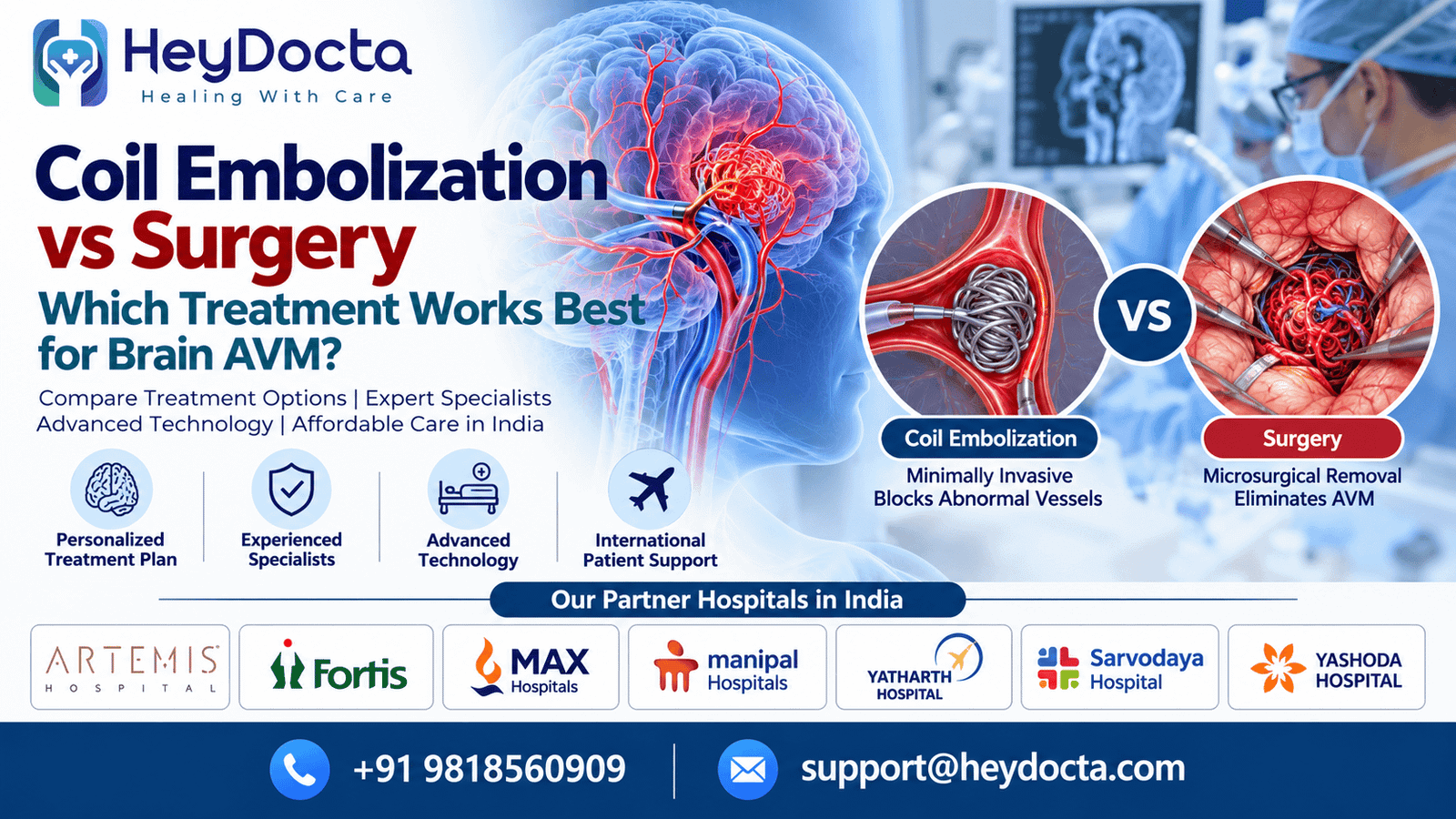
The phrase “coil embolization” is commonly associated with brain aneurysms. For a brain AVM, doctors more often discuss endovascular embolization, which may use liquid embolic agents, particles, coils or other materials depending on the vascular anatomy and treatment goal.
| Feature | Endovascular embolization | Microsurgery |
| How it works | A catheter is guided through blood vessels to block selected parts of the AVM | A neurosurgeon accesses the AVM through an opening in the skull and removes it |
| Main purpose | Reduce blood flow, treat selected AVMs or prepare for another treatment | Remove the AVM when it can be reached safely |
| Best suited for | Selected AVMs based on vessel structure and treatment plan | Often smaller, accessible AVMs where surgical risks are acceptable |
| Incisions | Usually a small catheter entry site | Requires an operation to access the brain |
| Treatment timeline | May require multiple sessions or further treatment | May provide immediate removal when complete resection is achieved |
| Main considerations | Vessel injury, stroke, bleeding or incomplete closure | Bleeding, infection, stroke or neurological injury |
Neither treatment is automatically better for every patient. Embolization alone does not always eliminate the AVM, and it is frequently combined with surgery or radiosurgery. The choice depends on AVM size, location, drainage pattern, prior bleeding and the risks of treatment.
Other Brain AVM Treatment Options Available in India
1. Endovascular embolization
A specialist inserts a thin catheter through a blood vessel, usually from the groin or wrist, and guides it towards the AVM. An embolic material is delivered to block selected abnormal vessels. Some patients need more than one session.
2. Microsurgical AVM resection
The neurosurgeon removes the abnormal vessels through an operation. This may be considered when the AVM is accessible and the expected benefit outweighs the risk to surrounding brain tissue.
3. Stereotactic radiosurgery
Focused radiation targets the AVM without an open surgical incision. The abnormal vessels close gradually, often over months or longer, so the AVM does not disappear immediately and follow-up is essential.
4. Combined treatment
Some patients need embolization followed by surgery or radiosurgery. Others may be advised to undergo monitoring if the risks of intervention are judged greater than the expected benefit.
Brain AVM Treatment Cost in India: An Affordability Guide
India is considered by many international patients because they can seek specialist assessment and compare treatment plans across hospitals. However, the lowest initial price is not necessarily the lowest total treatment cost. The number of procedures, ICU requirements, imaging, rehabilitation and follow-up can substantially change the final bill.
The following are indicative planning estimates in USD, not confirmed quotations from HeyDocta partner hospitals. They are intended to help patients prepare questions for a personalised estimate.
| Treatment option | Indicative cost in India (USD) |
| Stereotactic radiosurgery | $6,500–$10,000 |
| Microsurgical AVM removal | $8,000–$20,000 |
| Endovascular AVM embolization | $8,000–$18,000 |
| Embolization followed by surgery | $18,000–$35,000 |
| Embolization combined with radiosurgery | $15,000–$28,000 |
Actual prices depend on the AVM’s complexity, the number of embolization sessions, the materials used, hospital stay and any complications. A written estimate should confirm exactly what is included.
India vs USA, UK, Europe, Middle East and Africa
International prices are difficult to compare directly because hospitals use different billing systems and treatment packages. Some published figures refer to hospital charges rather than the amount a patient actually pays.
| Destination | What patients should consider |
| India | Obtain an itemised estimate for the recommended treatment, hospital stay, imaging and follow-up |
| USA | Request a complete estimate including hospital, specialist, anaesthesia, imaging and any staged procedures |
| UK and Europe | Check whether the quote includes all procedures, follow-up scans and any private hospital fees |
| Middle East | Confirm whether treatment is available locally and compare the full cost of the proposed plan |
| Nigeria, Ghana, Kenya, Zimbabwe and other African countries | Ask local specialists which procedures are available and compare the cost of treatment plus travel and follow-up |
| Guyana, Jamaica and the wider Caribbean | Compare local referral options with the full cost of travelling abroad and remaining near the treating team |
For an accurate comparison, HeyDocta can help patients request case-specific estimates from partner hospitals in India. The appropriate comparison is between clinically suitable treatment plans, not just the headline procedure price.
Talk to Our Medical Tourism Expert: Share your scan reports and angiography findings to request an assessment and an indicative treatment estimate.
Brain AVM Specialist and Partner Hospitals in India
For brain AVM treatment, patients should consult a specialist team experienced in cerebrovascular neurosurgery, neuro-interventional procedures and radiosurgery. Depending on the case, the team may include a neurosurgeon, interventional neuroradiologist, neurologist and rehabilitation professionals.
Dr. Aditya Gupta – Artemis Hospitals, Gurugram: Dr. Gupta is the Chairperson – Neurosurgery & CNS Radiosurgery and Co-Chief – CyberKnife Centre at Artemis Hospitals. His listed areas of expertise include cerebrovascular surgery and AVM treatment.
HeyDocta can help international patients enquire about relevant services at its partner hospitals:
- Artemis Hospital
- Fortis Hospitals
- Max Hospitals
- Manipal Hospital
- Yatharth Hospital
- Sarvodaya Hospital
- Yashoda Hospital
Treatment availability and the appropriate specialist must be confirmed with the individual hospital.
Step-by-Step Process for International Patients
- Share medical records: Provide MRI, CT, cerebral angiography (DSA), previous reports and details of symptoms or prior bleeding.
- Obtain a specialist opinion: The treating team assesses the AVM’s size, location and complexity.
- Discuss treatment options: Ask why embolization, surgery, radiosurgery, combined treatment or monitoring is recommended.
- Request a written estimate: Confirm procedure charges, embolic materials, ICU, hospital stay, medicines and follow-up imaging.
- Arrange travel: Travel only after the treating team confirms that it is medically appropriate.
- Undergo treatment and recovery: Follow the hospital’s instructions and complete recommended imaging and clinical reviews.
Medical Visa, Travel and Recovery
International patients travelling from Africa, the USA, Europe, the Middle East or the Caribbean should check the current Indian medical visa requirements and obtain the necessary hospital documentation before travel.
HeyDocta can assist with hospital coordination, appointment scheduling, treatment estimates and guidance on visa and travel arrangements. This support helps organise the process but does not replace medical advice or guarantee visa approval.
Hospital stay and recovery depend on the treatment. Embolization may require monitoring after the procedure, while open surgery may involve a longer hospital stay and rehabilitation. Radiosurgery may have a shorter initial stay, but the AVM can take months or longer to close. Follow-up imaging is important to assess the result.
Patients should not book return flights until their treating team confirms they are fit to travel.
Frequently Asked Questions
1. Is coil embolization better than surgery for a brain AVM?
Not necessarily. Embolization may reduce blood flow or prepare an AVM for another treatment. Surgery may be suitable for an accessible AVM that can be removed safely. The best option depends on individual imaging and clinical assessment.
2. What is the cost of brain AVM treatment in India?
Indicative planning estimates range from approximately $6,500 to $20,000 for selected single-modality treatments. Combined treatment may cost more. The final amount depends on complexity, hospital stay and the number of procedures.
3. Can embolization completely cure a brain AVM?
Sometimes, but not always. Embolization is frequently used alongside surgery or radiosurgery. Follow-up imaging is needed to determine whether the AVM has been completely eliminated.
4. Is brain AVM surgery risky?
All brain procedures carry risks, including bleeding, stroke, infection and neurological injury. A specialist evaluates these risks against the potential benefit of treatment.
5. How long should international patients stay in India?
The required stay varies by treatment and recovery. Patients may need several days or longer in hospital, followed by additional time for review and travel clearance. Complex or staged treatment may require a longer visit.
6. Can a brain AVM be treated without open surgery?
Yes. Selected patients may be considered for endovascular embolization or stereotactic radiosurgery. Some AVMs are best managed with a combination of treatments, while others may be monitored.
7. Can HeyDocta help compare hospital costs?
Yes. HeyDocta can help coordinate enquiries and obtain indicative estimates from its partner hospitals. The final treatment recommendation and quotation must come from the treating hospital after reviewing the patient’s records.
Conclusion
Choosing between embolization, surgery and radiosurgery for a brain AVM requires careful evaluation by an experienced specialist team. India offers international patients an opportunity to compare treatment plans and costs, but the safest option depends on the individual AVM, not affordability alone.
Contact HeyDocta.com for a Free Medical Opinion. Share your medical reports to explore appropriate brain AVM treatment options, request cost estimates from our partner hospitals and receive assistance with hospital coordination, medical visa guidance and travel planning. HeyDocta provides medical tourism facilitation at no extra cost to patients; hospital treatment and other third-party expenses are charged separately.