When severe back or neck pain continues despite medicines, physiotherapy, injections or other conservative treatments, a spine specialist may recommend surgery. For selected patients, robotic spine surgery can provide computer-assisted planning and navigation during procedures such as spinal fusion and deformity correction. But robotic technology is not required for every spine condition, and the final approach depends on the diagnosis, anatomy, imaging and surgeon’s assessment.
For international patients from Nigeria, Ghana, Kenya, Zimbabwe, Cameroon, Guyana, Jamaica, the Middle East, Europe and the USA, India offers conventional, minimally invasive and technology-assisted spine procedures at major hospitals. Understanding which conditions may be treated with robotic assistance, how much treatment can cost and what is involved in travelling to India can help patients plan their treatment more confidently.
Get a Free Medical Opinion: Share your MRI, CT scans and medical history with HeyDocta to explore suitable treatment options and receive an estimated treatment plan from leading Indian hospitals.
What Is Robotic Spine Surgery?
Robotic spine surgery is a computer-assisted surgical approach that can help the surgeon plan and execute selected spinal procedures with navigation and robotic guidance.
The robotic system does not independently perform the operation. A qualified spine surgeon remains responsible for the diagnosis, surgical plan and procedure, while technology can assist with:
- Three-dimensional surgical planning
- Navigation during surgery
- Implant trajectory planning
- Pedicle screw placement
- Intraoperative imaging
- Selected minimally invasive approaches
The technology is particularly relevant to procedures where accurate implant positioning and detailed planning are important.
Modern spine centres may also combine robotic guidance with O-arm imaging, neuronavigation, intraoperative neuromonitoring, microscopic techniques and minimally invasive surgery.
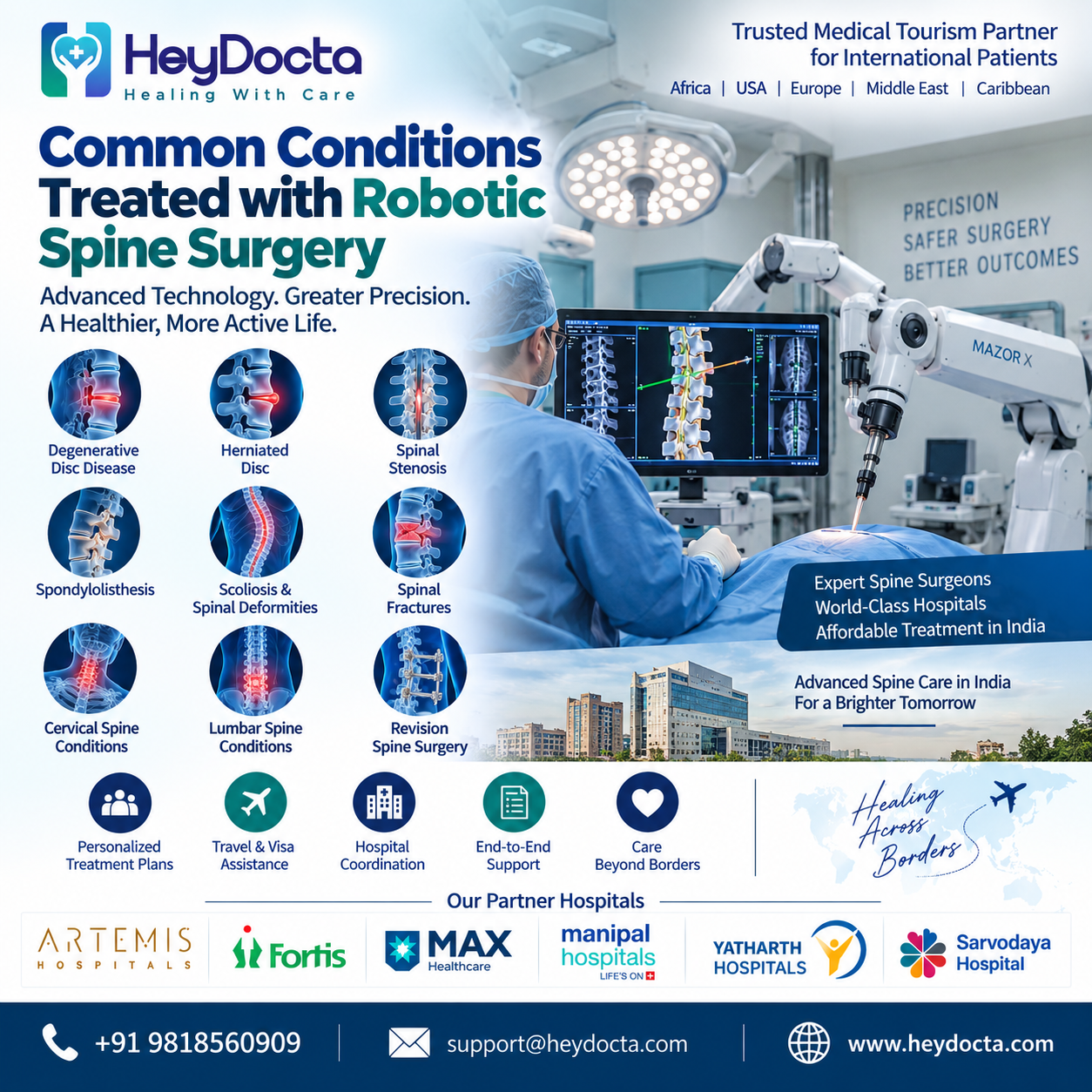
Which Conditions Can Be Treated with Robotic Spine Surgery?
Robotic assistance is not a treatment for a specific disease by itself. Instead, it can be used during certain surgical procedures performed for different spinal conditions.
The following are some of the conditions where robotic or navigation-assisted spine surgery may be considered.
1. Degenerative Disc Disease
Degenerative disc disease occurs when spinal discs gradually lose their normal structure and function. It can contribute to chronic back or neck pain and may occur with other degenerative changes.
Treatment depends on the severity and symptoms.
Possible options include:
- Physiotherapy
- Medicines
- Injections
- Lifestyle modification
- Disc surgery
- Spinal fusion in selected patients
- Disc replacement in appropriately selected cases
When fusion is required, robotic or navigation-assisted technology may be considered to assist with implant placement.
2. Herniated or Slipped Disc
A herniated disc occurs when part of an intervertebral disc protrudes and may compress a nearby nerve.
Symptoms can include:
- Back or neck pain
- Leg or arm pain
- Numbness
- Tingling
- Weakness
Many patients improve without surgery. When surgery becomes necessary, procedures such as microdiscectomy or minimally invasive decompression may be considered.
Robotic technology is not necessarily required for every disc herniation. The surgeon determines whether navigation or robotic assistance adds value to the specific operation.
3. Spinal Stenosis
Spinal stenosis refers to narrowing around the spinal canal or nerve passages. It commonly affects older adults and can cause back pain, leg pain, numbness or difficulty walking.
Treatment may range from conservative care to decompression surgery.For selected patients requiring fusion alongside decompression, robotic or navigation-assisted techniques may be used.
4. Spondylolisthesis
Spondylolisthesis occurs when one vertebra shifts relative to another. It can cause back pain, nerve compression and spinal instability.
Treatment depends on:
- Degree of vertebral displacement
- Symptoms
- Nerve compression
- Spinal stability
- Response to non-surgical treatment
Some patients require decompression and fusion. In these cases, computer-assisted navigation or robotic technology may help with accurate implant placement.
5. Spinal Deformities and Scoliosis
Scoliosis is a sideways curvature of the spine. More complex spinal deformities may also involve abnormal curvature from front to back or rotational changes.
Surgery may be considered when deformity is significant, progressive or associated with pain, imbalance, neurological problems or functional limitations.Robotic and navigation technology can be useful in selected deformity-correction procedures, particularly when multiple implants are required.
6. Spinal Fractures
Trauma, osteoporosis and other conditions can cause vertebral fractures.
Some fractures can be treated without surgery, while others may require procedures such as:
- Vertebroplasty
- Kyphoplasty
- Decompression
- Spinal fixation
- Spinal fusion
Whether robotic assistance is appropriate depends on the fracture pattern and the procedure being performed.
7. Revision Spine Surgery
Revision surgery is performed when a patient has previously undergone spinal surgery but requires another operation.
Revision cases can be technically challenging because of:
- Previous implants
- Scar tissue
- Altered anatomy
- Spinal instability
- Previous fusion
- Recurrent nerve compression
Advanced imaging and navigation can sometimes be useful during complex revision procedures. However, robotic surgery is not automatically appropriate for every revision case.
8. Cervical Spine Conditions
Robotic or navigation-assisted technology can also be considered in selected cervical spine procedures.
Conditions may include:
- Cervical disc disease
- Cervical spinal stenosis
- Cervical instability
- Cervical deformity
- Selected cervical fractures
Procedures such as cervical fusion may involve screws, plates or other implants, where image guidance can assist the surgeon.
9. Lumbar Spine Conditions
The lumbar spine is one of the most common areas requiring surgical treatment.
Conditions may include:
- Lumbar spinal stenosis
- Degenerative disc disease
- Spondylolisthesis
- Recurrent disc problems
- Lumbar instability
- Selected deformities
Robotic assistance is particularly relevant to some lumbar fusion procedures where multiple pedicle screws and implants are required.
Why International Patients Choose India for Robotic Spine Surgery
India has developed advanced spine-care programmes in major private hospitals, including hospitals serving international patients.
Patients travelling to India may have access to:
- Experienced orthopaedic spine and neurosurgery teams
- Robotic and navigation-assisted procedures at selected centres
- Minimally invasive spine techniques
- Advanced imaging
- Intraoperative neuromonitoring
- Modern intensive-care facilities
- International patient departments
- English-speaking medical teams
- International patient coordination
Hospitals such as Artemis, Max, Fortis and Manipal have established specialty services, while other partner hospitals in the HeyDocta network include Yatharth Hospital and Sarvodaya Hospital.
Robotic Spine Surgery Cost in India
Cost is one of the biggest considerations for international patients.
In 2026 estimates place robotic/navigation-assisted spine surgery in India broadly around $4,800–$12,000, although complex deformity surgery or extensive fusion can cost considerably more. One current 2026 cost source lists robotic spine surgery at approximately $4,848–$10,908, while another specialist cost guide gives a broader $4,800–$12,000 range. These should be treated as indicative planning figures, not fixed quotations.
For comparison, an international-patient estimates for spinal fusion show approximately $6,000–$18,000 in India, depending on the complexity, while private US costs can be substantially higher.
Indicative Spine Surgery Cost Comparison
| Procedure | India | USA | UK |
| Lumbar decompression / laminectomy | $4,500–$7,500 | $35,000–$75,000 | £14,000–£24,000 |
| Single-level spinal fusion | $6,000–$10,000 | $60,000–$110,000 | £22,000–£40,000 |
| Multi-level spinal fusion | $9,000–$15,000 | $90,000–$160,000 | £30,000–£55,000 |
| Robotic/navigation-assisted spine surgery | Approx. $4,800–$12,000+ | Varies substantially | Varies substantially |
These figures come from current medical-tourism cost guides and are useful for initial budgeting only. Actual pricing depends on the hospital, surgeon, number of spinal levels, implant selection, procedure type and medical complexity.
For patients from Africa, Guyana, Jamaica, the Middle East, Europe and the USA, the overall financial calculation should also include flights, accommodation, local transportation, investigations and the accompanying person’s expenses.
What Factors Affect Robotic Spine Surgery Cost in India?
Your final treatment quotation may depend on:
- Type of spinal condition
- Number of spinal levels
- Type of surgery
- Robotic/navigation technology used
- Implant brand and number of implants
- Surgeon fees
- Hospital category
- Anaesthesia
- ICU requirements
- Neuromonitoring
- Diagnostic imaging
- Length of hospital stay
- Rehabilitation
- Additional procedures
A personalised quotation should therefore be obtained after the medical team reviews the patient’s reports.
Talk to Our Medical Tourism Expert: HeyDocta can coordinate your medical records with suitable partner hospitals, help compare treatment plans and provide an estimated cost before you travel to India.
Leading Spine Surgeons in India
Dr Hitesh Garg – Artemis Hospital
Dr Hitesh Garg as Head – Ortho Spine Surgery at Artemis Hospital, Gurugram. His qualifications include MBBS from AIIMS and fellowships in spine surgery at Yale University and paediatric spine surgery at Shriners Hospitals for Children in the USA. His extensive experience in spinal fusion, deformity correction, disc replacement and complex spine surgery.
Dr Jitesh Manghwani – Max Hospital
Dr Jitesh Manghwani as Associate Director & Unit Head – Orthopaedic Spine Surgery at Max Super Speciality Hospital, Shalimar Bagh. His training includes a fellowship in Robotic Spine Surgery in the USA, and his listed interests include spinal stenosis, disc herniation, spinal deformity correction and O-arm navigated spine surgery.
Partner Hospitals for International Spine Patients
HeyDocta works with a network of partner hospitals that includes:
- Artemis Hospital
- Fortis Hospitals
- Max Hospitals
- Manipal Hospitals
- Yatharth Hospital
- Sarvodaya Hospital
The appropriate hospital and surgeon depend on the patient’s diagnosis, required procedure, medical history and preferred location.
Treatment Process for International Patients
Step 1: Send Your Medical Reports
Share your MRI, CT scans, X-rays, previous surgical reports and medical history with HeyDocta.
Step 2: Specialist Review
The medical team reviews the available information and determines whether surgery may be appropriate.
Step 3: Compare Treatment Options
Patients may receive recommendations for conventional, minimally invasive, navigation-assisted or robotic-assisted surgery depending on their condition.
Step 4: Receive the Cost Estimate
The hospital provides a treatment estimate based on the proposed procedure and expected requirements.
Step 5: Medical Visa and Travel Planning
HeyDocta can assist with medical visa documentation, hospital coordination, accommodation and airport transfers.
Step 6: Treatment in India
The patient meets the specialist, undergoes necessary investigations and proceeds with treatment if surgery is recommended and accepted.
Step 7: Recovery and Follow-Up
Post-operative monitoring, physiotherapy and follow-up are arranged according to the surgeon’s recommendations.
Recovery After Robotic Spine Surgery
Recovery depends more on the actual procedure than on the word “robotic.”
For example, recovery following a single-level fusion can be very different from recovery following complex scoliosis correction or multi-level revision surgery.
Recovery may involve:
- Initial hospital observation
- Pain management
- Early mobilisation
- Physiotherapy
- Wound care
- Activity restrictions
- Follow-up imaging
- Gradual return to normal activities
International patients should plan their return journey only after the treating surgeon confirms that they are medically fit to travel.
Medical Visa and Travel Support with HeyDocta
Travelling from Nigeria, Ghana, Kenya, Zimbabwe, Cameroon, Guyana, Jamaica, the Middle East, Europe or the USA for spine surgery requires careful planning.
HeyDocta can assist with:
- Medical opinion coordination
- Hospital selection
- Appointment scheduling
- Cost estimates
- Medical visa assistance
- Airport pickup
- Accommodation coordination
- Local transportation
- Interpreter assistance where required
- Follow-up coordination
The objective is to provide end-to-end medical travel support so patients and their families can focus on the treatment journey.
FAQs About Common Conditions Treated with Robotic Spine Surgery
1. What conditions can be treated with robotic spine surgery?
Robotic assistance may be used during selected procedures for conditions such as spinal stenosis, spondylolisthesis, degenerative disc disease, scoliosis, spinal deformity, selected fractures, revision surgery and cervical or lumbar spinal conditions.
2. Is robotic spine surgery suitable for every spine condition?
No. Robotic technology is not necessary for every spinal operation. A spine specialist should determine whether robotic or navigation assistance provides a meaningful benefit for the specific procedure.
3. How much does robotic spine surgery cost in India?
Current estimates commonly place robotic or navigation-assisted spine surgery in India around $4,800–$12,000, although complex procedures can cost more. The final quotation depends on the diagnosis, procedure, implants and hospital.
4. Is robotic spine surgery cheaper in India than in the USA?
Medical-tourism estimates generally show substantially lower self-pay prices for spine procedures in India than in the USA. However, patients should compare complete treatment packages rather than comparing surgery fees alone.
5. How long should international patients stay in India?
The required stay depends on the operation. Patients undergoing complex fusion or deformity surgery generally need longer hospital and post-operative observation than patients undergoing simpler procedures. The treating hospital should confirm the recommended stay before travel.
6. Can robotic spine surgery be used for scoliosis?
Robotic and navigation-assisted technology may be used during selected scoliosis and spinal deformity procedures, particularly when complex instrumentation is required. The surgeon determines whether it is appropriate for the individual patient.
7. Can I get a robotic spine surgery opinion before travelling to India?
Yes. International patients can send their medical records and imaging for preliminary specialist review. HeyDocta can coordinate the medical opinion and help patients understand available hospital and treatment options before travelling.
Conclusion
The common conditions treated with robotic spine surgery include selected cases of spinal stenosis, spondylolisthesis, degenerative disc disease, spinal deformity, scoliosis, fractures and complex or revision spine conditions. However, robotic technology is not automatically required for every patient.
For international patients, India provides access to a range of spine treatment options, including conventional, minimally invasive, navigation-assisted and robotic-assisted procedures.
HeyDocta.com helps patients from Africa, Guyana, Jamaica, the Middle East, Europe and the USA coordinate medical opinions, compare hospitals, understand treatment costs and organise their medical journey to India.
Get Treatment Cost from Top Indian Hospitals: Send your MRI/CT reports and medical history to HeyDocta for a specialist opinion, treatment options and an estimated cost before planning your trip to India