Frozen Embryo Transfer (FET) is an important part of modern IVF treatment. It allows a previously created and frozen embryo to be transferred into the uterus during a later menstrual cycle. For many patients, FET provides more flexibility than transferring an embryo immediately after egg retrieval. It is also useful when embryos are frozen for future attempts or when the fertility specialist recommends delaying embryo transfer.
For international patients from Ghana, Zimbabwe, Cameroon, Nigeria, Kenya, Guyana, Jamaica, the wider African region, the USA, Europe, and the Middle East, India offers access to experienced fertility specialists, modern IVF laboratories, and comparatively affordable fertility treatment. The Frozen Embryo Transfer cost in India depends on the clinic, medicines, preparation protocol, monitoring, and whether the patient already has frozen embryos.
HeyDocta helps international patients coordinate fertility consultations, hospital appointments, treatment planning, travel arrangements, visa guidance, and follow-up support.
Get a Free Medical Opinion: Share your previous IVF and embryo reports with HeyDocta to understand whether FET in India is suitable for you and receive guidance about expected treatment costs.
What Is Frozen Embryo Transfer?
Frozen Embryo Transfer is a fertility procedure in which a previously frozen embryo is thawed and transferred into the uterus. The embryo is usually created during an earlier IVF cycle and stored using a freezing technique called vitrification.
Unlike a fresh embryo transfer, FET does not require egg retrieval during the same treatment cycle. The uterus is prepared separately so the endometrium is suitable for embryo implantation.
FET might be performed after a previous IVF cycle, after embryos have been frozen for future use, or when the fertility specialist believes a later transfer offers a more suitable treatment approach.
Why Is FET Used in IVF?
There are several reasons a fertility specialist might recommend frozen embryo transfer.
FET might be considered when:
- Good-quality embryos remain after an earlier IVF cycle
- The doctor recommends delaying embryo transfer
- The endometrium needs additional preparation
- A patient wants to use embryos from a previous IVF cycle
- Embryos are being preserved for future pregnancy attempts
- A fresh transfer was not suitable during the original IVF cycle
- Genetic testing has been performed and an embryo is being transferred later
The decision depends on your medical history, embryo quality, uterine condition, age, previous IVF treatment, and fertility specialist’s assessment.
Frozen Embryo Transfer Success Rate
One of the most common questions patients ask is, “What is the FET success rate?”
There is no single success rate that applies to every patient. Outcomes depend on several factors, with embryo quality and the patient’s age being particularly important. Uterine health, endometrial preparation, embryo stage, previous fertility history, and the underlying reason for infertility also influence outcomes.
A frozen embryo transfer does not guarantee pregnancy. A fertility specialist should review your individual circumstances and explain realistic expectations before treatment.
Patients should also ask clinics how they report success rates. Pregnancy rate, clinical pregnancy rate, implantation rate, and live birth rate are different measures and should not be treated as the same figure.
Does FET Have Advantages Over Fresh Embryo Transfer?
FET offers several practical advantages. Since egg retrieval is not required during the FET cycle, the treatment is generally less intensive than the original IVF cycle.
Other potential advantages include:
- Use of embryos already created during IVF
- More flexibility in choosing the transfer cycle
- Opportunity to prepare the uterine lining separately
- Ability to preserve embryos for future attempts
- No need for another egg retrieval when suitable frozen embryos are available
However, FET is not automatically better than fresh transfer for every patient. Your fertility specialist should recommend the approach based on your specific circumstances.
Frozen Embryo Transfer Process in India
The FET process is usually simpler than the complete IVF cycle, but it still requires careful preparation and monitoring.
Step 1: Medical Consultation
International patients can share their IVF records, embryo reports, previous ultrasound scans, hormone tests, and treatment history before travelling to India.
The fertility specialist reviews the available information and determines whether FET is appropriate.
Step 2: Uterine Assessment
The doctor assesses the uterus and endometrium. Ultrasound monitoring helps evaluate the uterine lining and determine the appropriate timing for embryo transfer.
Step 3: Preparing the Endometrium
Depending on the patient’s menstrual cycle and medical history, the doctor might use a natural cycle or medicines to prepare the uterine lining.
The exact protocol varies between patients.
Step 4: Monitoring
Ultrasound and, when required, hormone testing are used to monitor the endometrium and determine when the uterus is ready for transfer.
Step 5: Embryo Thawing
The selected frozen embryo is carefully thawed in the IVF laboratory. Modern vitrification techniques allow fertility laboratories to preserve embryos at extremely low temperatures.
The embryology team assesses the embryo after thawing before proceeding with the transfer.
Step 6: Embryo Transfer
The embryo is transferred into the uterus through a thin catheter. The procedure is generally short and does not usually require hospital admission.
Step 7: Pregnancy Test
A pregnancy test is performed after the recommended interval. If the test is positive, the fertility team provides further instructions regarding follow-up and pregnancy monitoring.
Frozen Embryo Transfer Cost in India
The cost of FET varies depending on whether the patient already has frozen embryos and what preparation and monitoring are required. The final quotation should be confirmed with the fertility hospital after medical assessment.
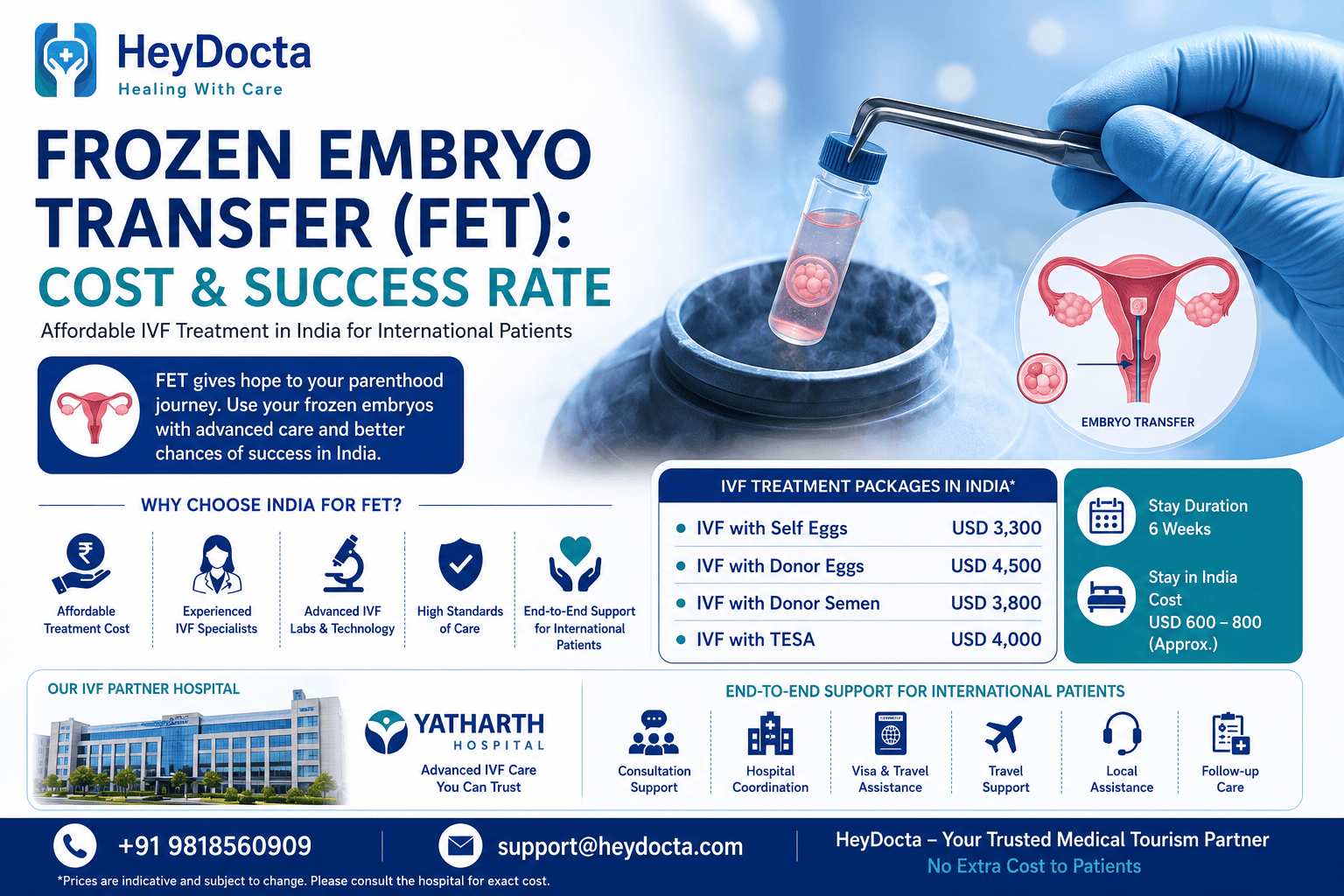
HeyDocta’s indicative IVF package costs are:
| IVF Treatment | Approximate Cost |
|---|---|
| IVF with Self Eggs | USD 3,300 |
| IVF with Donor Eggs | USD 4,500 |
| IVF with Donor Sperm | USD 3,800 |
| IVF with TESA | USD 4,000 |
| Recommended Stay | Approx 6 weeks |
| Estimated Stay Cost | USD 600–800 |
These are indicative treatment package figures provided for international patients. FET-specific charges are not necessarily the same as a complete IVF package, particularly when embryos have already been created and frozen. Medicines, scans, consultations, embryo storage, thawing, laboratory services, and additional procedures might be charged separately depending on the hospital.
Patients should request a written estimate before travelling.
India vs Other Countries: IVF Cost Comparison
India is often considered by international patients because fertility treatment is comparatively affordable.
| Country/Region | Typical IVF Cost Range |
|---|---|
| India | USD 3,300–4,500 |
| USA | USD 12,000–20,000 |
| UK | USD 8,000–15,000 |
| UAE | USD 7,000–12,000 |
| Europe | USD 6,000–12,000 |
These are broad indicative ranges. Costs vary by hospital, city, treatment protocol, medicines, laboratory procedures, and services included in the package.
When comparing FET costs internationally, patients should ask whether embryo thawing, transfer, scans, medicines, consultations, and follow-up are included.
Talk to Our Medical Tourism Expert: HeyDocta can help you understand the expected treatment expenses and coordinate your fertility consultation in India before you travel.
Who May Be Suitable for FET?
FET might be suitable for patients who have frozen embryos from an earlier IVF cycle and whose fertility specialist considers embryo transfer appropriate.
The doctor might review:
- Age
- Embryo quality
- Number of frozen embryos
- Previous IVF outcome
- Uterine health
- Endometrial thickness
- Hormonal status
- Previous pregnancy history
- Reason for infertility
Patients without previously frozen embryos generally need an IVF cycle first to create embryos before a future FET.
FET With Self Eggs or Donor Eggs
FET is not limited to embryos created using the patient’s own eggs. Frozen embryos created through donor egg IVF can also be transferred when legally and medically appropriate.
HeyDocta’s indicative package is USD 3,300 for IVF with self eggs and USD 4,500 for IVF with donor eggs. These figures relate to the respective IVF packages and should not be assumed to represent the exact price of a subsequent FET cycle.
The fertility specialist will explain which treatment option is appropriate after reviewing the patient’s medical history.
Why International Patients Choose India for IVF and FET
Patients travelling from Africa, the USA, Europe, and the Middle East often look for fertility treatment that combines medical expertise with reasonable costs.
India offers:
- Experienced IVF and reproductive medicine specialists
- Modern embryology laboratories
- Advanced embryo freezing facilities
- Multiple fertility treatment options
- Competitive treatment costs
- Diagnostic facilities
- International patient coordination
- Travel and hospital assistance
HeyDocta’s IVF partner hospital is Yatharth Hospital. IVF treatment coordination is also available with Dr. Amreen Singh, an IVF specialist with 16 years of experience, based on patient requirements and doctor availability.
The choice of fertility specialist and treatment protocol should always depend on individual medical evaluation.
How Long Should You Stay in India for FET?
The required stay depends on the FET protocol and whether the patient already has embryos stored at the treating centre.
For the IVF treatment journey coordinated through HeyDocta, patients should plan for approximately 6 weeks in India. The actual duration can differ depending on medical evaluation, uterine preparation, monitoring, embryo transfer timing, and follow-up.
Patients should discuss their expected timeline with the fertility team before booking flights.
Medical Visa and Travel Support for International Patients
International patients should check the latest Indian medical visa requirements applicable to their nationality before travelling.
You should keep your medical records, passport documents, previous IVF reports, embryo storage records, prescriptions, and other relevant paperwork ready.
HeyDocta supports international patients with:
- Fertility consultation coordination
- Hospital appointment scheduling
- Medical record coordination
- Visa guidance
- Travel assistance
- Hospital coordination
- Local support
- Follow-up coordination
Patients should confirm all visa and treatment requirements before making final travel arrangements.
Recovery After Frozen Embryo Transfer
FET is generally a short procedure and usually does not require a prolonged hospital stay. Some patients experience mild cramping or spotting following embryo transfer.
Your fertility specialist will provide specific instructions regarding medicines, activity, travel, and pregnancy testing.
Contact your medical team promptly if you experience severe abdominal pain, heavy bleeding, fainting, breathing difficulty, or other concerning symptoms.
After returning home, keep your treatment records and follow the recommended schedule for pregnancy testing and medical follow-up.
Frequently Asked Questions About Frozen Embryo Transfer
1. What is Frozen Embryo Transfer?
Frozen Embryo Transfer is a procedure in which a previously frozen embryo is thawed and transferred into the uterus during a prepared menstrual cycle.
2. What is the success rate of FET?
FET success varies between patients. Age, embryo quality, uterine health, endometrial preparation, and other fertility factors influence pregnancy and live birth outcomes. Your doctor can provide a more personalised assessment after reviewing your medical records.
3. How much does Frozen Embryo Transfer cost in India?
The exact FET cost varies by hospital and treatment requirements. Patients should request a specific FET quotation because a complete IVF package and a subsequent FET cycle do not necessarily have the same price.
4. Is FET better than fresh embryo transfer?
Neither approach is automatically better for every patient. The fertility specialist chooses between fresh and frozen transfer based on the patient’s medical circumstances and IVF treatment plan.
5. Can I travel after Frozen Embryo Transfer?
Travel recommendations vary according to your medical situation and the treating specialist’s advice. International patients should discuss their return-flight plans with their fertility team before leaving India.
6. How long should I stay in India for IVF treatment?
The suggested stay for the IVF journey through HeyDocta is approximately six weeks. FET alone might require a different timeline depending on the cycle and monitoring requirements.
7. Does HeyDocta help international patients with IVF treatment?
Yes. HeyDocta helps coordinate fertility consultations, partner hospitals, treatment planning, visa guidance, travel arrangements, and follow-up support for international patients.
Frozen Embryo Transfer in India: What Should You Consider?
Frozen Embryo Transfer gives IVF patients an opportunity to use embryos created during an earlier treatment cycle. It can offer greater flexibility in planning embryo transfer and avoids another egg retrieval when suitable frozen embryos are already available.
The actual FET cost and treatment timeline should always be confirmed with the fertility centre. Ask for a clear estimate covering consultations, scans, medicines, embryo thawing, laboratory services, embryo transfer, and follow-up.
HeyDocta.com helps international patients connect with IVF specialists and partner hospitals in India while providing end-to-end support with consultation, hospital coordination, visa guidance, travel assistance, and follow-up. Contact HeyDocta to discuss your IVF history and plan your Frozen Embryo Transfer treatment in India.