Bone marrow transplant (BMT) has transformed the treatment of serious blood cancers and bone marrow disorders. However, many international patients from Nigeria, Kenya, Ghana, Jamaica, Guyana, Zimbabwe, Cameroon, the Middle East, Europe, and the USA often struggle with one important question: “Which type of bone marrow transplant is better — Autologous or Allogeneic?” The answer depends on the patient’s disease, overall health, donor availability, and treatment goals.
India has become one of the leading destinations for affordable and advanced bone marrow transplant treatment because patients can access internationally trained specialists, modern transplant facilities, and lower treatment costs compared to Western countries.
At heydocta.com, international patients receive complete medical tourism assistance including hospital coordination, medical visa support, travel guidance, accommodation assistance, and treatment planning with top Indian hospitals at no additional service cost.
Get a Free Medical Opinion from experienced bone marrow transplant specialists in India today.
Understanding Bone Marrow Transplant (BMT)
Bone marrow transplant, also called stem cell transplant, is a specialized treatment used to replace damaged or diseased bone marrow with healthy stem cells. These stem cells help restore the body’s ability to produce healthy blood cells.
Bone marrow transplant is commonly recommended for:
- Leukemia
- Lymphoma
- Multiple myeloma
- Aplastic anemia
- Thalassemia
- Sickle cell anemia
- Certain immune deficiency disorders
The two major types of bone marrow transplant are:
- Autologous Bone Marrow Transplant
- Allogeneic Bone Marrow Transplant
Understanding the differences between these procedures is important before choosing treatment.
What Is an Autologous Bone Marrow Transplant?
In an autologous bone marrow transplant, the patient’s own healthy stem cells are collected before high-dose chemotherapy or radiation treatment. After treatment, the stem cells are infused back into the patient’s body.
Common Conditions Treated with Autologous BMT
- Multiple myeloma
- Hodgkin lymphoma
- Non-Hodgkin lymphoma
- Certain autoimmune disorders
Advantages of Autologous BMT
- No donor required
- Lower risk of graft-versus-host disease (GVHD)
- Faster immune recovery
- Lower complication rates in many cases
- Shorter hospital stay
Limitations of Autologous BMT
- Not suitable for all blood cancers
- Cancer cells may sometimes remain in collected stem cells
- Higher relapse risk for some diseases
What Is an Allogeneic Bone Marrow Transplant?
In an allogeneic transplant, stem cells are obtained from a donor whose tissue type closely matches the patient.
The donor may be:
- A sibling
- A parent
- A child
- An unrelated matched donor
- A partially matched family donor (haploidentical transplant)
Common Conditions Treated with Allogeneic BMT
- Acute leukemia
- Chronic leukemia
- Aplastic anemia
- Thalassemia
- Sickle cell anemia
- Myelodysplastic syndrome
Advantages of Allogeneic BMT
- Healthy donor cells can help destroy remaining cancer cells
- Effective for many aggressive blood disorders
- Suitable for inherited blood diseases
Limitations of Allogeneic BMT
- Requires compatible donor
- Higher risk of infections
- Risk of graft-versus-host disease
- Longer recovery period
Autologous vs Allogeneic BMT: Key Differences
| Feature | Autologous BMT | Allogeneic BMT |
|---|---|---|
| Stem Cell Source | Patient’s own cells | Donor cells |
| Donor Required | No | Yes |
| GVHD Risk | Very low | Higher |
| Recovery Speed | Faster | Slower |
| Relapse Risk | May be higher | Often lower in certain cancers |
| Hospital Stay | Shorter | Longer |
| Suitable for Genetic Disorders | No | Yes |
| Treatment Complexity | Moderate | More complex |
Which Bone Marrow Transplant Is Better?
There is no single answer because the best option depends on the patient’s medical condition.
Autologous BMT May Be Better For:
- Multiple myeloma patients
- Some lymphoma patients
- Patients needing lower complication risk
- Patients without suitable donors
Allogeneic BMT May Be Better For:
- Leukemia patients
- Patients with genetic blood disorders
- Aggressive blood cancers
- Patients needing donor immune system support
The decision is made after detailed evaluation by hematologists and transplant specialists.
Why International Patients Choose India for Bone Marrow Transplant
India has become a preferred destination for both autologous and allogeneic bone marrow transplants because of affordability and advanced medical care.
Affordable Treatment Costs
Patients from Africa, Europe, the Caribbean, and the Middle East can save significantly on treatment costs in India.
Advanced Medical Technology
Indian transplant centers use:
- HEPA-filtered transplant ICUs
- Advanced infection control systems
- Modern stem cell processing labs
- Haploidentical transplant technology
Experienced Specialists
Many Indian transplant doctors are internationally trained and experienced in handling complex transplant cases.
Shorter Waiting Time
Treatment can often begin quickly after medical evaluation.
International Patient Services
Hospitals provide dedicated coordinators for international patients.
Talk to Our Medical Tourism Expert to compare transplant options and treatment costs in India.
Bone Marrow Transplant Cost in India vs Other Countries
Treatment affordability is one of the biggest reasons international patients choose India.
Autologous BMT Cost Comparison
| Country | Approximate Cost |
|---|---|
| India | USD 18,000 – USD 30,000 |
| USA | USD 250,000 – USD 500,000 |
| UK | USD 120,000 – USD 300,000 |
| Germany | USD 100,000 – USD 250,000 |
| UAE | USD 70,000 – USD 150,000 |
Allogeneic BMT Cost Comparison
| Country | Approximate Cost |
|---|---|
| India | USD 25,000 – USD 45,000 |
| USA | USD 350,000 – USD 800,000 |
| UK | USD 200,000 – USD 450,000 |
| Germany | USD 180,000 – USD 400,000 |
| Turkey | USD 80,000 – USD 180,000 |
The final cost depends on:
- Type of transplant
- Donor availability
- Length of hospital stay
- Complications if any
- Patient condition
- Hospital category
Even after including travel and accommodation expenses, India remains substantially more affordable for international patients.
Leading Bone Marrow Transplant Hospitals in India
India has several reputed hospitals offering advanced BMT programs for international patients.
Partner hospitals include:
- Artemis Hospital
- Fortis Hospitals
- Max Hospitals
- Sharda Health City
- Yatharth Hospital
- Akash Healthcare
These hospitals provide:
- Dedicated BMT units
- Advanced hematology labs
- International patient departments
- Intensive care support
- Multidisciplinary cancer care
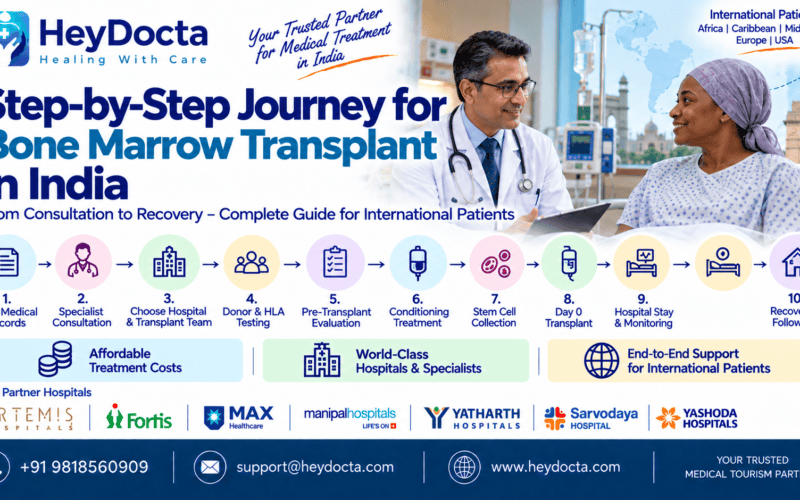
Bone Marrow Transplant Process in India
1. Medical Report Review
Doctors review blood reports, biopsy reports, imaging scans, and previous treatment history.
2. Treatment Planning
Specialists decide whether autologous or allogeneic transplant is appropriate.
3. Donor Testing (For Allogeneic BMT)
HLA matching tests are conducted to identify suitable donors.
4. Stem Cell Collection
Stem cells are collected either from the patient or donor.
5. Conditioning Therapy
Chemotherapy or radiation is administered before transplant.
6. Stem Cell Infusion
Healthy stem cells are infused through a vein similar to blood transfusion.
7. Recovery & Monitoring
Patients are monitored closely for infection control and immune recovery.
Recovery and Stay Duration in India
Typical Duration
| Stage | Approximate Duration |
|---|---|
| Pre-transplant evaluation | 1–2 weeks |
| Hospital stay | 3–6 weeks |
| Initial recovery | 2–3 months |
| Long-term follow-up | Several months |
Patients may need to stay near the hospital after discharge for regular follow-up visits.
Medical Visa and Travel Assistance
India offers medical visas for international patients seeking specialized healthcare treatment.
Patients generally require:
- Passport
- Medical records
- Visa application
- Hospital invitation letter
heydocta.com provides:
- Hospital appointment coordination
- Visa assistance
- Airport pickup
- Accommodation guidance
- Language support
- Follow-up coordination
This helps reduce stress for patients traveling from overseas.
Get Treatment Cost from Top Indian Hospitals and receive personalized treatment planning support today.
Important Risks and Considerations
Bone marrow transplant is a highly specialized treatment and may involve risks including:
- Infection
- Bleeding
- Organ complications
- Graft-versus-host disease
- Delayed immune recovery
Treatment outcomes vary depending on:
- Disease stage
- Patient health
- Donor compatibility
- Response to treatment
Patients should discuss all potential benefits and risks with transplant specialists before proceeding.
Frequently Asked Questions
Which is safer: autologous or allogeneic BMT?
Autologous BMT generally has fewer complications because the patient’s own cells are used. However, the best option depends on the medical condition.
Why is allogeneic BMT more expensive?
Allogeneic transplant involves donor testing, longer hospitalization, and higher monitoring requirements.
How much can international patients save by choosing India?
Patients can often save 60% to 80% compared to treatment costs in the USA, UK, or Europe.
Can family members become stem cell donors?
Yes. Parents, siblings, and children may become donors in haploidentical or matched donor transplants.
How long should patients stay in India after transplant?
Most patients remain in India for 2 to 4 months depending on recovery progress.
Is bone marrow transplant available for children in India?
Yes. Many Indian hospitals offer pediatric bone marrow transplant programs.
Does heydocta.com charge patients for assistance?
No. heydocta.com offers medical tourism coordination and patient assistance without extra service charges.
Conclusion
Choosing between autologous and allogeneic bone marrow transplant depends on several factors including the patient’s disease, donor availability, treatment goals, and overall health condition. Both procedures offer important benefits, and the right treatment plan should always be decided by experienced transplant specialists.
India has become one of the most trusted destinations for affordable and advanced bone marrow transplant treatment because patients receive high-quality care, experienced specialists, modern transplant facilities, and substantial cost savings compared to Western countries.
At heydocta.com, international patients receive complete end-to-end support including hospital selection, treatment coordination, visa assistance, accommodation support, and follow-up care planning.
Contact heydocta.com today to get a free medical opinion, compare treatment costs from top Indian hospitals, and begin your treatment journey in India with confidence.