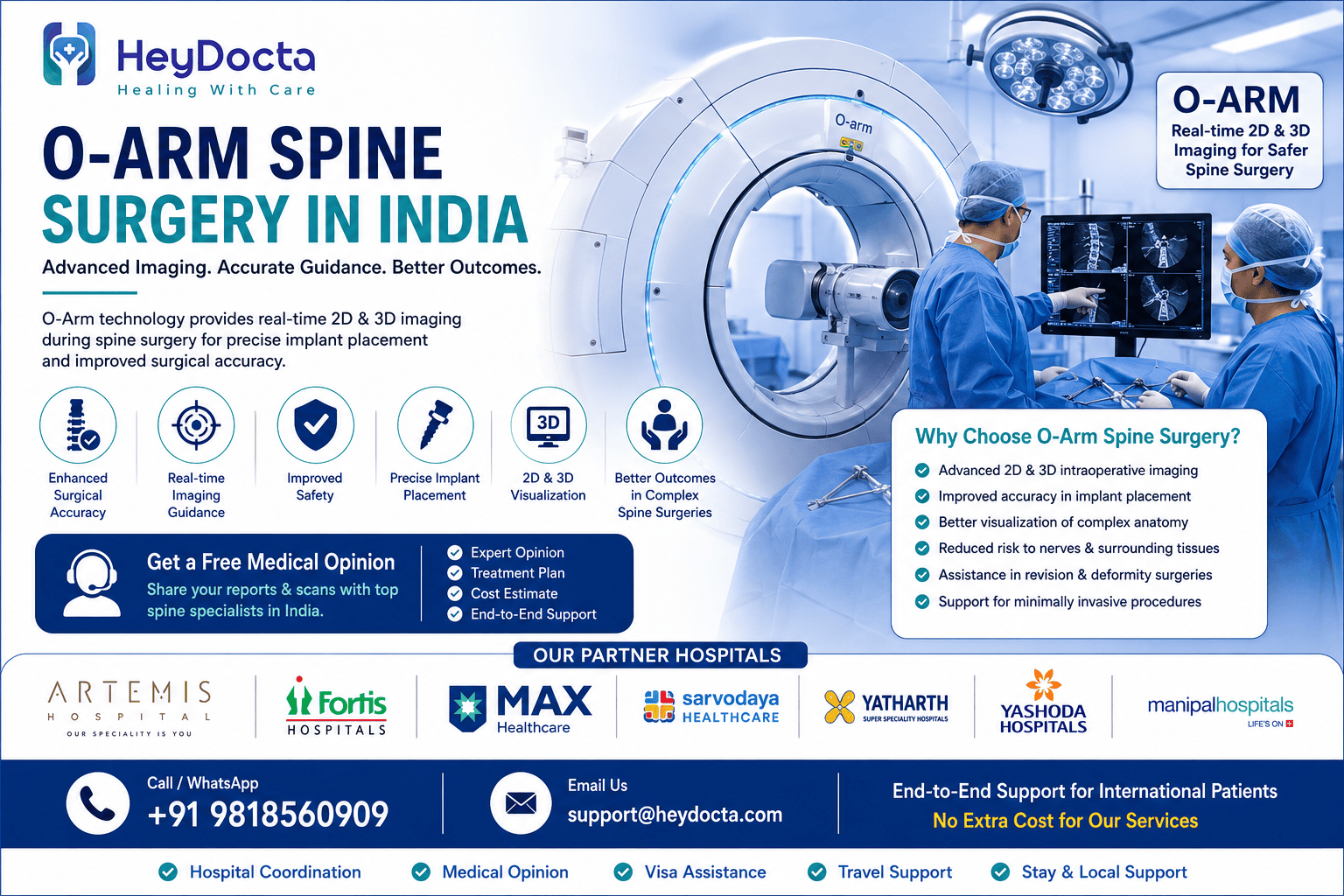
O-Arm spine surgery in India is an advanced image-guided approach used for selected complex spinal procedures, including spinal fusion, deformity correction, revision surgery, and procedures requiring accurate implant placement. The O-Arm is an intraoperative imaging system capable of producing 2D and 3D images during surgery. When combined with surgical navigation, it gives the spine team updated anatomical information while the operation is underway.
For international patients from Nigeria, Ghana, Kenya, Zimbabwe, Cameroon, Guyana, Jamaica, the Middle East, Europe, and the USA, India offers access to advanced spine hospitals at comparatively lower treatment costs than many Western healthcare markets. However, O-Arm technology is not required for every spine operation. Your surgeon should decide whether it adds value for your specific condition.
Get a Free Medical Opinion: Send your previous MRI or CT scans and medical reports to HeyDocta for coordination with suitable spine specialists and partner hospitals in India.
What Is O-Arm Spine Surgery?
O-Arm spine surgery refers to spine surgery performed with the assistance of an O-Arm intraoperative imaging system and, when appropriate, computer-assisted navigation.
The O-Arm is not itself a surgical procedure. It is an imaging and guidance technology used during surgery. The system provides 2D and 3D imaging of the surgical area, helping the surgeon assess spinal anatomy and verify the position of instruments and implants during the operation.
This technology is particularly useful when the surgeon needs detailed information about the position of spinal bones, screws, rods, cages, or other implants.
How Does O-Arm Technology Work?
The process generally involves several stages:
- The patient is positioned for surgery.
- The surgical team obtains intraoperative images using the O-Arm system.
- The images are integrated with the navigation system when navigation is being used.
- The surgeon uses the information to plan or refine instrument and implant placement.
- Additional imaging can be performed during surgery when clinically appropriate.
- The surgical team uses the information to verify aspects of the procedure before completing the operation.
The current O-Arm system is designed for intraoperative 2D and 3D imaging in spine, neurological, and orthopaedic procedures.
Why Is O-Arm Technology Used in Spine Surgery?
Spinal surgery often involves placing implants close to important nerves, the spinal cord, and blood vessels. Accurate anatomical information is therefore important, especially during complex procedures.
O-Arm-assisted navigation can help surgeons:
- Visualise spinal anatomy during surgery
- Plan and guide implant placement
- Check the position of screws and other implants
- Work with altered anatomy in selected revision procedures
- Assist with complex or multilevel spinal reconstruction
- Reduce dependence on repeated conventional imaging in some procedures
Research and manufacturer information indicate that image-guided navigation can improve pedicle screw placement accuracy compared with non-navigated techniques. However, better technical accuracy does not mean every patient will experience a better clinical outcome.
Which Spine Conditions May Be Treated Using O-Arm Guidance?
O-Arm technology may be considered for selected patients undergoing:
Spinal Fusion
O-Arm navigation can assist with accurate placement of screws and other implants during procedures such as TLIF, PLIF, and other fusion techniques.
Revision Spine Surgery
Patients who have undergone previous spine surgery might have altered anatomy, scar tissue, existing implants, or fusion-related problems. Image guidance can provide additional anatomical information during selected revision procedures.
Spinal Deformity Surgery
Complex scoliosis, kyphosis, and other deformity correction procedures may require accurate placement of multiple implants.
Spinal Stenosis Surgery
In selected cases requiring decompression and instrumentation, intraoperative imaging can assist surgical planning and implant placement.
Complex Multilevel Surgery
Patients requiring treatment at multiple spinal levels may benefit from image-guided technology when the surgeon considers it appropriate.
Tumour and Other Complex Spinal Procedures
Certain complex spinal procedures involving abnormal anatomy may also use intraoperative imaging. The exact technology depends on the diagnosis and surgical plan.
O-Arm Spine Surgery vs Conventional Spine Surgery
O-Arm technology should not be viewed as a replacement for surgical expertise. It is an additional tool.
| Feature | Conventional Image Guidance | O-Arm + Navigation |
| Intraoperative imaging | Usually 2D fluoroscopy | 2D and 3D imaging |
| Surgical navigation | Limited or procedure-dependent | Computer-assisted navigation |
| Implant verification | Available depending on technique | Intraoperative 3D imaging can assist verification |
| Complex anatomy | May provide less information | Additional 3D anatomical information |
| Technology cost | Generally lower | Generally higher |
| Availability | More widely available | Available at selected centres |
The choice depends on the patient’s condition, surgeon’s assessment, hospital facilities, and expected value of the technology.
Benefits of O-Arm Spine Surgery
Potential advantages include:
Better Visualisation
Three-dimensional intraoperative imaging provides additional information about spinal anatomy and implant positioning.
Accurate Implant Placement
Navigation can assist with the trajectory and positioning of spinal screws and other implants.
Useful for Complex Cases
O-Arm technology can be particularly useful when normal anatomy is difficult to interpret because of previous surgery, deformity, or complex spinal pathology.
Intraoperative Verification
The surgical team can use intraoperative imaging to evaluate implant positioning rather than relying only on preoperative scans.
Support for Minimally Invasive Techniques
Image guidance can assist selected minimally invasive spine procedures by providing information without requiring a large surgical exposure.
However, these are potential advantages. O-Arm technology does not eliminate surgical complications or guarantee a successful outcome.
O-Arm Spine Surgery Cost in India
The O-Arm spine surgery cost in India depends on the procedure being performed rather than the imaging technology alone.
There is no universal O-Arm surgery package price. A simple decompression and a complex multilevel fusion have significantly different costs.
Current published estimates for spine surgery in Indian private hospitals commonly place standard procedures in the range of approximately ₹1.5 lakh to ₹5 lakh, while complex multilevel fusion, deformity correction, and revision procedures can cost considerably more.
For international patients, complex O-Arm-assisted procedures can broadly fall in the range of USD 6,000–15,000 or more, depending on the surgery, implants, number of levels, hospital, surgeon, and length of stay. This should be treated as an indicative medical-tourism planning range rather than a fixed quotation.
O-Arm and navigation equipment, specialised implants, additional imaging, and complex surgical planning can increase the final hospital bill.
O-Arm Spine Surgery Cost Comparison: India vs Other Countries
| Country | Indicative Cost for Complex Spine Surgery |
| India | USD 6,000–15,000+ |
| USA | USD 40,000–150,000+ |
| UK | USD 25,000–80,000+ |
| Europe | USD 30,000–100,000+ |
| Middle East | USD 15,000–40,000+ |
| Africa | Varies by country and hospital |
Published 2026 estimates show substantial differences between Indian and Western private healthcare costs, particularly for spinal fusion and complex procedures. For example, one recent comparison places Indian spinal fusion costs around USD 4,000–10,000 compared with USD 60,000–150,000 in the USA.
These numbers are not direct quotations for O-Arm surgery. The final cost depends on the exact procedure.
What Is Included in the O-Arm Surgery Cost?
Before travelling to India, ask the hospital whether the quotation includes:
- Spine surgeon fees
- Anaesthesia
- Operation theatre charges
- O-Arm or navigation charges
- Implants
- Screws, rods, cages, or other hardware
- Preoperative investigations
- MRI or CT scans
- Hospital room
- ICU care if required
- Medicines
- Physiotherapy
- Postoperative imaging
- Follow-up consultation
The implant cost is particularly important in fusion and revision surgery because implant selection can have a significant impact on the final bill.
Talk to Our Medical Tourism Expert: HeyDocta can help coordinate your medical records with suitable partner hospitals and request an individual treatment plan and cost estimate before you travel.
Why International Patients Choose India for O-Arm Spine Surgery
India has developed a large private healthcare sector serving both domestic and international patients. Selected hospitals have advanced imaging, navigation, neuromonitoring, intensive care, rehabilitation, and multidisciplinary spine services.
International patients often consider India because of:
- Comparatively affordable private healthcare
- Experienced spine specialists
- Advanced imaging and navigation at selected centres
- Multispecialty hospital infrastructure
- Options for complex spine surgery
- International patient departments
- English-speaking medical teams
- Medical tourism support
- Multiple hospital choices
O-Arm systems are not available at every hospital, so patients should specifically confirm whether the selected centre has the required technology and whether it is appropriate for their planned procedure.
Best Hospitals and Spine Specialists in India
HeyDocta works with partner hospitals including Artemis Hospital, Fortis Hospitals, Max Hospitals, Sarvodaya Hospital, Yatharth Hospital, Yashoda Hospital, and Manipal Hospital.
For patients seeking evaluation for complex spine conditions, Dr Hitesh Garg at Artemis Hospital and Dr Jitesh Manghwani at Max Hospital can be considered for specialist consultation based on the patient’s diagnosis and surgical requirements.
Patients should select a surgeon based on relevant experience with their particular spinal condition, previous operations, imaging findings, and proposed procedure rather than relying only on general online rankings.
O-Arm Spine Surgery Process for International Patients
Step 1: Share Your Medical Records
Send your MRI, CT scans, X-rays, previous surgery reports, discharge summaries, and current medical information to HeyDocta.
Step 2: Specialist Medical Review
A suitable spine specialist reviews the available information and determines whether further evaluation is required.
Step 3: Treatment Recommendation
The specialist determines whether surgery is appropriate and whether O-Arm navigation would add value to the planned procedure.
Step 4: Hospital and Cost Estimate
HeyDocta coordinates with the selected partner hospital to obtain treatment details and an estimated cost.
Step 5: Medical Visa
International patients travelling to India for treatment should use the appropriate medical visa route. India’s official e-Visa system includes e-Medical and e-Medical Attendant categories. The government portal states that medical applicants require documentation from the Indian hospital, among other requirements.
Visa requirements can change, so patients should verify the latest information through the official Indian government portal before travelling.
Step 6: Travel to India
HeyDocta can assist with hospital coordination and other agreed medical-tourism logistics.
Step 7: In-Person Consultation
The treating surgeon examines the patient and reviews imaging before confirming the final surgical plan.
Step 8: O-Arm-Assisted Surgery
If appropriate, O-Arm imaging and navigation are used during the operation.
Step 9: Recovery and Follow-Up
After surgery, the patient receives postoperative monitoring, pain management, mobilisation, physiotherapy when recommended, and follow-up evaluation.
Recovery After O-Arm Spine Surgery
O-Arm technology itself does not determine recovery time. Recovery depends mainly on the type and complexity of surgery.
A patient undergoing a single-level procedure might recover differently from someone undergoing multilevel fusion, deformity correction, or revision surgery.
Recovery can include:
- Hospital observation
- Pain management
- Early mobilisation
- Wound care
- Physiotherapy
- Activity restrictions
- Follow-up imaging
- Gradual return to daily activities
International patients should not schedule a return flight solely based on a standard recovery timeline. The treating surgeon should confirm when travel is medically appropriate.
How Long Should International Patients Stay in India?
The required stay varies according to the procedure and individual recovery.
Your medical-tourism plan should allow time for:
- Initial consultation
- Preoperative investigations
- Surgery
- Hospital recovery
- Early follow-up
- Wound review
- Travel clearance
Complex spinal fusion or revision surgery often requires a longer stay than uncomplicated procedures.
Medical Tourism Support Through HeyDocta
For international patients, arranging treatment involves more than finding a hospital. You may need assistance with medical records, specialist appointments, treatment estimates, visa documentation, accommodation, airport transfers, and follow-up communication.
HeyDocta supports international patients with:
- Medical record coordination
- Specialist opinion coordination
- Hospital appointment scheduling
- Treatment cost estimates
- Hospital coordination
- Medical visa assistance
- Travel support
- Local coordination
- Follow-up support
HeyDocta acts as a medical tourism facilitator. Medical decisions remain with the treating hospital and qualified medical professionals.
Frequently Asked Questions About O-Arm Spine Surgery in India
1. What is O-Arm spine surgery?
O-Arm spine surgery refers to spine surgery performed with the assistance of the O-Arm intraoperative imaging system, often combined with computer-assisted navigation. It provides 2D and 3D imaging during selected spinal procedures.
2. Is O-Arm technology better than conventional spine surgery?
O-Arm navigation can provide additional imaging and assist with accurate implant placement in selected procedures. However, it is not automatically better for every patient or every operation. The surgeon decides whether it is clinically appropriate.
3. How much does O-Arm spine surgery cost in India?
Complex O-Arm-assisted spine surgery may cost approximately USD 6,000–15,000 or more, depending on the procedure, implants, hospital, surgeon, and length of stay. A personalised hospital quotation is required.
4. Is O-Arm useful for revision spine surgery?
It can be useful in selected revision cases where previous surgery has changed the anatomy or where accurate implant placement is important. The surgeon should determine whether navigation adds value.
5. Does O-Arm spine surgery guarantee better results?
No. O-Arm technology can assist surgical planning, navigation, and implant verification, but it does not guarantee a particular outcome. Results depend on the diagnosis, surgical procedure, surgeon, patient factors, and postoperative care.
6. Can international patients get an opinion before travelling to India?
Yes. Patients can share medical reports and imaging for preliminary specialist review. A physical examination in India is required before the final treatment decision.
7. Does HeyDocta help international patients?
HeyDocta helps coordinate specialist opinions, partner hospitals, treatment estimates, medical appointments, visa assistance, travel logistics, and follow-up support. The exact services should be confirmed before travel.
Conclusion
O-Arm spine surgery in India combines advanced intraoperative imaging with surgical navigation for selected spinal procedures. The technology can provide surgeons with additional 2D and 3D information during surgery and assist with implant placement and intraoperative verification.
For patients from Nigeria, Ghana, Kenya, Zimbabwe, Cameroon, Guyana, Jamaica, the Middle East, Europe, and the USA, India offers access to advanced spine treatment at comparatively affordable prices. The cost advantage can be significant, particularly when compared with private treatment in the USA and other high-cost healthcare markets.
However, O-Arm technology is not necessary for every spine patient. The most important step is to establish the correct diagnosis and determine whether surgery is appropriate. Your surgeon should also explain why O-Arm navigation is being recommended and what additional cost it adds to your treatment.
Get a Free Medical Opinion and Treatment Cost from Top Indian Hospitals with HeyDocta.com , Share your MRI or CT scans and previous medical reports to explore suitable O-Arm-assisted spine surgery options, hospital choices, estimated treatment costs, and end-to-end medical travel support.