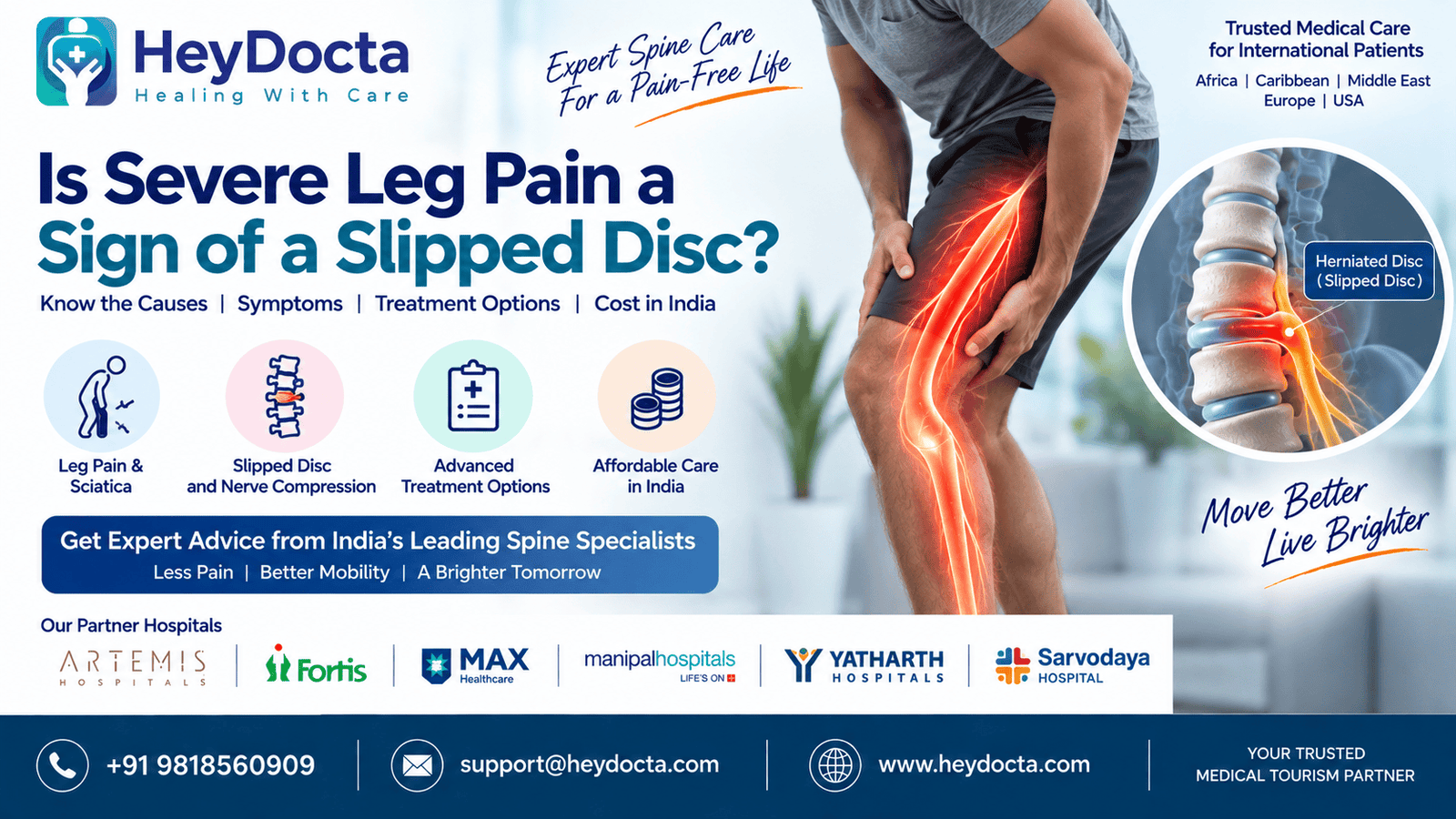
Severe leg pain can sometimes be a sign of a slipped disc, particularly when a disc in the lower spine presses or irritates a nerve. This can cause sciatica, with pain travelling from the lower back or buttock into the thigh, calf or foot. However, severe leg pain does not always mean you have a slipped disc. Other spinal conditions, injuries and non-spinal problems can also cause similar symptoms.
For international patients from Nigeria, Ghana, Kenya, Zimbabwe, Cameroon, Guyana, Jamaica, the Middle East, Europe and the USA, India offers a range of treatment options, from physiotherapy and medicines to injections and minimally invasive spine surgery.
Get a Free Medical Opinion: Share your MRI reports and medical records with HeyDocta to understand the possible cause of your leg pain and explore treatment options in India.
What Does Severe Leg Pain From a Slipped Disc Feel Like?
A slipped disc, also called a herniated disc, occurs when part of a spinal disc pushes outward and irritates or compresses a nearby nerve.
When this happens in the lumbar spine, the affected nerve can produce pain along its pathway into the leg. This condition is commonly called sciatica.
Typical symptoms may include:
- Sharp or burning pain travelling down one leg
- Pain from the lower back or buttock into the thigh or calf
- Tingling or pins and needles
- Numbness in the leg or foot
- Muscle weakness
- Pain that becomes worse with coughing, sneezing or certain movements
The NHS notes that sciatica commonly affects the buttock and back of one leg and can include pain, tingling, numbness and weakness. A slipped disc is one of its most common causes.
Is Severe Leg Pain Always Caused by a Slipped Disc?
No. Severe leg pain can have several causes.
Possible causes include:
- Lumbar slipped or herniated disc
- Spinal stenosis
- Spondylolisthesis
- Nerve compression
- Back injury
- Degenerative changes in the spine
- Muscle or soft-tissue problems
- Certain non-spinal medical conditions
Therefore, the location and severity of pain alone cannot confirm a slipped disc. A spine specialist may perform a physical and neurological examination and, when clinically appropriate, recommend imaging such as an MRI.
How Does a Slipped Disc Cause Leg Pain?
The lumbar spine contains nerves that travel from the lower back toward the legs.
If a herniated disc presses against one of these nerve roots, the irritation can cause pain along the nerve’s pathway.
This explains why a patient may have relatively moderate back pain but experience much stronger pain in the leg. Sciatica commonly causes leg pain that can be more prominent than back pain.
When Should Severe Leg Pain Be Taken Seriously?
Severe leg pain should not automatically be considered an emergency, but certain symptoms require urgent medical assessment.
Seek urgent medical attention if leg pain is accompanied by:
- New or worsening weakness in the legs
- Severe or worsening numbness in both legs
- Numbness around the genitals, buttocks or inner thighs
- Difficulty starting urination
- Inability to urinate
- Loss of bladder control
- Loss of bowel control
- Severe symptoms affecting both legs
These can be warning signs of serious nerve compression, including cauda equina syndrome, which requires urgent assessment.
How Is a Slipped Disc Diagnosed?
Diagnosis generally starts with a consultation and physical examination.
The spine specialist may assess:
- Muscle strength
- Reflexes
- Sensation
- Walking ability
- Pain distribution
- Range of movement
- Neurological symptoms
An MRI may be recommended when the clinical findings suggest nerve compression or when symptoms are persistent or concerning.
The purpose of imaging is not simply to find a disc abnormality but to determine whether the imaging findings correspond with the patient’s symptoms.
Treatment Options for Severe Leg Pain From a Slipped Disc
Treatment depends on the cause, severity and duration of symptoms.
1. Medicines
Pain-relieving and anti-inflammatory medicines may be recommended for selected patients. Medication should be taken according to advice from a qualified healthcare professional.
2. Physiotherapy
Physiotherapy can help patients improve movement, strength and physical function. Patients may receive exercises and advice regarding posture, activity and safe movement.
For many people with sciatica, symptoms improve over several weeks to months without surgery.
3. Epidural Injection
For selected patients with severe nerve-related pain, an epidural injection may be considered.
It may help reduce inflammation around the affected nerve and can sometimes be used when pain remains significant despite conservative treatment.
4. Microdiscectomy
Microdiscectomy removes the portion of a herniated disc that is compressing a spinal nerve.
It is commonly considered for selected patients whose symptoms remain significant despite appropriate non-surgical treatment or who have clinically important neurological symptoms.
5. Endoscopic Discectomy
Endoscopic discectomy is a minimally invasive approach using specialised instruments and a small access point.
It may be appropriate for certain types and locations of disc herniation. Not every patient is suitable for an endoscopic procedure.
6. Other Spine Procedures
More complex disc or spinal conditions may require procedures such as decompression, spinal fusion or disc replacement. These are not routinely required for every slipped disc and depend on the individual diagnosis.
When Is Surgery Considered for Severe Leg Pain?
Surgery is generally not the first treatment for uncomplicated sciatica.
A spine surgeon may consider surgery when:
- Severe symptoms persist despite appropriate conservative treatment
- Pain significantly interferes with daily activities
- There is progressive muscle weakness
- There is significant nerve compression
- Imaging findings correspond with the patient’s symptoms
- An urgent neurological condition requires surgical treatment
The decision should be based on a specialist assessment rather than pain severity alone.
Slipped Disc Treatment Cost in India
For international patients, treatment affordability is an important consideration when comparing India with the USA, UK, Europe, Middle East and other countries.
Published Indian estimates vary considerably because treatment costs depend on the procedure, hospital, city, surgeon, room category, investigations and complexity of the case.
Indicative Cost Comparison
| Country/Region | Typical Private Treatment Cost* | Affordability Consideration |
| India | Approximately USD 1,200–4,700+ | Generally lower self-pay costs for many procedures |
| USA | Often several thousand to tens of thousands of USD | Hospital, surgeon and insurance coverage can significantly affect cost |
| UK | Often several thousand USD or more privately | Private specialist and hospital charges vary |
| Middle East | Varies significantly | Hospital and procedure type influence pricing |
| Africa | Varies by country and hospital | Private-sector availability and pricing differ |
| Caribbean | Varies by country and facility | Complex spine procedures may require overseas referral |
*International comparisons are indicative rather than fixed package prices. The Indian figures are based on published estimates and may not represent the final international-patient quotation. Currency conversions are approximate and can change.
For international patients, the most useful comparison is the total treatment package, including consultation, MRI/diagnostics, surgeon fees, hospitalisation, anaesthesia, procedure, medicines and follow-up where included.
Get Treatment Cost from Top Indian Hospitals: HeyDocta can coordinate your medical reports with partner hospitals and help you obtain a treatment estimate based on your specific condition.
Why International Patients Consider India for Slipped Disc Treatment
India has specialised spine departments offering both non-surgical and surgical management of disc-related conditions.
International patients may consider India because of:
- Multiple specialised spine hospitals
- Experienced orthopaedic and neurosurgical specialists
- Minimally invasive treatment options
- Advanced diagnostic facilities
- Multiple hospital and city choices
- Competitive private healthcare costs
- International-patient coordination
- English-speaking medical teams
The most appropriate hospital and surgeon depend on the patient’s diagnosis, treatment requirements, budget and medical reports.
Spine Surgeons International Patients Can Consider
Dr Hitesh Garg – Artemis Hospitals, Gurugram
Dr Hitesh Garg is Head – Ortho Spine Surgery at Artemis Hospitals, Gurugram. His official Artemis profile lists spine surgery among his specialties and reports more than 5,000 spine surgeries, including spinal fusion, deformity correction and lumbar and cervical artificial disc replacement procedures.
Dr Jitesh Manghwani – Max Healthcare
Dr Jitesh Manghwani is Associate Director & Unit Head – Orthopaedic Spine Surgery at Max Healthcare. His listed areas of interest include disc herniation, conservative spine management, microscopic keyhole surgery, endoscopic spine surgery and O-Arm navigated spine procedures.
These specialists are examples of spine-care options in India; patients should be matched with a specialist based on their medical reports and specific diagnosis.
Partner Hospitals for Spine Treatment Through HeyDocta
HeyDocta works with partner hospitals including:
- Artemis Hospitals
- Fortis Hospitals
- Max Hospitals
- Manipal Hospitals
- Yatharth Hospitals
- Sarvodaya Hospital
Hospital selection can depend on the required treatment, specialist availability, location and estimated cost.
Treatment Process for International Patients
Step 1: Share Your Medical Reports
Send your MRI reports, previous treatment records, prescriptions and other relevant medical information to HeyDocta.
Step 2: Specialist Review
HeyDocta can coordinate your case with an appropriate spine specialist for an initial medical opinion.
Step 3: Treatment and Cost Estimate
The hospital can provide a proposed treatment plan and estimated cost after reviewing the available medical information.
Step 4: Travel and Medical Visa Support
After treatment planning, HeyDocta can assist with hospital coordination, medical visa guidance and travel arrangements.
Step 5: Consultation in India
After arriving in India, the patient undergoes specialist consultation and any additional investigations recommended by the treating team.
Step 6: Treatment and Recovery
Treatment is performed according to the final clinical assessment. Follow-up and discharge instructions are provided before the patient returns home.
Recovery After Slipped Disc Treatment
Recovery depends on the severity of nerve compression and the treatment performed.
Patients receiving non-surgical treatment may gradually return to normal activities as symptoms improve. Gentle movement and avoiding prolonged bed rest are generally encouraged for sciatica.
After surgery, recovery varies depending on the procedure. Patients may be advised to:
- Walk gradually as instructed
- Avoid heavy lifting initially
- Follow physiotherapy recommendations
- Take prescribed medicines
- Attend follow-up consultations
- Follow restrictions provided by the surgeon
International patients should allow sufficient time in India for post-treatment assessment before planning their return flight.
FAQs About Severe Leg Pain and Slipped Disc
1. Is severe leg pain a sign of a slipped disc?
It can be. A lumbar slipped disc can irritate or compress a nerve and cause sciatica, producing pain that travels into the leg. However, other conditions can also cause severe leg pain.
2. Can a slipped disc cause pain only in the leg?
Yes. Some patients may experience much more prominent leg pain than back pain when a spinal nerve is irritated.
3. Does severe leg pain mean I need surgery?
No. Many cases of sciatica improve with conservative treatment. Surgery is considered when symptoms persist, neurological problems develop or another clinical reason makes surgery appropriate.
4. How do I know if my leg pain requires an MRI?
A doctor decides whether imaging is appropriate based on symptoms, physical examination and clinical history. MRI may be particularly useful when nerve compression is suspected or symptoms are persistent or concerning.
5. When is leg pain an emergency?
Leg pain with new bladder or bowel problems, numbness around the genitals or buttocks, severe or worsening weakness, or significant symptoms affecting both legs requires urgent medical assessment.
6. Can international patients get a slipped disc treatment estimate before travelling to India?
Yes. Patients can share their medical reports with HeyDocta for coordination with an appropriate Indian hospital or spine specialist before planning their medical trip.
Conclusion
Severe leg pain can be a sign of a slipped disc, particularly when it follows the typical pattern of sciatica caused by irritation or compression of a lumbar nerve. However, leg pain has several possible causes, so proper medical evaluation is important.
India offers a broad range of spine treatment options, including physiotherapy, medication, injections, microdiscectomy and minimally invasive procedures. For international patients, India may also provide a cost-effective alternative to private treatment in several overseas healthcare markets.
HeyDocta.com helps international patients coordinate medical opinions, hospital selection, treatment estimates, medical visa guidance, travel arrangements and follow-up support. There is no extra facilitation cost to patients for HeyDocta’s coordination service.
Get Your Slipped Disc Treatment Cost in India: Send your MRI and medical reports to HeyDocta and speak with a medical tourism expert about suitable spine specialists, hospitals and treatment options in India.