Partial vs Total Knee Replacement: Which Is Right for You? This is an important question for patients experiencing persistent knee pain, stiffness and difficulty walking due to arthritis or joint damage. For international patients from Nigeria, Ghana, Kenya, Zimbabwe, Cameroon, Guyana, Jamaica, the USA, Europe and the Middle East, understanding the differences between these procedures can help with treatment planning and budgeting.
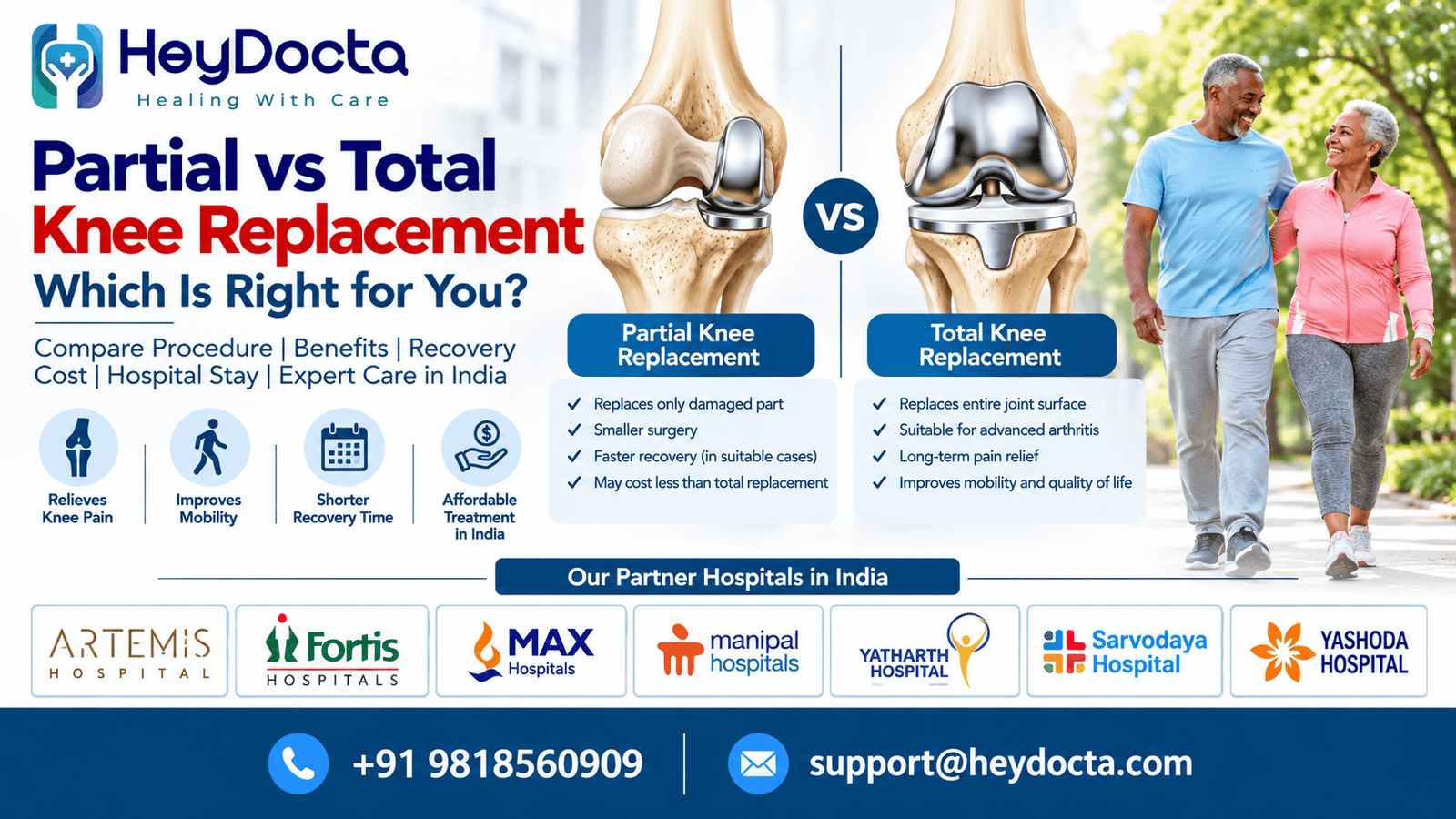
Partial knee replacement treats only the damaged compartment of the knee, while total knee replacement replaces the damaged surfaces across the main compartments of the joint. The right procedure depends on the extent of arthritis, ligament health, knee alignment, overall health and the patient’s goals. Neither option is automatically better for everyone.
India offers both procedures at selected hospitals, potentially at lower costs than some private healthcare markets. Patients should compare not only the surgery price but also the implant, hospital stay, rehabilitation, travel and follow-up expenses.
Get a Free Medical Opinion : Contact HeyDocta to request a medical opinion, explore treatment options at partner hospitals and obtain an estimated cost before arranging travel.
What Is the Difference Between Partial and Total Knee Replacement?
The knee has three main compartments: the medial compartment on the inner side, the lateral compartment on the outer side and the patellofemoral compartment between the kneecap and thigh bone.
Arthritis may affect one compartment or several. The extent of joint damage helps determine which type of knee replacement may be appropriate.
What Is Partial Knee Replacement?
Partial knee replacement, also called unicompartmental knee replacement, replaces the damaged part of the knee while preserving the healthier compartments and many natural structures.
It may be considered when:
- Arthritis is limited mainly to one knee compartment.
- The knee’s major ligaments function adequately.
- Knee alignment and movement are suitable for the procedure.
- Symptoms remain troublesome despite appropriate non-surgical treatment.
Potential benefits include a smaller operation, less tissue disruption and faster early recovery for some suitable patients. However, arthritis can progress in the remaining compartments, and some patients may eventually require further surgery.
What Is Total Knee Replacement?
Total knee replacement, also called total knee arthroplasty, replaces damaged joint surfaces across the knee’s main compartments with artificial components.
It may be considered when:
- Arthritis affects multiple compartments.
- Joint damage or deformity is extensive.
- Pain and stiffness significantly affect daily activities.
- Other appropriate treatments have not provided sufficient relief.
Total knee replacement can address more widespread joint damage, but it generally involves a larger operation and may require a longer early recovery than partial replacement.
Partial vs Total Knee Replacement: Key Differences
| Feature | Partial knee replacement | Total knee replacement |
| Area treated | One damaged compartment | Damaged surfaces across the main compartments |
| Eligibility | Carefully selected patients | Patients with more widespread joint damage |
| Surgical approach | Usually less extensive | Usually more extensive |
| Early recovery | Often faster in suitable patients | May require more rehabilitation |
| Natural knee structures | More healthy structures preserved | More joint surfaces replaced |
| Future arthritis | May develop in untreated compartments | Most damaged joint surfaces are addressed |
| Cost | May be lower, but varies by package | May cost more, depending on implant and complexity |
The final choice should be based on examination and imaging, not cost or recovery time alone.
Why Do International Patients Consider Knee Replacement in India?
Patients travelling from Africa, the Caribbean, the USA, Europe and the Middle East may consider India for several reasons.
Potentially lower treatment costs: Private hospital prices for knee replacement can be lower than those in some Western countries. Actual savings depend on the procedure, implant and total travel budget.
Access to orthopaedic specialists: Patients can seek consultations with surgeons who specialise in joint replacement and knee reconstruction.
Different surgical options: Depending on clinical suitability and hospital availability, options may include partial replacement, total replacement, computer-assisted surgery or robotic-assisted procedures.
Hospital choice: HeyDocta’s partner network includes Artemis Hospitals, Fortis Hospitals, Max Hospitals, Manipal Hospital, Yatharth Hospital, Sarvodaya Hospital and Yashoda Hospital.
Patients should assess the surgeon’s experience, infection prevention standards, implant options, rehabilitation services and follow-up arrangements alongside affordability.
Knee Replacement Specialist in India
Patients considering treatment at Yatharth Hospital can enquire about Dr. Dhananjay Sabat and his current orthopaedic and joint replacement services. Before selecting a surgeon, confirm the doctor’s current designation, experience with partial and total knee replacement, hospital affiliation and suitability for your diagnosis.
Ask the treating team:
- How many partial and total knee replacements do you perform?
- Am I suitable for partial replacement, or is total replacement more appropriate?
- Which implant options are available?
- What are the risks and possible reasons for revision surgery?
- What rehabilitation and follow-up care will I need?
A specialist assessment is essential because the most affordable procedure is not necessarily the most appropriate one.
Partial vs Total Knee Replacement Cost in India and Worldwide
Cost is an important consideration for international patients, but prices should be compared on a like-for-like basis. The following are broad planning ranges in US dollars for private treatment, not verified quotations from individual hospitals.
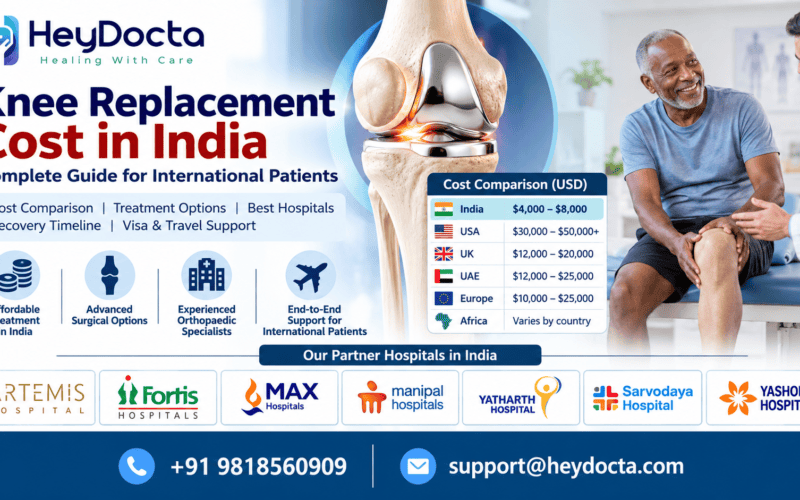
| Country or region | Partial knee replacement (USD) | Total knee replacement (USD) |
| India | $3,000–$6,000 | $4,000–$8,000 |
| USA | $20,000–$35,000 | $30,000–$50,000+ |
| UK, private treatment | $8,000–$14,000 | $12,000–$20,000 |
| UAE, private treatment | $8,000–$15,000 | $12,000–$25,000 |
| Africa | Varies by country and hospital | Varies by country and hospital |
| Europe, private treatment | Varies by country | Varies by country |
These figures are indicative only and should be verified with current hospital quotations. Costs differ by country, hospital, implant, insurance coverage and whether rehabilitation is included. Public healthcare eligibility may also change what patients pay in the UK and Europe.
What Affects the Cost of Knee Replacement in India?
The total price can depend on:
- Partial versus total knee replacement.
- Implant brand, design and materials.
- Standard versus robotic-assisted surgery.
- Surgeon, anaesthesia and operating theatre charges.
- Hospital room category and length of admission.
- Preoperative investigations and medicines.
- Physiotherapy, follow-up visits and any additional treatment.
Patients travelling from abroad should also budget for flights, visas, accommodation, local transport and extra days if recovery takes longer than expected.
Want to compare treatment costs? HeyDocta can help you request estimates from partner hospitals and clarify what is included in each package. Quotations depend on medical review and confirmation by the hospital.
How Is the Right Procedure Selected?
The orthopaedic surgeon usually reviews the patient’s symptoms, examines the knee and assesses X-rays. Additional imaging or tests may be recommended when necessary.
The decision considers:
- Location of arthritis: Whether damage is confined to one compartment or affects several.
- Ligament stability: Whether the knee’s supporting ligaments are functioning adequately.
- Knee alignment: Whether deformity can be addressed with the proposed procedure.
- General health: Other conditions that may affect surgery and recovery.
- Patient goals: Activity expectations, mobility needs and willingness to complete rehabilitation.
A partial replacement may be suitable for a patient with localised arthritis, while widespread damage may make total replacement more appropriate. The final decision is made after a clinical assessment.
Step-by-Step Treatment Process in India
1. Share Medical Records
Send recent knee X-rays, previous reports, treatment history, medication details and information about other medical conditions.
2. Obtain a Medical Opinion
The orthopaedic team reviews the records and advises whether further assessment or imaging is needed. A final decision may require an in-person examination.
3. Confirm the Treatment and Cost
Request a written estimate covering the implant, hospital stay, investigations, medicines, rehabilitation and possible additional charges.
4. Arrange Travel and Visa Requirements
Check the latest Indian visa rules for your nationality and treatment. Arrange flights and accommodation only after coordinating the proposed treatment dates with the hospital.
5. Undergo Surgery and Rehabilitation
After surgery, the team monitors your recovery and starts mobilisation and physiotherapy when medically appropriate.
6. Plan Follow-Up and Return Travel
Obtain your discharge summary, implant information, medication instructions and rehabilitation plan. Your surgeon must assess whether you are fit for a long-haul flight.
Recovery Time and Length of Stay in India
Recovery varies by patient, procedure and rehabilitation progress.
- Hospital stay: Often around 1–3 days after uncomplicated partial replacement and 2–5 days after total replacement, subject to clinical condition and hospital protocols.
- Initial recovery: Patients usually need walking aids and supervised physiotherapy.
- Stay in India: Many international patients should plan approximately 2–3 weeks, sometimes longer, depending on the procedure and travel clearance.
- Further recovery: Strength, walking ability and daily function may improve over several weeks or months.
Partial replacement often allows faster early recovery for suitable patients, but individual results vary. Do not book a fixed return date without discussing travel fitness with your surgeon.
Medical Visa and Travel Support
International patients should confirm current Indian visa requirements with the official authorities and the treating hospital. A medical visa and hospital documentation may be required, depending on eligibility and current rules.
HeyDocta can assist with hospital coordination, appointment scheduling, treatment estimates and travel guidance. Visa approval remains the responsibility of the relevant authorities. Patients should also plan for follow-up care in their home country.
Frequently Asked Questions
1. Is partial knee replacement better than total knee replacement?
Neither is universally better. Partial replacement may suit patients whose arthritis is limited to one compartment, while total replacement may be more appropriate for widespread joint damage.
2. Is partial knee replacement cheaper in India?
It may cost less than total replacement in some cases, but the final price depends on the implant, hospital package, surgical complexity and recovery requirements.
3. Which procedure has a faster recovery?
Partial replacement often allows faster early recovery in appropriately selected patients. Recovery varies with health, surgical factors and rehabilitation.
4. Can partial knee replacement be converted to total knee replacement later?
Yes. If arthritis progresses or other problems develop, some patients may need revision surgery or conversion to total knee replacement. This is not inevitable, but it should be discussed before surgery.
5. How long should international patients stay in India?
A stay of approximately 2–3 weeks is a common planning starting point, but some patients need longer. Your treating surgeon should confirm when it is safe to travel.
6. Does robotic surgery guarantee better results?
No. Robotic assistance may support planning and component positioning, but it does not guarantee better outcomes or eliminate surgical risks. Suitability and expected benefits should be discussed with the surgeon.
7. Does HeyDocta charge patients for coordination?
HeyDocta provides medical tourism facilitation without an additional facilitation charge to patients. Hospital treatment, medicines, investigations, travel, accommodation, visa fees and other third-party expenses are separate and should be confirmed in advance.
Conclusion: Make an Informed Knee Replacement Decision
Choosing between partial and total knee replacement depends on the extent of arthritis, ligament health, overall medical condition and individual treatment goals. Partial replacement may preserve more of the natural knee in suitable patients, while total replacement may be appropriate for more widespread joint damage. Cost matters, but clinical suitability, hospital quality and rehabilitation planning should guide the final decision.
HeyDocta supports international patients from Africa, Guyana, Jamaica, the USA, Europe and the Middle East with medical opinions, partner hospital coordination, treatment cost estimates and travel guidance.
Contact HeyDocta.com to discuss your knee condition, compare partial and total knee replacement costs in India and plan your next steps.