
Finding the right specialist is one of the most important steps when planning a bone marrow transplant in India. Patients from Nigeria, Kenya, Ghana, Cameroon, Zimbabwe, Guyana, Jamaica, the Middle East, Europe and the USA often compare doctors based on transplant experience, specialization, hospital facilities, treatment options, donor-matching services and overall treatment cost.
India has experienced hematologists and bone marrow transplant specialists working across major transplant centres. Treatment can also be more affordable than private treatment in several Western countries. However, there is no single doctor who is the right choice for every patient. The appropriate specialist depends on the diagnosis, transplant type, age, donor availability and previous treatment.
HeyDocta helps international patients obtain medical opinions, coordinate with suitable Indian hospitals and understand estimated treatment costs.
Get a Free Medical Opinion | Talk to Our Medical Tourism Expert
Why Choose a Specialized BMT Doctor?
Bone marrow transplantation is a complex treatment involving multiple stages, including disease assessment, conditioning treatment, stem-cell collection or donor preparation, transplantation, engraftment and long-term follow-up.
The National Cancer Institute explains that the choice between autologous and allogeneic transplantation depends on factors such as the disease, previous treatment, availability of matching donor cells and the patient’s ability to tolerate high-dose treatment.
A specialist should therefore have experience relevant to the patient’s particular condition and transplant type.
Important factors include:
- Experience in hematology and stem-cell transplantation
- Experience with the required type of BMT
- Treatment of the patient’s specific blood disorder
- HLA and donor-matching expertise
- Access to a dedicated transplant unit
- Infection-control facilities
- Blood-bank and transfusion support
- Critical-care backup
- Long-term follow-up arrangements
Types of Bone Marrow Transplant in India
Autologous Stem Cell Transplant
The patient’s own stem cells are collected and returned after high-dose treatment. This approach is commonly used for selected conditions such as multiple myeloma and certain lymphomas.
Allogeneic Stem Cell Transplant
Stem cells are obtained from a donor. The donor may be a matched sibling, matched unrelated donor or partially matched family member.
Haploidentical Transplant
A partially matched family member provides the stem cells. This can be an option when a fully matched donor is unavailable or unsuitable.
Matched Unrelated Donor Transplant
Stem cells are obtained from a compatible unrelated donor after appropriate donor identification and matching.
The final decision should always be made by the treating transplant team after reviewing the patient’s medical history and test results.
Selected Bone Marrow Transplant Doctors in India
Rather than presenting a universal ranking, international patients can consider specialists with documented BMT roles at established Indian hospitals.
Dr. Gaurav Dixit – Artemis Hospitals, Gurugram
Dr. Gaurav Dixit is Head – Haematology Oncology & Bone Marrow Transplant at Artemis Hospitals, Gurugram. His specialties include BMT, hematopoietic stem-cell transplantation, hematology, oncology and paediatric haemato-oncology.
His listed transplant procedures include:
- Autologous stem-cell transplant
- Matched sibling allogeneic transplant
- Haploidentical stem-cell transplant
- Matched unrelated donor transplant
- CAR T-cell therapy
His areas of expertise include leukemia, myeloma, lymphoma, aplastic anemia, thalassemia, sickle-cell disease and other hematological disorders. His qualifications include MBBS, MD in General Medicine and DM in Clinical Hematology.
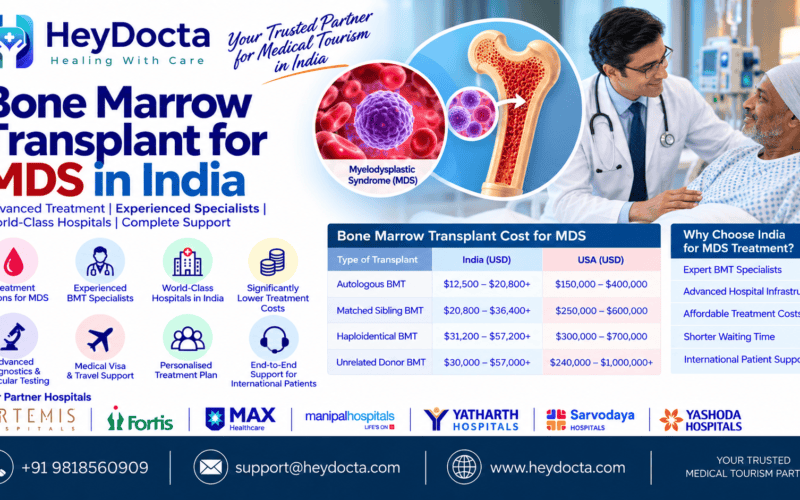
Bone Marrow Transplant Cost in India
Treatment cost is an important consideration for international patients, but the final quotation depends on the individual case.
Some Hospitals currently publishes a general BMT cost range of USD15,700 –31,500 in India, with variations based on hospital, location, room type and complications.
Current 2026 market data from MedCasts lists approximately USD 25,560–59,510 for autologous BMT and USD 34,660–81,380 for allogeneic BMT in India. These are indicative quoted ranges and not guaranteed prices for every patient.
| Treatment Type | Indicative India Cost |
| Autologous BMT | USD 25,560–59,510* |
| Allogeneic BMT | USD 34,660–81,380* |
| Haploidentical BMT | USD 36,440–87,040* |
Indicative 2026 market ranges. Actual costs can vary according to diagnosis, donor requirements, medicines, hospital stay, complications and services included.
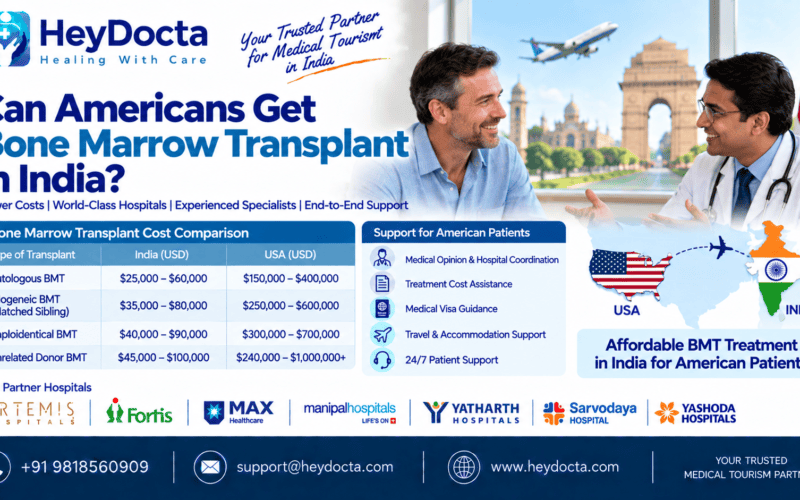
India vs USA: Bone Marrow Transplant Cost
For international patients, the difference in private-treatment costs can be substantial.
The U.S. Health Resources and Services Administration states that an unrelated bone marrow or cord-blood transplant in the USA can cost USD 240,000 to more than USD 1 million, including the transplant and up to six months of care.
| Factor | India | USA |
| Autologous BMT | Approx. USD 25,560–59,510* | Generally higher |
| Allogeneic BMT | Approx. USD 34,660–81,380* | USD 240,000–1M+ in some unrelated-donor cases* |
| Donor matching | Available at transplant centres | Available through specialized systems |
| International travel | Additional | Depends on patient’s location |
These figures are not directly equivalent package definitions, so patients should compare itemized quotations rather than headline prices alone.
Talk to Our Medical Tourism Expert to compare your treatment estimate and suitable Indian hospitals.
How to Choose the Right BMT Doctor
Before selecting a specialist, international patients should ask:
- Does the doctor treat the patient’s specific condition?
- How frequently does the doctor perform the required type of transplant?
- Does the hospital offer HLA and donor-matching services?
- Is there a dedicated BMT unit?
- What infection-control measures are available?
- Is ICU and blood-bank support available?
- What follow-up care is provided after discharge?
- What costs are included in the treatment estimate?
A doctor with extensive general experience may not necessarily be the most suitable for every disease or transplant type. The clinical match between the patient and specialist is important.
Bone Marrow Transplant Process in India
Step 1: Medical Record Review
The specialist reviews diagnosis reports, pathology, imaging, blood tests and previous treatments.
Step 2: Specialist Consultation
The BMT team determines whether transplantation is appropriate and discusses available options.
Step 3: Donor Evaluation
For allogeneic transplantation, HLA testing and donor assessment may be required.
Step 4: Treatment Planning
The hospital provides a treatment plan and estimated cost.
Step 5: Conditioning
Depending on the treatment protocol, chemotherapy and/or radiation may be given before transplantation.
Step 6: Stem-Cell Infusion
The stem cells are administered through an IV or central venous catheter.
Step 7: Engraftment
The transplanted stem cells begin producing new blood cells. NCI describes engraftment as the process through which transplanted stem cells begin producing white blood cells, red blood cells and platelets.
Step 8: Recovery and Follow-Up
Blood counts, infections, graft-versus-host disease and other potential complications are monitored.
Recovery and Stay in India
BMT recovery is a gradual process. NCI notes that immune recovery can take several months after autologous transplantation and one to two years after allogeneic or syngeneic transplantation.
International patients should plan for:
- Hospital stay
- Post-discharge accommodation
- Regular blood tests
- Medicines
- Infection precautions
- Follow-up consultations
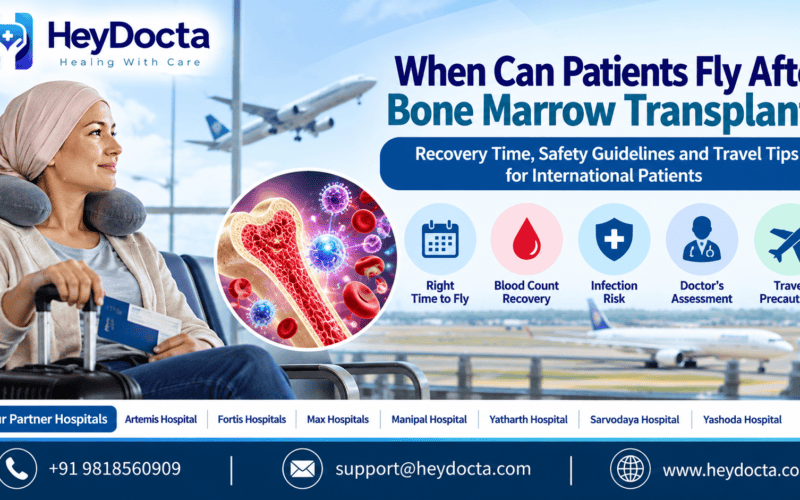
- Medical clearance before travelling home
The exact timeline differs from patient to patient.
Medical Visa and Travel Support
HeyDocta can support international patients with the non-clinical aspects of travelling to India for treatment.
Support may include:
- Medical record coordination
- Specialist consultation
- Hospital appointment scheduling
- Treatment-cost estimates
- Medical visa documentation guidance
- Airport transfers
- Accommodation coordination
- Local transportation
- Communication with the hospital
- Follow-up coordination
HeyDocta does not charge patients an additional fee for its coordination service. Hospital treatment, medicines, travel and accommodation costs remain separate.
Partner Hospitals for International Patients
HeyDocta can coordinate with partner hospitals including:
- Artemis Hospital
- Fortis Hospitals
- Max Hospitals
- Manipal Hospital
- Yatharth Hospital
- Sarvodaya Hospital
- Yashoda Hospital
The appropriate hospital and specialist should be selected according to the patient’s diagnosis, transplant requirements, location and medical assessment.
FAQs About Bone Marrow Transplant Doctors in India
Which doctor is best for bone marrow transplant?
There is no universally appropriate doctor for every patient. The choice should depend on the patient’s disease, transplant type, age, donor availability and specialist experience.
How much does BMT cost in India?
A general published Indian estimate is around USD15,700 –31,500, while current market data shows broader ranges depending on transplant type and package inclusions.
Is BMT cheaper in India than the USA?
Private BMT treatment is generally quoted at substantially lower prices in India than some U.S. self-pay estimates. HRSA reports USD 240,000 to more than USD 1 million for some unrelated U.S. transplants and up to six months of care.
Can international patients consult Indian BMT doctors before travelling?
Many Indian hospitals offer online or remote consultation options. Medical records can be reviewed before travel, allowing the transplant team to determine whether an in-person evaluation is appropriate.
How long does BMT recovery take?
Recovery varies significantly. Blood-cell recovery and immune-system recovery occur at different rates, and allogeneic transplantation can require prolonged monitoring.
Can HeyDocta help international patients find a BMT specialist?
Yes. HeyDocta can coordinate medical records, specialist opinions, hospital appointments, treatment estimates, visa guidance and travel arrangements.
Conclusion
Choosing among the best bone marrow transplant doctors in India should be based on medical suitability rather than a simple ranking. International patients should consider the doctor’s experience with their specific disease and transplant type, the hospital’s BMT infrastructure, donor-matching services, infection-control systems, blood-bank support and follow-up facilities.
India also offers comparatively affordable private BMT treatment for many international patients, but the final cost must be calculated according to the patient’s individual treatment plan.
HeyDocta helps patients from Africa, the Caribbean, the Middle East, Europe and the USA connect with Indian BMT specialists and coordinate their treatment journey.
Get a Free Medical Opinion and Treatment Cost from Top Indian Hospitals. Contact HeyDocta.com for specialist coordination, hospital arrangements, medical-visa guidance, travel assistance and end-to-end support.