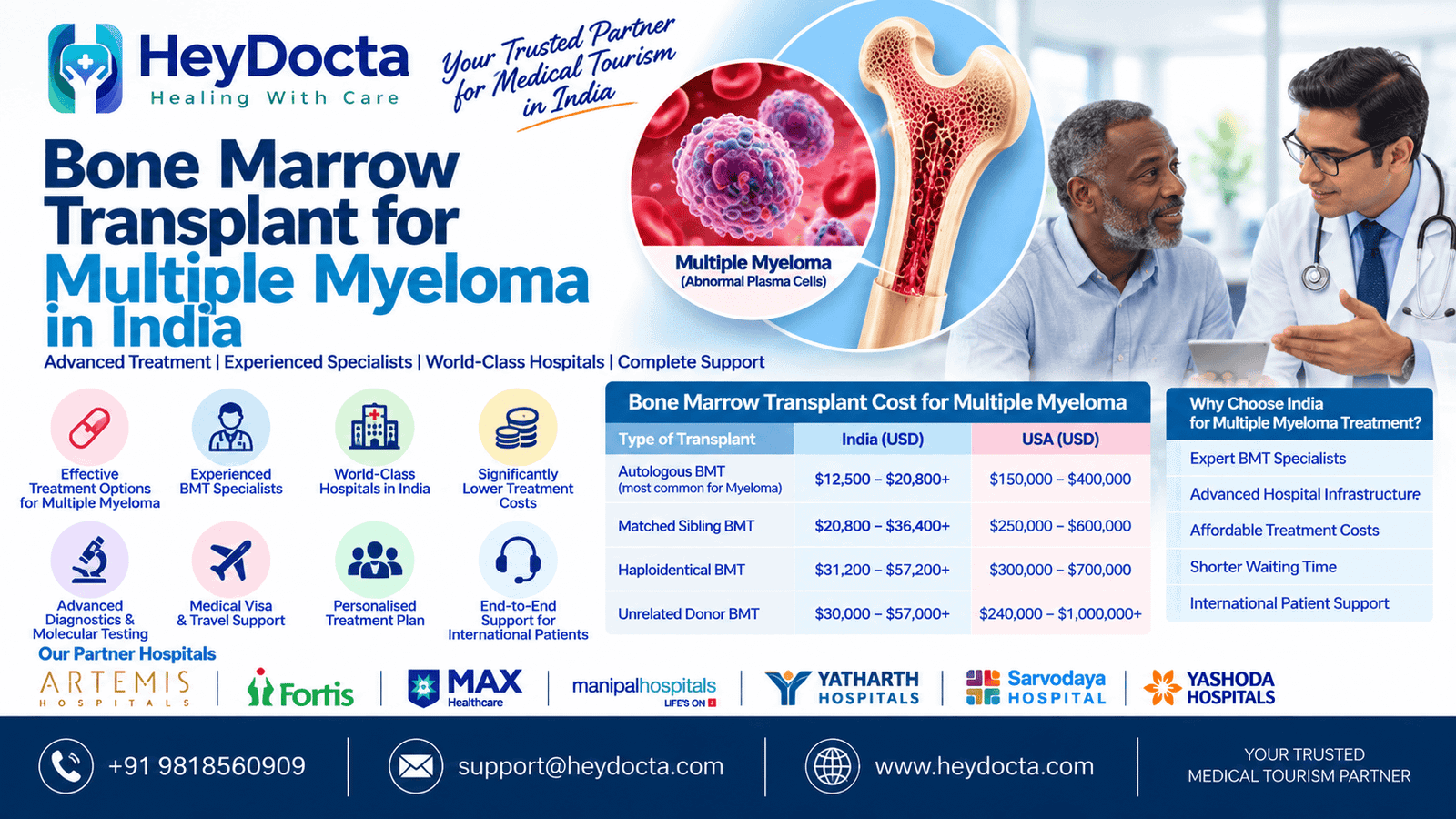
Bone marrow transplant for multiple myeloma in India usually refers to an autologous stem cell transplant (ASCT), in which the patient’s own blood-forming stem cells are collected, stored and returned after high-dose treatment. It is an established treatment approach for selected transplant-eligible patients with multiple myeloma.
For international patients from Africa, the Middle East, Europe, the USA and other regions, India can provide access to specialised hematology and transplant teams, while treatment costs may be lower than in several Western healthcare markets.
However, not every patient with multiple myeloma needs a transplant. Age, fitness, kidney function, disease characteristics, response to initial treatment and the treating specialist’s assessment all influence the treatment plan.
Get a Free Medical Opinion: HeyDocta can coordinate your medical records with Indian hematology specialists, help identify suitable hospitals and obtain an indicative treatment-cost estimate.
What Is Multiple Myeloma?
Multiple myeloma is a cancer of plasma cells, a type of blood cell found mainly in the bone marrow. Abnormal plasma cells can produce an abnormal protein and interfere with normal blood-cell production and bone health.
Patients may experience:
- Bone pain
- Anemia and fatigue
- Frequent infections
- Kidney problems
- High calcium levels
- Weakness
- Fractures or bone lesions
Treatment depends on whether the disease requires immediate therapy, the patient’s overall health and whether the patient is considered eligible for stem cell transplantation.
The NCI describes treatment as a combination of approaches that may include induction therapy, stem cell transplantation and maintenance therapy.
Is Bone Marrow Transplant Used for Multiple Myeloma?
Yes. For suitable patients, autologous stem cell transplant can be used after initial drug treatment.
Modern multiple myeloma treatment commonly follows several stages:
- Initial or induction therapy
- Stem cell collection
- High-dose conditioning treatment
- Autologous stem cell transplant
- Maintenance therapy
The NCI notes that fit patients may receive several months of induction therapy followed by autologous stem cell transplant and subsequent maintenance treatment.
Importantly, “bone marrow transplant” is commonly used in everyday language, but for multiple myeloma the transplant is generally an autologous peripheral blood stem cell transplant, rather than a donor bone marrow transplant.
Who May Be Eligible for Stem Cell Transplant?
Eligibility is determined individually. Doctors may consider:
- Age
- Overall fitness
- Heart, lung and kidney function
- Multiple myeloma stage and risk
- Response to induction therapy
- Ability to collect an adequate number of stem cells
- Previous treatments
- Other medical conditions
Older age alone does not automatically exclude every patient. The NCI notes that transplant eligibility is increasingly based on overall fitness and health rather than age alone.
Patients who are not suitable for transplant may have other treatment options involving combinations of targeted therapy, immunotherapy and other medicines.
Why International Patients Consider India for Multiple Myeloma Treatment
Patients from Nigeria, Kenya, Ghana, Zimbabwe, Cameroon, Guyana, Jamaica, the Middle East, Europe and the USA may explore India because of:
- Specialised hematology and BMT departments
- Experienced transplant specialists
- Modern diagnostic and laboratory facilities
- Availability of autologous stem cell transplantation
- Potentially lower treatment costs
- International patient coordination
- Medical visa assistance
- Travel and accommodation support
- Follow-up coordination
Cost is an important consideration, but patients should compare the complete treatment pathway, including medicines, stem-cell collection, hospitalisation and follow-up.
Bone Marrow Transplant Options for Multiple Myeloma
Autologous Stem Cell Transplant
This is the most commonly discussed transplant approach for transplant-eligible multiple myeloma patients.
The patient’s own stem cells are collected, usually from the bloodstream, and stored. High-dose chemotherapy is then given, after which the collected stem cells are returned to help restore blood-cell production.
Tandem Autologous Transplant
In selected situations, doctors may consider two planned autologous transplants. This is not appropriate for every patient and depends on disease characteristics and treatment response.
Allogeneic Stem Cell Transplant
An allogeneic transplant uses stem cells from a donor. It may be considered in selected multiple myeloma situations, particularly certain relapsed or high-risk cases, but it has different risks and is not the routine transplant approach for most newly diagnosed patients.
Stem Cell Transplant Is Not Required for Every Patient
Some patients may be considered transplant-ineligible or may defer transplantation and continue with drug-based treatment and maintenance. Current treatment decisions increasingly consider disease biology and individual patient fitness.
BMT in India for Multiple Myeloma
International patients can seek an opinion from specialised hematology and BMT teams in India.
Dr. Gaurav Dixit is Head – Haematology Oncology & Bone Marrow Transplant at Artemis Hospitals, Gurugram. His official profile lists BMT, hematopoietic stem cell transplantation, hematology and oncology among his specialties. It also lists myeloma among his special interests. His profile states that he received a professional certificate in multiple myeloma and lists autologous, matched-sibling allogeneic, haploidentical and matched-unrelated donor transplantation among his procedures.
Artemis Hospitals’ BMT division lists multiple myeloma among the malignant blood disorders treated by its transplant team.
Patients should choose a specialist based on their diagnosis, transplant eligibility, treatment history and individual medical requirements.
Bone Marrow Transplant Cost for Multiple Myeloma in India
Affordability is one of the major reasons international patients explore India for stem cell transplantation.
For 2026 planning, an India-focused cost guide estimates:
- Autologous BMT: USD 12,500–20,800
- Matched-related allogeneic BMT: USD 20,800–36,400
- Haploidentical/unrelated or complex BMT: USD 31,200–57,200+
For multiple myeloma, the relevant figure is generally the autologous transplant range, although the complete myeloma treatment journey can cost more because induction medicines, stem-cell collection and maintenance treatment may be separate from the transplant package.
Some Hospitals gives a broader general BMT estimate of approximately USD15,700 –31,500 noting that the final cost depends on the hospital, location, room type and complications.
India vs USA: Indicative Cost Comparison
| Treatment Component | India | USA |
| Autologous BMT planning range | USD 12,500–20,800+ | Varies significantly |
| Matched-related BMT | USD 20,800–36,400+ | Generally higher |
| Complex donor BMT | USD 31,200–57,200+ | Generally higher |
| Extended transplant care | Hospital-specific | Can add substantially to total cost |
For multiple myeloma, a direct comparison should include induction therapy + stem-cell collection + transplant + hospitalisation + medicines + maintenance therapy, rather than comparing only the transplant procedure.
Talk to Our Medical Tourism Expert: HeyDocta can help you request an itemised treatment estimate from a suitable Indian hospital based on the patient’s diagnosis and previous treatment.
What Can Increase Multiple Myeloma Treatment Cost?
The total cost may depend on:
- Type of treatment
- Induction medicines
- Number of treatment cycles
- Stem-cell mobilisation
- Stem-cell collection and storage
- Conditioning chemotherapy
- Hospitalisation
- Laboratory testing
- Blood products
- Supportive medicines
- Infection management
- Complications
- Maintenance treatment
- Follow-up investigations
International patients should also budget for flights, accommodation, local transportation and caregiver expenses.
Partner Hospitals for Multiple Myeloma and BMT
Depending on medical suitability and hospital availability, HeyDocta can coordinate enquiries with:
- Artemis Hospitals
- Fortis Hospitals
- Max Hospitals
- Manipal Hospitals
- Yatharth Hospitals
- Sarvodaya Hospital
- Yashoda Hospitals
There is no single hospital that is appropriate for every multiple myeloma patient. The treating centre should be selected according to transplant eligibility, specialist expertise, diagnostic facilities, supportive care and the patient’s treatment plan.
Step-by-Step Multiple Myeloma Transplant Process in India
Step 1: Medical Records Review
Patients can provide:
- Bone marrow biopsy reports
- Serum protein electrophoresis
- Immunofixation reports
- Free light-chain results
- Cytogenetic or molecular reports
- PET-CT or other imaging
- Kidney-function reports
- Previous treatment records
Step 2: Specialist Consultation
A hematologist reviews the diagnosis, disease risk, previous treatment and overall health.
Step 3: Induction Treatment
Transplant-eligible patients may first receive several months of combination therapy to reduce the myeloma burden. The exact medicines depend on the patient’s clinical situation.
Step 4: Stem Cell Collection
Stem cells are mobilised and collected from the bloodstream. They are then stored until transplantation.
Step 5: High-Dose Conditioning
High-dose chemotherapy, commonly involving melphalan in autologous myeloma transplantation, is used before the stem cells are returned.
Step 6: Stem Cell Infusion
The patient’s stored stem cells are infused back into the bloodstream.
Step 7: Engraftment and Recovery
The medical team monitors blood counts, infections, organ function and other parameters until the transplanted cells begin producing blood cells.
Step 8: Maintenance and Follow-Up
Maintenance treatment may be recommended after transplant to help control the disease over the longer term.
Medical Visa and Travel Support for International Patients
Eligible international patients can apply for an Indian e-Medical Visa. The official Indian e-Visa system provides e-Medical and e-Medical Attendant categories and requires documentation from the treating hospital.
HeyDocta can assist patients with:
- Hospital invitation documentation
- Appointment coordination
- Medical visa guidance
- Airport transfers
- Accommodation
- Local transportation
- Attendant arrangements
Patients should verify current visa requirements before booking travel.
Recovery and Stay in India After Transplant
Recovery varies significantly between patients. Hospitalisation is required during the early post-transplant period, followed by regular outpatient monitoring.
Patients may need:
- Frequent blood tests
- Infection monitoring
- Medicines
- Nutritional support
- Blood-product support when required
- Follow-up consultations
- Monitoring of kidney and other organ function
International patients should not book a fixed return flight without discussing travel plans with their treating team.
How HeyDocta Supports International Myeloma Patients
HeyDocta acts as a medical tourism facilitator and can support patients throughout the treatment journey.
Services may include:
- Medical opinion coordination
- Hospital coordination
- Specialist appointment scheduling
- Treatment-cost estimates
- Medical visa assistance
- Travel and accommodation support
- Airport transfers
- Attendant coordination
- Follow-up communication
HeyDocta does not charge patients an additional service fee for its medical-tourism facilitation, subject to the specific hospital and travel arrangements.
Frequently Asked Questions
Is bone marrow transplant used for multiple myeloma?
Yes. Autologous stem cell transplantation is an established treatment approach for selected transplant-eligible multiple myeloma patients.
Is autologous or allogeneic transplant more common for multiple myeloma?
Autologous transplantation using the patient’s own stem cells is the more commonly used transplant approach for eligible multiple myeloma patients. Allogeneic transplantation is considered only in selected circumstances.
How much does multiple myeloma stem cell transplant cost in India?
For 2026 planning, an autologous BMT may cost approximately USD 12,500–20,800+ in India. The complete multiple myeloma treatment pathway can cost more because induction, collection, maintenance medicines and follow-up may be additional.
Is multiple myeloma treatment cheaper in India than the USA?
Treatment costs in India can be considerably lower, but a meaningful comparison should include the complete treatment pathway and not just the transplant procedure.
How long does the multiple myeloma transplant process take?
The overall journey can take several months because induction treatment generally occurs before stem-cell collection and transplantation. The exact timeline depends on disease response, stem-cell collection and the patient’s health.
Can older patients receive an autologous stem cell transplant?
Some older patients may be eligible if they are sufficiently fit. Transplant suitability is based on overall health and fitness rather than age alone.
Can international patients receive multiple myeloma treatment in India?
Yes. Eligible international patients can seek planned medical treatment in India, subject to current visa requirements and medical suitability.
Conclusion
Bone marrow transplant for multiple myeloma in India generally involves autologous stem cell transplantation for selected patients who are considered suitable for transplant. Treatment usually includes induction therapy, stem-cell collection, high-dose conditioning, stem-cell infusion and subsequent maintenance or follow-up treatment.
India can be an option for international patients because of its specialised hematology and transplant services and potentially lower treatment costs. However, treatment should be planned around the patient’s disease characteristics, transplant eligibility, overall health and long-term follow-up needs.
Get a Free Medical Opinion and Multiple Myeloma Treatment Cost Estimate: Contact HeyDocta.com to share your medical records and connect with suitable Indian hematology and BMT specialists. HeyDocta can assist with hospital coordination, cost estimates, medical visa guidance, travel planning and follow-up support.