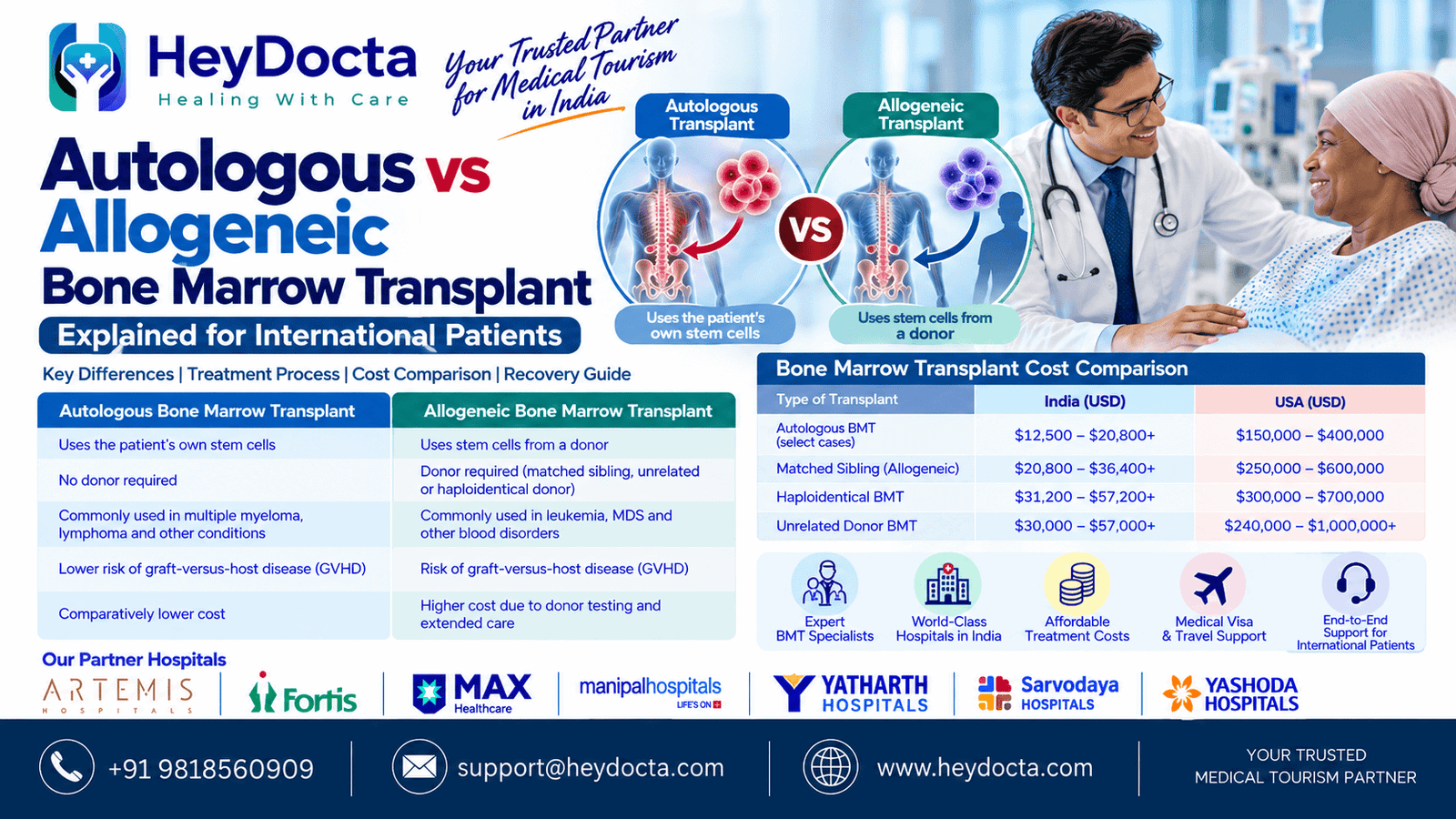
Autologous vs allogeneic bone marrow transplant is one of the most important comparisons for patients considering stem-cell transplantation in India. Both are forms of hematopoietic stem-cell transplantation (HSCT), but the main difference is the source of the stem cells. An autologous transplant uses the patient’s own stem cells, while an allogeneic transplant uses stem cells from another person (a donor).
The choice is not simply about which transplant is better. It depends on the disease, treatment history, disease response, donor availability, overall health and the risks and benefits expected by the treating transplant team.
For international patients from Nigeria, Kenya, Ghana, Zimbabwe, Cameroon, Guyana, Jamaica, the Middle East, Europe and the USA, understanding this difference can also make it easier to compare treatment plans and costs in India.
HeyDocta supports international patients with medical opinions, hospital coordination, treatment-cost estimates, visa guidance, travel assistance and follow-up planning.
Get a Free Medical Opinion: Share your medical reports with HeyDocta to understand which transplant approach may be considered for your condition.
What Is the Difference Between Autologous and Allogeneic Transplant?
The simplest distinction is:
- Autologous transplant: The patient’s own blood-forming stem cells are collected, stored and returned after high-dose treatment.
- Allogeneic transplant: Blood-forming stem cells are obtained from a donor and infused into the patient after conditioning treatment.
The National Cancer Institute explains that autologous transplantation uses the patient’s own stem cells, while allogeneic transplantation uses stem cells from a related or unrelated donor.
Autologous vs Allogeneic BMT at a Glance
| Feature | Autologous Transplant | Allogeneic Transplant |
| Stem-cell source | Patient’s own cells | Donor’s cells |
| Donor required | No | Yes |
| HLA matching | Not required between donor and patient | Important |
| Common applications | Selected lymphoma, multiple myeloma and other conditions | Selected leukemia, MDS, lymphoma and other disorders |
| GVHD risk | No donor-versus-patient GVHD | Possible |
| Main challenge | Disease relapse remains possible | Donor matching, infections and GVHD |
| Immune effect | No donor immune-cell effect | Donor immune cells may provide graft-versus-tumor effects |
| Recovery | Varies by treatment | Often more prolonged |
The appropriate transplant depends on the patient’s diagnosis and clinical circumstances rather than the transplant name alone.
What Is an Autologous Bone Marrow Transplant?
An autologous bone marrow transplant is more accurately described in many cases as an autologous stem-cell transplant.
The patient’s stem cells are collected before high-dose treatment. They are processed and stored, and then returned after the conditioning treatment.
Typical Autologous Transplant Process
- Disease assessment and transplant evaluation
- Stem-cell mobilisation
- Stem-cell collection, usually through the bloodstream
- Cell processing and storage
- High-dose conditioning treatment
- Stem-cell infusion
- Engraftment and monitoring
- Follow-up treatment
Autologous transplantation is used in selected diseases, including some lymphomas and multiple myeloma. The exact indication depends on the disease and treatment response.
One advantage is that the cells are already matched to the patient. However, because the patient’s own cells are returned, there is no donor immune system to provide a graft-versus-tumor effect.
What Is an Allogeneic Bone Marrow Transplant?
An allogeneic transplant uses blood-forming stem cells from another person.
Potential donors may include:
- Matched siblings
- Other related donors
- Haploidentical family donors
- Matched unrelated donors
- Selected cord-blood sources
HLA testing helps the transplant team evaluate donor compatibility. The NCI notes that close matching is important because the patient’s immune system can recognise donor cells as foreign.
Allogeneic transplantation can also produce a graft-versus-tumor or graft-versus-leukemia effect, in which donor immune cells can help attack abnormal cells. However, this type of transplant also carries risks that do not occur in the same way with autologous transplantation.
Graft-Versus-Host Disease
One major complication of allogeneic transplantation is graft-versus-host disease (GVHD). It occurs when donor immune cells attack the patient’s tissues.
GVHD can affect organs such as the skin, liver and intestines and may be acute or chronic. The risk is influenced by donor matching and other transplant factors.
When Is Autologous Transplant Considered?
Autologous transplantation may be considered when:
- The patient’s disease is suitable for high-dose treatment
- The patient’s own stem cells can be collected
- A donor transplant is not required
- The expected benefits justify the treatment risks
- The patient is medically able to undergo intensive therapy
It is commonly used in selected cases of multiple myeloma and lymphoma, although the specific indication depends on disease subtype and response.
When Is Allogeneic Transplant Considered?
Allogeneic transplantation may be considered when:
- A donor-based transplant offers a potential treatment benefit
- The disease is suitable for an allogeneic approach
- A suitable donor is available
- The patient can tolerate the transplant
- Other treatment options may not provide adequate disease control
It is used in selected cases of leukemia, MDS and other blood disorders. The NCI stresses that transplant choice depends on disease type, disease status, donor availability, previous treatment and the patient’s ability to tolerate intensive therapy.
Bone Marrow Transplant Specialist in India
Dr. Gaurav Dixit at Artemis Hospitals, Gurugram is Head – Haematology Oncology & Bone Marrow Transplant . Artemis lists his specialty areas as BMT, haematopoietic stem-cell transplantation, haematology and oncology.
His listed transplant procedures include:
- Autologous stem-cell transplant
- Matched-sibling allogeneic stem-cell transplant
- Haploidentical stem-cell transplant
- Matched unrelated donor transplant
- CAR-T cell therapy
Artemis lists his areas of expertise across malignant and benign blood disorders, including leukemia, lymphoma, multiple myeloma and myelodysplastic syndrome.
Artemis’ BMT division provides transplantation services for malignant and non-malignant blood disorders.
Autologous vs Allogeneic Bone Marrow Transplant Cost in India
The cost of bone marrow transplant in India depends strongly on whether the transplant is autologous or allogeneic.
Some Hospitals currently reports a general BMT cost of approximately USD15500 to 31000, with costs varying according to hospital, location, room category and complications.
For 2026 planning, an India-focused transplant cost guide estimates:
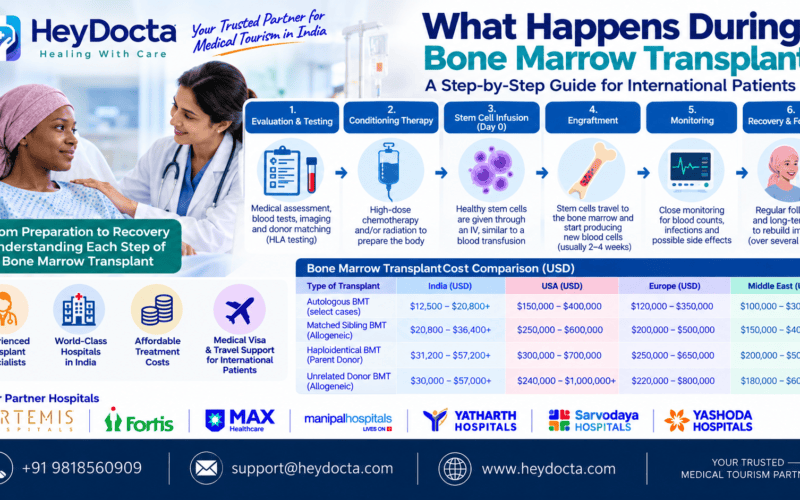
- Autologous transplant: approximately USD 12,500–20,800
- Matched-related allogeneic transplant: approximately USD 20,800–36,400
- Haploidentical, unrelated-donor, cord or complicated pathways: approximately USD 31,200–57,200+
These are planning ranges rather than guaranteed hospital package prices.
India vs USA: Transplant Cost Comparison
| Transplant pathway | India – indicative planning range | USA – cost context |
| Autologous | USD 12,500–20,800 | Generally lower than unrelated-donor transplant |
| Matched-related allogeneic | USD 20,800–36,400 | Higher depending on centre and care |
| Alternative/complex donor | USD 31,200–57,200+ | Can be substantially higher |
| Unrelated donor transplant | Varies by case | USD 240,000 to over USD 1 million, including transplant and up to 6 months of care |
The U.S. Health Resources & Services Administration reports that an unrelated bone marrow or cord-blood transplant can range from USD 240,000 to more than USD 1 million, including the transplant and up to six months of care. Donor-search expenses can also be additional.
These figures should not be treated as direct package-to-package comparisons because the services included in hospital quotations differ.
Talk to Our Medical Tourism Expert: HeyDocta can help international patients obtain personalised treatment estimates from suitable Indian hospitals after reviewing their medical records.
What Makes Allogeneic Transplant More Expensive?
Allogeneic transplantation may involve additional costs related to:
- HLA testing
- Donor evaluation
- Donor mobilisation and collection
- Registry or unrelated donor search
- Cell processing and transportation
- GVHD prevention
- Immunosuppressive medicines
- Longer monitoring
- Infection treatment
- Extended hospitalisation
- Readmission after discharge
Autologous transplantation generally avoids donor-search and donor-matching costs, although stem-cell mobilisation, collection and high-dose treatment still contribute significantly to the overall expense.
Hospitals for Bone Marrow Transplant in India
International patients can explore BMT and haematology services through partner hospitals including:
- Artemis Hospitals
- Fortis Hospitals
- Max Hospitals
- Manipal Hospitals
- Yatharth Hospitals
- Sarvodaya Hospital
- Yashoda Hospitals
The appropriate hospital should be selected according to the patient’s diagnosis, transplant type, donor requirements, specialist availability and required supportive-care infrastructure rather than a generic ranking.
Bone Marrow Transplant Process in India
Step 1: Medical Records Review
Patients share pathology reports, blood tests, imaging, bone-marrow reports and previous treatment records.
Step 2: Specialist Assessment
The transplant team reviews the diagnosis, disease status and previous treatments.
Step 3: Decide the Transplant Type
The team determines whether an autologous or allogeneic approach is appropriate.
Step 4: Stem-Cell or Donor Evaluation
For autologous transplantation, stem-cell mobilisation and collection are planned. For allogeneic transplantation, HLA testing and donor evaluation are performed.
Step 5: Pre-Transplant Testing
Organ function, infection status, blood counts and other relevant investigations are assessed.
Step 6: Conditioning Treatment
High-dose chemotherapy, with or without radiation depending on the protocol, prepares the body for transplantation.
Step 7: Stem-Cell Infusion
The collected stem cells are infused through an intravenous line. The stem cells then travel to the bone marrow and begin producing blood cells.
Step 8: Engraftment and Monitoring
Blood counts, infections, organ function and other possible complications are closely monitored.
Step 9: Follow-Up
After discharge, patients require continued follow-up. International patients should coordinate their care between the Indian transplant team and their local haematologist.
Medical Visa and Travel Support
Eligible international patients can apply for an Indian e-Medical Visa. The official Indian e-Visa portal requires a hospital letter on its letterhead for an e-Medical Visa application, including the proposed or tentative admission date.
HeyDocta can assist international patients with:
- Hospital appointment coordination
- Medical opinion coordination
- Hospital invitation documentation
- Medical visa guidance
- Airport and local transportation
- Accommodation assistance
- Caregiver coordination
- Follow-up appointment planning
Recovery and Stay in India
Recovery depends on the transplant type, disease, conditioning regimen and complications.
Autologous transplant patients generally do not face GVHD, but they can still experience infections, low blood counts and other treatment-related complications.
Allogeneic transplant patients may require longer monitoring because of infection risks, immune suppression and possible GVHD. NCI notes that stem-cell transplantation can cause both short- and long-term complications and that immune recovery can continue for a prolonged period.
International patients should plan their accommodation and return travel around medical clearance rather than a fixed pre-booked schedule.
Frequently Asked Questions
1. What is the main difference between autologous and allogeneic transplant?
Autologous transplantation uses the patient’s own stem cells, while allogeneic transplantation uses stem cells from a donor.
2. Which transplant is more expensive in India?
Allogeneic transplantation is generally more expensive because it can involve donor testing, HLA matching, donor collection, GVHD prevention and longer monitoring. However, actual costs vary by patient and transplant pathway.
3. Which transplant has a risk of GVHD?
Allogeneic transplantation carries the risk of graft-versus-host disease because donor immune cells can react against the patient’s tissues.
4. Is autologous transplant safer than allogeneic transplant?
They have different risks and benefits. Autologous transplantation avoids donor-related complications such as GVHD, while allogeneic transplantation may provide a donor immune effect against certain diseases. The appropriate option depends on the patient’s condition.
5. How much does BMT cost in India?
General BMT estimates are around USD15000–30000, while 2026 planning ranges can vary from approximately USD12000 for some autologous pathways to USD 55000 or more for complex allogeneic pathways.
6. Can international patients travel to India for BMT?
Eligible international patients can travel to India for medical treatment subject to Indian visa requirements and medical suitability. Medical records should be reviewed by the transplant team before travel.
7. Does HeyDocta charge an additional coordination fee?
HeyDocta provides medical tourism facilitation, hospital coordination and visa/travel assistance without an additional service charge to patients for its facilitation support. Patients remain responsible for actual hospital treatment, medicines, investigations, flights, accommodation and other expenses.
Conclusion
Understanding autologous vs allogeneic bone marrow transplant is important before choosing a treatment pathway. Autologous transplantation uses the patient’s own stem cells and is used in selected diseases such as multiple myeloma and lymphoma. Allogeneic transplantation uses donor stem cells and is considered for selected blood cancers and blood disorders where donor transplantation may provide a clinical benefit.
India offers specialised haematology and transplant centres and comparatively lower treatment costs than many Western healthcare systems. However, the transplant type, donor strategy, treatment cost and recovery period must be determined individually by a qualified transplant team.
HeyDocta supports international patients from Africa, the Middle East, Europe, the USA and the Caribbean with medical opinion coordination, hospital coordination, cost estimates, visa assistance, travel planning and follow-up support.Get Treatment Cost from Indian Hospitals: Share your medical reports with HeyDocta.com to discuss the appropriate transplant pathway and receive guidance on estimated treatment costs from Indian hospitals