Haploidentical bone marrow transplant in India is an allogeneic stem-cell transplant option in which the donor is a partially HLA-matched relative, usually sharing about 50% of the patient’s HLA type. This approach can be important when a fully matched sibling or suitable unrelated donor is not available.
For international patients from Nigeria, Kenya, Ghana, Zimbabwe, Cameroon, Guyana, Jamaica, the Middle East, Europe and the USA, India offers specialised haematology and transplant centres and comparatively lower treatment costs. However, haploidentical transplantation is a complex procedure and suitability must be determined by a transplant specialist based on the disease, patient condition, donor availability and other clinical factors.
HeyDocta helps international patients coordinate medical opinions, hospitals, treatment estimates, medical visas, travel and follow-up care.
Get a Free Medical Opinion: Share your medical reports with HeyDocta to understand whether a haploidentical transplant may be an option for your condition.
What Is a Haploidentical Bone Marrow Transplant?
A haploidentical transplant is a type of allogeneic hematopoietic stem-cell transplant (HSCT).
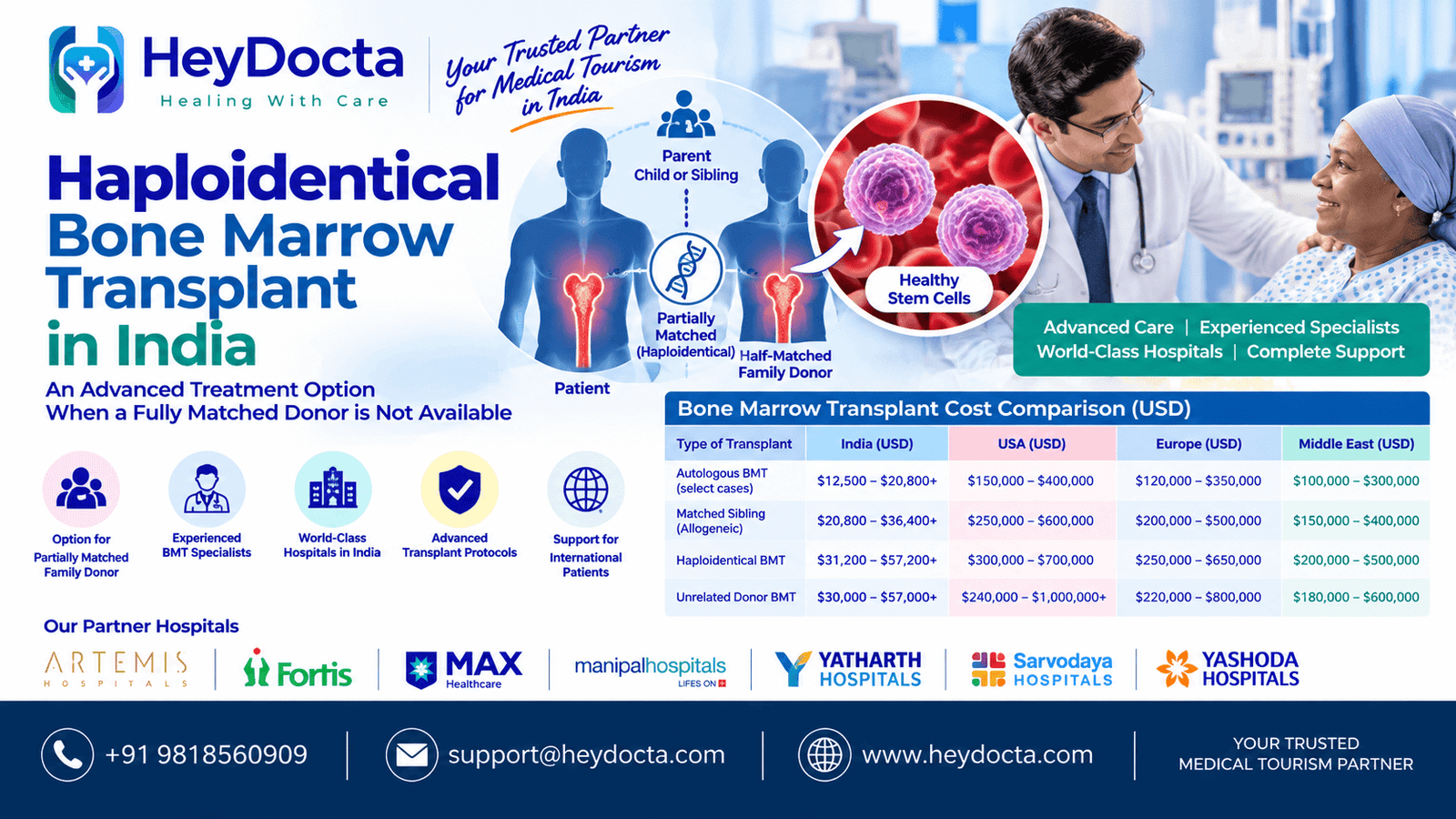
“Haploidentical” means that the donor is partially matched, usually sharing approximately half of the recipient’s HLA markers. A parent, child or sibling may potentially serve as a haploidentical donor.
This approach has expanded donor availability for patients who do not have a fully matched donor.
Depending on the transplant centre and treatment protocol, stem cells may be collected from the donor’s peripheral blood or bone marrow.
Who May Need a Haploidentical Transplant?
A haploidentical transplant may be considered when:
- An allogeneic transplant is medically appropriate
- A fully matched sibling donor is unavailable
- A suitable unrelated donor cannot be identified in the required timeframe
- A partially matched family donor is available
- The patient’s disease and medical condition support transplantation
It can be considered in selected patients with blood cancers and bone-marrow disorders, including some cases of AML, ALL, MDS, lymphoma and other haematological diseases. The exact indication depends on disease status and the transplant team’s assessment. NCI clinical-trial information also describes haploidentical transplantation using related half-matched donors for selected high-risk blood disorders.
A haploidentical transplant is not automatically appropriate simply because a matched donor is unavailable. The transplant team evaluates the patient’s disease, donor options, HLA results, organ function, infection status and other factors.
Why Is Haploidentical Transplant Important?
One of the major challenges in allogeneic transplantation is finding an appropriate donor.
A fully matched sibling is not available for every patient. Finding a well-matched unrelated donor can also take time and may be difficult for patients whose HLA types are less common in donor registries.
Haploidentical transplantation allows a suitable family member who is only partially HLA matched to potentially serve as the donor. NCI notes that haploidentical donors can include parents, children or siblings when a fully or closely matched donor is unavailable.
For international patients, this can be particularly relevant because donor availability and the time needed for donor searches can influence treatment planning.
Haploidentical Transplant Specialist in India
Dr. Gaurav Dixit at Artemis Hospitals, Gurugram is Head – Haematology Oncology & Bone Marrow Transplant. Artemis lists his specialties as BMT, haematopoietic stem-cell transplantation, haematology and oncology.
His listed transplant procedures include:
- Haploidentical stem-cell transplant
- Matched sibling allogeneic transplant
- Matched unrelated donor transplant
- Autologous stem-cell transplant
- CAR-T cell therapy
Artemis lists his areas of expertise across malignant and non-malignant blood disorders, including leukemia, lymphoma, myelodysplastic syndrome, multiple myeloma and aplastic anemia.
Artemis also has a dedicated BMT service and describes specialised transplant infrastructure, including positive-pressure isolation rooms designed to help reduce infection exposure.
Haploidentical Bone Marrow Transplant Cost in India
The haploidentical bone marrow transplant cost in India depends on the patient’s disease, donor evaluation, conditioning treatment, stem-cell collection, hospitalisation, medicines, complications and duration of follow-up.
Some Hospitals currently gives a general BMT cost range of USD 15000 to 31000 while noting that the final cost can vary according to hospital, location, room category and complications.
A 2026 India cost guide reports that allogeneic transplantation generally starts at a higher level than autologous transplantation and that haploidentical or unrelated-donor procedures can increase the overall cost. It gives a broad 2026 BMT range of approximately USD 10000–USD 40000 depending on transplant type and complexity.
For planning purposes, haploidentical transplantation in India may therefore fall toward the higher end of general BMT cost ranges, but a patient-specific quotation is essential.
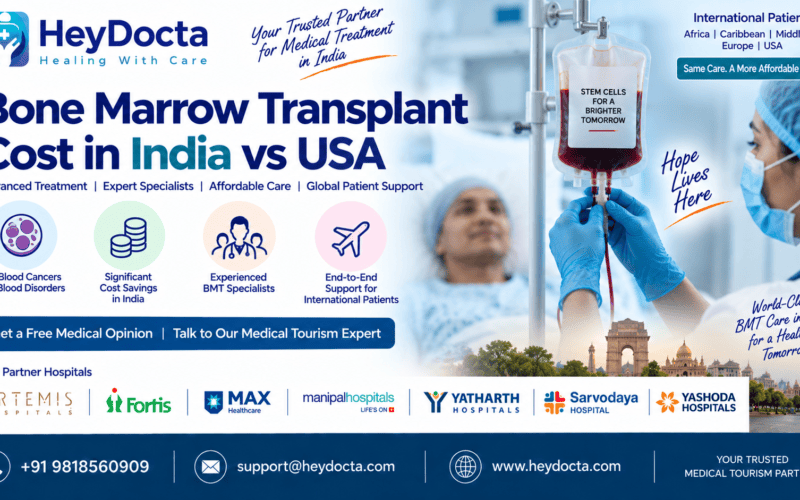
Haploidentical BMT Cost: India vs USA
| Country | Indicative Cost | Important Factors |
| India | Often within the higher end of the general ₹10–40 lakh BMT planning range | Donor evaluation, conditioning, hospitalisation and complications |
| India – complex allogeneic pathway | May exceed the basic BMT range | Donor-related and post-transplant care |
| USA | USD 240,000 to over USD 1 million for unrelated BMT/cord-blood transplant and up to 6 months of care | Donor search and extended care can add costs |
The U.S. Health Resources & Services Administration reports that an unrelated bone marrow or cord-blood transplant can cost USD 240,000 to more than USD 1 million, including the transplant and up to six months of care. It also notes that donor-search costs can range from USD 10,000 to more than USD 50,000 in some situations.
These figures are not direct package comparisons because hospitals and healthcare systems may include different services in their estimates.
What Is Included in the Cost?
A hospital quotation may include some or all of the following:
- Initial transplant evaluation
- HLA testing
- Donor evaluation
- Stem-cell collection
- Conditioning chemotherapy
- Stem-cell infusion
- Hospitalisation
- Protective isolation
- Blood and platelet transfusions
- Antibiotics and other medicines
- GVHD prevention
- Laboratory monitoring
- Infection management
- Early post-transplant follow-up
Additional expenses may include flights, accommodation, food, caregiver costs, local transportation and prolonged treatment if complications occur.
Talk to Our Medical Tourism Expert: HeyDocta can coordinate with suitable Indian hospitals to help international patients obtain an individual treatment plan and cost estimate.
Haploidentical vs Matched Donor Transplant
The key difference is the degree of HLA matching.
| Feature | Haploidentical Transplant | Matched Donor Transplant |
| Donor match | Usually about 50% | Closer/full match depending on donor |
| Typical donor | Parent, child or sibling | Matched sibling or suitable unrelated donor |
| Donor availability | Family-based option when a full match is unavailable | Depends on sibling or donor registry |
| GVHD risk | Requires specific prevention strategies | Also carries GVHD risk |
| Donor search | May avoid a prolonged unrelated-donor search | May require donor search |
| Cost | Depends on protocol and complications | Depends on donor and treatment pathway |
Both are allogeneic transplants and can involve significant risks. The appropriate donor is selected by the transplant team after detailed HLA and medical evaluation.
GVHD and Other Risks
Because haploidentical transplantation uses donor cells, graft-versus-host disease (GVHD) is an important potential complication.
GVHD occurs when donor immune cells recognise the patient’s tissues as foreign and attack them. It can affect the skin, liver, intestines and other organs and can be acute or chronic.
Modern transplant protocols use different strategies to reduce this risk. Post-transplant cyclophosphamide is one approach used in some allogeneic transplant protocols, sometimes alongside other immunosuppressive medicines.
Other potential complications can include:
- Infections
- Low blood counts
- Organ complications
- Mucositis
- GVHD
- Delayed immune recovery
- Disease relapse
NCI notes that stem-cell transplantation can cause both short- and long-term complications, so patients need careful monitoring.
Partner Hospitals for BMT in India
International patients can explore BMT and haematology services through HeyDocta’s partner network, including:
- Artemis Hospitals
- Fortis Hospitals
- Max Hospitals
- Manipal Hospitals
- Yatharth Hospitals
- Sarvodaya Hospital
- Yashoda Hospitals
The appropriate centre should be selected based on the patient’s diagnosis, transplant protocol, donor situation, specialist availability and required supportive care.
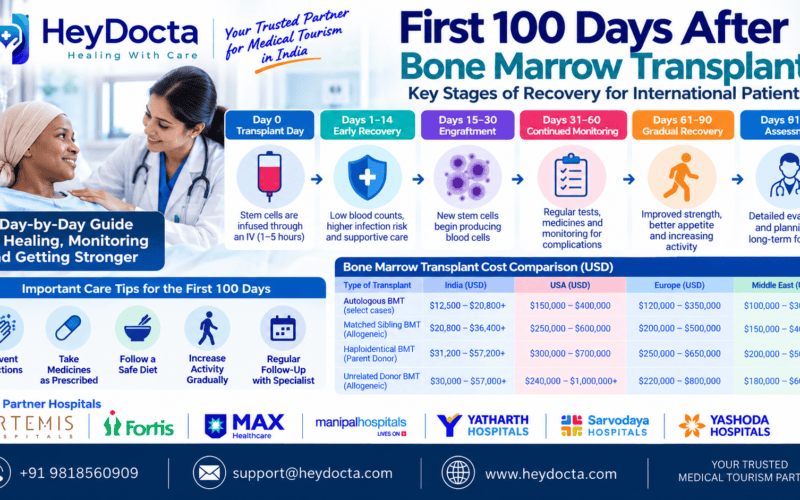
Haploidentical Bone Marrow Transplant Process in India
Step 1: Medical Records Review
The patient shares pathology reports, blood counts, bone-marrow reports, molecular or genetic tests, imaging and previous treatment records.
Step 2: Specialist Consultation
The transplant team determines whether an allogeneic transplant is appropriate and evaluates alternative donor options.
Step 3: HLA and Donor Testing
Potential family donors undergo HLA testing and medical screening. A haploidentical donor is generally a partially matched relative.
Step 4: Pre-Transplant Assessment
The patient undergoes investigations of organ function, infection status, blood counts and overall fitness for transplantation.
Step 5: Conditioning Treatment
Chemotherapy, with or without radiation depending on the treatment protocol, is given to prepare the patient for donor stem-cell infusion.
Step 6: Donor Stem-Cell Collection
The donor’s stem cells are collected according to the transplant centre’s protocol.
Step 7: Stem-Cell Infusion
The donor stem cells are infused into the patient’s bloodstream.
Step 8: Engraftment and Monitoring
The transplant team closely monitors blood counts, infections, GVHD and other complications while the donor cells establish blood-cell production.
Step 9: Follow-Up Care
After discharge, regular monitoring continues. International patients need a coordinated follow-up plan with the Indian transplant team and their local haematologist.
Medical Visa and Travel Support
Eligible international patients can apply for an Indian e-Medical Visa. The official Indian e-Visa portal requires a hospital letter on its letterhead containing the proposed or tentative admission date for an e-Medical Visa application.
HeyDocta can assist with:
- Medical opinion coordination
- Hospital appointments
- Hospital invitation documentation
- Medical visa guidance
- Airport transfers
- Accommodation assistance
- Caregiver arrangements
- Follow-up appointment coordination
Recovery and Stay in India
Haploidentical transplantation requires close monitoring during and after the initial hospitalisation. The length of stay varies according to conditioning, engraftment, infection, GVHD and other individual factors.
Patients may need to remain close to the transplant centre after discharge for regular blood tests and clinical reviews.
NCI notes that immune recovery following allogeneic transplantation can take a prolonged period, making follow-up particularly important.
International patients should not book a fixed return date without medical clearance from their transplant team.
Frequently Asked Questions
1. What is a haploidentical bone marrow transplant?
It is an allogeneic stem-cell transplant using a partially HLA-matched donor, usually a family member who shares approximately half of the patient’s HLA type.
2. Who can be a haploidentical donor?
A parent, child or sibling may potentially be a haploidentical donor. HLA testing and detailed donor assessment are required before a donor is accepted.
3. How much does haploidentical BMT cost in India?
General BMT estimates in India range broadly from approximately USD 10000 to 40000, with haploidentical procedures often toward the higher end because of their complexity. The actual quotation depends on the hospital, donor evaluation, treatment protocol and complications.
4. Is haploidentical transplant safe?
Haploidentical transplantation can be an established option for selected patients, but it carries significant risks including infections and GVHD. Suitability must be assessed by an experienced transplant team.
5. How long does recovery take?
The initial recovery period can require several weeks of close medical monitoring, while immune recovery can take considerably longer. The timeline differs between patients.
6. Can international patients from Africa travel to India for haploidentical BMT?
Eligible international patients can travel to India for medical treatment subject to Indian visa requirements and medical suitability. Medical records should be reviewed before travel.
7. Does HeyDocta charge an additional coordination fee?
HeyDocta provides medical tourism facilitation, hospital coordination and visa/travel assistance without an additional service charge to patients for its facilitation support. Patients remain responsible for actual hospital treatment, medicines, investigations, flights, accommodation and other expenses.
Conclusion
Haploidentical bone marrow transplant in India provides an allogeneic transplant option for selected patients who do not have a fully matched donor but have a suitable partially matched family donor. The approach has expanded donor options, but it remains a complex treatment requiring specialised transplant care, careful donor selection and close monitoring.
India offers dedicated BMT centres, experienced transplant specialists and comparatively lower treatment costs than the USA and several other high-cost healthcare systems. However, the final treatment plan and cost depend on the patient’s disease, donor, conditioning protocol, hospital stay and possible complications.
HeyDocta supports international patients from Africa, the Middle East, Europe, the USA and the Caribbean with medical opinion coordination, hospital coordination, treatment-cost estimates, medical visa guidance, travel assistance and follow-up planning.
Get Treatment Cost from Indian Hospitals: Share your medical reports and donor information with HeyDocta.com to discuss potential haploidentical transplant options and receive guidance on estimated treatment costs in India.