For patients who need an allogeneic bone marrow or stem cell transplant, finding a suitable donor is one of the most important steps. The two commonly discussed options are a matched sibling donor and a matched unrelated donor. Understanding the difference can help international patients plan treatment, donor testing, travel and costs.
If you are considering treatment in India, HeyDocta can help coordinate medical opinions, hospital communication, donor-related coordination, visa assistance and travel arrangements.
Get a Free Medical Opinion: Share your medical reports with HeyDocta to understand potential treatment options and estimated hospital costs in India.
What Is a Matched Sibling Donor?
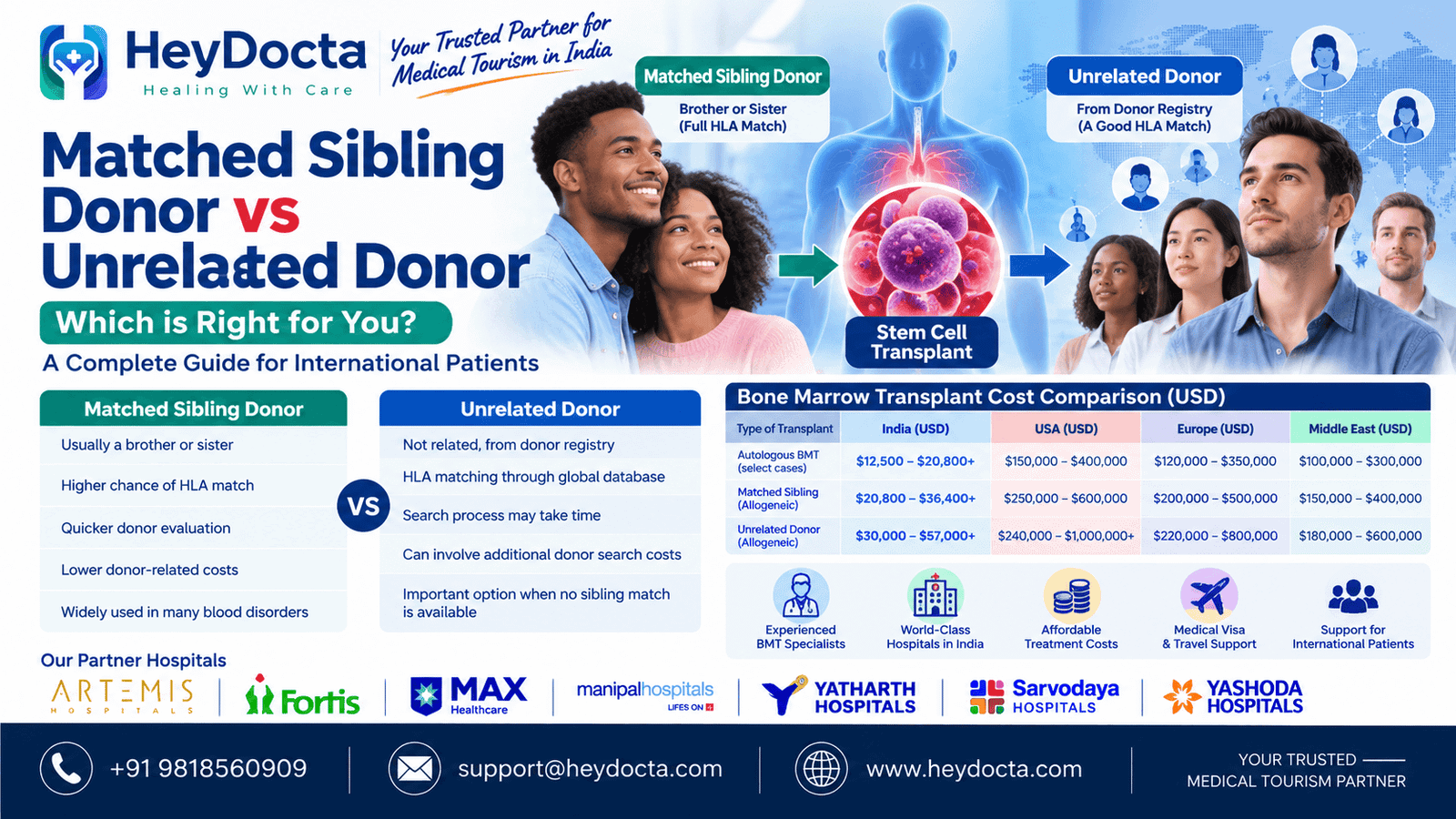
A matched sibling donor is usually a brother or sister whose human leukocyte antigen (HLA) markers closely match those of the patient. HLA testing is performed using blood or tissue samples to assess compatibility between donor and recipient.
A sibling from the same parents is often the first family donor evaluated because siblings can inherit matching HLA characteristics. However, being a biological sibling does not automatically mean that the person is a suitable donor. Formal HLA testing is still required.
What Is a Matched Unrelated Donor?
A matched unrelated donor is a person who is not biologically related to the patient but has suitable HLA characteristics.
If a suitable sibling cannot be found, doctors may search donor registries for an unrelated donor. The National Cancer Institute notes that finding an appropriately matched unrelated donor can be challenging, particularly for some ethnic and ancestral groups because HLA characteristics vary between populations.
For unrelated donor transplantation, high-resolution HLA testing is commonly used to determine the degree of compatibility.
Matched Sibling vs Unrelated Donor: Key Differences
| Factor | Matched Sibling Donor | Matched Unrelated Donor |
| Relationship | Brother or sister | Unrelated volunteer |
| HLA testing | Required | Required |
| Donor search | Usually starts within family | Requires registry search |
| Donor availability | Depends on family genetics | Depends on registry availability |
| Search process | Can be relatively straightforward if a sibling is available | May involve a more extensive search |
| Donor-related costs | Mainly testing and medical evaluation | May include registry/search and donor-related costs |
| Compatibility | Can provide a very close HLA match | Can also be highly matched |
| Transplant suitability | Depends on disease and patient factors | Depends on HLA match, donor suitability and clinical factors |
The final donor decision should always be made by the transplant team after reviewing HLA results, disease status, urgency, donor health and other clinical factors.
Which Donor Is Used for Bone Marrow Transplant?
There is no single donor option that is appropriate for every patient.
A transplant specialist may consider:
- Disease type and stage
- Patient age and general health
- HLA compatibility
- Availability of a suitable sibling
- Availability of an unrelated donor
- Urgency of transplantation
- Previous treatments
- Donor health and eligibility
- Risk of complications such as graft-versus-host disease (GVHD)
The NCI explains that the closer the donor’s stem cells match the recipient’s, the lower the likelihood of GVHD.
If a fully matched sibling is unavailable, a fully matched unrelated donor may be considered. In some cases, doctors may also consider other donor strategies, including haploidentical transplantation.
Matched Sibling Donor vs Unrelated Donor: Cost in India
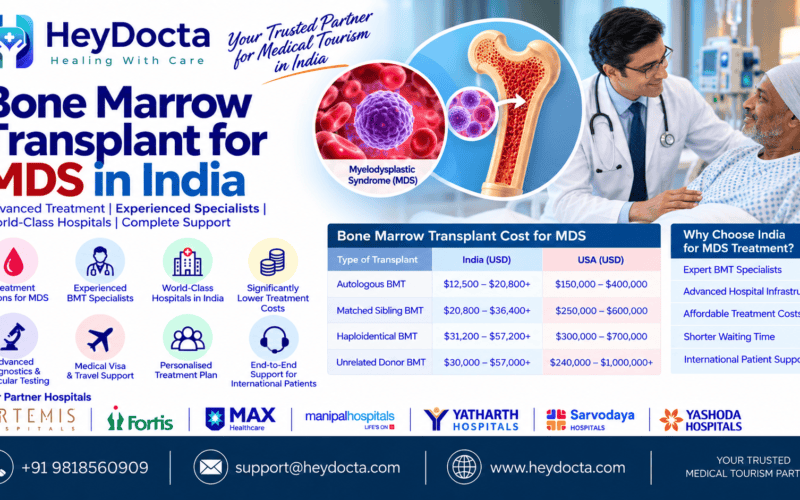
The total cost of an allogeneic bone marrow transplant depends on the transplant type, hospital, disease, conditioning treatment, donor testing, medicines, length of hospitalisation and complications.
Some Hospitals currently lists a general BMT cost range in India of approximately USD 15000 to 30000 while noting that the final cost varies according to hospital, location, room category and complications.
Indicative Cost Comparison
| Treatment / Cost Factor | India | USA |
| General BMT planning range | approx. USD 15,600–31,300 | — |
| Matched sibling transplant | Hospital-specific quote | Generally lower donor-search costs |
| Matched unrelated transplant | Hospital-specific quote | Can involve major donor-search and transplant costs |
| Unrelated donor search | Depends on transplant centre and registry | Donor search may cost USD 10,000–50,000+ |
| Complex complications | Additional | Can substantially increase total cost |
The U.S. Health Resources and Services Administration states that an unrelated bone marrow or cord blood transplant in the United States can range from USD 240,000 to more than USD 1 million, including the transplant and up to six months of care. It also notes that donor searches may cost USD 10,000 to more than USD 50,000 in some circumstances.
This illustrates why international patients often investigate India when comparing private treatment costs. However, prices in Europe, the Middle East and African countries vary substantially by healthcare system, hospital, insurance coverage and transplant complexity. A direct hospital quotation is therefore more reliable than a generic country-wide figure.
Why International Patients Consider India
International patients from Nigeria, Ghana, Kenya, Cameroon, Zimbabwe, Guyana, Jamaica, the Middle East, Europe and other regions may consider India for complex blood and cancer treatments because of the availability of specialised transplant centres and comparatively lower published treatment costs.
For international patients, the decision should not be based on price alone. Important factors include:
- Experience of the transplant team
- HLA and donor coordination
- Transplant infrastructure
- Infection-control protocols
- Blood bank and laboratory support
- Availability of ICU facilities
- Medicines and supportive care
- Follow-up arrangements
- Total estimated treatment cost
India has transplant centres across major cities, including hospitals such as Artemis Hospitals, Fortis Hospitals, Max Hospitals, Manipal Hospitals, Yatharth Hospital, Sarvodaya Hospital and Yashoda Hospital.
Bone Marrow Transplant Specialists in India
Patients should select a haematologist or transplant specialist according to their diagnosis and individual medical requirements.
Dr. Gaurav Dixit is Head – Haematology Oncology & Bone Marrow Transplant at Artemis Hospitals, Gurugram. His official profile lists 20 years of total experience and includes matched sibling allogeneic stem cell transplant and matched unrelated donor transplant among his procedures. His areas of expertise include acute myeloid leukemia, acute lymphoblastic leukemia, MDS, aplastic anemia and other haematological disorders.
Other transplant hospitals should also be evaluated based on the patient’s disease, donor availability, transplant protocol and specialist recommendation.
Step-by-Step Treatment Process
1. Medical Records Review
The transplant team reviews diagnosis, pathology, imaging, blood tests and previous treatment.
2. HLA Testing
The patient and potential family donors undergo HLA testing to identify compatibility.
3. Sibling Donor Evaluation
If a sibling appears compatible, additional medical testing determines whether the person is suitable to donate.
4. Unrelated Donor Search
If a suitable sibling is unavailable, the transplant team may initiate an unrelated donor search through appropriate registries.
5. Pre-Transplant Assessment
The patient undergoes organ-function tests, infection screening and other evaluations before transplantation.
6. Conditioning Therapy
Chemotherapy, with or without radiation depending on the protocol, prepares the body for the transplant. NHS guidance explains that conditioning is generally given before the donor stem cells are infused.
7. Stem Cell Infusion
The donor stem cells are administered through an intravenous line, similar to a blood transfusion.
8. Engraftment and Monitoring
The medical team monitors blood counts, infections, organ function and possible complications.
9. Long-Term Follow-Up
Regular follow-up is required after discharge. Recovery can take months, and some patients may need close monitoring for a year or longer.
Medical Visa and Travel Support for International Patients
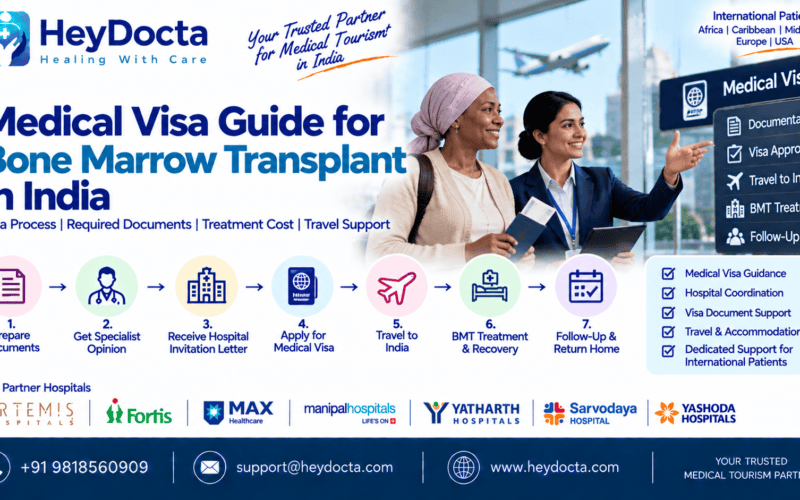
International patients travelling to India for transplantation need appropriate medical documentation and visa arrangements.
India’s official e-Visa information states that applicants for an e-Medical Visa need a scanned passport bio page and a letter from the Indian hospital on its letterhead showing the suggested admission or treatment date.
HeyDocta can assist international patients with:
- Hospital coordination
- Medical opinion and report sharing
- Treatment-cost estimates
- Donor coordination support
- Medical visa documentation guidance
- Airport and local travel assistance
- Accommodation coordination
- Follow-up communication with the hospital
HeyDocta’s facilitation service is designed to simplify the medical tourism journey without adding a separate service fee to the patient’s hospital treatment cost.
Talk to a Medical Tourism Expert: Get your medical reports reviewed and receive treatment options and an estimated cost from suitable Indian hospitals.
Recovery and Stay in India
The length of stay depends on the disease, transplant type, conditioning protocol, engraftment, complications and the treating team’s advice.
Patients may need to remain close to the transplant centre after discharge for regular blood tests, medicines and follow-up appointments. NCI notes that transplant patients require close follow-up, while NHS guidance states that patients usually spend several weeks in hospital and continue regular monitoring after discharge.
International patients should therefore plan for both the hospitalisation period and an additional period of local accommodation after discharge.
FAQs
1. Is a matched sibling donor better than an unrelated donor?
A matched sibling is often an important donor option, but the appropriate donor depends on HLA compatibility, disease, patient condition and transplant-team assessment.
2. What happens if I do not have a matched sibling?
Doctors may search for a suitable unrelated donor. Other donor options may also be considered depending on the clinical situation.
3. Is an unrelated donor more expensive?
It can involve additional donor-search and coordination expenses. In the U.S., HRSA reports unrelated donor searches can cost USD 10,000 to more than USD 50,000 in some cases.
4. How much does bone marrow transplant cost in India?
A general BMT range published by Some Hospitals is approximately USD15000–30000 but the final quotation depends on the transplant type, hospital and complications.
5. Can international patients get a matched donor transplant in India?
Yes. Indian transplant centres evaluate both related and unrelated donor options according to medical suitability and donor availability.
6. How long do I need to stay in India?
The duration varies significantly. Patients may require several weeks of hospital care followed by local follow-up and monitoring.
7. Can HeyDocta help with my transplant journey?
Yes. HeyDocta can coordinate hospital communication, medical opinions, estimated costs, visa guidance, travel arrangements and follow-up support for international patients.
Conclusion
The choice between a matched sibling donor and a matched unrelated donor depends on HLA compatibility, disease characteristics, donor availability, urgency and the transplant specialist’s assessment. A matched sibling may be evaluated first, while an unrelated donor can provide another option when a suitable family donor is unavailable.
For international patients, India offers access to specialised transplant centres with published BMT costs that can be substantially different from U.S. private-sector transplant costs. However, every patient should obtain an individual treatment plan and detailed hospital quotation before travelling.
Get Treatment Cost from Top Indian Hospitals: Contact HeyDocta.com for medical report review, hospital coordination, donor-related support, visa assistance and end-to-end international patient support for bone marrow transplantation in India.