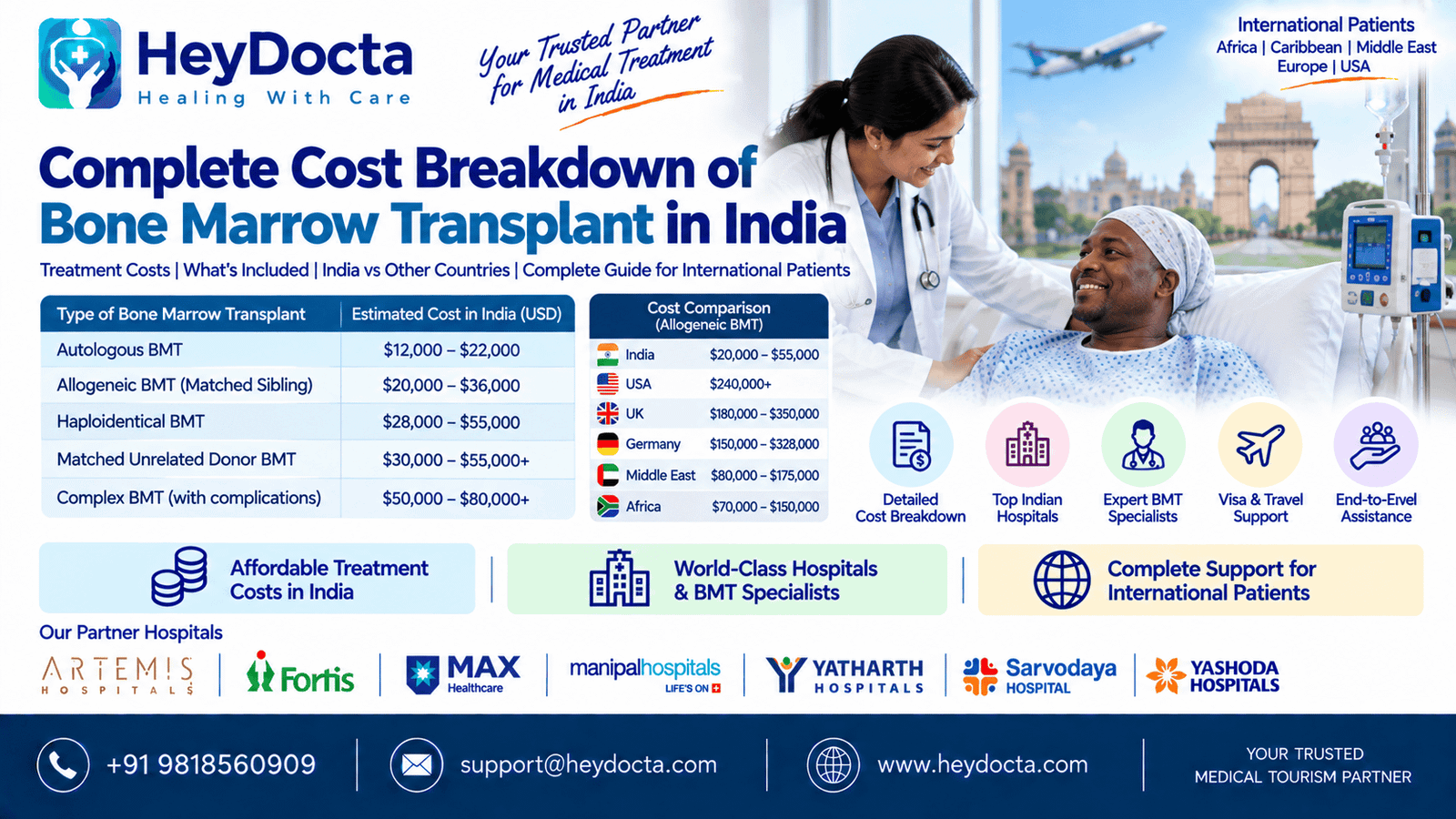
Planning a Bone Marrow Transplant (BMT) in India involves more than comparing one hospital price. The total cost depends on the transplant type, donor availability, disease condition, conditioning medicines, hospital stay, blood products, infection management, medicines and possible complications. For international patients from Nigeria, Ghana, Kenya, Zimbabwe, Cameroon, Guyana, Jamaica, the Middle East, Europe and the USA, India can offer significantly lower treatment costs than many Western healthcare systems. Current 2026 market estimates place several Indian BMT pathways in the USD 12,000–55,000+ range, depending on complexity.
Get a Free Medical Opinion: Share your medical reports with HeyDocta to understand the likely transplant type, hospital options and estimated treatment budget before travelling to India.
What Is a Bone Marrow Transplant?
A bone marrow transplant, more accurately called a hematopoietic stem cell transplant (HSCT), replaces damaged or diseased blood-forming cells with healthy stem cells. Depending on the disease and treatment plan, the cells may come from the patient or a donor.
BMT may be considered for selected patients with conditions such as leukemia, lymphoma, multiple myeloma, aplastic anemia, thalassemia, sickle cell disease and certain immune or inherited blood disorders. The appropriate transplant type is determined by the treating hematology and transplant team.
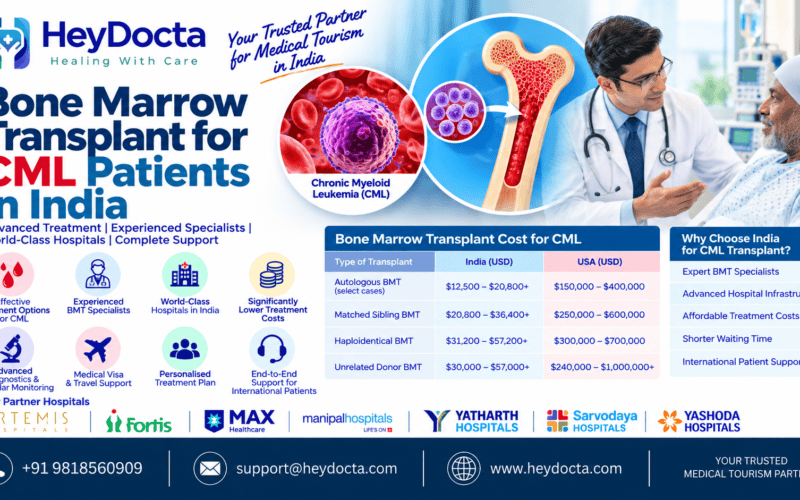
Bone Marrow Transplant Cost in India in USD
The following figures are indicative 2026 planning ranges, not fixed package prices. Actual quotations vary between hospitals and according to individual medical requirements.
| Type of BMT | Estimated Cost in India |
| Autologous BMT | USD 12,000–22,000 |
| Allogeneic – Matched Sibling Donor | USD 20,000–36,000 |
| Haploidentical BMT | USD 28,000–55,000 |
| Matched Unrelated Donor BMT | USD 30,000–55,000+ |
| Complex BMT with major complications | USD 50,000–80,000+ |
Recent 2026 Indian cost estimates show autologous transplantation around USD 12,500–20,800 and matched-related allogeneic transplantation around USD 20,800–36,400, while more complex donor pathways can exceed USD 50,000. Other current market data place haploidentical transplantation at approximately USD 36,440–87,040 depending on the hospital and case.
These figures should therefore be used for initial budgeting only. A written hospital quotation after medical review is more reliable.
What Does the BMT Cost Usually Include?
A transplant bill can contain several components:
- Hematologist and transplant specialist consultation
- Pre-transplant investigations
- HLA and donor-related testing
- Stem-cell collection
- Conditioning chemotherapy
- Stem-cell infusion
- Hospital and isolation-room charges
- Blood and platelet transfusions
- Antibiotics, antivirals and other medicines
- Laboratory monitoring
- Nursing and supportive care
- Initial post-transplant monitoring
Additional expenses may arise from prolonged hospitalization, infections, graft-versus-host disease (GVHD), ICU care, graft failure, additional procedures or readmission.
This is why two patients receiving the same type of BMT can have very different final bills.
Autologous vs Allogeneic BMT: Why Does the Price Differ?
Autologous BMT
In an autologous transplant, the patient’s own stem cells are collected before intensive treatment and later returned to the patient.
Because there is no donor search and no donor collection, this pathway is generally less expensive than donor transplantation.
Typical India cost: USD 12,000–22,000.
Allogeneic BMT
Allogeneic transplantation uses stem cells from another person. The donor may be a matched sibling, another related donor, a haploidentical family donor or an unrelated donor.
HLA matching, donor testing, donor collection and more complex post-transplant management can increase the overall cost.
Typical India cost: USD 20,000–55,000+, depending on donor pathway and complexity.
India vs USA: Bone Marrow Transplant Cost Comparison
Cost is one of the major reasons international patients investigate treatment in India.
| Country | Indicative BMT Cost |
| India | USD 12,000–55,000+ |
| USA | USD 240,000 to over USD 1 million for an unrelated transplant and up to six months of care |
| Germany | USD 150,000–328,000 for allogeneic BMT in current international package data |
| Other Western countries | Often substantially higher than Indian private-hospital estimates |
The U.S. Health Resources and Services Administration states that an unrelated bone marrow or cord-blood transplant in the USA can range from USD 240,000 to more than USD 1 million, including the transplant and up to six months of care. Donor-search expenses can also add USD 10,000–50,000 or more in some cases.
For allogeneic BMT, current international treatment data list India at approximately USD 34,660–81,380, compared with approximately USD 150,180–327,900 in Germany, although these figures represent quoted treatment ranges and should not be treated as universal national prices.
Why Is BMT More Affordable in India?
Several factors contribute to India’s comparatively lower medical costs:
- Lower hospital and accommodation costs
- Competitive specialist and clinical service fees
- Lower supporting medical-service costs
- Availability of experienced hematology and transplant teams
- Large private hospitals with dedicated transplant infrastructure
- International-patient departments
- Multiple hospital choices across major Indian cities
Affordability should not mean choosing treatment based only on the lowest quotation. The transplant type, hospital infrastructure, infection-control facilities, specialist expertise and post-transplant support should also be considered.
BMT Specialist in India
International patients considering treatment in India may consult experienced hematology and BMT specialists such as Dr. Gaurav Dixit at Artemis Hospitals, Gurugram.
Dr. Dixit is Head – Haematology Oncology & Bone Marrow Transplant at Artemis Hospitals. His areas include hematology, oncology, hematopoietic stem-cell transplantation and pediatric haemato-oncology. His listed procedures include autologous, matched-sibling allogeneic, haploidentical and matched-unrelated donor transplantation.
The final treatment plan should always be based on the patient’s diagnosis, medical reports, donor availability and transplant-team assessment.
BMT Hospitals in India for International Patients
HeyDocta can coordinate medical opinions and treatment enquiries with partner hospitals such as:
- Artemis Hospitals
- Fortis Hospitals
- Max Hospitals
- Manipal Hospitals
- Yatharth Hospitals
- Sarvodaya Hospital
- Yashoda Hospitals
For example, Fortis Gurugram reported more than 2,500 BMTs performed as of June 2026 and offers adult and pediatric transplant services, including autologous, allogeneic and haploidentical transplantation.
The appropriate hospital depends on the patient’s diagnosis, transplant type, donor situation, age, medical complexity and treating team’s expertise rather than on a universal ranking.
Bone Marrow Transplant Process in India
The treatment journey generally follows these stages:
- Medical report review: Previous diagnosis, pathology, imaging and treatment records are assessed.
- Specialist consultation: A hematology/BMT specialist determines whether transplantation is appropriate.
- Transplant planning: The transplant type and donor pathway are identified.
- HLA and donor testing: Required testing is performed for donor transplantation.
- Pre-transplant evaluation: Organ function, infections and general health are assessed.
- Conditioning: Chemotherapy and/or other conditioning treatment prepares the patient for transplantation.
- Stem-cell infusion: Collected stem cells are infused.
- Engraftment and monitoring: Blood counts, infections and other complications are closely monitored.
- Discharge and follow-up: The patient continues medicines, monitoring and specialist follow-up after discharge.
The hospital stay can vary considerably depending on transplant type and recovery. International patients should therefore plan accommodation and travel with flexibility.
Medical Visa and Travel Support
India offers an e-Medical Visa for eligible international patients and an e-Medical Attendant Visa for eligible accompanying attendants. The official Indian e-Visa portal states that a hospital letter containing the proposed admission/treatment date is required for an e-Medical Visa application.
HeyDocta can assist international patients with:
- Hospital coordination
- Medical opinion and report sharing
- Treatment-cost enquiries
- Medical visa documentation support
- Travel planning
- Airport and local coordination
- Accommodation assistance
- Communication with the hospital
- Post-treatment coordination
HeyDocta’s medical tourism coordination is provided at no extra cost to patients.
Talk to Our Medical Tourism Expert: Get assistance with hospital selection, medical reports, estimated BMT costs and travel planning before coming to India.
How Much Should You Budget for Your Complete BMT Journey?
The transplant quotation is only one part of an international patient’s total budget.
You should also consider:
- Flights
- Visa fees
- Accommodation before and after hospitalization
- Food and local transportation
- Companion expenses
- Diagnostic tests outside the package
- Additional medicines
- Extended hospital stay
- Management of complications
- Follow-up consultations
For this reason, patients should request an itemized treatment estimate that clearly explains what is included and what may be charged separately.
FAQs About Bone Marrow Transplant Cost in India
1. How much does a bone marrow transplant cost in India?
A BMT in India may cost approximately USD 12,000–55,000+, depending on transplant type, donor requirements, hospital and medical complexity.
2. What is the cheapest type of BMT in India?
Autologous transplantation is generally less expensive because the patient’s own stem cells are used. Indicative costs are around USD 12,000–22,000.
3. How much does allogeneic BMT cost in India?
Depending on the donor type and complexity, allogeneic BMT may cost approximately USD 20,000–55,000+.
4. Is donor testing included in the BMT package?
It depends on the hospital and package. Patients should specifically ask whether HLA testing, donor collection, donor-related expenses and additional medicines are included.
5. Can international patients receive BMT treatment in India?
Yes. Indian hospitals provide BMT services to international patients, subject to medical evaluation, eligibility and appropriate visa requirements.
6. How long should I stay in India for BMT?
The required stay varies by transplant type, engraftment, complications and follow-up requirements. International patients should generally allow several weeks and discuss their return-travel plan with the treating team.
7. Can HeyDocta help me get a BMT cost estimate?
Yes. HeyDocta can coordinate your medical reports with partner hospitals and help you obtain treatment-cost information before travelling to India.
Conclusion: Plan Your BMT in India With a Clear Cost Estimate
The complete cost of bone marrow transplant in India depends on much more than the basic procedure. Autologous transplantation may fall around USD 12,000–22,000, while donor-based and more complex transplants can reach USD 55,000 or more. Complications and prolonged treatment can increase the final expense.
Compared with the very high costs reported for unrelated transplantation in the USA, India can offer a substantially lower-cost pathway for eligible international patients. However, the right treatment plan must be determined by an experienced transplant team after reviewing the patient’s medical condition and donor requirements.
HeyDocta.com helps international patients coordinate medical opinions, hospital selection, treatment-cost enquiries, visa assistance, travel planning and hospital coordination throughout the treatment journey, with no extra service cost to patients.
Get a Free Medical Opinion from HeyDocta: Share your medical reports today and let our team help you understand your BMT treatment options and estimated cost in India.