Why bone marrow transplant costs less in India is an important question for patients from Nigeria, Ghana, Kenya, Zimbabwe, Cameroon, Guyana, Jamaica, the Middle East, Europe and the USA. Bone marrow transplant (BMT), also called haematopoietic stem cell transplant (HSCT), can involve major expenses in countries such as the USA and parts of Europe. India offers a comparatively affordable treatment pathway, while patients can access specialised transplant centres and experienced haematology teams.
However, lower cost does not mean that every patient’s treatment will have the same price. Transplant type, donor requirements, medicines, hospital stay, complications and the patient’s medical condition can significantly affect the final bill.
Get a Free Medical Opinion: International patients can share their medical reports with HeyDocta to understand potential treatment options, hospital choices and an estimated BMT cost in India before planning travel.
Why Is Bone Marrow Transplant More Affordable in India?
There is no single reason why BMT can cost less in India. The difference generally comes from the overall cost structure of healthcare, including staffing, hospital operations, medicines, diagnostics, accommodation and other medical services.
1. Lower Healthcare Operating Costs
India generally has lower operating and staffing costs than the USA and several Western countries. This can reduce the overall cost of hospital-based treatment.
BMT requires a large multidisciplinary team, including haematologists, transplant physicians, nurses, laboratory specialists, pharmacists, nutritionists and other healthcare professionals. Lower overall healthcare labour costs can contribute to a lower treatment price.
2. Lower Cost of Supporting Medical Services
A transplant is not simply the cost of the stem cell infusion. Patients may require:
- Blood tests and monitoring
- Imaging and diagnostic procedures
- Medicines
- Blood products
- Infection management
- Specialist consultations
- Isolation facilities
- Nursing care
- Nutrition support
- Follow-up consultations
When these services are comparatively affordable, the total treatment cost can also be lower.
3. Competitive Private Healthcare Sector
India has a large private healthcare sector with hospitals investing in specialised oncology, haematology and transplant programmes.
Competition between hospitals can contribute to competitive treatment packages. However, patients should compare hospitals based on transplant expertise, infection-control infrastructure, medical team experience and patient support, not price alone.
4. Pharmaceutical and Medical Supply Costs
The cost of medicines and medical supplies can vary considerably between countries. India has a large pharmaceutical industry and extensive domestic production of medicines, which can contribute to lower prices for some treatments and supportive medications.
The exact savings depend on the drugs required by each patient and whether imported medicines or specialised products are needed.
5. Lower Ancillary Costs
International patients also need to consider expenses outside the hospital.
Accommodation, local transportation, food and certain support services can be less expensive in India than in many Western countries. These costs are separate from the medical treatment bill but can influence the total medical tourism budget.
How Much Does Bone Marrow Transplant Cost in India?
Published hospital guidance from Some Hospitals currently places the general cost of bone marrow transplantation in India at approximately USD 15000 to 31000. The hospital notes that the actual cost can vary depending on the hospital, location, room category and complications.
This should be considered an indicative planning range, not a guaranteed package price.
The final estimate may depend on:
- Autologous or allogeneic transplant
- Matched sibling or unrelated donor
- Haploidentical transplantation
- Donor testing and matching
- Conditioning treatment
- Hospitalisation period
- Medicines
- Blood and platelet transfusions
- Infection treatment
- ICU requirements, if necessary
- Post-transplant complications
- Follow-up and supportive care
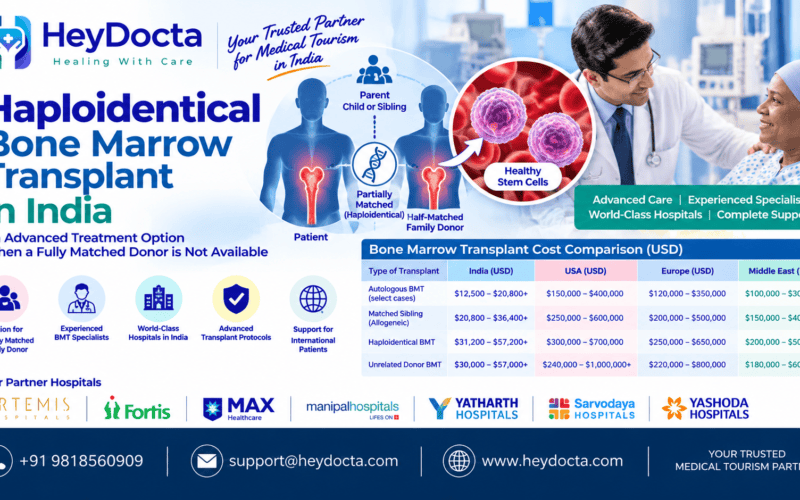
Bone Marrow Transplant Cost: India vs USA
The difference can be substantial.
According to the U.S. Health Resources and Services Administration, an unrelated bone marrow or cord blood transplant in the United States can cost US$240,000 to more than US$1 million, including the transplant and up to six months of post-transplant care. Donor-search costs may also add US$10,000 to more than US$50,000 in some circumstances.
| Cost Factor | India | USA |
| General BMT planning range | Approx. USD 15000–31000* | US$240,000 to >US$1 million for some unrelated transplants |
| Hospital and clinical services | Comparatively lower | Generally higher |
| Staffing costs | Comparatively lower | Higher |
| Medicines and medical supplies | Often lower for many items | Often higher |
| Accommodation and local expenses | Generally affordable | Often substantially higher |
| Donor-related expenses | Depends on donor type | Can add significant costs |
| Final cost | Patient-specific | Patient-specific |
India range is based on published hospital guidance and can vary substantially according to transplant type and complications.
This comparison should not be interpreted as a guarantee of a specific saving. Patients should obtain individual quotations from hospitals before making travel arrangements.
Does Lower BMT Cost Mean Lower Quality?
Not necessarily.
Cost and quality are different considerations. Patients should evaluate the complete transplant programme rather than assuming that the cheapest option is the best option.
Important factors include:
- Experience of the transplant team
- Number and type of transplant procedures performed
- Infection-control measures
- Availability of blood and laboratory services
- ICU and emergency support
- Donor-matching facilities
- Post-transplant monitoring
- International patient services
- Follow-up arrangements
For example, Artemis Hospitals describes its BMT unit as having infection-control policies, positive-pressure rooms and HEPA-filtered rooms.
Talk to a Medical Tourism Expert: HeyDocta can help international patients compare treatment estimates, communicate with partner hospitals and understand the expected treatment pathway before travelling to India.
Bone Marrow Transplant Options Available in India
The appropriate transplant depends on the patient’s disease and medical assessment.
Autologous Stem Cell Transplant
The patient’s own stem cells are collected, stored and later returned after conditioning treatment. This approach is used for selected diseases and patients.
Allogeneic Stem Cell Transplant
Stem cells are obtained from another person. Depending on the situation, the donor may be a matched sibling, matched unrelated donor or a haploidentical donor.
Haploidentical Transplant
A partially matched family donor may be considered in appropriate cases when a fully matched donor is unavailable or unsuitable.
The transplant team decides which approach is appropriate after reviewing the diagnosis, disease status, donor availability and overall health.
BMT Specialist in India
International patients may be evaluated by experienced haematology and transplant specialists.
Dr. Gaurav Dixit at Artemis Hospitals, Gurugram, is Head – Haematology Oncology & Bone Marrow Transplant (Unit II). Artemis lists his specialties as BMT, haematopoietic stem cell transplant, haematology, oncology and paediatric haemato-oncology and BMT. His listed procedures include autologous transplant, matched sibling allogeneic transplant, haploidentical transplant and matched unrelated donor transplant.
Patients should select a specialist based on their specific diagnosis and transplant requirements rather than relying solely on online rankings or cost.
Partner Hospitals for BMT Treatment in India
HeyDocta can coordinate treatment enquiries with its partner hospitals:
- Artemis Hospital
- Fortis Hospitals
- Max Hospitals
- Manipal Hospital
- Yatharth Hospital
- Sarvodaya Hospital
- Yashoda Hospital
The appropriate hospital can vary depending on the patient’s condition, transplant type, doctor availability and required facilities.
Bone Marrow Transplant Process for International Patients
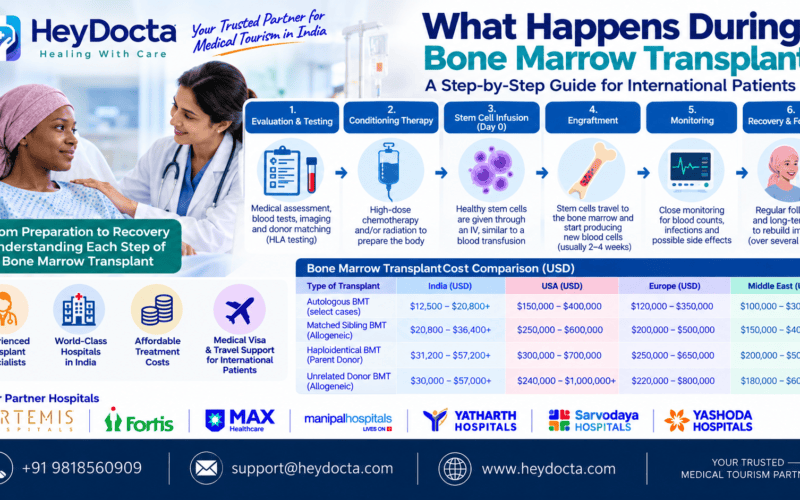
The journey generally follows these steps:
Step 1: Share Medical Reports
Patients provide pathology reports, blood tests, imaging, previous treatment records and other relevant medical documents.
Step 2: Specialist Evaluation
A haematology or BMT specialist reviews the medical history and determines whether transplantation should be considered.
Step 3: Treatment and Cost Estimate
The hospital may recommend additional investigations before providing a more detailed treatment plan and estimate.
Step 4: Donor Assessment
For allogeneic transplantation, donor compatibility and HLA testing may be required.
Step 5: Travel Planning
Once the treatment plan is agreed upon, patients can arrange their medical visa, flights, accommodation and caregiver support.
Step 6: Treatment and Hospitalisation
Conditioning treatment is followed by stem cell infusion and close monitoring during the recovery period.
Step 7: Follow-Up
After discharge, patients require regular medical monitoring. International patients should discuss the timing of their return journey with their treating team.
Medical Visa and Travel Support
Travelling abroad for BMT requires more planning than a routine medical visit. Patients may need medical visa documentation, hospital invitation letters, accommodation and airport transfers.
Hospital international-patient services can assist with several of these arrangements. Artemis, for example, lists teleconsultations, visa services, hotel booking, airport pickup and post-discharge travel assistance among its international-patient services.
HeyDocta helps coordinate hospital communication, medical opinions, treatment enquiries, visa and travel guidance and other international-patient requirements.
HeyDocta does not add a separate service fee to the patient’s hospital treatment cost. Patients should nevertheless confirm the hospital quotation and all travel, accommodation and medical expenses before travelling.
What Makes the Total Cost Higher?
Even when the initial BMT estimate appears affordable, additional expenses can arise.
Potential cost factors include:
- Extended hospitalisation
- Serious infections
- ICU care
- Additional medicines
- Blood or platelet requirements
- Donor-related testing
- Treatment of transplant complications
- Additional investigations
- Extended accommodation after discharge
- Follow-up consultations
This is why a detailed patient-specific estimate is more useful than comparing headline prices online.
FAQs About BMT Cost in India
Why is bone marrow transplant cheaper in India?
Lower healthcare operating costs, staffing costs, competitive private healthcare, pharmaceutical availability and lower ancillary expenses can contribute to India’s comparatively lower BMT costs.
How much does BMT cost in India?
Some Hospitals guidance currently gives an indicative range of approximately USD 15000 to 31000, although actual costs vary by transplant type, hospital, patient condition and complications.
Is BMT cheaper in India than the USA?
For some patients, the overall treatment cost can be substantially lower in India. HRSA reports that an unrelated BMT or cord blood transplant in the USA can cost US$240,000 to more than US$1 million, including the transplant and up to six months of care.
Does affordable BMT mean lower-quality treatment?
No. Treatment quality should be evaluated independently of price. Patients should assess transplant expertise, infrastructure, infection control, medical support and follow-up services.
Can international patients receive BMT in India?
Yes. Patients from Africa, the Middle East, Europe, the USA and other regions can seek treatment in India, subject to medical suitability and hospital acceptance.
Does the BMT cost include everything?
Not always. Package inclusions differ between hospitals. Patients should ask whether donor testing, medicines, conditioning, hospitalisation, investigations and management of complications are included.
Can HeyDocta help me compare BMT treatment costs?
Yes. HeyDocta can help international patients obtain medical opinions, coordinate with partner hospitals, understand treatment estimates and plan visa and travel requirements.
Conclusion
The answer to why bone marrow transplant costs less in India is largely connected to India’s overall healthcare cost structure. Lower operating and staffing costs, pharmaceutical availability, competitive healthcare services and comparatively affordable supporting expenses can make India an attractive option for international patients seeking BMT.
However, affordability should never be the only consideration. BMT is a complex treatment that requires experienced specialists, appropriate transplant infrastructure and careful long-term monitoring. Patients should compare the complete treatment pathway, not just the advertised package price.
For patients from Nigeria, Ghana, Kenya, Zimbabwe, Cameroon, Guyana, Jamaica, the Middle East, Europe and the USA, HeyDocta can help simplify the process of exploring BMT in India.
Get a Free Medical Opinion and Treatment Cost Estimate: Send your medical reports to HeyDocta.com to begin the hospital coordination process and understand your potential BMT options in India.