DVT and IVC filter treatment in India can be an important option for international patients who need specialised vascular care at a comparatively affordable cost. Deep vein thrombosis (DVT) occurs when a blood clot develops in a deep vein, usually in the leg, thigh or pelvis. If part of the clot travels to the lungs, it can cause a pulmonary embolism (PE), which requires urgent medical attention.
For patients from Nigeria, Ghana, Kenya, Zimbabwe, Cameroon, Guyana, Jamaica, the Middle East, Europe and the USA, understanding when an IVC filter is needed, how much treatment may cost, and what recovery involves can make medical travel planning easier.
Get a Free Medical Opinion: Share your medical reports with HeyDocta to receive guidance on suitable vascular specialists, partner hospitals and an estimated treatment plan in India.
What Is DVT?
Deep vein thrombosis is a blood clot that develops in a deep vein. It most commonly affects the lower extremities but can also occur in other parts of the body.
Common DVT symptoms include:
- Swelling in one leg or arm
- Pain or tenderness without an obvious injury
- Warmth over the affected area
- Redness or skin discoloration
Some people with DVT may have no symptoms. A clot can sometimes break away and travel to the lungs, causing pulmonary embolism. Symptoms of PE can include sudden difficulty breathing, chest pain, coughing up blood, rapid heartbeat, lightheadedness or fainting. These symptoms require immediate medical attention.
What Is an IVC Filter?
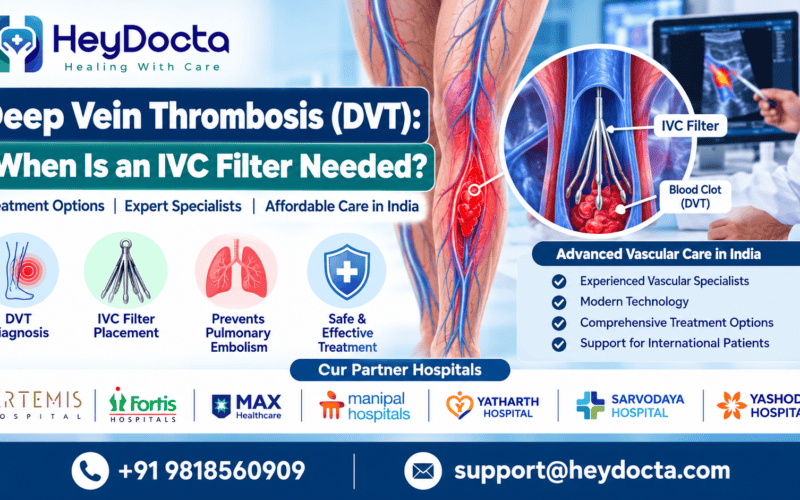
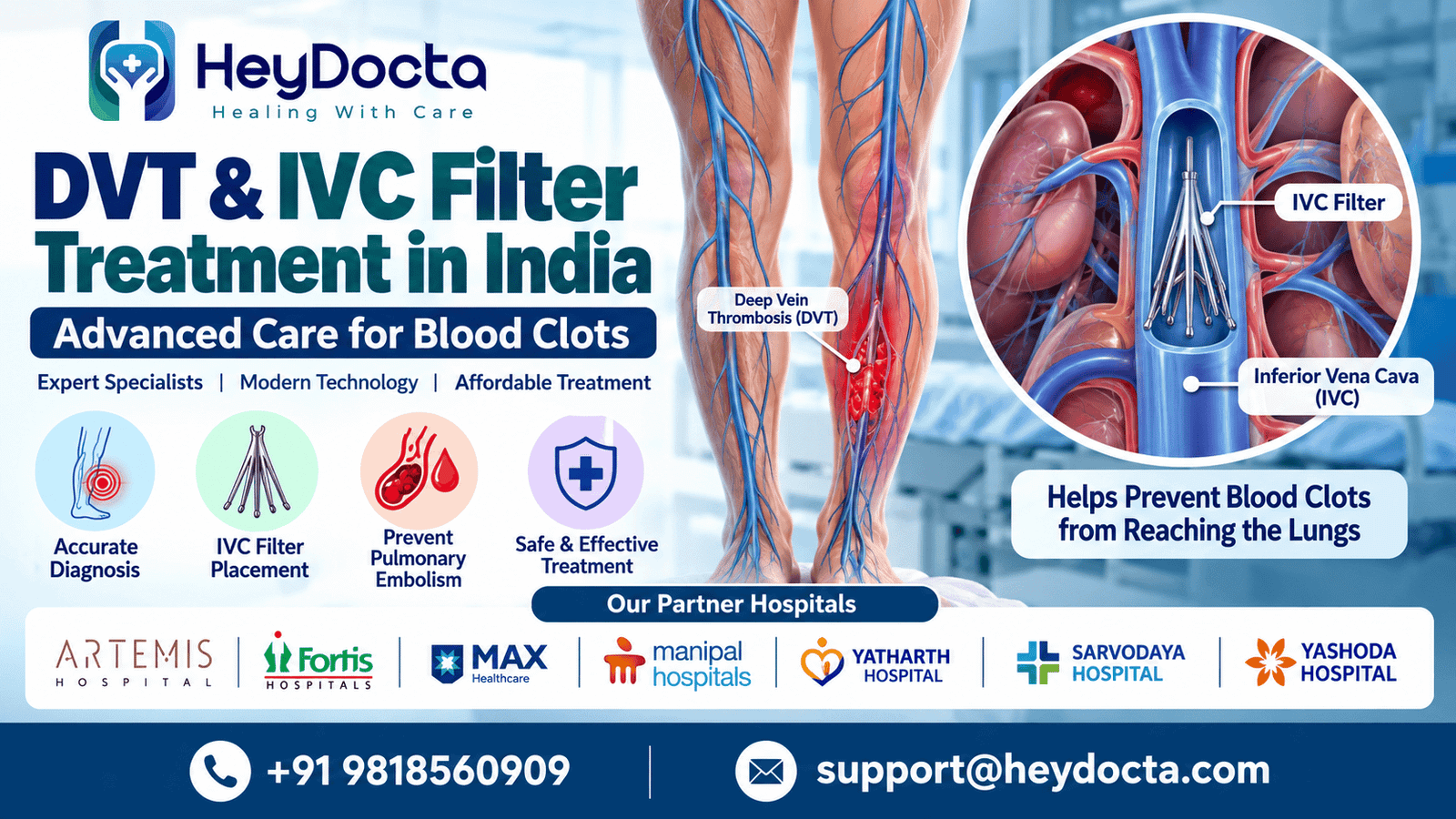
An inferior vena cava (IVC) filter is a small medical device placed inside the inferior vena cava, the large vein that carries blood from the lower body toward the heart.
The filter is designed to capture certain blood clots travelling from the lower extremities before they reach the lungs. It does not directly dissolve the existing DVT.
IVC filters are generally considered for selected patients, particularly when anticoagulant treatment cannot be used or is not effective. The American Society of Hematology recommends against routine IVC filter insertion when anticoagulation can safely be given. When a filter is required because anticoagulation is contraindicated, a retrievable filter is generally preferred when appropriate, with removal considered once anticoagulation can safely be started.
The FDA also lists situations such as contraindication to anticoagulation and failure of anticoagulant therapy among indications for certain IVC filters.
When Might an IVC Filter Be Recommended?
An IVC filter is not automatically required for every DVT patient.
A vascular specialist may consider one when:
- Anticoagulants cannot safely be used
- There is a significant bleeding risk
- Anticoagulant treatment has failed in selected circumstances
- A patient has certain serious thromboembolic conditions
- The clinical situation creates a significant concern about pulmonary embolism
The decision should be individualised after reviewing imaging, medical history, bleeding risk and the patient’s overall condition.
DVT Treatment Options in India
Treatment depends on the location and severity of the clot, the patient’s medical history and the risk of complications.
Anticoagulant Medicines
Blood-thinning medicines are commonly used to prevent existing clots from growing and reduce the risk of additional clots. The duration and type of medication depend on the patient’s circumstances.
Compression and Supportive Treatment
Some patients may be advised to use graduated compression stockings or other measures to reduce swelling and discomfort.
Catheter-Based or Surgical Treatment
In selected severe cases, specialists may consider procedures to remove or break up the clot. These are not required for every DVT patient.
IVC Filter Placement
An IVC filter may be considered when anticoagulation is contraindicated or unsuitable in specific clinical circumstances. It is primarily intended to reduce the risk of pulmonary embolism rather than treat the underlying DVT itself.
IVC Filter Placement Procedure
IVC filter placement is generally performed through a blood vessel using image guidance rather than through conventional open surgery.
A typical process may include:
- Medical evaluation and review of previous reports
- Blood tests and imaging
- Assessment of the DVT and pulmonary embolism risk
- Review of whether anticoagulation is appropriate
- Selection of the appropriate filter if required
- Catheter-based placement of the filter into the IVC
- Monitoring after the procedure
- Follow-up and assessment of whether retrieval is appropriate
The exact technique depends on the filter type and the patient’s anatomy.
DVT and IVC Filter Treatment Cost in India
Cost is one of the major reasons international patients explore treatment in India.
Some Indian Hospitals currently lists an indicative cost of approximately USD 1080 to 2593 for IVC filter placement in India. It notes that the actual cost can vary according to hospital, location, room category and complications.
The total cost for a patient with DVT can be different because DVT management may involve diagnostic tests, medicines, hospitalisation or additional procedures.
Estimated Cost Factors
| Treatment component | What can affect the cost |
| DVT diagnosis | Ultrasound, CT or other imaging |
| Specialist consultation | Vascular/cardiovascular specialist |
| Anticoagulation | Medicine type and treatment duration |
| IVC filter | Filter type and device cost |
| Procedure | Hospital, equipment and specialist fees |
| Hospital stay | Room category and length of stay |
| Complications | Additional medicines, procedures or monitoring |
| Follow-up | Consultations and imaging |
These figures are indicative planning information, not fixed quotations. A personalised hospital estimate should be obtained before travel.
DVT and IVC Filter Cost: India vs Other Countries
Treatment costs vary significantly between healthcare systems, and direct international comparisons can be difficult because packages may include different services.
| Region | General cost perspective |
| India | IVC filter placement published by Apollo at approximately USD 1080–2593 |
| USA | Generally higher hospital, procedure, device and professional costs |
| Europe | Costs vary considerably by country and healthcare system |
| Middle East | Costs vary by country, hospital and insurance |
| Africa | Availability and cost vary by country; overseas treatment adds travel expenses |
For international patients, the meaningful comparison is the total treatment budget, including hospital care, investigations, medicines, accommodation, flights and follow-up.
Vascular Specialist for DVT and IVC Filter Treatment in India
Patients should consult a vascular specialist experienced in venous disease and appropriate endovascular or surgical treatment.
Dr. Biswarup Purkayastha at Artemis Hospitals, Gurugram, is listed as Consultant – Heart & Lung Transplant and Vascular Surgery. His areas of expertise include vascular surgery and aortic surgery, including endovascular management in suitable cases.
The appropriate specialist should be selected according to the patient’s diagnosis and the specific vascular procedure required.
Partner Hospitals for Vascular Treatment
HeyDocta can coordinate treatment enquiries with its partner hospitals:
- Artemis Hospital
- Fortis Hospitals
- Max Hospitals
- Manipal Hospital
- Yatharth Hospital
- Sarvodaya Hospital
- Yashoda Hospital
The most appropriate hospital may depend on the patient’s medical condition, required procedure, specialist availability and diagnostic needs.
Talk to Our Medical Tourism Expert: HeyDocta can help international patients share reports with partner hospitals, coordinate specialist consultations and understand the expected treatment and cost before travelling.
Step-by-Step Treatment Journey for International Patients
1. Share Medical Records
Patients can provide Doppler ultrasound reports, CT scans, blood tests, previous prescriptions and treatment history.
2. Specialist Review
A vascular specialist reviews the medical information and determines whether further testing is necessary.
3. Treatment Recommendation
The doctor determines whether medication, observation, an intervention or an IVC filter should be considered.
4. Cost Estimate
The hospital provides an estimated treatment cost based on the recommended procedure and patient’s requirements.
5. Visa and Travel Planning
After deciding to proceed, patients can arrange medical visa documentation, flights and accommodation.
6. Treatment in India
The patient undergoes the recommended treatment and monitoring at the selected hospital.
7. Follow-Up and Return Planning
Before returning home, the patient should receive instructions regarding medicines, activity, follow-up tests and travel.
Medical Visa and Travel Support
International patients travelling to India for vascular treatment may require a medical visa and supporting hospital documentation. Planning is especially important for patients who have recently experienced DVT or PE because long-distance travel itself can increase VTE risk in people with relevant risk factors.
The CDC advises travellers with blood-clot risk factors to discuss their individual risk with a healthcare professional and take appropriate precautions during long-distance travel.
HeyDocta can assist with hospital coordination, medical opinions, visa and travel guidance, accommodation planning and international patient support.
HeyDocta does not add a separate service fee to the patient’s hospital treatment cost. Patients should confirm the final hospital quotation and separate travel and accommodation expenses before making arrangements.
Recovery After IVC Filter Placement
Recovery depends on the patient’s overall condition and whether other DVT treatment is also required.
Patients may need:
- Medication as prescribed
- Monitoring for recurrent DVT or PE
- Follow-up imaging when recommended
- Care of the catheter insertion site
- Activity guidance
- Follow-up with a vascular specialist
If a retrievable filter has been placed, the treating team should determine whether and when it should be removed. Patients should not assume that every filter needs to remain permanently. ASH recommends removal of a retrievable filter once anticoagulation can safely be given when the filter was initially required because anticoagulation was contraindicated.
FAQs About DVT and IVC Filter Treatment
Is an IVC filter a treatment for DVT?
An IVC filter primarily helps prevent certain clots from reaching the lungs. It does not directly dissolve the existing DVT. Anticoagulation or other appropriate treatment may still be required.
Does every DVT patient need an IVC filter?
No. IVC filters are not routinely recommended when anticoagulation can safely be used.
How much does IVC filter placement cost in India?
Some Indian Hospitals currently publishes an indicative range of approximately USD 1080 to 2593 for IVC filter placement. Actual costs vary according to the hospital, filter, patient condition and complications.
Can international patients get DVT treatment in India?
Yes. International patients can seek evaluation and treatment in India, subject to medical assessment and hospital acceptance.
Is IVC filter placement a major surgery?
IVC filter placement is generally performed using a catheter and image guidance rather than conventional open surgery. The exact procedure depends on the patient’s condition and filter type.
Can an IVC filter be removed?
Some filters are designed to be retrievable. Whether removal is appropriate depends on the patient’s clinical situation and treating specialist’s assessment.
Can I fly after DVT or IVC filter treatment?
Travel timing must be decided by the treating doctor. Recent DVT or PE and long-distance travel require particular attention because prolonged immobility can increase VTE risk.
Conclusion
DVT requires timely medical evaluation because a clot can potentially travel to the lungs and cause pulmonary embolism. An IVC filter can be useful for selected patients, particularly when anticoagulation cannot safely be used, but it is not a routine treatment for every DVT patient.
India can be an attractive medical tourism destination for patients seeking vascular evaluation and treatment because certain procedures may cost less than in many Western healthcare systems. However, patients should compare specialist expertise, hospital infrastructure, procedure costs, medicines, follow-up and travel expenses rather than choosing treatment based only on price.
For patients from Africa, the Middle East, Europe, the USA, Guyana and Jamaica, HeyDocta can help coordinate the process from medical opinion and hospital selection to visa, travel and follow-up support.
Get a Free Medical Opinion and Treatment Cost Estimate: Send your medical reports to HeyDocta.com to discuss DVT and IVC filter treatment options with an appropriate partner hospital in India.