
For international patients planning a bone marrow transplant in India, arranging the correct medical visa is an important part of the treatment journey. Patients travelling from Nigeria, Ghana, Kenya, Zimbabwe, Cameroon, Guyana, Jamaica, the Middle East, Europe and the USA need to plan their hospital treatment, visa, caregiver arrangements, accommodation and length of stay in advance.
A bone marrow transplant can require several weeks of hospital care followed by close monitoring. Therefore, patients should not plan their visa and return flight around only the transplant date.
This guide explains the Indian medical visa process, documents required, medical attendant visa, BMT treatment costs, hospital coordination and travel support for international patients.
Get a Free Medical Opinion: Contact HeyDocta to share your medical reports, coordinate with an appropriate Indian hospital and understand the expected treatment and travel requirements before coming to India.
What Visa Do You Need for Bone Marrow Transplant in India?
Patients travelling to India specifically for medical treatment generally need a Medical Visa or, where eligible, an e-Medical Visa.
International patients travelling with a family member or caregiver can also apply for a Medical Attendant Visa or e-Medical Attendant Visa, subject to eligibility.
The Government of India’s official e-Visa system currently includes e-Medical and e-Medical Attendant categories. Eligible applicants can apply online and receive their electronic travel authorisation by email.
The exact visa category, validity, entry conditions and permitted stay depend on the patient’s nationality and visa issued.
Important: Patients should always verify the latest requirements on the official Indian visa portal before submitting an application.
Who Can Apply for a Medical Visa for BMT in India?
A medical visa is intended for foreign nationals travelling to India for medical treatment.
For a BMT patient, the medical purpose may include:
- Bone marrow transplant
- Stem cell transplant
- Haematology treatment
- Leukemia treatment
- Lymphoma treatment
- Multiple myeloma treatment
- Aplastic anemia treatment
- Thalassemia treatment
- Sickle cell disease treatment
- Other specialist blood-disorder treatment
The patient should have medical documentation supporting the proposed treatment in India.
Medical Visa vs Medical Attendant Visa
International BMT patients frequently need a caregiver because treatment and recovery can extend over several weeks or months.
| Visa | Who needs it? | Purpose |
| Medical Visa | Patient | Medical treatment in India |
| e-Medical Visa | Eligible patient | Online medical treatment visa |
| Medical Attendant Visa | Caregiver/family member | Accompanying a medical patient |
| e-Medical Attendant Visa | Eligible caregiver | Online attendant visa |
The official Indian e-Visa system currently allows up to two e-Medical Attendant Visas against one e-Medical Visa, subject to the applicable rules.
For BMT, families should decide in advance who will accompany the patient and ensure that the caregiver’s visa arrangements match the patient’s treatment period.
Documents Required for a Medical Visa for BMT
Patients should keep their documents ready before starting the application.
Common documents may include:
- Valid passport
- Recent passport-size photograph
- Medical reports
- Diagnosis documents
- Bone marrow biopsy or pathology reports, where applicable
- Previous treatment records
- Hospital invitation or treatment letter
- Proposed admission or treatment date
- Completed visa application
- Additional documents requested by the Indian embassy or immigration authorities
For an e-Medical Visa, the official portal specifically lists a scanned passport bio page and a letter from the Indian hospital mentioning the proposed or tentative treatment/admission date.
Requirements can vary according to nationality and visa category.
Step-by-Step Medical Visa Process for BMT in India
Step 1: Share Your Medical Reports
Before travelling, international patients can share their medical records with HeyDocta.
These may include:
- Diagnosis reports
- Blood tests
- Bone marrow reports
- Imaging
- Previous chemotherapy details
- Current medications
- HLA or donor reports
- Previous medical opinions
This allows the hospital’s specialist team to understand the patient’s condition.
Step 2: Get a Specialist Medical Opinion
A BMT specialist reviews the patient’s medical history and determines the appropriate treatment pathway.
The doctor may advise:
- Whether BMT is appropriate
- Type of transplant
- Donor requirements
- Additional investigations
- Expected treatment duration
- Approximate hospitalisation
- Expected recovery period
Step 3: Coordinate With an Indian Hospital
Once the patient decides to proceed, the hospital can provide the necessary treatment-related documentation.
HeyDocta can coordinate communication between the international patient and the hospital.
Step 4: Receive the Hospital Invitation Letter
For an e-Medical Visa, the official Indian visa portal requires a letter from the Indian hospital containing relevant treatment/admission information.
The patient should carefully check that the name, passport number and other personal information are correct.
Step 5: Apply for the Visa
Eligible applicants can apply through the official Indian e-Visa portal.
The online process generally involves:
- Completing the application
- Uploading the required documents
- Paying the applicable fee
- Receiving the application confirmation
- Waiting for visa processing
- Receiving the Electronic Travel Authorisation if approved
For applicants who are not eligible for e-Visa, a regular visa application may be required through the relevant Indian mission or authorised visa application centre.
Step 6: Plan Your Travel
After receiving the visa approval, patients can arrange:
- Flights
- Airport transfers
- Hospital admission
- Accommodation
- Caregiver arrangements
- Local transportation
Patients should avoid booking a non-refundable return ticket too early because BMT recovery timelines can change.
How Long Should BMT Patients Stay in India?
The length of stay varies significantly between patients.
A BMT journey may include:
- Initial consultation
- Pre-transplant investigations
- Donor testing
- Conditioning treatment
- Stem-cell transplantation
- Engraftment monitoring
- Hospital recovery
- Outpatient follow-up
International patients may need to remain in India for several weeks and sometimes several months, particularly when close monitoring is required after an allogeneic transplant.
The treating BMT specialist should determine when the patient is medically fit to return home.
This is important when selecting the visa duration.
Can the Medical Visa Be Extended?
Patients should not assume that they can automatically extend their visa if treatment takes longer.
If BMT treatment or recovery extends beyond the permitted stay, the patient should contact the hospital’s international patient department and the appropriate Indian immigration authority well before the visa expires.
Visa extension or other immigration permission depends on the applicable rules and individual circumstances.
Bone Marrow Transplant Specialist in India
International patients can seek consultation with experienced BMT specialists in India.
Dr. Gaurav Dixit, Head – Haematology Oncology & Bone Marrow Transplant at Artemis Hospitals, Gurugram, specialises in bone marrow transplantation, haematology and oncology.
His listed transplant procedures include:
- Autologous transplant
- Matched-sibling allogeneic transplant
- Haploidentical transplant
- Matched-unrelated donor transplant
The appropriate specialist should be selected according to the patient’s diagnosis, transplant type, donor requirements and medical complexity.
BMT Hospitals in India for International Patients
HeyDocta works with a network of hospitals that includes:
- Artemis Hospital
- Fortis Hospitals
- Max Hospitals
- Manipal Hospital
- Yatharth Hospital
- Sarvodaya Hospital
- Yashoda Hospital
Patients should compare hospitals based on:
- BMT programme availability
- Specialist expertise
- Transplant facilities
- Infection-control infrastructure
- Donor-transplant capabilities
- ICU and emergency support
- Follow-up facilities
- International patient services
- Overall treatment estimate
The most suitable hospital depends on the individual patient’s medical requirements.
Bone Marrow Transplant Cost in India
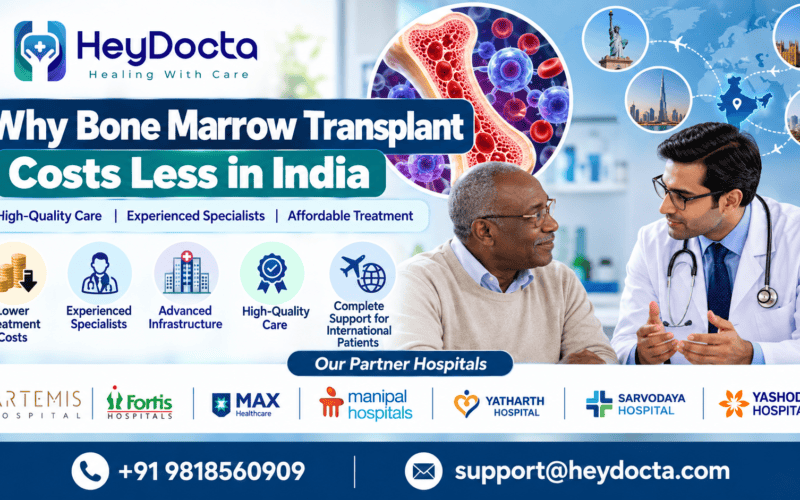
Cost is one of the major reasons international patients investigate BMT treatment in India.
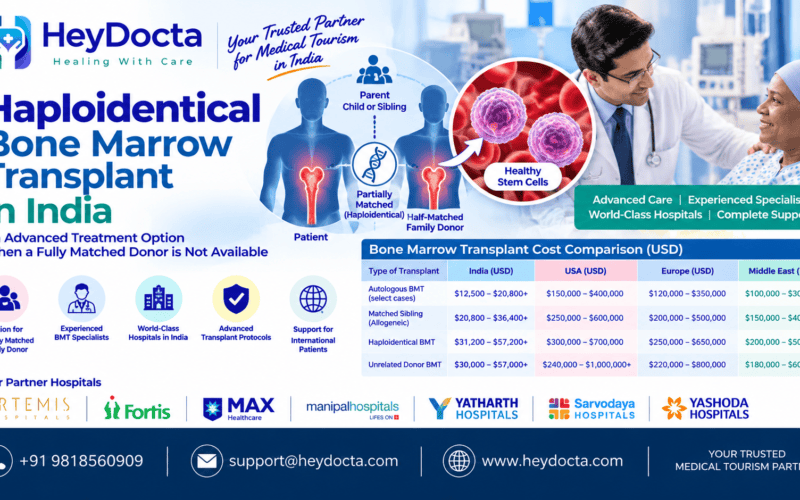
A general BMT treatment estimate in India may range from approximately USD15,700-31,500 or more, depending on the transplant type, hospital, medicines, donor requirements, length of stay and complications.
For international patients, the complete budget can include:
| Expense | What it may include |
| BMT treatment | Conditioning, transplant and hospitalisation |
| Donor testing | HLA and compatibility testing |
| Medicines | Supportive and post-transplant medicines |
| Investigations | Blood tests, imaging and monitoring |
| Accommodation | Hotel or serviced apartment |
| Caregiver expenses | Food, accommodation and transport |
| Flights | Patient and caregiver |
| Visa | Visa application and related charges |
| Follow-up | Consultations and laboratory tests |
These figures are indicative only. The hospital should provide the final treatment estimate after reviewing the patient’s medical records.
India vs USA: BMT Cost Comparison
Treatment cost is an important consideration for international patients.
Indicative published figures for unrelated donor transplantation in the USA can reach USD 240,000 to more than USD 1 million, depending on the treatment pathway and duration of care.
In India, published hospital estimates for BMT are substantially lower in many cases.
However, patients should compare the complete treatment package, rather than comparing only the initial hospital quotation.
Factors such as donor testing, medicines, complications, ICU care, accommodation and follow-up can affect the final cost.
Talk to Our Medical Tourism Expert: HeyDocta can help international patients obtain an indicative treatment estimate based on their diagnosis and medical records.
Why International Patients Choose India for BMT
International patients may consider India because it offers:
- Specialist BMT teams
- Multiple transplant options
- Private hospitals with dedicated transplant facilities
- International patient departments
- Lower treatment costs in many cases
- Availability of specialist investigations
- Accommodation options near major hospitals
- Medical tourism support services
However, medical suitability should always come before cost considerations.
HeyDocta Medical Tourism Support
Planning BMT abroad can involve many steps beyond medical treatment.
HeyDocta can help with:
- Medical report collection
- Specialist consultation
- Hospital coordination
- Treatment-cost estimates
- Hospital invitation documentation
- Medical visa assistance
- Medical travel planning
- Airport transfer coordination
- Accommodation guidance
- Caregiver planning
- Follow-up coordination
HeyDocta does not charge patients an additional fee for its medical-tourism coordination service. Hospital treatment, medicines, visa fees, flights, accommodation and other third-party expenses are separate.
Medical Visa and BMT Travel Checklist
Before travelling to India, international patients should ideally have:
- Valid passport
- Approved medical visa/e-Medical Visa
- Hospital invitation letter
- Medical records
- Previous treatment documents
- Prescriptions and current medicines
- Flight details
- Accommodation information
- Caregiver documents
- Hospital contact details
- Emergency contact information
- Copies of important documents
Keep digital and printed copies of important documents during the journey.
FAQs About Medical Visa for Bone Marrow Transplant in India
1. Can I get an Indian medical visa for bone marrow transplant?
Yes. Foreign nationals travelling to India for medical treatment may apply for the appropriate Medical Visa or e-Medical Visa if they meet the eligibility requirements.
2. Do I need a hospital invitation letter?
For an e-Medical Visa, the official requirements include a letter from the Indian hospital containing the proposed or tentative treatment/admission date.
3. Can my family member accompany me?
Yes. Eligible caregivers can apply for a Medical Attendant Visa or e-Medical Attendant Visa. Up to two e-Medical Attendant Visas can currently be granted against one e-Medical Visa.
4. How early can I apply for an e-Medical Visa?
For eligible applicants, the official e-Visa portal currently allows applications up to 120 days before the intended arrival and generally requires submission at least four days before arrival.
5. What happens if BMT treatment takes longer than expected?
Patients should contact their hospital and the appropriate immigration authority before their permitted stay expires. Any extension depends on the applicable immigration rules and individual circumstances.
6. How much does BMT cost in India?
BMT costs vary by transplant type and patient condition. A general planning range can be around ₹15–30 lakh or more, but the hospital provides the final estimate after medical evaluation.
7. Can HeyDocta help with the medical visa?
HeyDocta can assist with hospital coordination and visa-related documentation and planning. Final visa approval is determined by the Government of India and the relevant immigration authorities.
Conclusion
Obtaining the correct medical visa for bone marrow transplant in India is an important part of planning treatment abroad. International patients should begin the process early by arranging a specialist opinion, selecting an appropriate hospital, obtaining the required hospital documentation and checking the latest visa requirements.
However, every patient’s treatment, recovery and length of stay is different. Patients should plan their visa, accommodation and travel around their individual medical requirements rather than a fixed treatment timeline.
Planning a bone marrow transplant in India? Contact HeyDocta.com for a Free Medical Opinion, hospital coordination, treatment-cost guidance, medical visa assistance and end-to-end support for your medical journey.