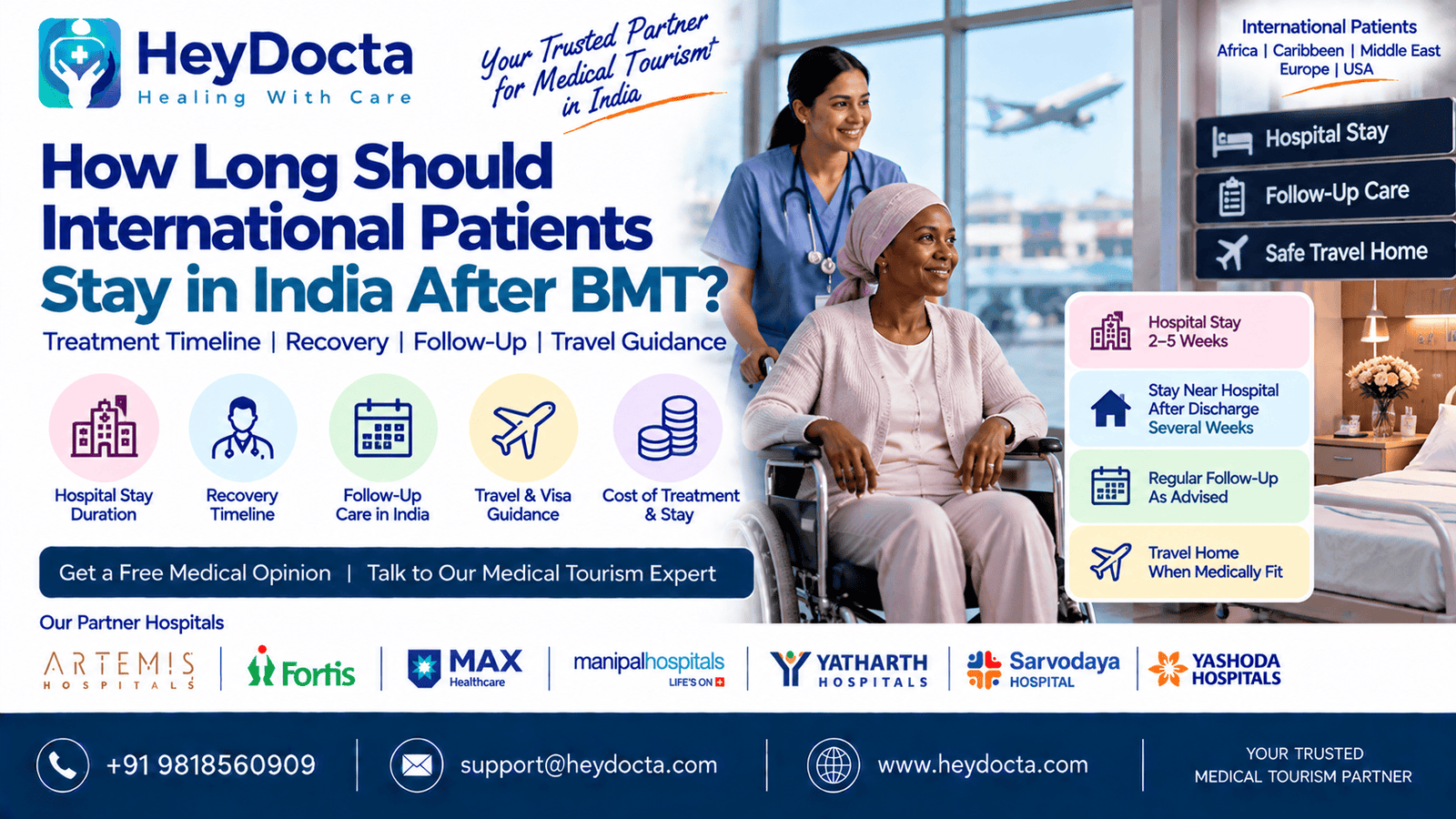
For international patients planning a bone marrow transplant (BMT) in India, knowing how long to stay is almost as important as choosing the right transplant centre. Patients from Nigeria, Ghana, Kenya, Zimbabwe, Cameroon, Guyana, Jamaica, the Middle East, Europe and the USA often need to plan accommodation, visas, flights, caregiver support and medical expenses well in advance.
So, how long should international patients stay in India after BMT? There is no single fixed duration. The required stay depends on whether the transplant is autologous or allogeneic, how quickly the new stem cells engraft, the patient’s blood counts, infections, complications and the treating team’s assessment. Major transplant centres note that recovery may continue for several weeks or months after discharge.
Get a Free Medical Opinion: HeyDocta can coordinate a specialist review of your medical records and help you understand the likely treatment and stay requirements before travelling to India.
How Long Should International Patients Stay in India After BMT?
For planning purposes, international patients should generally avoid booking a short return trip immediately after transplantation.
A practical planning range is:
| BMT stage | Indicative time in India |
| Pre-transplant evaluation | 1–2 weeks or as advised |
| Conditioning and transplant | Several weeks |
| Initial post-transplant monitoring | 2–5+ weeks |
| Nearby accommodation after discharge | Several additional weeks |
| Longer monitoring for allogeneic BMT | Often up to around 3 months |
| Total stay | Commonly several weeks to several months |
These are planning ranges, not medical requirements. MD Anderson reports hospital stays of about two to three weeks for autologous transplantation and three to five weeks for allogeneic transplantation, while some patients need to remain close to the transplant centre for additional weeks or months after discharge.
Why International Patients May Need to Stay Longer
BMT is different from many routine procedures. Discharge from the hospital does not mean that the transplant recovery is complete.
After transplantation, doctors need to monitor:
- Blood-cell recovery and engraftment
- Fever and infections
- Platelet and red-cell levels
- Medication response
- Kidney and liver function
- Nutrition and hydration
- Graft-versus-host disease (GVHD) after donor transplantation
- Signs of disease relapse
- Other transplant-related complications
The National Cancer Institute explains that immune recovery can take several months after an autologous transplant and one to two years after an allogeneic or syngeneic transplant, even though the patient may leave the hospital much earlier.
This is why international patients should plan their India stay around the treating team’s medical milestones rather than a fixed flight date.
Hospital Stay After Autologous vs Allogeneic BMT
The type of transplant makes a major difference.
Autologous BMT
In an autologous transplant, the patient’s own stem cells are collected and later returned after conditioning treatment.
MD Anderson states that patients receiving their own stem cells may stay in hospital for approximately two to three weeks, although individual recovery can be shorter or longer.
After discharge, some patients still need frequent outpatient visits and may need to remain close to the hospital for additional monitoring.
Allogeneic BMT
Allogeneic transplantation uses stem cells from a donor. It may involve a matched sibling, matched unrelated donor or haploidentical family donor.
Hospitalisation can be longer. MD Anderson indicates approximately three to five weeks for many allogeneic patients, depending on recovery and complications.
The post-transplant monitoring period can also be significantly longer. Fred Hutch notes an initial recovery period of about three months for allogeneic transplant compared with about one month for autologous transplant.
What Happens During the First Few Weeks After BMT?
The early post-transplant period is focused on engraftment and managing complications.
First phase: Hospital recovery
The patient remains under close medical supervision while blood counts recover. Protective infection-control measures may be required because immunity is significantly reduced.
Second phase: Early outpatient monitoring
After discharge, patients may need frequent blood tests, consultations, medication adjustments and transfusions.
Some transplant programmes require patients to remain within a short travel distance of the hospital during this period so that urgent medical care is available if needed.
Third phase: Stabilisation
As blood counts, nutrition, medications and overall condition improve, hospital visits may become less frequent.
The treating BMT team determines when the patient is medically suitable to travel home.
Should International Patients Stay Near the Hospital After Discharge?
Yes, when recommended by the transplant team.
International patients should generally avoid moving to a distant tourist destination immediately after discharge. Staying close to the transplant centre makes it easier to attend appointments and receive urgent treatment if symptoms develop.
For example, some major transplant programmes require patients to remain within approximately 30–45 minutes of the hospital during early recovery.
The exact distance and duration vary between hospitals and patients.
BMT Recovery and Follow-Up for International Patients
Before travelling back home, the transplant team may assess:
- Blood counts and engraftment
- Infection status
- Medication requirements
- Organ function
- Nutrition and hydration
- GVHD, where applicable
- Ability to manage medicines at home
- Follow-up arrangements with a local haematologist
The patient should receive a detailed discharge summary containing the transplant type, conditioning regimen, donor information where relevant, medications, laboratory results and follow-up recommendations.
Long-term follow-up continues after returning home. NCI notes that immune recovery can continue for months or longer depending on transplant type.
BMT Specialist in India
International patients can seek consultation with experienced BMT specialists before deciding their treatment and travel schedule.
Dr. Gaurav Dixit, Head – Haematology Oncology & Bone Marrow Transplant at Artemis Hospitals, Gurugram, specialises in BMT and haematopoietic stem-cell transplantation. His listed procedures include autologous, matched-sibling allogeneic, haploidentical and matched-unrelated donor transplantation.
Artemis also describes dedicated BMT facilities, including isolation rooms with positive air pressure designed to help reduce infection risks.
Other hospitals with haematology and BMT services available to international patients include Artemis Hospital, Fortis Hospitals, Max Hospitals, Manipal Hospital, Yatharth Hospital, Sarvodaya Hospital and Yashoda Hospital. The appropriate centre depends on the diagnosis, transplant type, donor requirements and specialist assessment.
How Much Does Staying in India Add to BMT Costs?
Accommodation and living expenses are important when planning medical tourism.
Some Hospitals currently gives a general BMT treatment range of USD15,700–31,500, with costs varying according to hospital, location, room type and complications.
For an international patient, the total budget may include:
| Expense | What it may include |
| BMT treatment | Conditioning, transplant and hospital care |
| Medicines | Anti-infective, immunosuppressive and supportive medicines |
| Additional hospitalisation | Treatment of complications |
| Accommodation | Hotel or serviced apartment after discharge |
| Food | Patient and caregiver |
| Local transport | Hospital visits and essential travel |
| Flights | Initial and return travel |
| Visa | Medical visa and related documentation |
| Follow-up | Blood tests, consultations and medicines |
The longer the patient needs to remain near the hospital, the greater the accommodation and daily living expenses may become.
Talk to Our Medical Tourism Expert: HeyDocta can help international patients understand hospital estimates, expected treatment duration, accommodation requirements and travel planning before they arrive in India.
India vs USA: Why Stay Duration Matters for Cost Planning
Treatment costs are only one part of medical-tourism budgeting.
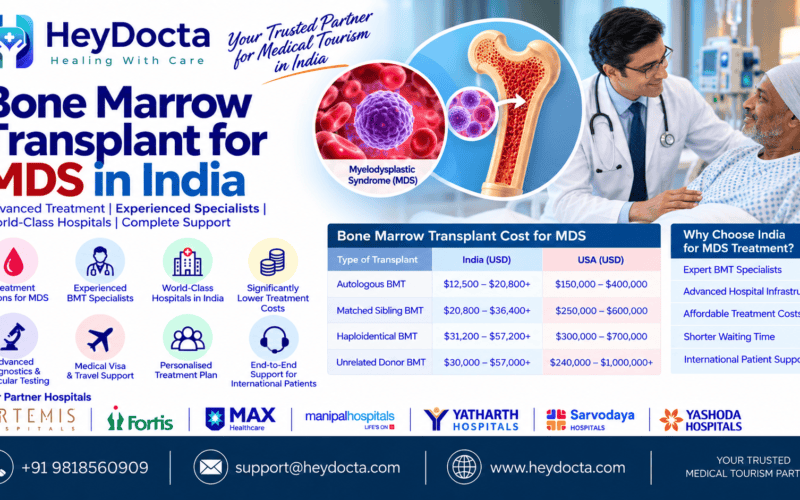
In the USA, HRSA states that an unrelated bone marrow or cord-blood transplant can cost USD 240,000 to more than USD 1 million, including the transplant and up to six months of care.
India’s BMT costs are generally much lower in published hospital estimates, but international patients should also budget for accommodation, caregiver expenses and follow-up.
The key point is that a lower treatment price does not automatically mean a short stay. Patients should request a complete estimate that considers both hospital and non-hospital expenses.
Step-by-Step BMT Journey for International Patients
- Send medical records to HeyDocta
- Receive specialist medical review
- Select an appropriate hospital and BMT team
- Receive an indicative treatment estimate
- Arrange medical visa and travel
- Complete pre-transplant investigations in India
- Begin conditioning treatment
- Undergo stem-cell transplantation
- Complete inpatient recovery and engraftment monitoring
- Move to nearby accommodation when medically cleared
- Attend regular outpatient follow-ups
- Return home when the transplant team confirms it is medically appropriate
- Continue follow-up with doctors in India and the patient’s home country
Medical Visa, Accommodation and Travel Support
International BMT patients often travel with a caregiver. Planning should therefore cover both the patient and caregiver.
HeyDocta can assist with:
- Hospital coordination
- Specialist appointment scheduling
- Medical documentation
- Medical visa-related assistance
- Airport and local travel coordination
- Accommodation guidance
- Communication with hospital teams
- Follow-up coordination after returning home
HeyDocta provides its medical-tourism coordination service without an additional service charge to patients. Hospital treatment, medicines, accommodation, flights and other third-party expenses are separate and should be confirmed before travel.
FAQs About Staying in India After BMT
1. How long should I stay in India after a bone marrow transplant?
There is no fixed duration. Many international patients need several weeks of close monitoring, while allogeneic transplant patients may need to remain near the hospital for around three months or longer depending on recovery and complications.
2. Can I fly home immediately after BMT?
Usually, travel should only be considered after the treating transplant team confirms that the patient is medically stable and fit to travel. Infection risk, blood counts, complications and follow-up requirements must be considered.
3. How long is hospitalisation after BMT?
As a general reference, MD Anderson reports approximately two to three weeks for autologous transplantation and three to five weeks for allogeneic transplantation, but individual stays vary.
4. Do I need to stay near the hospital after discharge?
Often yes, particularly during the early recovery period. The transplant team may require the patient to remain within a specific travel distance from the hospital.
5. Can my caregiver stay with me in India?
Yes. International patients commonly travel with a caregiver, but the hospital’s visitor and accommodation policies should be checked in advance.
6. Does a longer stay mean the transplant has failed?
No. A longer stay can simply reflect the need for additional monitoring, slower engraftment or management of complications. The medical team determines the reason and appropriate care.
7. Can HeyDocta help plan my stay in India?
Yes. HeyDocta can coordinate hospital communication, specialist appointments, treatment estimates, visa-related assistance, accommodation guidance and follow-up planning.
Conclusion
For international patients, the question “How long should I stay in India after BMT?” cannot be answered with one fixed number. Autologous and allogeneic transplants have different recovery patterns, and complications can significantly change the timeline.
As a practical planning approach, international patients should prepare for several weeks in India and potentially several months of proximity to the transplant centre, particularly after an allogeneic transplant. The final decision to return home should always come from the treating BMT team.
India can also be an important option for patients comparing treatment costs internationally, but the decision should consider medical expertise, transplant facilities, follow-up care, accommodation and the complete treatment budget rather than hospital cost alone.
Planning BMT treatment in India? Contact HeyDocta.com for a Free Medical Opinion, hospital coordination, indicative treatment costs and end-to-end support for your medical journey.