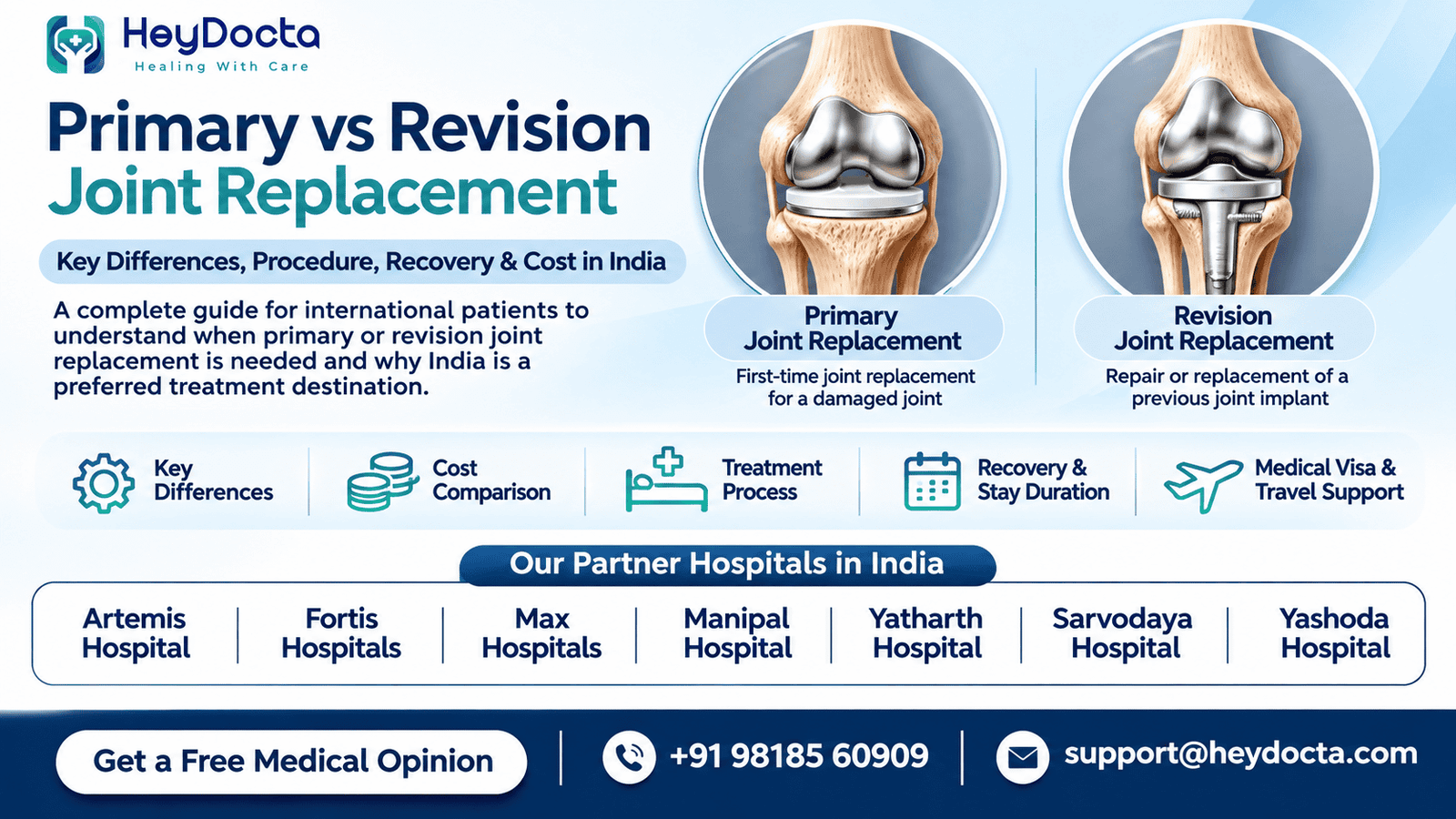
Joint replacement surgery is commonly recommended for patients with severe joint damage, arthritis or loss of mobility. However, patients often have questions about the difference between Primary vs Revision Joint Replacement, particularly when an earlier hip or knee replacement develops complications. Primary joint replacement is the first operation to replace a damaged joint, while revision surgery is performed to repair or replace an existing artificial joint.
The two procedures differ in complexity, surgical planning, recovery and cost. Revision surgery may require specialised implants, bone reconstruction or infection treatment, making it more challenging than the first operation.
For international patients from Nigeria, Ghana, Zimbabwe, Cameroon, Kenya, Guyana, Jamaica, the Middle East, Europe and the USA, India offers access to orthopaedic specialists and a range of joint replacement treatment options.
HeyDocta helps international patients coordinate medical opinions, hospital appointments, treatment estimates and travel arrangements in India.
Get a Free Medical Opinion: Share your medical reports and previous surgery records with HeyDocta to understand the treatment options available.
What Is Primary Joint Replacement?
Primary joint replacement is the first operation in which a damaged joint is replaced with artificial components. It is generally recommended when severe joint damage causes persistent pain, stiffness and difficulty performing daily activities, and non-surgical treatments are no longer providing sufficient relief.
Common types include:
- Primary knee replacement: Damaged surfaces of the knee joint are replaced with artificial components.
- Primary hip replacement: The damaged ball and socket of the hip joint are replaced with artificial components.
- Partial joint replacement: Only the damaged portion of a joint is replaced when the remaining joint structures are suitable.
The main goals are to reduce pain, improve joint function and help patients return to daily activities.
What Is Revision Joint Replacement?
Revision joint replacement is a second operation performed when an existing artificial joint develops a problem that requires surgical correction. The surgeon may replace one or more components or remove and replace the entire implant.
Revision surgery may be needed because of:
- Implant loosening or wear.
- Infection around the artificial joint.
- Repeated hip dislocation or joint instability.
- Bone loss around the implant.
- Fracture near the artificial joint.
- Persistent pain caused by a confirmed implant-related problem.
Not every patient with pain after joint replacement needs revision surgery. A specialist must identify the cause and consider whether monitoring, medication, physiotherapy or another treatment is appropriate.
Primary vs Revision Joint Replacement: Key Differences
| Comparison | Primary Joint Replacement | Revision Joint Replacement |
| Meaning | First artificial joint replacement | Repair or replacement of an existing implant |
| Surgical complexity | Generally more straightforward | Often more complex |
| Existing implant | No previous implant to remove | Old components may need removal |
| Bone condition | Depends on original joint damage | May involve bone loss or defects |
| Scar tissue | Usually less from previous joint surgery | Scar tissue from earlier operation may be present |
| Implant selection | Standard primary implants may be suitable | Specialised revision implants may be required |
| Surgical planning | Based on joint damage and patient health | Also considers previous implant, bone and soft-tissue condition |
| Recovery | Depends on procedure and patient | May be longer, especially in complex cases |
| Cost | Generally lower | Generally higher |
The exact differences depend on the joint involved, the patient’s health and the reason for revision.
Why Is Revision Joint Replacement More Complex?
Revision surgery can be more difficult because the surgeon must work around an existing implant and previously operated tissues.
1. Removal of the old implant: Existing components may be firmly attached to the bone and require careful removal.
2. Bone loss: Implant wear or loosening may damage surrounding bone. Bone grafts or specialised components may be needed.
3. Scar tissue: Previous surgery can create scar tissue that makes access to the joint more challenging.
4. Infection: If infection is present, the patient may require antibiotics, surgical cleaning or staged revision surgery.
5. Soft-tissue damage: Weakened muscles, tendons or ligaments may affect joint stability and require additional treatment.
These factors can increase operating time, hospital stay, rehabilitation needs and overall treatment cost.
Primary vs Revision Joint Replacement: Cost Comparison in India and Abroad
Cost is one of the most important considerations for international patients. Primary joint replacement is generally less expensive because it involves replacing a damaged joint for the first time. Revision surgery often costs more because it may require specialised implants, longer operating time, bone reconstruction and additional investigations.
The following figures are indicative planning estimates in USD. Actual hospital quotations depend on the patient’s condition, implant selection and treatment plan.
Primary Joint Replacement Cost Comparison
| Country | Primary knee replacement | Primary hip replacement |
| India | $4,500–$7,500 | $5,500–$9,000 |
| USA | $30,000–$50,000 | $35,000–$60,000 |
| UK | $18,000–$28,000 | Varies by provider |
| Germany | $16,000–$24,000 | Varies by provider |
| Singapore | $14,000–$20,000 | Varies by provider |
These are broad private-care planning ranges, not directly comparable national tariffs or confirmed hospital packages.
Revision Joint Replacement Cost Comparison
| Country | Revision knee replacement | Revision hip replacement |
| India | $9,000–$18,000 | $10,000–$20,000 |
| USA | $50,000–$100,000 | $55,000–$110,000 |
| UK | Hospital-specific quotation required | Hospital-specific quotation required |
| Germany | Hospital-specific quotation required | Hospital-specific quotation required |
| Singapore | Hospital-specific quotation required | Hospital-specific quotation required |
The India and USA figures are indicative planning ranges, not guaranteed prices. Reliable, directly comparable revision-specific quotations for the UK, Germany and Singapore are not consistently available. Patients should request written estimates from individual hospitals rather than rely on general primary-surgery prices.
Why Does Revision Surgery Cost More?
The final cost may increase due to:
- Removal of the previous implant.
- Specialised revision implants and longer components.
- Bone grafting or metal reconstruction parts.
- Infection investigations and antibiotic treatment.
- Longer operating time and hospital admission.
- Additional physiotherapy and rehabilitation.
Patients should compare itemised quotations, including the implant, surgeon, anaesthesia, hospital stay, investigations, medicines and rehabilitation. Travel, accommodation and companion expenses should be calculated separately.
Talk to a HeyDocta Medical Tourism Expert: Share your reports to request a personalised treatment estimate from our partner hospitals in India.
Treatment Options and Specialist Consultation in India
The treatment approach depends on whether the patient needs a first-time replacement or correction of an existing implant.
Primary joint replacement: The surgeon removes damaged joint surfaces and inserts artificial components. It is commonly recommended for advanced arthritis and other conditions causing severe joint damage.
Revision joint replacement: The surgeon assesses the existing implant and surrounding bone before deciding whether to replace selected components or the entire implant.
Patients can enquire about an orthopaedic evaluation with Dr. Dhananjay Sabat at Yatharth Hospital. The hospital and surgeon should confirm whether the patient’s specific primary or complex revision procedure is suitable for their current clinical practice.
Why International Patients Consider India
India offers international patients access to orthopaedic specialists, diagnostic facilities, implant options and post-operative rehabilitation. Treatment costs may be comparatively affordable, particularly for patients paying privately in countries with higher healthcare costs.
HeyDocta coordinates international patient enquiries with its partner hospitals:
- Artemis Hospital
- Fortis Hospitals
- Max Hospitals
- Manipal Hospital
- Yatharth Hospital
- Sarvodaya Hospital
- Yashoda Hospital
Hospital selection should be based on the required procedure, specialist experience, implant availability and the hospital’s ability to manage any complications.
Step-by-Step Treatment Process for International Patients
- Share medical records: Send X-rays, MRI or CT scans, previous operation reports and current medical information.
- Specialist consultation: The orthopaedic team reviews the case and recommends further investigations if required.
- Treatment planning: The surgeon explains the procedure, expected benefits, risks and alternatives.
- Cost estimate: The hospital provides a personalised quotation.
- Travel coordination: HeyDocta assists with appointment scheduling, visa guidance and travel arrangements.
- Surgery and hospital care: The patient receives the recommended treatment and post-operative monitoring.
- Rehabilitation and follow-up: The hospital provides physiotherapy instructions and follow-up recommendations.
Medical Visa and Travel Assistance
International patients travelling to India for joint replacement surgery may require a medical visa, depending on their nationality and current immigration rules.
HeyDocta can assist with hospital appointment coordination, medical invitation letter arrangements where applicable, visa guidance, airport transfers and accommodation planning.
Patients should receive medical advice before booking flights, particularly if they have an active infection, recent fracture or difficulty walking.
Recovery After Primary and Revision Joint Replacement
Recovery depends on the patient’s health, joint condition and surgical procedure.
After primary joint replacement, patients generally begin assisted walking and physiotherapy according to the surgeon’s instructions.
After revision surgery, recovery may be slower because of bone loss, scar tissue, muscle weakness or more extensive reconstruction. Some patients may also have temporary restrictions on weight-bearing or joint movement.
Hospital admission may last several days, but complex revision cases can require a longer stay. Patients should confirm their expected hospital stay and safe return-flight timing with their treating surgeon. Continued physiotherapy after returning home is often important.
Frequently Asked Questions
1. What is the main difference between primary and revision joint replacement?
Primary joint replacement is the first operation to replace a damaged joint. Revision surgery is performed to repair or replace an existing artificial joint that has developed a problem.
2. Is revision joint replacement more difficult than primary surgery?
Yes, revision surgery is generally more complex because it may involve removing an old implant, managing scar tissue, reconstructing bone and addressing infection or instability.
3. Is revision joint replacement more expensive?
Usually, yes. Specialised implants, longer operating time, additional investigations and bone reconstruction can increase the cost.
4. Can a patient avoid revision surgery?
Some implant-related problems can be managed through monitoring, medication, physiotherapy or other non-surgical treatments. The appropriate option depends on the underlying cause.
5. How long does recovery take after revision surgery?
Recovery varies according to the complexity of the operation. It may take several months, and some patients need longer rehabilitation than after primary replacement.
6. Can revision surgery be performed more than once?
In selected patients, further revision operations may be possible. However, each additional surgery can become more complex because of bone loss and damage to surrounding tissues.
7. Can international patients travel to India for joint replacement?
Yes. International patients can seek treatment at Indian hospitals after specialist assessment and confirmation of medical fitness to travel. HeyDocta assists with medical opinions, hospital coordination, treatment estimates and travel arrangements.
Choose HeyDocta for Joint Replacement Treatment in India
Understanding the difference between primary and revision joint replacement helps patients make informed decisions about treatment, recovery and cost. While primary surgery is generally more straightforward, revision surgery requires additional planning and may involve specialised implants and reconstruction.
HeyDocta supports international patients through medical record reviews, specialist consultations, hospital coordination, treatment estimates, visa and travel assistance, accommodation guidance and follow-up arrangements. HeyDocta does not charge patients an additional facilitation fee for its coordination support. Hospital, doctor, implant, investigation, treatment, travel and accommodation expenses remain separate and payable as applicable.
Get a Free Medical Opinion with HeyDocta.com, Contact our team to share your medical reports and explore primary or revision joint replacement options in India.