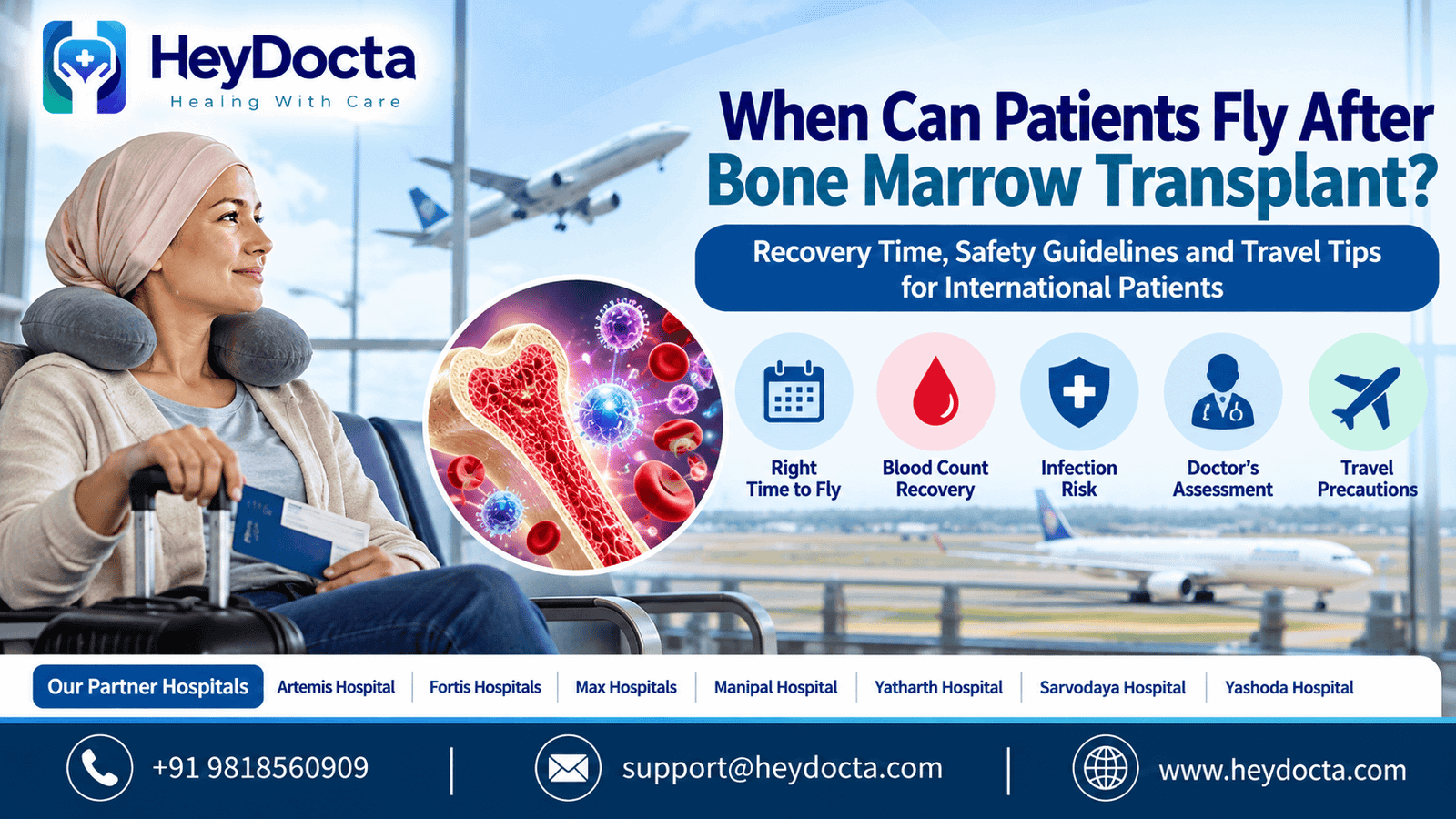
Recovering from a bone marrow transplant (BMT) takes time, and one of the most common questions international patients ask is: When can patients fly after bone marrow transplant? There is no single date that is safe for everyone. The timing depends on blood-count recovery, infection risk, transplant type, complications, medications and the treating transplant team’s assessment. NHS guidance notes that full recovery can take up to a year, while specialist centres commonly recommend staying close to the transplant team during the early recovery period.
For patients who travel to India from Nigeria, Ghana, Kenya, Zimbabwe, Cameroon, Guyana, Jamaica, the Middle East, Europe or the USA, planning the return flight is an important part of the treatment journey.
Get a Free Medical Opinion: Share your medical reports with HeyDocta to understand the expected treatment plan, approximate stay in India and post-transplant travel requirements.
When Can Patients Fly After Bone Marrow Transplant?
Patients should not plan a flight based only on a fixed number of days or weeks after BMT. The transplant team should confirm that the patient is medically fit to travel.
Cancer Research UK advises patients to seek specialist advice before travelling after a bone marrow or stem cell transplant and notes that doctors commonly advise avoiding international travel for at least six months in the early recovery period. It also highlights that travel may need to wait until blood counts, including platelets and red cells, have recovered.
Some patients may be cleared earlier, particularly after an uncomplicated autologous transplant, while patients undergoing allogeneic or more complicated transplants may need a longer period of monitoring.
Factors Doctors Consider Before Clearing a Patient to Fly
The transplant team may assess:
- Platelet and red blood cell counts
- White blood cell and immune recovery
- Evidence of infection
- Fever or recent infections
- Graft-versus-host disease (GVHD)
- Kidney, liver or lung function
- Oxygen levels and breathing
- Current medications
- Need for blood or platelet transfusions
- Central venous catheter or other medical devices
- Overall strength and ability to manage a long journey
- Availability of appropriate medical care at the destination
Memorial Sloan Kettering specifically advises patients to discuss air travel with their transplant team and notes that an adequate platelet count is necessary for safe air travel.
Why Is Flying Too Soon After BMT a Concern?
The immune system remains weakened after transplantation. Patients can therefore be more vulnerable to infections, and frequent hospital monitoring may still be necessary.
NHS guidance states that patients usually have regular follow-up after discharge and may still require medicines to prevent infections or blood and platelet transfusions while blood-cell production recovers.
Long flights also involve prolonged sitting, airport crowds, dehydration and exposure to other travellers. These factors need particular consideration in someone who is still recovering.
Low platelet levels can increase bleeding risk, while low red blood cell levels can contribute to weakness or breathlessness. For these reasons, fitness to fly should be individually assessed rather than assumed.
How Long Should International Patients Stay in India After BMT?
There is no universal stay duration.
The required stay depends on:
- Autologous vs allogeneic transplant
- Patient’s diagnosis
- Conditioning treatment
- Donor type
- Engraftment
- Blood-count recovery
- Infections or other complications
- Need for transfusions
- Doctor’s follow-up schedule
Some patients may require several weeks of hospital care followed by outpatient monitoring near the transplant centre. NHS information notes that patients can spend several weeks in hospital and continue with frequent follow-up after discharge.
For international patients, it is generally safer to keep the return flight flexible rather than purchasing a non-refundable ticket for a fixed date before the transplant team confirms fitness to travel.
What Tests May Be Needed Before Flying?
Before international travel, the transplant team may review recent:
- Complete blood count (CBC)
- Platelet count
- Haemoglobin
- White blood cell and neutrophil count
- Kidney and liver function
- Infection screening where clinically appropriate
- Medication levels, where required
- GVHD assessment for allogeneic transplant patients
The exact tests depend on the patient’s condition and transplant protocol.
Flying After Autologous vs Allogeneic BMT
The recovery timeline can differ significantly between transplant types.
Autologous transplant: The patient’s own stem cells are used. Some patients may recover more quickly, but they still require monitoring for infection, blood-count recovery and other complications.
Allogeneic transplant: Stem cells come from a donor. Recovery can be more complex because of risks such as GVHD and prolonged immune suppression. Travel may therefore need to be delayed for longer.
There is no safe assumption that one transplant type always permits flying at a particular time. The treating specialist must make the final decision.
How to Make the Flight Safer After BMT
Once cleared to fly, international patients should discuss travel arrangements with their medical team.
Depending on individual medical advice, useful precautions may include:
- Wear a well-fitting mask in crowded areas and during the journey if advised.
- Maintain good hand hygiene.
- Carry prescribed medicines in hand luggage.
- Carry a medical summary and recent test reports.
- Keep medicines in their original labelled packaging.
- Drink adequate fluids if medically permitted.
- Move your legs and walk periodically during a long flight when medically safe.
- Avoid contact with visibly ill passengers where practical.
- Arrange wheelchair or airport assistance if weakness or fatigue makes walking difficult.
- Keep emergency contact information readily available.
- Confirm follow-up with a haematologist after returning home.
Patients should also check airline requirements and travel insurance conditions before departure.
Bone Marrow Transplant Cost in India vs Other Countries
Cost is an important consideration for international patients. However, BMT costs vary significantly depending on transplant type, donor requirements, hospital, medicines, length of stay and complications.
Some Hospitals currently publishes a general Indian BMT range of approximately USD15000 to 31000, while noting that the actual cost varies according to hospital, location, room category and complications.
For a broader comparison, the U.S. Health Resources and Services Administration states that an unrelated bone marrow or cord blood transplant in the USA can range from USD 240,000 to more than USD 1 million, including the transplant and up to six months of care.
| Country/Region | Indicative BMT Cost | Important Note |
| India | USD15000–31000* | Varies by transplant type and complications |
| USA | USD 240,000–1M+* | HRSA figure for unrelated BMT/cord blood + up to 6 months care |
| Europe | Varies significantly | Public, insurance and private costs differ |
| Middle East | Varies by country and hospital | Private international-patient pricing differs |
| Africa | Varies considerably | Availability and private-sector pricing differ |
Indicative figures only. These figures are not directly comparable because the scope of included services differs between countries.
For international patients, the most useful approach is to obtain a case-specific quotation that clearly explains what is included: transplant, donor testing, hospitalisation, medicines, transfusions, investigations and follow-up.
Bone Marrow Transplant Specialists and Hospitals in India
India has specialised BMT centres providing autologous and allogeneic stem cell transplantation.
At Artemis Hospitals, Gurugram, Dr. Gaurav Dixit is listed as Head – Haematology Oncology & Bone Marrow Transplant, with 20 years of experience. His listed procedures include autologous stem-cell transplant, matched-sibling allogeneic transplant, haploidentical transplant, matched-unrelated donor transplant and CAR-T therapy.
Other hospitals international patients may consider include:
- Artemis Hospital
- Fortis Hospitals
- Max Hospitals
- Manipal Hospital
- Yatharth Hospital
- Sarvodaya Hospital
- Yashoda Hospital
Patients should select a transplant centre based on their diagnosis, transplant requirements, specialist assessment, infrastructure, donor options and follow-up arrangements rather than cost alone.
Step-by-Step: Planning Your Return Flight After BMT
1. Complete the transplant and initial recovery
The patient remains under close medical supervision during engraftment and early recovery.
2. Continue outpatient monitoring
After discharge, regular blood tests and specialist appointments may still be required.
3. Discuss travel with the transplant team
The doctor reviews blood counts, infection risk, medications and complications.
4. Obtain medical clearance
Only book or confirm the international return journey after the treating team considers the patient fit to travel.
5. Arrange follow-up at home
A local haematologist should receive the discharge summary, transplant details, medication list and recommended monitoring plan.
6. Maintain follow-up after returning home
Remote coordination with the Indian transplant centre may be useful where available, alongside local medical care.
Medical Visa and Travel Support for BMT Patients
International patients travelling to India for BMT need to plan medical documentation, visa requirements, accommodation, airport transfers and follow-up care.
HeyDocta can support patients with:
- Hospital coordination
- Medical opinion and report sharing
- Treatment-cost coordination
- Medical visa assistance
- Travel and accommodation guidance
- Airport transfer coordination
- Communication with hospital international-patient teams
- Post-treatment follow-up coordination
HeyDocta acts as a medical tourism facilitator and does not add a separate service fee to the patient’s hospital treatment cost.
Talk to Our Medical Tourism Expert: Get help planning your BMT treatment, expected stay and return-travel arrangements in India.
FAQs About Flying After Bone Marrow Transplant
1. Can I fly one month after a bone marrow transplant?
Possibly in selected cases, but it is not automatically safe. Blood counts, infection risk, complications and overall recovery must be assessed by the transplant team.
2. When is it usually safer to fly after BMT?
There is no universal timeframe. Some guidance recommends avoiding international travel for at least six months, while individual patients may receive different advice based on recovery.
3. Can I fly if my platelet count is low?
Low platelets can increase bleeding risk, and some transplant centres may advise against flying until counts have recovered sufficiently.
4. Is flying different after an allogeneic transplant?
It can be. Allogeneic patients may have prolonged immune suppression and risks such as GVHD, which can require longer and closer monitoring.
5. Should I book my return flight before BMT?
It is generally better to keep the return flight flexible because the recovery period can change depending on engraftment, infections, blood counts and complications.
6. Can international patients return home after BMT in India?
Yes, many international patients eventually return home, but the transplant team should first provide medical clearance and a follow-up plan.
7. Can HeyDocta help with my return travel after BMT?
Yes. HeyDocta can coordinate with the hospital and help international patients plan hospital care, accommodation, visa support, travel arrangements and post-treatment follow-up.
Conclusion
When can patients fly after bone marrow transplant? The answer depends on individual recovery rather than a fixed calendar date. Blood-count recovery, infection risk, immune function, complications and the need for ongoing monitoring are important considerations.
For international patients receiving BMT in India, planning the return journey with the transplant team is essential. Keeping travel dates flexible and arranging follow-up with a haematologist at home can make the transition safer and more organised.
India can also provide a potentially more affordable treatment pathway for eligible international patients, but the final BMT cost should always be based on an individual medical assessment and written hospital quotation.
Get a Free Medical Opinion from HeyDocta: Share your medical reports with Heydocta.com to explore BMT treatment options in India, estimated treatment costs, hospital coordination, visa assistance, travel planning and post-transplant follow-up support. Final medical and travel decisions should always be made with the treating transplant specialist.