When spine surgery is recommended, international patients often ask an important question: Is robotic spine surgery better than traditional spine surgery, and is the additional cost justified? The answer depends on the patient’s diagnosis, spinal level, surgical procedure, anatomy, and the surgeon’s assessment.
Robotic spine surgery uses computer-assisted planning and robotic guidance to help the surgeon position instruments and implants with greater precision. Traditional spine surgery relies more heavily on the surgeon’s conventional techniques and imaging guidance. Importantly, the robot does not independently perform the operation; the surgeon remains responsible for planning and carrying out the procedure.
For patients travelling from Nigeria, Ghana, Kenya, Zimbabwe, Cameroon, Guyana, Jamaica, the USA, Europe and the Middle East, India offers both conventional and technology-assisted spine procedures at major private hospitals. The appropriate option should be selected after reviewing medical records and imaging rather than based on technology alone.
Get a Free Medical Opinion: Share your MRI/CT reports with HeyDocta to understand which spine treatment options may be suitable and receive an estimated treatment plan from partner hospitals in India.
What Is Robotic Spine Surgery?
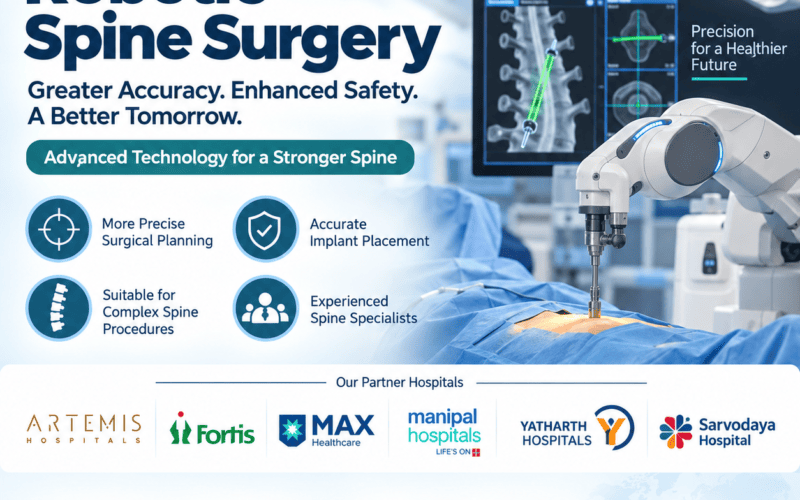
Robotic spine surgery is a form of computer-assisted surgery in which advanced navigation, imaging and robotic guidance are used during selected spinal procedures.
The surgeon generally uses pre-operative or intra-operative imaging to create a surgical plan. The robotic system then helps guide the surgeon according to that plan.
It may be particularly useful for procedures involving:
- Spinal fusion
- Pedicle screw placement
- Complex spinal deformity correction
- Selected minimally invasive spine procedures
- Revision spine surgery in appropriately selected patients
- Certain cervical and lumbar procedures
Robot-assisted techniques were associated with a modest increase in pedicle-screw placement accuracy compared with fluoroscopic guidance, while fluoroscopic procedures had shorter operating-room times in the studies reviewed. The evidence therefore supports robotic assistance as a precision tool, rather than suggesting that it is automatically superior for every patient.
What Is Traditional Spine Surgery?
Traditional spine surgery refers to established surgical techniques performed without robotic assistance. It can include open or minimally invasive procedures, depending on the condition.
Common procedures include:
- Discectomy
- Laminectomy
- Spinal decompression
- Spinal fusion
- TLIF or PLIF
- ACDF
- Cervical or lumbar disc replacement
- Scoliosis correction
Traditional surgery does not mean outdated surgery. Experienced spine surgeons routinely perform complex procedures using advanced imaging, navigation, neuromonitoring and minimally invasive techniques without requiring robotic assistance.
The choice depends on the specific operation and the surgeon’s experience.
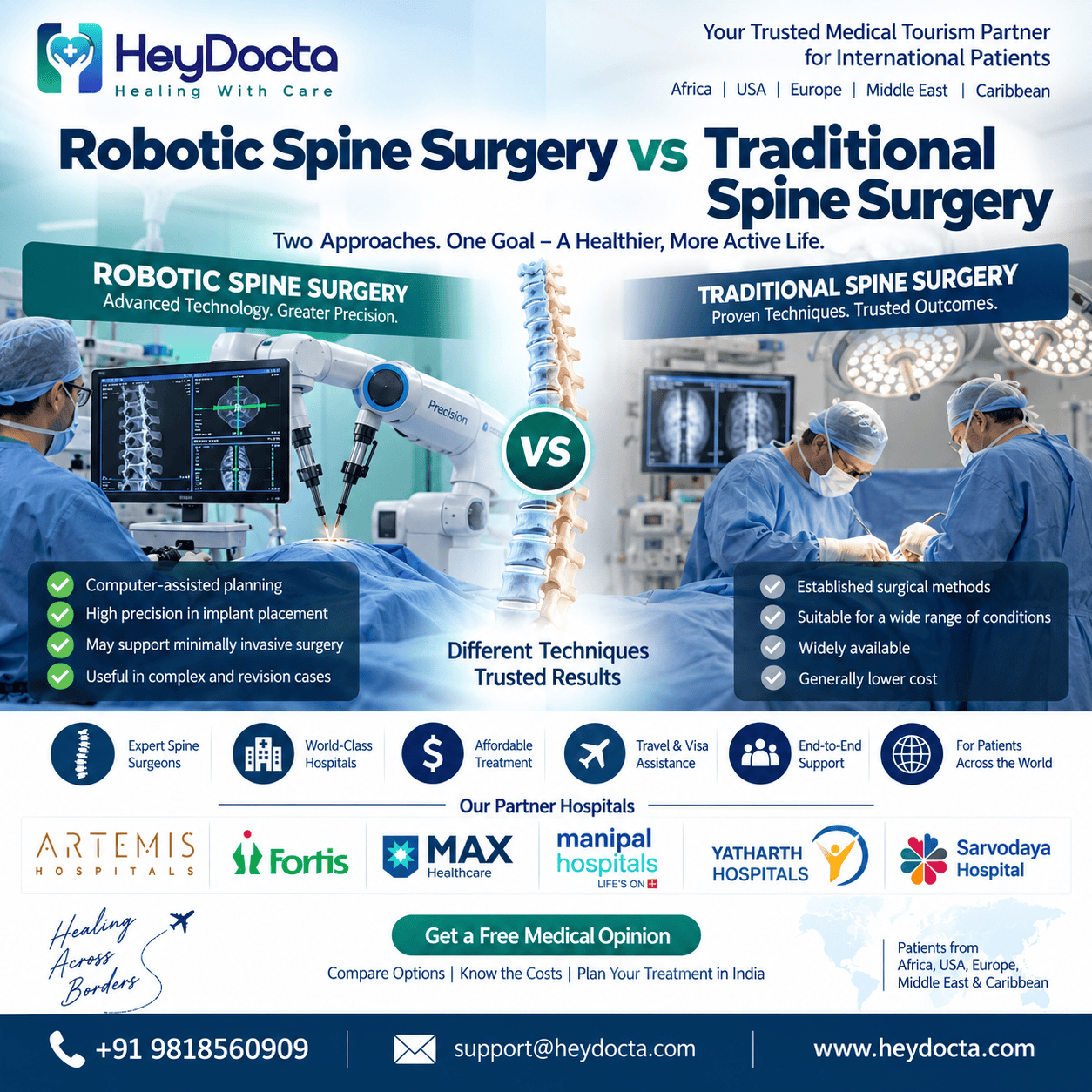
Robotic Spine Surgery vs Traditional Spine Surgery: Key Differences
| Feature | Robotic Spine Surgery | Traditional Spine Surgery |
| Surgical planning | Computer-assisted planning | Conventional surgical planning |
| Guidance | Robotic/navigation assistance | Surgeon-guided with imaging/navigation as required |
| Implant positioning | Robotic guidance may improve placement precision | Surgeon places implants using established techniques |
| Surgeon involvement | Surgeon remains fully in control | Surgeon performs the procedure directly |
| Technology cost | Generally higher | Usually lower |
| Availability | Available at selected advanced centres | Widely available |
| Suitability | Selected complex and fusion procedures | Broad range of spine procedures |
| Cost | Usually higher when robotic technology is used | Generally more affordable |
| Best choice | Depends on anatomy and procedure | Depends on anatomy and procedure |
Robotic Spine Surgery vs Traditional Spine Surgery: Which Is More Precise?
Precision is one of the major reasons robotic technology is used in spine surgery.
Robotic systems can assist with:
- Surgical planning
- Three-dimensional navigation
- Implant trajectory planning
- Pedicle screw placement
- Intraoperative positioning
- Minimally invasive access in selected procedures
The systematic review mentioned above found higher rates of accurate pedicle-screw placement with robot-assisted techniques compared with fluoroscopic guidance. However, the same review did not show an advantage in every measured outcome, and operating-room time was longer with robotic assistance in the analysed studies.
Therefore, patients should ask not simply, “Is robotic surgery better?”, but rather:
“Will robotic assistance provide a meaningful advantage for my particular procedure?”
Benefits of Robotic Spine Surgery
Depending on the procedure and patient, robotic assistance may offer several potential advantages.
1. More Detailed Surgical Planning
Advanced imaging and computer planning can help the surgeon plan implant trajectories before or during surgery.
2. Greater Implant Placement Precision
This can be particularly relevant during spinal fusion procedures requiring multiple screws and implants.
3. Assistance in Complex Anatomy
Patients with spinal deformities, previous surgery or challenging anatomy may sometimes benefit from computer-assisted navigation.
4. Potentially Less Invasive Surgery
In selected procedures, navigation and robotic assistance may support smaller incisions and targeted surgical approaches. This is not guaranteed and depends on the operation.
5. Reduced Radiation Exposure in Some Settings
The 2024 meta-analysis found lower radiation dosage per case with robot-assisted techniques compared with fluoroscopic guidance, although results varied across outcomes and procedures.
Benefits of Traditional Spine Surgery
Traditional surgery also has important advantages.
Established Surgical Techniques
Many spinal procedures have been performed successfully for decades using conventional approaches.
Wider Availability
Traditional spine surgery is available at a larger number of hospitals and does not depend on access to a robotic platform.
Potentially Lower Cost
Because there is no additional robotic technology component, conventional surgery may cost less.
Suitable for Many Conditions
Many patients do not require robotic assistance. A surgeon may determine that conventional or minimally invasive surgery is appropriate based on the diagnosis.
Robotic Spine Surgery Cost in India vs Traditional Spine Surgery
Cost is an important consideration for international patients.
Indicative 2026 sources place robotic spine surgery in India in a broad range of approximately $4,800–$11,000, depending on the procedure, hospital and complexity. General spine surgery costs can range from approximately $3,500 to $10,000+, with fusion and complex procedures generally costing more. These are planning ranges rather than fixed quotations.
| Treatment | India – Indicative Cost | USA – Indicative Cost | UK – Indicative Cost |
| General spine surgery | $3,500–$10,000+ | $30,000–$110,000+ | $15,000–$50,000+ |
| Single-level spinal fusion | $5,000–$10,000 | $40,000–$110,000 | $22,000–$45,000 |
| Robotic-assisted spine surgery | $4,800–$11,000+ | Often substantially higher | Often substantially higher |
Medical-tourism cost guides report substantial variation between hospitals and procedures, so these figures should be used only for preliminary budgeting. The final price depends on the number of levels treated, implants, robotic/navigation requirements, surgeon and hospital charges, length of stay and medical complexity.
For patients from Africa, the Caribbean, the Middle East, Europe and the USA, India can therefore represent a potentially lower-cost option for both conventional and advanced spine surgery.
What Determines the Cost of Spine Surgery in India?
Your final treatment estimate may depend on:
- Type of spine condition
- Robotic vs non-robotic approach
- Number of spinal levels
- Type and number of implants
- Hospital selected
- Surgeon’s professional fees
- Anaesthesia
- ICU requirements, if necessary
- Hospital stay
- Diagnostic imaging
- Neuromonitoring
- Rehabilitation and physiotherapy
- Complications or additional procedures
A lower initial quotation should not automatically be considered better. International patients should compare what is included in the package before making travel arrangements.
Leading Spine Surgeons and Hospitals in India
India has multiple private hospital groups offering orthopaedic and spine services.
HeyDocta works with partner hospitals including:
- Artemis Hospital
- Fortis Hospitals
- Max Hospitals
- Manipal Hospitals
- Yatharth Hospital
- Sarvodaya Hospital
Dr Hitesh Garg – Artemis Hospital
Dr Hitesh Garg as Head of Ortho Spine Surgery at Artemis Hospital, Gurugram. He has cpmpleted his fellowships in spine surgery at Yale University and paediatric spine surgery at Shriners Hospitals for Children, USA. He is also experienced in spinal fusion, deformity correction, disc replacement and complex spine procedures.
Dr Jitesh Manghwani – Max Hospital
Dr Jitesh Manghwani as Associate Director & Unit Head – Orthopaedic Spine Surgery at Max Super Speciality Hospital, Shalimar Bagh. His listed training includes a fellowship in robotic spine surgery in the USA.
The right surgeon should be selected according to the patient’s diagnosis and required procedure rather than simply choosing a surgeon because robotic technology is available.
Talk to a Medical Tourism Expert: HeyDocta can coordinate medical records with suitable partner hospitals and help international patients compare treatment plans and estimated costs before travelling to India.
Robotic Spine Surgery in India: Step-by-Step Process
Step 1: Send Your Medical Reports
International patients can share MRI, CT scans, X-rays, medical history and previous treatment records.
Step 2: Specialist Evaluation
The reports are reviewed by an appropriate spine specialist to determine the likely diagnosis and treatment options.
Step 3: Treatment Plan and Cost Estimate
The hospital provides a proposed treatment plan and estimated cost based on the patient’s condition.
Step 4: Hospital Selection
Patients can evaluate available hospitals, surgeons, treatment approaches and estimated expenses.
Step 5: Medical Visa Assistance
Once treatment is planned, HeyDocta can assist with the medical-travel documentation and coordination required for the patient’s journey.
Step 6: Arrival in India
Airport pickup, accommodation coordination and hospital appointments can be arranged according to the patient’s requirements.
Step 7: Surgery and Hospital Stay
The selected surgeon performs the recommended procedure. Hospitalisation varies depending on the operation and recovery.
Step 8: Recovery and Follow-Up
Patients receive post-operative instructions, medication guidance and rehabilitation recommendations. Follow-up can also be coordinated after returning home.
Recovery After Robotic vs Traditional Spine Surgery
Recovery varies considerably according to the actual procedure.
A simple decompression or discectomy generally has a different recovery timeline from multi-level spinal fusion or deformity correction.
Factors affecting recovery include:
- Type of surgery
- Number of spinal levels
- Patient’s age and general health
- Previous spine surgery
- Bone quality
- Physical activity
- Rehabilitation
- Any complications
Robotic assistance does not guarantee a faster recovery. A patient should follow the treating surgeon’s specific post-operative instructions.
International patients may need to remain in India for the recommended post-operative observation period before flying home. The exact duration should be confirmed by the treating hospital.
Medical Visa and Travel Support for International Patients
Travelling abroad for spine surgery involves more than selecting a surgeon.
HeyDocta can support international patients with:
- Hospital coordination
- Medical opinion coordination
- Treatment-cost estimates
- Appointment scheduling
- Medical visa documentation assistance
- Airport transfer coordination
- Accommodation assistance
- Local transportation
- Interpreter coordination where required
- Follow-up coordination
The goal is to make the medical journey easier for patients and accompanying family members.
Is Robotic Spine Surgery Worth the Extra Cost?
There is no universal answer.
For some procedures, robotic assistance may provide useful planning and implant-placement benefits. For other operations, conventional or minimally invasive surgery may provide an appropriate solution without the additional robotic expense.
The most important factors are:
- Correct diagnosis
- Appropriate surgical indication
- Experienced spine surgeon
- Suitable hospital infrastructure
- Appropriate surgical technology
- Transparent treatment cost
- Proper post-operative care
A specialist should determine whether robotic assistance adds meaningful value in an individual case.
FAQs About Robotic Spine Surgery vs Traditional Spine Surgery
1. Is robotic spine surgery better than traditional spine surgery?
Not necessarily for every patient. Robotic technology can assist with planning and implant positioning in selected procedures, but conventional surgery remains appropriate for many spinal conditions.
2. Is robotic spine surgery more expensive in India?
Usually, robotic-assisted procedures can cost more than comparable conventional procedures because of the additional technology and operating-room resources. The exact difference depends on the procedure and hospital.
3. How much does robotic spine surgery cost in India?
Indicative 2026 medical-tourism sources report approximately $4,800–$11,000 for robotic spine surgery, but the final cost can be higher or lower depending on the procedure, implants, hospital and complexity.
4. Can international patients get robotic spine surgery in India?
Yes. Selected Indian private hospitals have advanced spine programmes and robotic/navigation technology. Availability depends on the hospital and required procedure.
5. How long should an international patient stay in India?
The duration depends on the surgery and recovery. A hospital stay may range from a few days to longer for complex surgery, followed by additional time in India for observation and follow-up.
6. Does robotic spine surgery guarantee a faster recovery?
No. Recovery depends on the surgery, patient’s health, spinal condition and rehabilitation. Robotic assistance does not guarantee a particular outcome.
7. How can I compare spine surgery costs before travelling to India?
Send your MRI/CT reports and medical history to HeyDocta. A medical coordinator can help obtain specialist opinions, hospital options and an estimated treatment cost before you make travel arrangements.
Conclusion: Choosing the Right Spine Surgery in India
The decision between robotic spine surgery vs traditional spine surgery should be based on the patient’s condition rather than technology alone. Robotic systems can provide computer-assisted planning and guidance in selected procedures, while traditional spine surgery remains an established option for many patients.
For international patients, India offers access to both conventional and advanced spine-care options through major private hospitals.
HeyDocta helps international patients navigate the process by coordinating medical opinions, hospital selection, treatment estimates, appointments and travel-related assistance. Contact HeyDocta.com today to get a free medical opinion and compare treatment costs from leading Indian hospitals before planning your journey.