
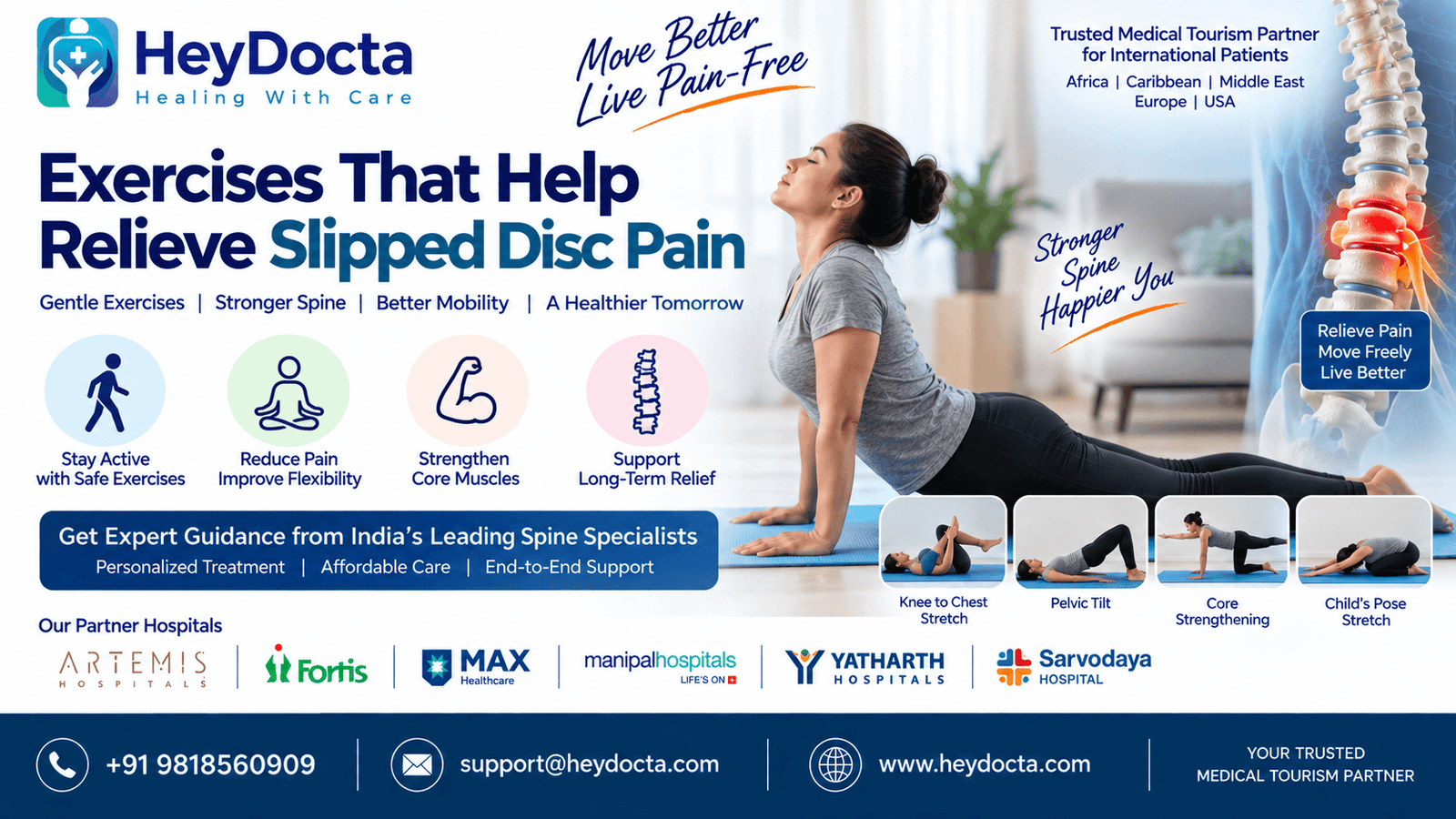
Exercises that help relieve slipped disc pain can play an important role in recovery for many patients, particularly when symptoms are mild or moderate and there is no serious neurological problem. Gentle movement, walking and an individually designed physiotherapy programme may help improve mobility and function. However, the right exercises depend on the location of the disc problem, symptoms, nerve involvement and overall health.
For international patients from Nigeria, Ghana, Kenya, Zimbabwe, Cameroon, Guyana, Jamaica, the Middle East, Europe and the USA, India offers both conservative treatment and advanced spine procedures through specialised hospitals. This can be particularly relevant when physiotherapy and other non-surgical treatments have not provided sufficient improvement.
Get a Free Medical Opinion: Share your MRI reports and previous medical records with HeyDocta to understand whether physiotherapy, exercise-based treatment or specialist spine care may be appropriate for you.
Can Exercise Help a Slipped Disc?
Yes, exercise can be part of slipped disc recovery for many patients.
A slipped disc occurs when the soft material inside a spinal disc pushes through its outer layer and may irritate a nearby nerve. This can cause back pain, sciatica, numbness, tingling or weakness.
Staying active is generally preferred over prolonged bed rest. The NHS recommends gradually returning to gentle exercise, including activities such as walking, swimming and yoga, provided they do not increase symptoms.
However, exercise should not be treated as a universal cure. A physiotherapist or spine specialist should determine which movements are appropriate for an individual patient.
Best Exercises for Slipped Disc Pain
1. Walking
Walking is one of the simplest ways to remain physically active during recovery.
Start with a comfortable distance and gradually increase the duration as tolerated. Short, frequent walks may be easier than one long walk.
Walking can help prevent prolonged inactivity and maintain general mobility.
2. Gentle Core-Strengthening Exercises
The muscles around the abdomen, pelvis and lower back help support the spine.
A physiotherapist may introduce gentle core exercises after assessing the patient’s condition. Examples can include controlled abdominal activation and other stabilisation exercises.
The exact exercise and intensity should be adjusted according to symptoms.
3. Pelvic Tilts
Pelvic tilts are commonly included in some rehabilitation programmes for lower-back problems.
The exercise involves gently moving the pelvis while lying in a controlled position. It should be performed slowly without forcing the lower back.
A physiotherapist can demonstrate the correct technique and determine whether it is appropriate.
4. Gentle Hamstring Stretching
Tight muscles around the hips and legs can affect movement patterns.
A gentle hamstring stretch may be included in an individual rehabilitation programme. Stretching should never be forced, particularly when a patient has active nerve pain.
If stretching increases shooting leg pain, numbness or tingling, stop and seek professional guidance.
5. Knee-to-Chest Movement
For some patients with lower-back problems, gentle knee-to-chest movements may be included in physiotherapy.
However, this exercise is not appropriate for everyone with a herniated disc. The effect of different spinal positions varies between patients.
Therefore, it should be performed only if recommended by a healthcare professional.
6. Gentle Swimming
Swimming can provide a low-impact way of maintaining activity for some patients.
The buoyancy of water reduces the load on the body, although certain swimming strokes or movements may aggravate symptoms in some people.
Start gradually and stop if pain becomes worse.
7. Physiotherapist-Prescribed Nerve Mobility Exercises
Patients with sciatica may sometimes receive specific nerve mobility or neural mobilisation exercises.
These exercises are different from ordinary stretching and should be taught by a trained physiotherapist. Incorrect or aggressive movements may aggravate nerve-related symptoms.
Exercises to Avoid During a Slipped Disc Flare-Up
Not every exercise is suitable when you have an active slipped disc.
Depending on your condition, a specialist may advise avoiding:
- Heavy weightlifting
- Deep bending under load
- Repeated twisting
- High-impact jumping
- Sudden jerking movements
- Exercises that increase leg pain
- Heavy lifting with poor technique
- Prolonged positions that aggravate symptoms
The important principle is not to push through increasing nerve pain.
The NHS advises people with sciatica to remain active but avoid sitting or lying down for long periods and to seek professional advice when symptoms worsen or do not improve.
When Should You Stop Exercising?
Stop an exercise and seek medical advice if you experience:
- Increasing shooting pain
- New or worsening numbness
- New muscle weakness
- Significant worsening of symptoms
- Loss of balance
- Severe pain that does not settle
- New bladder or bowel problems
New bladder or bowel dysfunction, numbness around the genital or buttock area, or significant progressive weakness can indicate serious nerve compression and requires urgent medical assessment.
The NHS recommends seeking medical advice when sciatica is worsening, preventing normal activities or not improving after several weeks.
When Is Physiotherapy Better Than Surgery?
For many patients, conservative management is the starting point.
Treatment may include:
- Activity modification
- Physiotherapy
- Exercise
- Pain management
- Posture and movement education
- Lifestyle changes
- Selected injections
Surgery is generally considered when symptoms persist despite appropriate conservative treatment or when significant neurological problems develop. The NHS notes that surgery for a slipped disc is not usually necessary but may be discussed when symptoms do not improve or when weakness or numbness worsens.
When Might Surgery Be Needed?
A spine specialist may consider surgery when:
- Severe symptoms persist despite non-surgical treatment
- Leg or arm pain significantly affects daily activities
- Progressive muscle weakness develops
- There is significant nerve compression
- MRI findings correspond with the patient’s symptoms
- An urgent neurological condition is present
Possible procedures include microdiscectomy, endoscopic discectomy or other decompression procedures. The appropriate procedure depends on the patient’s diagnosis.
Cost of Slipped Disc Treatment in India
For international patients, the cost difference between conservative care and surgery can be significant.
Physiotherapy is generally much less expensive than hospital-based spinal surgery. However, the total cost depends on the number of sessions, location, physiotherapist, diagnostic requirements and duration of treatment.
If surgery becomes necessary, published Indian hospital prices provide a useful reference.
Indicative Slipped Disc Treatment Cost Comparison
| Treatment / Country | Indicative Cost |
| Physiotherapy in India | Varies by sessions and centre |
| Microdiscectomy in India | USD 1100-1500* |
| Private slipped-disc surgery in UK | £5,579–£12,381* |
| Private microdiscectomy in USA | Around USD 27,342 mean complete price in a published hospital-price study* |
| Microdiscectomy in UAE | Approximately USD 10,080–22,930* |
These are indicative figures from published sources, not personalised quotations. Actual costs vary according to diagnosis, hospital, surgeon, procedure, investigations, anaesthesia, length of stay and other factors.
For international patients, comparing the complete treatment package is more useful than comparing a surgery fee alone.
Talk to Our Medical Tourism Expert: HeyDocta can help coordinate your reports with an appropriate Indian spine specialist and provide guidance on available treatment options and estimated costs.
Why International Patients Consider India for Slipped Disc Treatment
India has specialised spine departments offering conservative treatment, physiotherapy, minimally invasive procedures and conventional spine surgery.
International patients may consider India because of:
- Specialised spine surgeons
- Physiotherapy and rehabilitation services
- Advanced diagnostic facilities
- Minimally invasive treatment options
- Multiple hospital choices
- Competitive private healthcare costs
- International-patient coordination
- English-speaking medical teams
The goal should not be to choose surgery simply because it is available. A proper diagnosis should determine whether exercise, physiotherapy, medication, injections or surgery is appropriate.
Spine Specialists International Patients Can Consider
Dr Hitesh Garg – Artemis Hospitals, Gurugram
Dr Hitesh Garg is Head – Ortho Spine Surgery at Artemis Hospitals, Gurugram. Artemis lists his specialties as orthopaedic surgery, spine surgery and scoliosis surgery. His profile reports more than 15 years of spine-surgery experience and more than 5,000 spine surgeries.
Dr Jitesh Manghwani – Max Healthcare
Dr Jitesh Manghwani is Associate Director & Unit Head – Orthopaedic Spine Surgery at Max Healthcare. Max lists his interests including conservative management of spinal diseases, disc herniation, microscopic keyhole surgery, endoscopic spine surgery and spinal stenosis.
These are examples of specialists international patients can consider. The appropriate doctor should be selected according to the patient’s medical reports, diagnosis and treatment requirements.
Partner Hospitals for Spine Treatment Through HeyDocta
HeyDocta works with partner hospitals including:
- Artemis Hospitals
- Fortis Hospitals
- Max Hospitals
- Manipal Hospitals
- Yatharth Hospitals
- Sarvodaya Hospital
Hospital selection can depend on the patient’s diagnosis, required treatment, surgeon availability, location and budget.
How HeyDocta Helps International Patients
Step 1: Share Medical Reports
Send your MRI reports, previous prescriptions and medical history to HeyDocta.
Step 2: Specialist Review
HeyDocta can coordinate your reports with an appropriate spine specialist for an initial medical opinion.
Step 3: Treatment Plan
The specialist can recommend conservative management, physiotherapy, further investigations or surgery depending on the case.
Step 4: Cost Estimate
If treatment in India is recommended, HeyDocta can coordinate with the hospital to obtain an estimated treatment cost.
Step 5: Visa and Travel Assistance
HeyDocta can assist with medical visa guidance, hospital coordination and travel arrangements.
Step 6: Treatment and Follow-Up
After arrival, the patient receives an in-person consultation and treatment according to the final assessment. Follow-up recommendations are provided before returning home.
Recovery and Long-Term Spine Care
Exercise is often only one part of slipped disc recovery.
Patients may also be advised to:
- Maintain a healthy body weight
- Stay physically active
- Use correct lifting techniques
- Avoid prolonged sitting
- Improve sitting and working posture
- Follow a structured rehabilitation programme
- Gradually increase activity
The NHS recommends remaining active and gradually starting gentle exercise for sciatica rather than prolonged bed rest.
FAQs About Exercises for Slipped Disc Pain
1. What is the best exercise for a slipped disc?
There is no single exercise that is best for every patient. Walking and individually prescribed physiotherapy exercises are commonly used, but the programme should be based on symptoms and diagnosis.
2. Can walking help a slipped disc?
Walking can help maintain movement and physical activity during recovery. It should be increased gradually and should not significantly worsen symptoms.
3. Should I exercise if I have sciatica?
Gentle activity is generally encouraged, but exercises that increase pain or neurological symptoms should be stopped. A physiotherapist can help identify appropriate movements.
4. Can exercise cure a slipped disc?
Exercise can help manage symptoms, improve mobility and support rehabilitation, but it does not guarantee that a disc herniation will disappear. Some patients may eventually require additional treatment.
5. When should I consider surgery for a slipped disc?
Surgery may be considered when symptoms do not improve with appropriate conservative treatment or when significant or progressive neurological problems develop.
6. How much does slipped disc surgery cost in India?
The final international-patient quotation depends on the hospital, surgeon, procedure and individual medical requirements.
7. Can international patients get a treatment opinion before travelling to India?
Yes. Patients can send their MRI and medical records to HeyDocta for coordination with an appropriate Indian spine specialist before planning their medical journey.
Conclusion
Exercises that help relieve slipped disc pain can be an important part of conservative treatment and rehabilitation. Walking, gentle mobility work, core strengthening and physiotherapist-guided exercises may help selected patients remain active and improve physical function. However, exercises should be individualised, particularly when symptoms include sciatica, numbness or weakness.
For international patients from Africa, the Caribbean, the Middle East, Europe and the USA, India provides access to spine specialists, physiotherapy services, advanced diagnostics and surgical options at comparatively competitive private healthcare costs.
HeyDocta.com helps international patients coordinate medical opinions, hospitals, treatment estimates, medical visa guidance, travel arrangements and follow-up care. There is no additional facilitation cost to patients for HeyDocta’s coordination service.
Get Treatment Cost from Top Indian Hospitals: Send your MRI and medical reports to HeyDocta to explore suitable spine specialists, physiotherapy programmes and treatment options in India.