
The hidden costs of bone marrow transplant abroad can make the final treatment bill much higher than the initial hospital quotation. For patients travelling from Nigeria, Ghana, Kenya, Zimbabwe, Cameroon, Guyana, Jamaica, the Middle East, Europe or the USA, the advertised transplant package may cover only part of the complete medical journey. Donor testing, additional medicines, extended hospitalisation, accommodation, flights, visa expenses, follow-up care and complications can all affect the final budget.
India is increasingly considered by international patients because BMT treatment can be considerably more affordable than treatment in some Western healthcare systems. Current Indian planning data place bone marrow transplantation broadly around USD 25,000–70,000, depending on transplant type and complexity, while unrelated BMT in the USA can range from USD 240,000 to more than USD 1 million, including the transplant and up to six months of care.
Get a Free Medical Opinion: Share your medical reports with HeyDocta to understand the likely treatment pathway, hospital options and estimated overall budget before travelling to India.
What Are the Hidden Costs of Bone Marrow Transplant?
A BMT quotation is not always the same as the total cost of treatment. Some hospitals provide an initial package covering the main transplant admission, while other expenses are billed separately.
The final cost may include:
- Pre-transplant investigations
- HLA and donor testing
- Donor search and donor-related expenses
- Stem-cell collection
- Conditioning medicines
- Hospital and isolation-room charges
- Blood and platelet products
- Antibiotics and other supportive medicines
- ICU treatment if required
- Treatment of infections or complications
- Additional diagnostic tests
- Post-transplant medicines
- Accommodation outside the hospital
- Flights and local transportation
- Visa and documentation expenses
- Follow-up after returning home
For international patients, these additional expenses can be especially important because accommodation and travel may continue for weeks after hospital discharge.
Why Can the Final BMT Cost Be Higher Than the Quotation?
1. Pre-Transplant Tests
Before BMT, doctors generally need detailed information about the patient’s disease, previous treatment, organ function, infection status and donor compatibility.
International patients may need additional pathology review, imaging, molecular testing, HLA testing or other investigations after arriving in India.
Ask the hospital:
“Which investigations are included in the quoted package, and which are billed separately?”
2. Donor Search and HLA Matching
Allogeneic BMT requires stem cells from another person. HLA testing helps determine donor compatibility.
A related donor may require compatibility testing, while an unrelated donor pathway may involve registry searches, confirmatory testing, donor procurement and transportation of the graft.
In the USA, the Health Resources and Services Administration notes that donor-search costs can range from USD 10,000 to more than USD 50,000 in some cases.
This makes donor-related expenses an important part of international treatment planning.
3. Additional Medicines
The transplant itself is only one component of BMT treatment.
Patients may require medicines for:
- Infection prevention
- GVHD prevention
- Nausea and other treatment-related symptoms
- Pain management
- Blood-count support
- Other complications
For allogeneic transplantation, graft-versus-host disease (GVHD) can occur when donor immune cells attack the patient’s tissues. Management may require additional medicines and monitoring.
4. Longer Hospital Stay
A standard quotation may assume a particular length of hospitalisation.
However, discharge can be delayed if the patient develops an infection, delayed engraftment, GVHD, bleeding or another complication.
An additional week or more in a transplant unit can significantly change the final hospital bill.
Before travelling, ask for:
- Daily additional-room charges
- ICU charges
- Additional nursing charges
- Medicine charges
- Blood-product charges
- Additional investigation costs
5. Complication-Related Costs
BMT is a complex treatment and complications can require additional care.
Possible problems include infections, bleeding, organ complications and GVHD after an allogeneic transplant.
International patients should therefore keep an emergency financial reserve rather than budgeting only for the planned transplant package.
6. Accommodation After Hospital Discharge
This is one of the most commonly overlooked expenses for medical tourists.
A patient may be medically stable enough to leave the hospital but still require frequent outpatient monitoring. Returning home immediately may not be practical, particularly after an allogeneic transplant.
Accommodation costs may include:
- Hotel or serviced apartment
- Food
- Caregiver accommodation
- Local transportation
- Airport transfers
- Extended stay because of delayed recovery
The patient’s treating team should determine when it is medically appropriate to travel home.
7. Companion and Caregiver Costs
International BMT patients often travel with a family member or caregiver.
The overall budget may therefore need to include:
- Companion airfare
- Visa
- Accommodation
- Food
- Local transportation
- Additional stay if the patient’s treatment is extended
These expenses can become significant when the patient needs to remain in India for several weeks.
India vs USA: Why the Total Cost Can Differ
| Cost Factor | India | USA |
| BMT treatment planning range | About USD 25,000–70,000 | Can reach USD 240,000 to over USD 1 million for unrelated BMT |
| Donor-related costs | Depends on donor type and hospital | Donor search can add USD 10,000–50,000+ |
| Accommodation | Additional depending on stay | Often separate from medical billing |
| Travel | Patient-funded | Patient-funded |
| Post-transplant care | Depends on treatment plan | May be included in some U.S. cost estimates |
| Complication costs | May increase hospital bill | Can substantially increase overall expenses |
Indian cost figures are indicative planning ranges and not fixed quotations. U.S. figures above are based on HRSA information for unrelated bone marrow or cord-blood transplantation, including up to six months of care.
The comparison shows why international patients should compare the complete treatment pathway, rather than only the headline transplant price.
Why International Patients Consider India for BMT
India has established BMT programmes in major private hospitals and offers treatment options for selected malignant and non-malignant blood disorders.
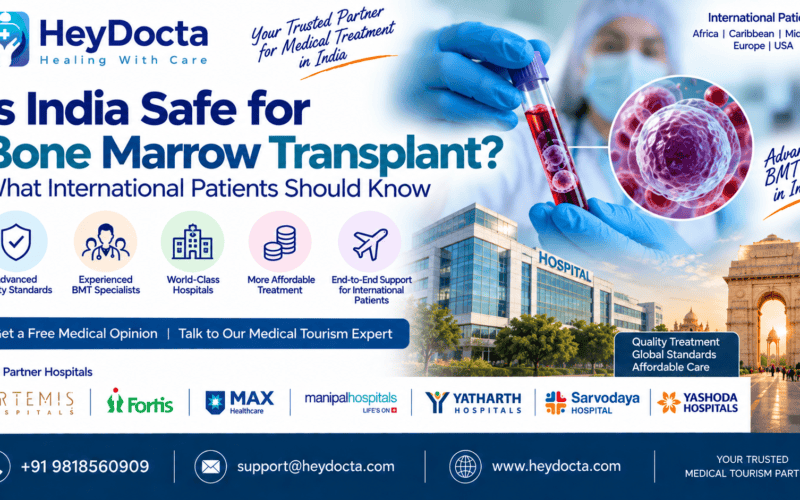
Partner hospitals available through HeyDocta include:
- Artemis Hospitals
- Fortis Hospitals
- Max Hospitals
- Manipal Hospitals
- Yatharth Hospitals
- Sarvodaya Hospital
- Yashoda Hospitals
For example, Artemis Hospitals lists BMT specialists including Dr. Gaurav Dixit, Head – Haematology Oncology & Bone Marrow Transplant . Its BMT programme covers malignant and non-malignant blood disorders.
Fortis Gurugram also reports more than 2,500 BMTs performed as of June 2026, with adult and paediatric transplantation programmes.
The appropriate hospital and specialist depend on the patient’s diagnosis, transplant type, donor availability, age and medical complexity.
How to Calculate Your Complete BMT Budget
Before travelling, divide your expected expenses into four categories.
Medical Costs
- Specialist consultation
- Diagnostic tests
- HLA testing
- Donor work-up
- Conditioning
- Transplant procedure
- Hospitalisation
- Medicines
- Blood products
- Follow-up
Travel Costs
- Flights
- Medical visa
- Airport transfers
- Local transportation
Living Costs
- Hotel or serviced apartment
- Food
- Caregiver expenses
- Local communication
Contingency Costs
Keep an additional reserve for:
- Extended hospitalisation
- Additional medicines
- Infection treatment
- ICU care
- Delayed discharge
- Additional follow-up
Talk to Our Medical Tourism Expert: HeyDocta can help you request an itemised treatment estimate from partner hospitals so you can understand which expenses are included before travelling.
Step-by-Step BMT Journey for International Patients
1. Share Medical Reports
Send diagnosis reports, pathology, previous treatment records, imaging and blood-test results.
2. Specialist Review
A BMT specialist evaluates the patient’s condition and determines whether transplantation may be appropriate.
3. Hospital and Cost Estimate
The hospital provides a treatment plan and estimated cost based on the patient’s individual requirements.
4. Donor Evaluation
For allogeneic BMT, donor compatibility and availability are assessed.
5. Visa and Travel Planning
Eligible patients can apply for an Indian e-Medical Visa. The official Indian e-Visa portal requires a hospital letter for an e-Medical Visa application, including the proposed or tentative treatment/admission date.
6. Treatment in India
The patient undergoes the planned transplant process and remains under specialist monitoring.
7. Recovery and Follow-Up
After discharge, continued monitoring is required. The treating team determines when the patient can safely return home.
How HeyDocta Helps Reduce Unexpected Costs
HeyDocta works as a medical tourism facilitator for international patients travelling to India.
Our support includes:
- Medical report coordination
- Hospital coordination
- Specialist consultation arrangements
- Treatment-cost enquiries
- Visa documentation assistance
- Travel coordination
- Accommodation assistance
- Communication with hospital teams
- Follow-up coordination
Patients can use this support to understand their expected medical and travel expenses before making arrangements.
HeyDocta does not charge patients an extra service fee for its medical tourism coordination.
FAQs About Hidden BMT Costs Abroad
1. What are the most common hidden costs of BMT abroad?
Additional tests, donor-related expenses, medicines, extended hospitalisation, complications, accommodation, flights, caregiver expenses and follow-up care are among the main costs.
2. Is the donor search included in a BMT package?
Not always. It depends on the donor type and hospital. Always request written clarification about HLA testing, donor search, donor collection and graft transportation.
3. Can BMT complications increase the total cost?
Yes. Infections, GVHD and other complications may require additional medicines, investigations or hospitalisation.
4. How much does BMT cost in India?
Current planning estimates place BMT in India around USD 25,000–70,000, although the actual cost varies significantly by transplant type and individual case.
5. Why can BMT cost much more in the USA?
The HRSA reports that an unrelated bone marrow or cord-blood transplant in the USA can cost USD 240,000 to more than USD 1 million, including the transplant and up to six months of care.
6. How long should international patients stay in India?
The required stay varies according to transplant type, engraftment, complications and follow-up requirements. Patients should follow the treating team’s advice before booking return travel.
7. Can HeyDocta help me understand the complete cost?
Yes. HeyDocta can coordinate your medical records with partner hospitals and help you request an estimated treatment plan and cost before travelling.
Conclusion
The hidden costs of bone marrow transplant abroad can be substantial if patients budget only for the headline hospital package. Donor testing, additional medicines, extended hospitalisation, complications, accommodation, flights, caregiver expenses and post-transplant monitoring should all be considered.
India offers international patients access to established BMT programmes and can provide a lower-cost treatment pathway compared with some high-cost healthcare markets. However, affordability should always be assessed alongside the treatment plan, transplant expertise, hospital facilities, donor requirements and follow-up arrangements.
The safest way to plan financially is to obtain an individualised, itemised hospital estimate before travelling.
Get Treatment Cost from Top Indian Hospitals: Contact HeyDocta.com with your medical reports. Our team can coordinate your case with partner hospitals, help you understand the expected BMT expenses, assist with visa and travel planning, and support you throughout your medical journey in India.