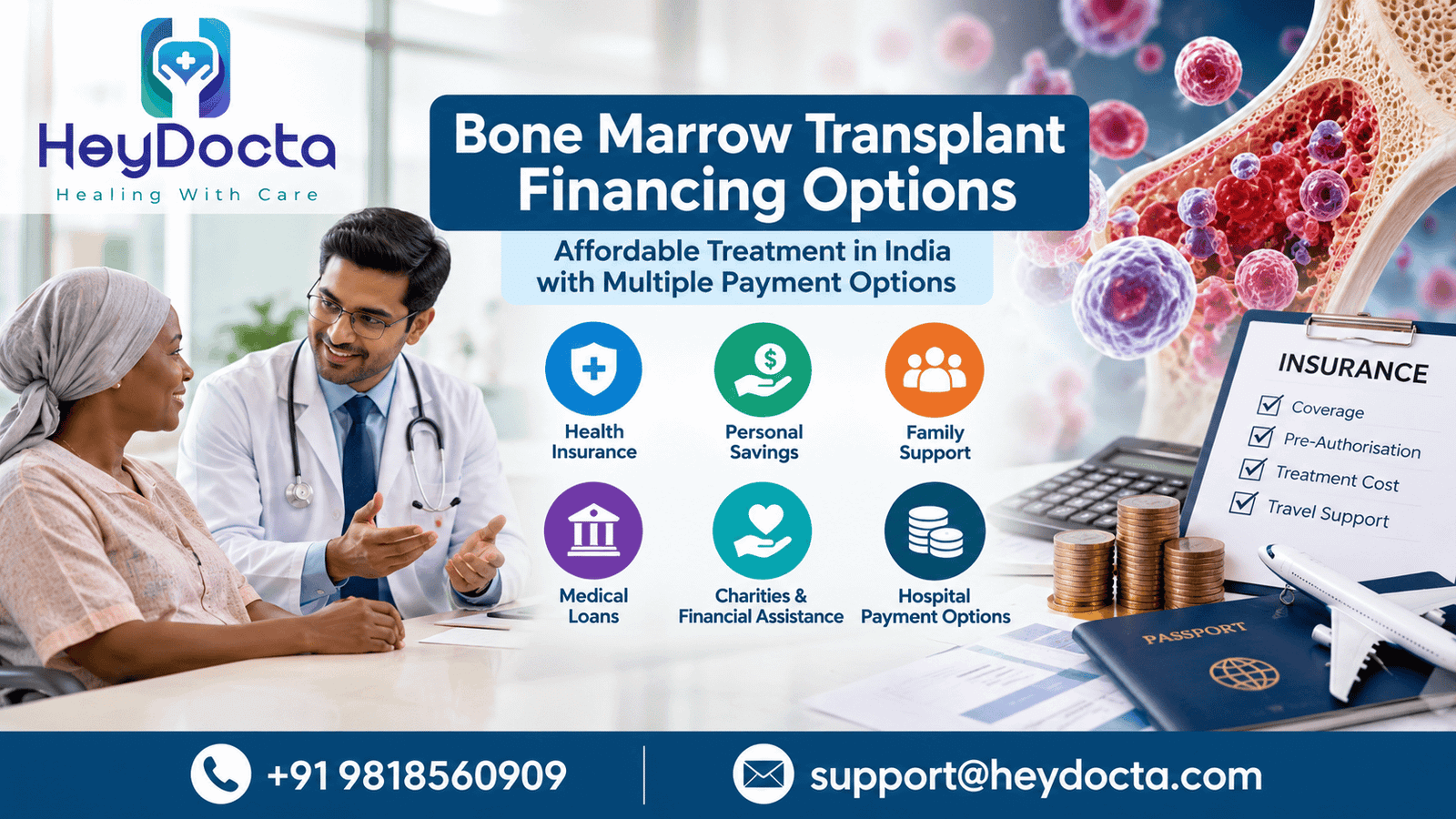
A bone marrow transplant (BMT) can be a major financial commitment, especially for international patients travelling to India for treatment. Understanding bone marrow transplant financing options before travelling can help families plan for hospital expenses, medicines, accommodation, travel and possible additional treatment costs. For patients from Nigeria, Ghana, Kenya, Zimbabwe, Cameroon, Guyana, Jamaica, the Middle East, Europe and the USA, India may offer a comparatively lower-cost treatment pathway, but the final cost depends on the transplant type, hospital, donor requirements and complications.
Some Hospitals currently publishes a general BMT cost range of USD15000 to 31000 in India, while noting that the actual amount varies by hospital, location, room type and complications.
Get a Free Medical Opinion: Share your medical reports with HeyDocta to understand your potential treatment plan, estimated BMT cost and available financial-planning options before travelling to India.
Why International Patients Consider India for Bone Marrow Transplant
Bone marrow or stem cell transplantation is used for selected blood cancers and blood disorders, including conditions such as leukemia, lymphoma, multiple myeloma, sickle cell disease and thalassemia.
International patients may consider India because of:
- Availability of specialised transplant centres
- Experienced haematology and BMT teams
- Multiple transplant approaches
- International-patient coordination
- Potentially lower treatment costs compared with some Western healthcare markets
- Availability of private and charitable financial resources
- English-language communication at many major hospitals
However, affordability should not mean choosing a treatment centre based only on the lowest quotation. BMT is complex and requires specialised infrastructure, experienced transplant teams and long-term monitoring.
What Does a Bone Marrow Transplant Cost in India?
There is no single BMT price applicable to every patient.
The cost can depend on:
- Autologous or allogeneic transplant
- Matched sibling or unrelated donor
- Haploidentical transplant
- Conditioning treatment
- Donor testing and collection
- Hospitalisation
- Medicines
- Blood and platelet transfusions
- Diagnostic investigations
- ICU requirements
- Infection management
- Graft-versus-host disease (GVHD)
- Other complications
- Follow-up care
Some Hospitals currently gives a general range of USD 15000–31000 for BMT in India. This should be treated as a planning range rather than a guaranteed package price.
Typical Cost Components
| Expense | May Be Included in BMT Estimate? |
| Specialist consultation | Depending on package |
| Pre-transplant investigations | Depends on hospital |
| Conditioning therapy | Depends on treatment plan |
| Stem-cell collection | Depends on transplant type |
| Hospitalisation | Usually a major component |
| Medicines | Varies |
| Blood/platelet support | May be additional |
| Donor testing | Depends on donor type |
| ICU care | Usually additional if required |
| Treatment of complications | May be additional |
| Follow-up | Depends on package |
Always ask the hospital for a written quotation showing what is included and excluded.
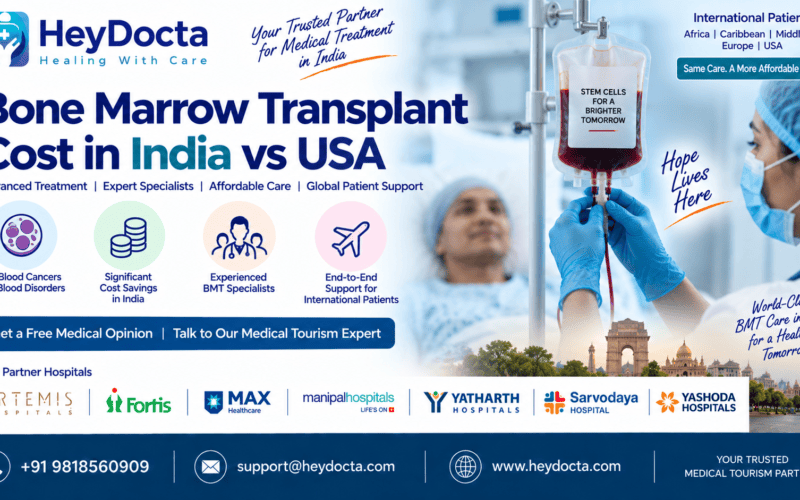
Bone Marrow Transplant Cost: India vs USA
Cost differences can be substantial, although comparisons must account for differences in healthcare systems and what each estimate includes.
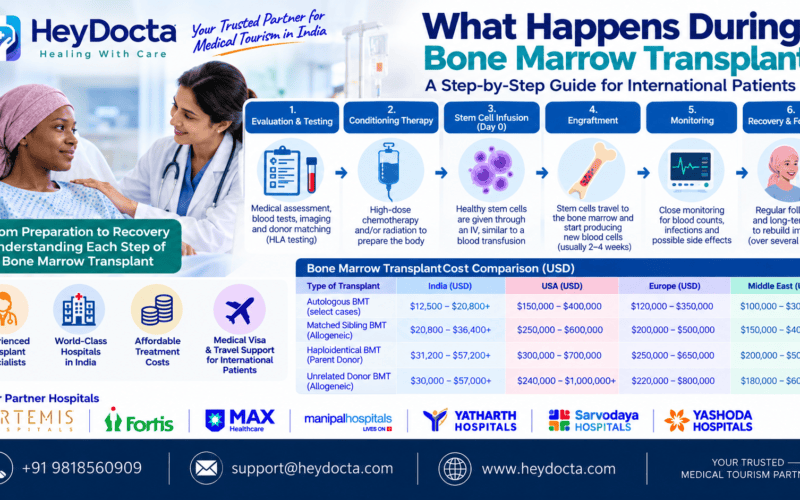
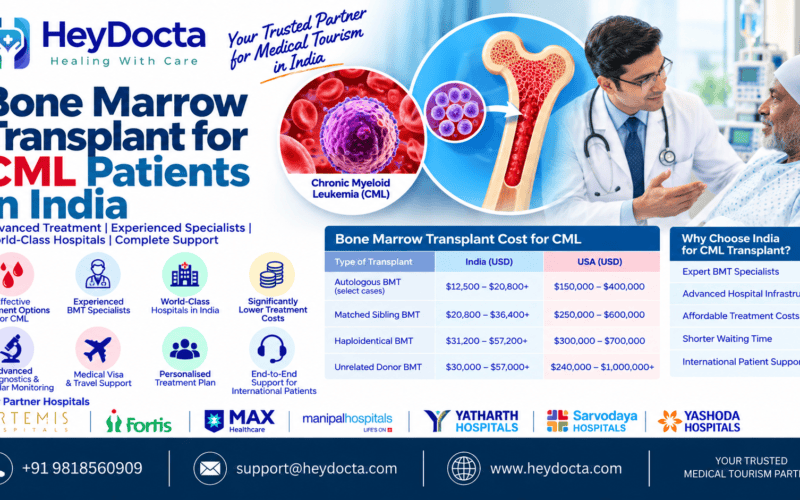
The U.S. Health Resources and Services Administration states that an unrelated bone marrow or cord blood transplant in the USA can range from USD 240,000 to more than USD 1 million, including the transplant and up to six months of care. HRSA also notes that donor-search expenses may be separate and can range from USD 10,000 to more than USD 50,000.
| Country | Published/Indicative Cost Information |
| India | USD 15000–31000* |
| USA | USD 240,000–1 million+* |
| UK/Europe | Costs vary by healthcare system, eligibility and provider |
| Middle East | Varies by country, hospital and insurance |
| Africa | Varies considerably by country and transplant centre |
These figures are not directly comparable because they can cover different services and periods of care.
For international patients, comparing the total financial requirement is more useful than comparing the transplant procedure alone.
8 Bone Marrow Transplant Financing Options
1. Health Insurance
Insurance can potentially cover some or all eligible BMT expenses, depending on the policy.
Before travelling, confirm:
- Whether BMT is covered
- Whether treatment in India is permitted
- Pre-existing-condition rules
- Waiting periods
- Deductibles and co-payments
- Annual limits
- Donor-related coverage
- Hospital-network requirements
- Pre-authorisation requirements
- Coverage for complications
Do not assume that ordinary travel insurance covers a planned transplant.
2. Employer or Corporate Health Benefits
Patients employed by companies with international health benefits may have access to employer-sponsored medical insurance or treatment assistance.
Ask your employer’s HR or insurance administrator whether the policy provides:
- Overseas treatment
- Cancer treatment
- Stem-cell/BMT coverage
- Second opinions
- Travel assistance
- Family or dependent coverage
Obtain written confirmation before committing to treatment.
3. Personal Savings
Some families choose to self-fund treatment using personal savings.
When calculating the required amount, include more than the hospital quotation:
- BMT treatment
- Medicines
- Diagnostic tests
- Visa expenses
- Flights
- Accommodation
- Food
- Local transportation
- Attendant expenses
- Follow-up visits
- Emergency contingency funds
A financial buffer is particularly important because BMT recovery can involve additional monitoring and treatment.
4. Family Financial Support
Families may combine resources from several relatives rather than relying on a single source of funding.
A written budget can help identify:
- Amount already available
- Expected hospital cost
- Travel expenses
- Accommodation expenses
- Emergency reserve
- Expected follow-up expenses
This can make the financial planning process more transparent for family members contributing to treatment.
5. Medical Loans or Personal Loans
Depending on the patient’s country of residence, banks and licensed financial institutions may offer medical or personal loans.
Before taking a loan, compare:
- Interest rate
- Processing fee
- Repayment period
- Monthly instalment
- Early repayment charges
- Currency exchange risk
- Total amount repayable
Patients should avoid borrowing more than they can reasonably repay.
6. Hospital Payment Arrangements
Some hospitals may provide information about payment schedules or financial counselling for eligible patients.
Ask the hospital international-patient or billing department:
- What deposit is required?
- When are payments due?
- Is advance payment required?
- What happens if the treatment extends?
- How are additional expenses billed?
- Which payment methods are accepted?
Availability of payment arrangements varies by hospital and patient.
7. Charities and Patient-Assistance Organisations
Some countries have cancer charities, blood-disorder foundations, disease-specific organisations or community groups that may provide financial assistance.
Potential sources include organisations supporting:
- Leukemia patients
- Children with blood disorders
- Thalassemia patients
- Sickle cell patients
- Cancer patients
- Low-income families
Eligibility, funding amounts and geographic availability vary. Patients should verify organisations independently before paying any registration or fundraising fees.
8. Crowdfunding and Community Fundraising
Some families use legitimate crowdfunding platforms or community fundraising to collect treatment expenses.
If using crowdfunding:
- Explain the medical diagnosis accurately.
- Provide genuine medical documentation where appropriate.
- Clearly state the estimated treatment cost.
- Explain how funds will be used.
- Avoid promising a treatment outcome.
- Use reputable platforms.
- Protect sensitive medical and financial information.
Crowdfunding should be considered supplementary funding rather than guaranteed financial support.
How to Build a BMT Financial Plan
Before travelling to India, create a simple financial worksheet.
Step 1: Obtain a Medical Opinion
Send your medical reports to a BMT specialist.
Step 2: Confirm the Treatment Plan
Understand whether the recommended transplant is autologous, matched sibling, haploidentical or another type.
Step 3: Request a Written Hospital Estimate
Ask for an itemised estimate.
Step 4: Check Insurance
Find out exactly what your insurer will pay and what you must pay yourself.
Step 5: Calculate Travel Expenses
Include flights, visa, accommodation and local transportation.
Step 6: Create an Emergency Reserve
Allow for possible additional hospital days, investigations or medicines.
Step 7: Compare Financing Sources
Consider insurance, savings, family support, loans, charities and fundraising.
Step 8: Keep All Financial Documents
Maintain copies of quotations, invoices, receipts, insurance approvals and payment records.
Talk to Our Medical Tourism Expert: HeyDocta can help coordinate your medical reports with partner hospitals and assist with obtaining a treatment estimate so your family can plan the expected expenses.
BMT Specialists and Hospitals in India
India has specialised BMT centres providing different forms of haematopoietic stem cell transplantation.
At Artemis Hospitals, Gurugram, Dr. Gaurav Dixit is listed as Head – Haematology Oncology & Bone Marrow Transplant. His listed expertise includes BMT, haematopoietic stem cell transplantation, haematology and oncology. His profile lists autologous, matched-sibling allogeneic, haploidentical and matched-unrelated donor transplantation among his procedures.
Artemis also lists a BMT division with specialists in transplantation and infrastructure including infection-control measures, positive-pressure and HEPA-filtered rooms.
International patients may also explore BMT services at:
- Artemis Hospital
- Fortis Hospitals
- Max Hospitals
- Manipal Hospital
- Yatharth Hospital
- Sarvodaya Hospital
- Yashoda Hospital
The appropriate hospital depends on the patient’s diagnosis, transplant type, specialist assessment, donor requirements, infrastructure and financial situation.
Medical Visa and Travel Costs
Financial planning should include visa and travel arrangements.
For India’s e-Medical Visa, the official Indian e-Visa portal lists a scanned passport bio page and a hospital letter from India containing the suggested or tentative admission/treatment date among the required documents.
HeyDocta can assist with:
- Medical report coordination
- Specialist consultation
- Hospital coordination
- Treatment-cost estimates
- Medical visa assistance
- Accommodation guidance
- Airport transfer coordination
- Travel planning
- Follow-up coordination
HeyDocta acts as a medical tourism facilitator and does not add a separate service fee to the patient’s hospital treatment cost.
Recovery and Additional Financial Planning
BMT is not simply a single hospital procedure. Recovery can require continued monitoring and treatment after the transplant.
The NHS notes that recovery following a stem cell or bone marrow transplant can take time, with some patients taking up to a year to fully recover.
Patients should therefore budget for:
- Extended accommodation
- Follow-up consultations
- Blood tests
- Medicines
- Additional hospital visits
- Local transportation
- Attendant expenses
- Potential changes to the return-flight date
The treating transplant team should provide the most appropriate guidance for the individual patient’s recovery and travel schedule.
FAQs About Bone Marrow Transplant Financing
1. How can I finance a bone marrow transplant in India?
Common options include health insurance, personal savings, family support, medical or personal loans, employer benefits, charitable assistance and legitimate crowdfunding.
2. How much does BMT cost in India?
Some Hospitals currently publishes a general BMT cost range of USD 15000–31000, although the final cost depends on transplant type, hospital, treatment requirements and complications.
3. Does insurance cover BMT in India?
It may, depending on the policy. International patients should confirm geographical coverage, transplant benefits, pre-existing-condition provisions, limits and pre-authorisation requirements before travelling.
4. Can I take a loan for BMT treatment?
Depending on your country and financial profile, medical or personal loans may be available. Compare the total repayment cost before borrowing.
5. Can charities help pay for BMT?
Some charities and patient-assistance organisations may provide financial support to eligible patients. Availability depends on the disease, country, organisation and financial criteria.
6. Does HeyDocta provide financing?
HeyDocta can help patients coordinate hospital estimates and medical-tourism arrangements. Financing or loan approval is subject to the relevant insurer, bank, financial institution, charity or funding organisation.
7. What additional costs should I budget for?
In addition to the transplant, consider medicines, investigations, hospital extensions, travel, accommodation, food, visa expenses, local transportation, attendant costs and follow-up care.
Conclusion
Bone marrow transplant financing options can include insurance, personal savings, employer benefits, family contributions, loans, charitable assistance and community fundraising. The right combination depends on the patient’s country, financial circumstances, insurance policy and treatment requirements.
India can provide a potentially more affordable BMT treatment pathway for international patients. A currently published Indian estimate from Some Hospitals is USD 15000–31000, while HRSA reports that an unrelated BMT or cord blood transplant in the USA can cost USD 240,000 to more than USD 1 million, including the transplant and up to six months of care.
However, these figures should not be treated as personalised quotations. Patients should obtain a detailed hospital estimate and plan for possible additional expenses.
Get a Free Medical Opinion from HeyDocta: Share your medical reports to Heydocta.com to explore BMT treatment options in India, obtain hospital-based cost estimates, coordinate with transplant specialists and receive support with visa, travel, accommodation and hospital arrangements.