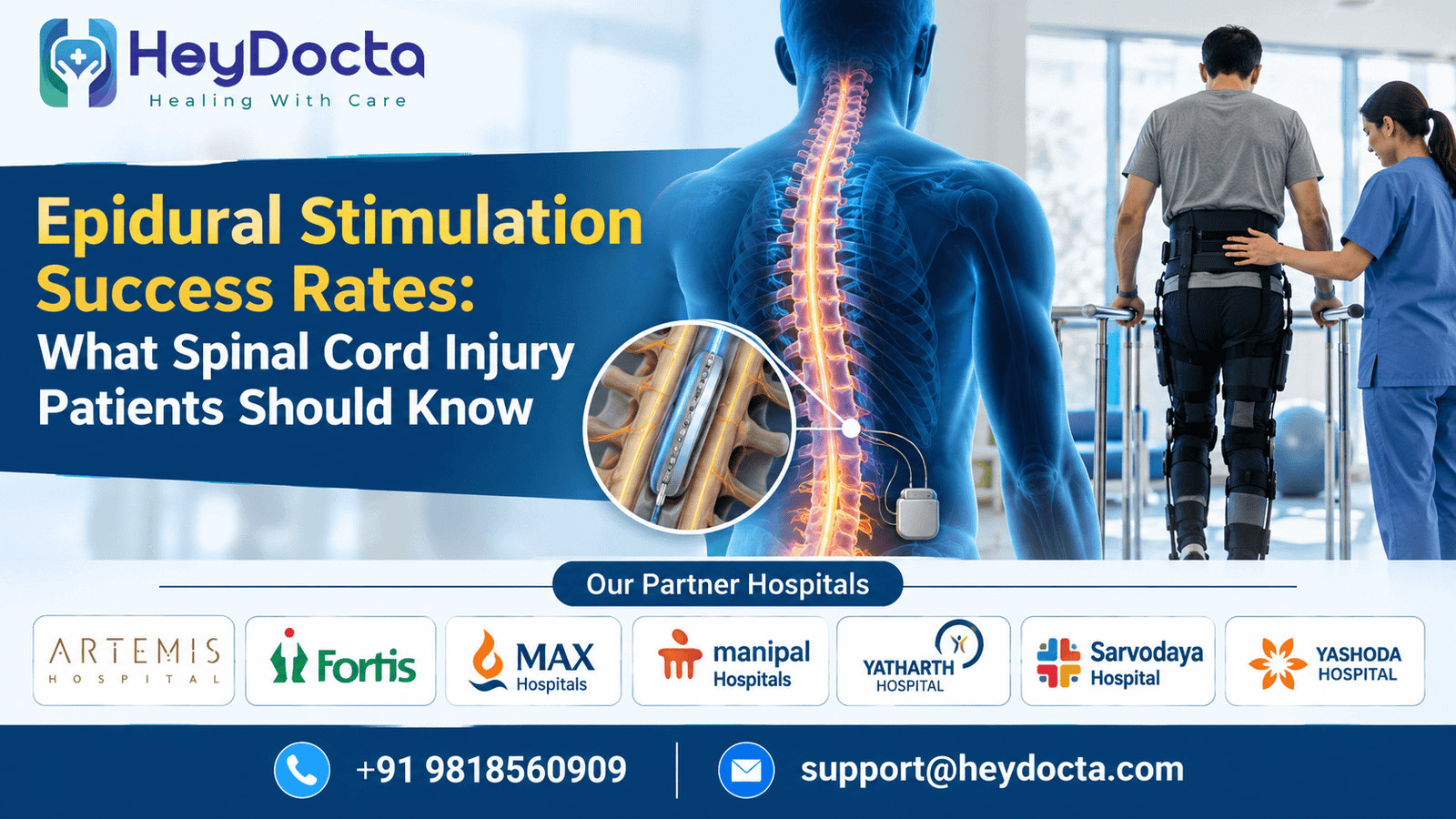
For patients living with spinal cord injury (SCI), epidural stimulation success rates are an important consideration before traveling abroad for treatment. Epidural spinal cord stimulation (eSCS) is an emerging treatment approach that may help selected patients improve motor activity, standing, stepping, walking ability or certain autonomic functions when combined with intensive rehabilitation. However, results vary significantly between patients, and epidural stimulation should not be presented as a guaranteed way to restore walking.
For international patients from Nigeria, Ghana, Kenya, Cameroon, Zimbabwe, Guyana, Jamaica, the Middle East, the USA and Europe, India offers access to specialist spine care, rehabilitation and emerging neuromodulation approaches at comparatively lower costs.
Get a Free Medical Opinion: Share your medical reports with HeyDocta to understand whether epidural stimulation may be appropriate for your condition and receive guidance on treatment options in India.
What Is Epidural Stimulation for Spinal Cord Injury?
Epidural spinal cord stimulation involves placing an electrical stimulation system near the spinal cord. The stimulation is intended to modulate spinal cord circuits and, in selected patients, support the nervous system’s ability to produce useful motor activity.
At Max Super Speciality Hospital, Dr Jitesh Manghwani has discussed epidural stimulation as an emerging option for selected patients with spinal cord injury. Max describes a system using multiple electrodes positioned near the injured spinal cord.
Importantly, epidural stimulation is generally considered alongside intensive physical rehabilitation, rather than as a stand-alone treatment.
What Are the Epidural Stimulation Success Rates?
There is no single success rate that applies to every spinal cord injury patient.
A 2024 systematic review examined 64 studies involving 306 patients who received epidural spinal cord stimulation for SCI. Across the studies, the review reported:
| Outcome reported in the review | Patients showing improvement |
| Assisted or independent stepping/standing | 44% |
| Enhanced muscle activity | 87% |
| Faster walking speed | 65% |
| Improved overground walking | 80% |
These numbers should not be interpreted as an individual patient’s probability of walking again. The studies used different stimulation devices, stimulation settings, rehabilitation programmes and patient populations. The review also included relatively small studies and different types and severities of spinal cord injury.
Therefore, a more accurate way to describe epidural stimulation success is that some carefully selected patients experience meaningful improvements in motor function and mobility, particularly when stimulation is combined with structured rehabilitation.
Does Epidural Stimulation Help Patients Walk Again?
It may help some patients achieve or improve standing, stepping or walking-related functions, but outcomes depend on several factors.
Important considerations include:
- Level of spinal cord injury
- Complete or incomplete injury
- Duration since the injury
- Remaining neurological function
- Muscle strength and control
- Overall physical condition
- Previous rehabilitation
- Ability to participate in intensive rehabilitation
- Stimulation system and programming
- Individual response to treatment
Patients should therefore undergo a detailed neurological and rehabilitation assessment before considering the procedure.
Complete vs Incomplete Spinal Cord Injury
Patients with incomplete spinal cord injury may have some preserved communication between the brain and spinal cord below the injury. This remaining function can be relevant when evaluating rehabilitation and neuromodulation options.
Patients with more severe or complete injuries may also be evaluated for epidural stimulation, but expectations must be realistic. Research has reported improvements in some individuals with severe chronic SCI, but outcomes are highly variable.
A specialist may review previous MRI scans, neurological examinations, rehabilitation history and functional status before deciding whether further evaluation is appropriate.
Epidural Stimulation and Rehabilitation
One of the most important factors in the available research is rehabilitation.
Epidural stimulation is not simply an implant followed by waiting for movement to return. Patients may require structured physiotherapy, gait training, strengthening, occupational therapy and repeated stimulation programming.
The systematic review found that epidural stimulation was particularly promising when combined with intensive physical rehabilitation.
This means international patients should consider the complete treatment and rehabilitation plan, not just the cost of the implant or procedure.
Epidural Stimulation Cost in India vs Other Countries
A standardized public price specifically for epidural stimulation for spinal cord injury is not available across hospitals. Costs depend on the technology used, evaluation, procedure, rehabilitation requirements, hospital stay and individual complexity.
As a planning reference, published estimates for conventional spinal cord stimulation (SCS) place India around USD 15,000–25,000. These figures should not be treated as a fixed price for epidural stimulation for SCI because eSCS for neurological rehabilitation is a different clinical application.
| Country/Region | Related spinal cord stimulation planning range |
| India | USD 15,000–25,000 |
| UK | USD 30,000–50,000 |
| Saudi Arabia | USD 25,000–42,000 |
| UAE | USD 28,000–48,000 |
| Singapore | USD 35,000–60,000 |
| Spain | USD 25,000–42,000 |
These figures are reference ranges for conventional spinal cord stimulation, not guaranteed epidural stimulation package prices. Actual costs for an SCI patient can be different.
What Can Increase the Treatment Cost?
The final treatment estimate may depend on:
- Specialist consultation and neurological assessment
- MRI and other diagnostic tests
- Type of stimulation system
- Number and type of electrodes
- Surgical and anaesthesia charges
- Hospital stay
- Device programming
- Physiotherapy and rehabilitation
- Additional medical treatment
- Complications or extended hospitalisation
- Accommodation and travel for international patients
This is why obtaining an individualized treatment quotation is more useful than relying only on online cost ranges.
Talk to Our Medical Tourism Expert: HeyDocta can coordinate medical records, specialist evaluation and an individualized cost estimate from partner hospitals in India.
Partner Hospitals for International Patients
Depending on the patient’s medical requirements and specialist availability, international patients can explore treatment through HeyDocta’s partner hospital network, including:
- Artemis Hospital
- Fortis Hospitals
- Max Hospitals
- Manipal Hospital
- Yatharth Hospital
- Sarvodaya Hospital
- Yashoda Hospital
Dr Jitesh Manghwani is an Associate Director & Unit Head – Orthopaedic Spine Surgery at Max Super Speciality Hospital, Shalimar Bagh, with 11+ years of experience. His listed interests include spine surgery, endoscopic and navigated spine procedures, spinal deformity and spinal pain management.
Epidural Stimulation Treatment Process in India
The treatment journey generally involves several stages:
1. Medical Record Review
Patients can send MRI reports, neurological records, previous surgery details and rehabilitation records for preliminary assessment.
2. Specialist Consultation
A spine, neurology or rehabilitation specialist evaluates the patient’s injury, neurological status and treatment history.
3. Eligibility Assessment
The medical team determines whether epidural stimulation or another treatment approach should be considered.
4. Treatment Planning
If appropriate, the hospital prepares a treatment plan covering investigations, procedure, rehabilitation and expected hospital stay.
5. Procedure and Device Programming
If the patient proceeds, the stimulation system is implanted and subsequently programmed according to the treatment plan.
6. Rehabilitation
Structured rehabilitation is an important component of the treatment journey.
7. Follow-Up
Follow-up appointments help the medical team monitor functional changes, adjust stimulation settings and manage rehabilitation.
How Long Should International Patients Stay in India?
The required stay varies according to the patient’s condition and treatment plan. It may include:
- Initial consultation and investigations
- Procedure and hospital recovery
- Early device programming
- Rehabilitation
- Follow-up assessment
Patients should obtain a personalized travel timeline from the treating hospital before booking flights.
Medical Visa and Travel Support
India offers an e-Medical Visa for eligible international patients seeking medical treatment. The official Indian e-Visa system states that medical treatment is an eligible purpose and requires documents including a passport and a hospital letter.
HeyDocta can assist international patients with hospital coordination, medical documentation, treatment planning, visa-related guidance, airport transfers, accommodation coordination and follow-up support. HeyDocta does not charge patients an extra facilitation fee for its medical tourism coordination.
Frequently Asked Questions
What is the success rate of epidural stimulation?
There is no single universal success rate. A 2024 systematic review of 306 patients reported improvements in different functional outcomes, including stepping, standing, muscle activity and overground walking.
Can epidural stimulation help a completely paralysed patient walk?
Some research has reported functional improvements in people with severe spinal cord injury, but walking recovery is not guaranteed. Individual results depend on injury characteristics, neurological function and rehabilitation.
Is epidural stimulation a cure for spinal cord injury?
No. Epidural stimulation is an emerging treatment approach and should not be described as a cure. It may help selected patients improve certain functions.
How much does epidural stimulation cost in India?
There is no standardized public price for eSCS specifically for SCI. Related conventional spinal cord stimulation estimates in India are around USD 15,000–25,000, but an individualized quotation is required for epidural stimulation.
Is rehabilitation necessary after epidural stimulation?
Rehabilitation is an important part of treatment. Research suggests that epidural stimulation may be particularly useful when combined with intensive physical rehabilitation.
Can international patients travel to India for epidural stimulation?
Eligible international patients can travel to India for medical treatment using the applicable medical visa route. Patients should first receive medical acceptance and a treatment plan from an Indian hospital.
How can HeyDocta help?
HeyDocta.com helps international patients connect with partner hospitals and specialists, coordinate medical records and consultations, obtain treatment estimates, and receive support with visa and travel arrangements.
Conclusion
Epidural stimulation success rates are encouraging but should be understood carefully. Research shows that some spinal cord injury patients experience improvements in stepping, standing, muscle activity and walking-related functions, particularly when stimulation is combined with intensive rehabilitation. However, results vary substantially, and no treatment can guarantee restoration of walking.
For international patients, India can provide access to experienced spine specialists, multidisciplinary care and rehabilitation at comparatively affordable treatment costs. The right approach is to obtain a specialist assessment before making travel or financial decisions.
Get a Free Medical Opinion from HeyDocta: Send your medical reports and previous treatment records to discuss suitable treatment options, expected costs and the next steps for spinal cord injury care in India.