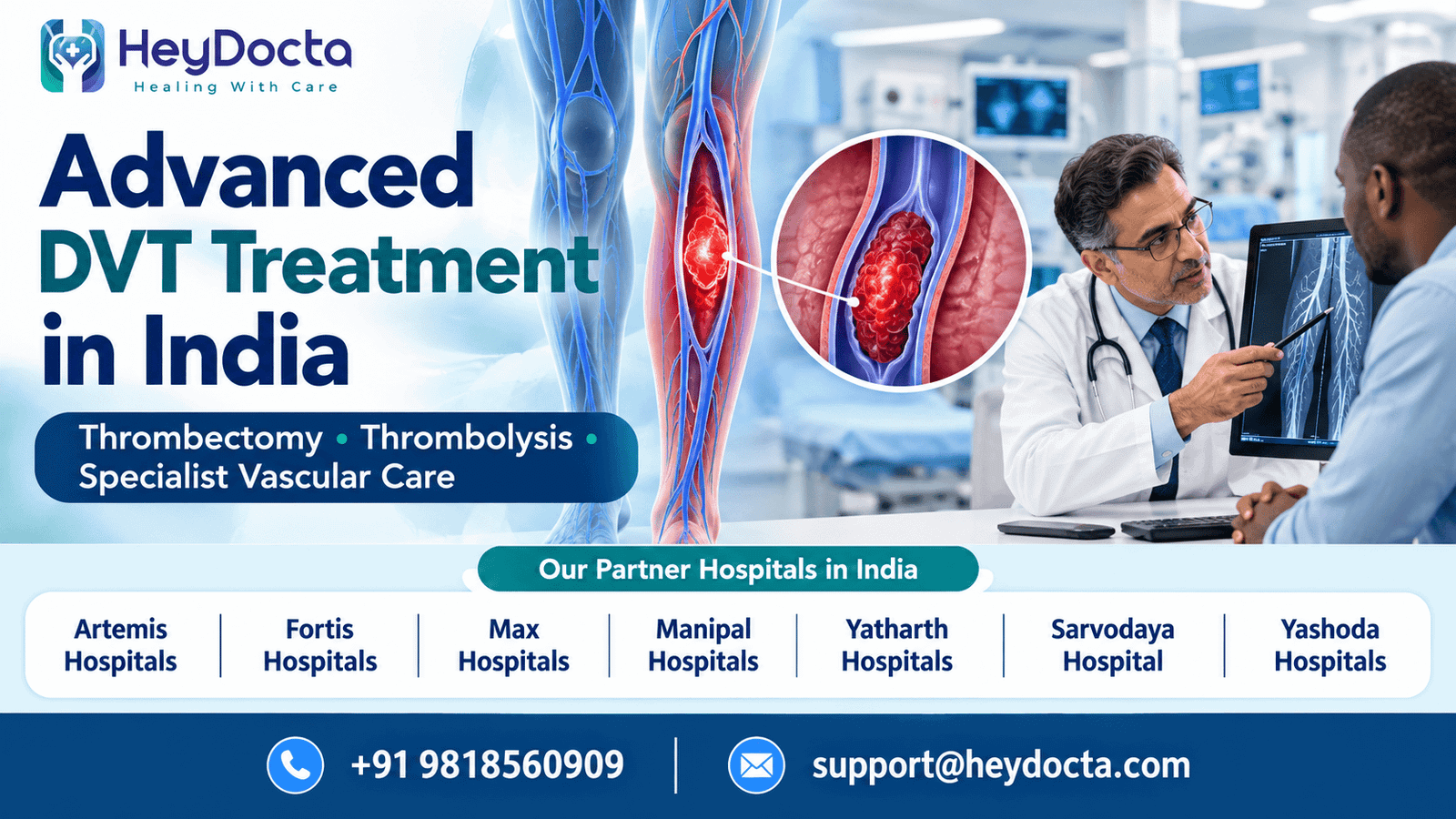
Advanced DVT treatment in India offers international patients access to specialist evaluation, anticoagulation therapy and, when medically appropriate, minimally invasive procedures such as catheter-directed thrombolysis and mechanical thrombectomy. For patients from Nigeria, Ghana, Zimbabwe, Cameroon, Kenya, Guyana, Jamaica, the USA, Europe and the Middle East, understanding the treatment options and expected costs is an important part of planning care.
Deep vein thrombosis (DVT) occurs when a blood clot forms in a deep vein, commonly in the leg. If part of the clot travels to the lungs, it can cause a potentially life-threatening pulmonary embolism (PE). Prompt medical assessment is essential, particularly when symptoms are sudden or severe.
India may offer a more affordable treatment pathway than some countries, but the final cost depends on the clot’s location and severity, the procedure required, hospital stay and any complications.
Get a Free Medical Opinion: Contact HeyDocta to help coordinate a specialist review, compare hospital estimates and understand your treatment options in India.
What Is Deep Vein Thrombosis (DVT)?
Deep vein thrombosis is a condition in which a blood clot forms in a deep vein, usually in the lower leg, thigh or pelvis. The clot may partially or completely block blood flow. Some patients develop swelling and pain, while others have few noticeable symptoms.
Common symptoms include:
- Swelling in one leg
- Pain or tenderness in the calf or thigh
- Warmth around the affected area
- Redness or discolouration of the skin
Emergency warning: Sudden breathlessness, chest pain, coughing up blood or fainting may indicate pulmonary embolism. Seek emergency medical care immediately. Do not delay urgent treatment to arrange international travel.
Why Do International Patients Consider DVT Treatment in India?
Patients from Africa, the Caribbean, the USA, Europe and the Middle East may consider India because it offers a range of vascular treatment options at different price levels.
Key considerations include:
- Treatment affordability: Some procedures may cost less than comparable private treatment in high-cost healthcare markets.
- Multiple treatment options: Care may range from anticoagulant medication to catheter-based procedures, depending on the diagnosis.
- Specialist consultations: Patients can seek opinions from vascular surgeons and other relevant specialists.
- Hospital choice: Patients can compare estimates from Artemis Hospital, Fortis Hospitals, Max Hospitals, Manipal Hospital, Yatharth Hospital, Sarvodaya Hospital and Yashoda Hospital.
- International patient coordination: HeyDocta helps patients organise medical opinions, hospital communication, travel planning and follow-up arrangements.
Treatment suitability, hospital availability and the final cost must be confirmed individually.
Advanced DVT Treatment Options Available in India
The best treatment depends on the clot’s location, size, duration, symptoms, risk of bleeding and the patient’s overall health.
1. Anticoagulation Therapy
Anticoagulants, often called blood thinners, are the standard treatment for many DVT cases. They help prevent the clot from growing and reduce the risk of new clots while the body gradually breaks down the existing clot.
The medicine and treatment duration depend on individual risk factors. Patients should not start, stop or change anticoagulants without medical advice.
2. Catheter-Directed Thrombolysis
In selected cases, a specialist inserts a thin catheter into a blood vessel and delivers clot-dissolving medication near the clot. This may be considered for certain extensive DVT cases, but it carries bleeding risks and is not suitable for everyone.
3. Mechanical Thrombectomy
Mechanical thrombectomy uses a specialised device to remove or reduce clot material from the affected vein. It may be considered for selected patients with extensive DVT or significant venous obstruction.
4. Pharmacomechanical Thrombectomy
This approach combines mechanical clot removal with medication. The choice depends on the clot’s characteristics, the patient’s condition and the treating team’s assessment.
5. Venous Angioplasty or Stenting
Some patients have an underlying narrowing or obstruction in a vein. Angioplasty or stenting may be considered in selected cases after detailed imaging and specialist assessment.
6. Inferior Vena Cava (IVC) Filter
An IVC filter is a device placed in a large vein to catch certain clots travelling towards the lungs. It does not dissolve an existing DVT and is not routinely required. It may be considered when anticoagulation cannot be used safely in specific circumstances. Removable filters should be reviewed for removal when appropriate.
Advanced DVT Treatment Cost in India
The cost of advanced DVT treatment in India depends on the procedure, medical urgency, hospital stay, equipment, medication and need for intensive care.
The following figures are approximate conversions of published Indian rupee estimates, using roughly ₹90 per US dollar. They are planning estimates, not confirmed package prices from any specific partner hospital.
| Treatment or procedure | Approximate cost in USD |
| Catheter-directed thrombolysis | $1,700–$3,900 |
| Mechanical thrombectomy | $2,800–$6,100 |
| Pharmacomechanical thrombectomy | $3,300–$6,700 |
| Complex or extensive DVT intervention | $4,400–$7,200 |
| DVT intervention with ICU or extended stay | $5,000–$7,800 |
| Treatment at a premium tertiary-care facility | $5,600–$8,900 |
These estimates are based on published Indian DVT thrombolysis and mechanical thrombectomy ranges. Actual charges can vary significantly.
Anticoagulation-only treatment may cost considerably less than an intervention. Diagnostic scans, blood tests, specialist fees, medicines, accommodation, travel and follow-up may be charged separately.
DVT Treatment Cost: India vs Other Countries
| Destination | Cost-planning guidance |
| India | Published estimates for advanced DVT interventions range approximately from $1,700 to $8,900. |
| USA | Obtain a procedure-specific estimate, including hospital and professional fees. |
| UK | Private treatment costs vary by procedure, provider and hospital stay. |
| Europe | Costs differ between countries and healthcare systems. |
| Middle East | Pricing depends on the country, hospital and treatment method. |
| Africa and the Caribbean | Availability and private treatment costs vary by location and provider. |
Comparable, current package prices are not consistently available across these countries. Therefore, a direct price comparison should use written quotations for the same procedure and similar clinical circumstances.
Before choosing a hospital, request an estimate covering the procedure, devices, medicines, hospital stay, possible ICU care and follow-up. Ask whether additional treatment or complications could increase the bill.
Vascular Specialist for DVT Treatment in India
Dr. Biswarup Purkayastha is listed by Artemis Hospitals, Gurugram, as Consultant – Heart & Lung Transplant and Vascular Surgery. His official profile describes his vascular surgery expertise and relevant clinical background. Patients should confirm directly with the hospital whether their specific DVT condition and proposed intervention fall within the services available.
For advanced DVT care, patients should look for a hospital team able to assess venous imaging, bleeding risk, anticoagulation needs and whether an intervention is appropriate. The right treatment is determined by the patient’s medical condition, not by the availability of a particular procedure.
Partner Hospitals for DVT Treatment in India
HeyDocta can help international patients enquire about DVT evaluation and treatment at its partner hospitals:
- Artemis Hospital
- Fortis Hospitals
- Max Hospitals
- Manipal Hospital
- Yatharth Hospital
- Sarvodaya Hospital
- Yashoda Hospital
The availability of a particular vascular procedure, specialist and treatment package should be confirmed with the chosen hospital before travel.
Talk to Our Medical Tourism Expert: Share your reports with HeyDocta to help coordinate a medical opinion and request a treatment estimate from a suitable partner hospital.
Step-by-Step Process for International Patients
Step 1: Share Medical Reports
Provide relevant Doppler ultrasound results, CT or MR imaging if available, blood test reports, medication details and a summary of symptoms.
Step 2: Obtain a Specialist Opinion
The treating team reviews the reports and determines whether medication, further testing or an intervention may be appropriate. Additional tests may be required after arrival.
Step 3: Request a Written Cost Estimate
Ask for an itemised estimate that identifies what is included and what may incur additional charges.
Step 4: Plan Travel and Admission
Once the hospital confirms suitability and timing, HeyDocta can assist with coordination, accommodation enquiries and travel planning.
Step 5: Receive Treatment and Follow-Up
The hospital team manages treatment, monitoring and discharge instructions. Patients should obtain a medication plan, follow-up schedule and medical summary before returning home.
Medical Visa and Travel Assistance
International patients travelling to India for treatment should check the current Indian visa requirements for their nationality and medical circumstances. A hospital invitation or appointment letter and supporting medical documents may be required.
HeyDocta can assist with hospital coordination and guidance on medical visa documentation, travel arrangements and accommodation enquiries. Visa approval remains the responsibility of the relevant authorities.
Important: Patients with suspected acute DVT or pulmonary embolism should receive urgent local medical assessment before considering travel. The treating doctor must determine whether flying is safe and when travel may be appropriate.
Recovery and Follow-Up After DVT Treatment
Recovery depends on the severity of DVT, the treatment performed and any underlying health conditions. Some patients receive medication and outpatient follow-up, while others need hospital monitoring after an intervention.
Follow your doctor’s instructions regarding anticoagulants, wound care, activity, compression garments and follow-up imaging. Do not discontinue blood-thinning medication without medical advice.
Before leaving India, arrange a written plan for continued treatment with a doctor in your home country. Confirm how long you should remain near the treating hospital and whether you are fit to fly.
Frequently Asked Questions
1. What is the cost of advanced DVT treatment in India?
Published estimates for catheter-directed thrombolysis and mechanical thrombectomy range approximately from $1,700 to $8,900, depending on the procedure and clinical complexity. A personalised hospital quotation is necessary.
2. Does every DVT patient need surgery?
No. Many patients are treated with anticoagulant medication. Clot-removal procedures are reserved for selected cases after specialist assessment.
3. Is mechanical thrombectomy better than medication?
Neither option is best for every patient. The choice depends on the extent of the clot, symptoms, risks and expected benefits. A specialist should explain the available options.
4. How long does DVT treatment take?
Treatment duration varies. Some patients require a short hospital stay or outpatient care, while complex interventions may require longer monitoring. Anticoagulant treatment often continues after discharge.
5. Can international patients receive DVT treatment in India?
Yes, international patients can enquire about evaluation and treatment. Acceptance, procedure availability, medical fitness to travel and costs must be confirmed with the hospital.
6. Can an IVC filter remove a blood clot?
No. An IVC filter catches certain clots travelling towards the lungs; it does not dissolve the existing clot. It is used only in selected circumstances.
7. Does HeyDocta charge patients extra for coordination?
HeyDocta provides medical tourism facilitation and states that its coordination support does not add an extra facilitation fee for patients. Hospital treatment, tests, medicines, travel, accommodation and other third-party services may still incur charges. Confirm the cost inclusions before proceeding.
Conclusion
Advanced DVT treatment in India may provide international patients with access to anticoagulation therapy, catheter-directed thrombolysis, mechanical thrombectomy and other selected vascular interventions. The most appropriate option depends on the individual diagnosis, and the total cost should be confirmed through a written hospital estimate.
HeyDocta supports patients from Africa, the Caribbean, the USA, Europe and the Middle East with medical opinion coordination, partner hospital communication and travel-planning assistance.
Contact HeyDocta.com today to get a medical opinion, compare treatment estimates and plan your DVT care in India.