
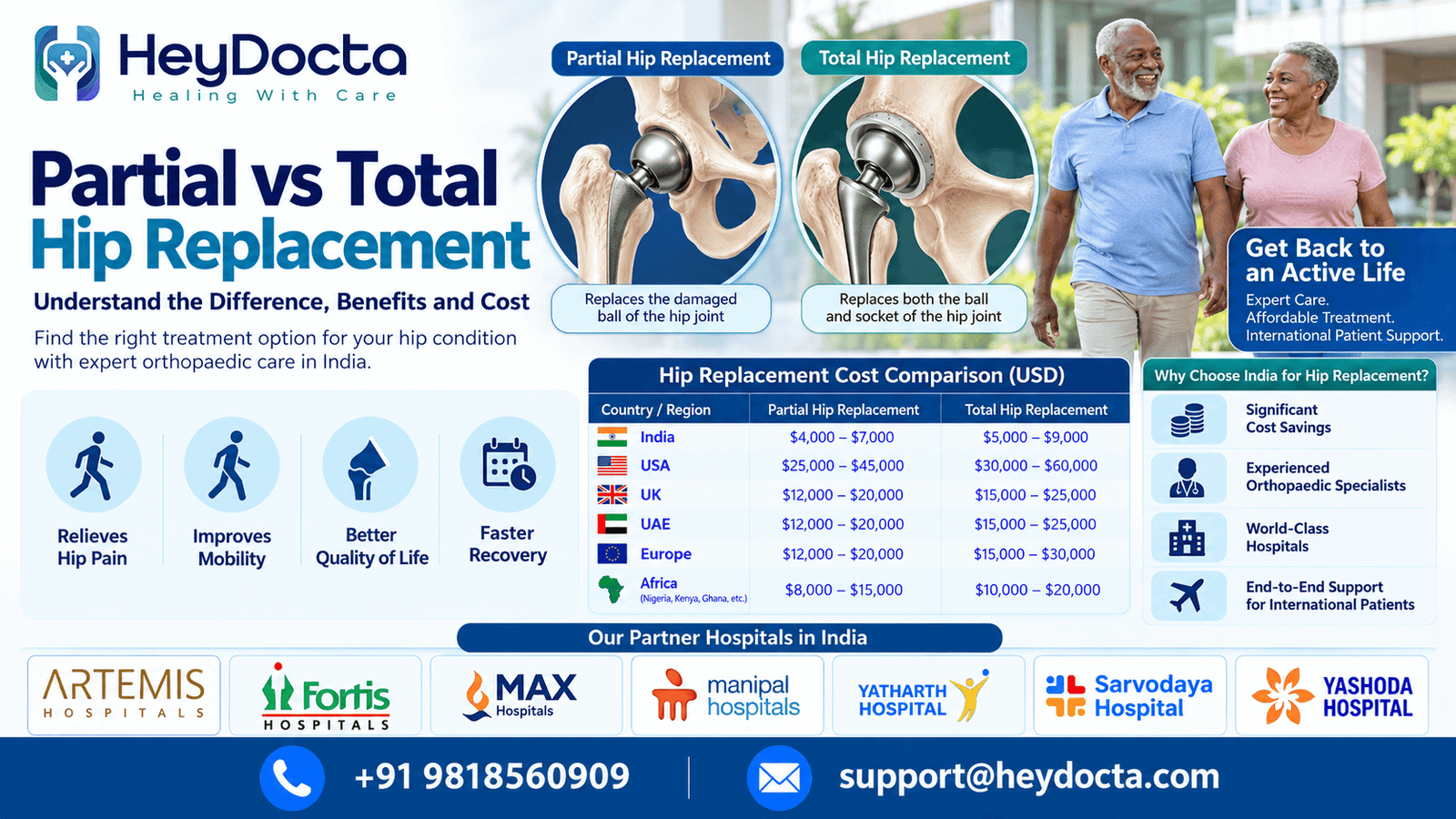
Choosing between partial vs total hip replacement is an important decision for patients experiencing severe hip pain, stiffness or difficulty walking. Both procedures replace damaged parts of the hip joint, but they differ in how much of the joint is replaced and which conditions they are designed to treat. For international patients considering treatment abroad, partial vs total hip replacement in India also involves comparing treatment costs, recovery time, hospital facilities and long-term outcomes.
India is an option for patients from Nigeria, Kenya, Ghana, Zimbabwe, Cameroon, Guyana, Jamaica, the Middle East, the USA and Europe who are exploring affordable orthopaedic treatment.
Get a Free Medical Opinion: Contact HeyDocta to discuss your medical reports, understand potential treatment options and request an estimated cost from a suitable partner hospital in India.
What Is the Difference Between Partial and Total Hip Replacement?
The hip is a ball-and-socket joint. The ball is the upper end of the thigh bone, while the socket is part of the pelvis. Conditions such as osteoarthritis, fractures and avascular necrosis can damage the joint, causing pain and reduced mobility.
What Is Partial Hip Replacement?
Partial hip replacement, also called hip hemiarthroplasty, replaces the damaged ball at the top of the thigh bone while leaving the natural hip socket in place.
It is commonly considered for certain hip fractures, particularly in older adults, when the socket remains suitable. It may not be the preferred option for patients with advanced arthritis affecting both the ball and socket.
What Is Total Hip Replacement?
Total hip replacement replaces both the damaged ball and the socket with artificial components. It is commonly used for advanced hip osteoarthritis and other conditions that affect the joint surfaces.
The goal is to reduce pain and improve mobility when non-surgical treatments are no longer providing adequate relief.
Partial vs Total Hip Replacement: Key Differences
| Feature | Partial hip replacement | Total hip replacement |
| Parts replaced | Ball of the hip joint | Ball and socket |
| Common indication | Selected hip fractures | Advanced arthritis and extensive joint damage |
| Surgical approach | Replaces fewer joint components | Replaces both major joint surfaces |
| Suitability | Depends on socket condition and diagnosis | Depends on the extent of joint damage |
| Recovery | Varies with the fracture, health and rehabilitation | Varies with health, surgical factors and rehabilitation |
| Cost | May be lower in some cases | May be higher due to additional components |
| Long-term considerations | The natural socket may develop wear or pain | Implant wear and other complications remain possible |
Neither procedure is automatically better for every patient. The correct choice depends on the diagnosis, imaging findings, activity level, age, general health and the surgeon’s assessment.
Who Needs Partial or Total Hip Replacement?
Patients Who May Need Partial Hip Replacement
A specialist may recommend partial hip replacement for:
- Certain fractures of the femoral neck.
- Hip fractures in which the socket remains healthy enough to retain.
- Selected patients for whom replacing the socket is not necessary.
The decision also depends on mobility before the fracture, bone quality, medical conditions and the expected benefits and risks of each treatment option.
Patients Who May Need Total Hip Replacement
Total hip replacement may be considered for:
- Severe hip osteoarthritis.
- Advanced joint damage from avascular necrosis.
- Certain inflammatory joint diseases.
- Hip pain that substantially limits walking, sleep and daily activities.
- Persistent symptoms despite appropriate non-surgical treatment.
Treatment may include medication, physiotherapy, activity modification or walking aids before surgery is considered. A specialist should assess whether these options remain appropriate.
Partial vs Total Hip Replacement Cost in India
Treatment affordability is a major consideration for international patients. India may offer lower private hospital treatment costs than several high-cost destinations, although the actual price depends on the hospital, implant, medical complexity and package inclusions.
The following figures are indicative planning estimates in USD, not verified quotations from individual partner hospitals.
| Procedure | Estimated cost in India |
| Partial hip replacement | $4,000–$7,000 |
| Total hip replacement | $5,000–$9,000 |
| Complex or revision hip replacement | $7,000–$12,000+ |
These ranges can vary considerably. A fracture-related admission, emergency surgery, additional medical conditions or a more complex implant may change the final bill. Ask the hospital for an itemised estimate based on the patient’s reports.
Hip Replacement Cost in India vs Other Countries
The following broad estimates help international patients understand possible differences in private treatment costs. They are not guaranteed prices, and partial and total hip replacement packages may not be directly comparable across countries.
| Country or region | Indicative hip replacement cost |
| India | $4,000–$9,000 |
| USA | $30,000–$60,000 |
| UK (private treatment) | $12,000–$25,000 |
| UAE | $12,000–$25,000 |
| Europe (selected private hospitals) | $10,000–$25,000 |
Costs depend on whether the procedure is partial or total, implant type, hospital stay, insurance arrangements and rehabilitation. Public healthcare access may also affect what patients pay in some countries.
What Is Included in the Treatment Cost?
Before choosing a hospital, ask whether the package includes:
- Surgeon and anaesthesia fees.
- Implant and surgical consumables.
- Operating theatre and hospital room charges.
- Pre-operative investigations.
- Medicines and post-operative care.
- Physiotherapy and follow-up appointments.
Flights, accommodation, meals, visa fees, local transport and extended rehabilitation may be additional expenses. Patients travelling internationally should compare the full expected cost, not just the advertised surgical price.
Why International Patients Consider Hip Replacement in India
India offers patients access to orthopaedic specialists, joint replacement services and a range of private hospital options. Depending on the hospital, patients may be able to discuss conventional or technology-assisted surgical approaches.
Potential advantages include:
- Treatment estimates in USD for easier financial planning.
- Access to specialist consultations and diagnostic facilities.
- Different hospital and accommodation options.
- Coordination of medical appointments before travel.
- Assistance with treatment planning and travel arrangements.
Affordability should not be the only deciding factor. Patients should also consider the surgeon’s experience, the hospital’s facilities, infection prevention measures, rehabilitation support and arrangements for follow-up after returning home.
Orthopaedic Consultation and Partner Hospitals
Patients considering hip replacement may discuss their treatment options with Dr. Dhananjay Sabat at Yatharth Hospital, as requested for this guide. The hospital should confirm his current role, relevant experience and availability for the specific procedure before an appointment is arranged.
HeyDocta’s partner hospital network includes:
- Artemis Hospital
- Fortis Hospitals
- Max Hospitals
- Manipal Hospital
- Yatharth Hospital
- Sarvodaya Hospital
- Yashoda Hospital
The appropriate hospital and specialist depend on the patient’s diagnosis, the procedure required and service availability at the relevant facility.
Talk to a HeyDocta Medical Tourism Expert: Share your X-rays, medical reports and previous treatment details to help arrange a specialist review and request an individualised cost estimate.
Treatment Process for International Patients
The process generally involves the following steps:
- Medical report review: Share imaging, medical history and details of current symptoms.
- Specialist consultation: The orthopaedic surgeon assesses whether partial or total hip replacement is appropriate.
- Cost estimate: The hospital provides a treatment plan and an itemised quotation.
- Travel preparation: Arrange the applicable medical visa, flights, accommodation and a companion if needed.
- Pre-operative assessment: Complete the required examinations and medical clearance.
- Surgery and rehabilitation: Receive treatment followed by supervised mobilisation and physiotherapy.
- Follow-up planning: Obtain discharge instructions, medication guidance and arrangements for follow-up care at home.
HeyDocta can help coordinate hospital appointments, medical records and travel planning. Hospital charges and other third-party expenses remain separate and should be confirmed before booking.
Recovery After Partial vs Total Hip Replacement
Recovery depends on the patient’s condition, age, general health, surgical approach and rehabilitation.
Patients may begin supervised movement and walking with assistance soon after surgery when the treating team considers it safe. Physiotherapy helps improve strength, balance and mobility.
Some patients progress substantially over the first six to twelve weeks, while others need longer. Recovery after a hip fracture may also be influenced by the injury itself and other health conditions.
International patients should obtain medical advice on how long to remain in India before flying home. The surgeon should confirm wound review, mobility, clot-prevention measures and fitness to travel. Follow-up with a local healthcare professional is important after returning home.
Medical Visa and Travel Support
Patients travelling from Africa, the Caribbean, the Middle East, the USA or Europe should check current Indian medical visa requirements through official sources before booking travel. Required documents and eligibility may vary.
HeyDocta can assist with hospital coordination, appointment planning, treatment estimates and travel arrangements. Visa approval remains the responsibility of the relevant authorities. Patients should also plan accessible accommodation, transport, rehabilitation and support from a companion where appropriate.
Frequently Asked Questions
1. Which is better: partial or total hip replacement?
Neither is universally better. Partial replacement is commonly used for selected hip fractures when the socket can be retained, while total replacement is often used when both joint surfaces are damaged.
2. Is partial hip replacement cheaper than total hip replacement?
It may cost less because fewer joint components are replaced, but the final price depends on the implant, hospital, diagnosis and complexity of the operation.
3. What is the cost of hip replacement in India?
Indicative estimates range from $4,000–$7,000 for partial replacement and $5,000–$9,000 for total replacement. Obtain a personalised quotation before making travel arrangements.
4. How long does recovery take?
Many patients make significant progress during the first six to twelve weeks, but full recovery can take longer. Rehabilitation and individual health factors influence the timeline.
5. Can international patients travel to India for hip replacement?
Yes, patients may travel to India for treatment if they are medically suitable and meet the applicable visa requirements. A specialist consultation and advice about safe travel timing are essential.
6. How long does a hip replacement last?
Many modern hip replacements function for 15–20 years or longer, but longevity varies with implant type, activity, health and other factors. No specific lifespan can be guaranteed.
7. Does HeyDocta charge extra for medical tourism assistance?
HeyDocta’s facilitation service is offered without an additional fee to patients. Hospital treatment, travel, accommodation, medicines and other third-party expenses remain payable as applicable; confirm the arrangements before proceeding.
Conclusion: Choose the Right Hip Replacement Option with Confidence
The choice between partial and total hip replacement depends on the extent of joint damage, the underlying condition and the patient’s overall health. Partial replacement may be appropriate for selected fractures, while total hip replacement is commonly used for advanced arthritis affecting the ball and socket.
India may provide a cost-effective option for international patients, but the decision should be based on a specialist’s assessment, transparent pricing, hospital facilities and a clear recovery plan.
Contact HeyDocta.com today to request a medical opinion and an estimated hip replacement cost from a suitable partner hospital in India. Our team can help coordinate consultations, treatment planning, visa guidance and travel arrangements so you can make an informed decision.