Total hip replacement is a surgical procedure that replaces a damaged hip joint with artificial components to reduce pain and improve mobility. For patients experiencing severe arthritis, hip fractures, or advanced joint damage, the procedure may make everyday activities such as walking, sitting, and climbing stairs easier. However, the cost of surgery, implant quality, hospital stay, and rehabilitation can make treatment difficult to plan, particularly for patients travelling from Nigeria, Ghana, Kenya, Zimbabwe, Cameroon, Guyana, Jamaica, the Middle East, the USA, or Europe.
India is an option for international patients seeking specialist orthopaedic care at comparatively affordable prices. This guide explains total hip replacement, treatment options, estimated costs in India and other countries, recovery expectations, and how HeyDocta can help coordinate medical travel.
Get a Free Medical Opinion: Contact HeyDocta to discuss your medical reports, explore suitable partner hospitals, and request an individualised treatment estimate before travelling.
What Is Total Hip Replacement Surgery?
Total hip replacement, also called total hip arthroplasty, involves removing damaged cartilage and bone from the hip joint and replacing them with artificial components. These generally include a socket component and a ball component that allow the joint to move.
The surgeon selects the implant type and surgical approach according to the patient’s anatomy, age, bone quality, activity level, and medical condition.
The main goals are to reduce pain, improve joint movement, and support a return to daily activities. Results vary, and surgery cannot guarantee completely pain-free movement or restore every patient to their previous activity level.
When Is Total Hip Replacement Necessary?
An orthopaedic surgeon may recommend total hip replacement when hip damage causes persistent pain or disability and non-surgical treatments no longer provide adequate relief.
Common reasons include:
- Osteoarthritis: Wear and tear of the joint cartilage, causing pain and stiffness.
- Rheumatoid arthritis: Inflammation that damages the hip joint.
- Avascular necrosis: Loss of blood supply to the bone, which can lead to bone collapse.
- Hip fractures: Certain fractures, particularly in older adults, may require joint replacement.
- Post-traumatic arthritis: Joint damage following an earlier injury.
- Developmental hip conditions: Structural problems that cause severe joint damage over time.
Treatment does not always require surgery. Depending on the diagnosis, medication, physiotherapy, activity modification, or other treatments may help. A specialist assesses whether replacement is appropriate.
Why International Patients Consider India for Hip Replacement
Patients from Africa, the Caribbean, the Middle East, the USA, and Europe may consider India for several reasons.
Comparatively Affordable Treatment
Hospital and surgical costs in India are often lower than private treatment costs in the USA, the UK, and some other countries. The final price depends on the hospital, surgeon, implant, surgical technique, medical complexity, and length of stay.
Access to Orthopaedic Specialists
Patients can seek consultations with orthopaedic surgeons experienced in joint replacement and receive an assessment based on their medical records, imaging, and examination.
Different Implant and Surgical Options
Depending on clinical suitability and availability, hospitals may offer conventional hip replacement techniques, different implant materials, and selected minimally invasive approaches.
Coordinated Care for Overseas Patients
International patients may need help arranging consultations, hospital appointments, travel documentation, accommodation, and follow-up planning. HeyDocta helps coordinate these arrangements with its partner hospitals.
Total Hip Replacement Options in India
The appropriate approach depends on the patient’s condition and the surgeon’s assessment.
1. Conventional total hip replacement: The damaged joint is replaced with artificial components using an established surgical approach.
2. Minimally invasive hip replacement: Selected patients may be suitable for techniques using smaller incisions. Suitability depends on anatomy, diagnosis, and the surgeon’s experience. Smaller incisions do not automatically guarantee faster recovery or fewer complications.
3. Cemented or uncemented implants: Cemented implants use bone cement to secure components, while uncemented implants are designed to allow bone to grow onto their surfaces. The choice depends on bone quality and other clinical factors.
4. Different bearing surfaces: Options may include ceramic, metal, or highly cross-linked polyethylene components in different combinations. Implant selection should consider durability, risks, cost, and the patient’s needs rather than price alone.
Orthopaedic Specialist and Partner Hospitals
Patients can discuss their diagnosis and treatment options with Dr. Dhananjay Sabat at Yatharth Hospital, as requested, subject to confirmation of his current availability and relevant clinical services by the hospital. The treating team should confirm whether total hip replacement is appropriate for the individual patient.
HeyDocta can help international patients explore consultations and treatment coordination through its partner hospitals:
- Artemis Hospital
- Fortis Hospitals
- Max Hospitals
- Manipal Hospital
- Yatharth Hospital
- Sarvodaya Hospital
- Yashoda Hospital
Hospital choice should be based on clinical suitability, surgeon experience, implant options, rehabilitation facilities, transparent pricing, and the patient’s medical needs. Patients should verify the specific procedure and services available at their chosen hospital.
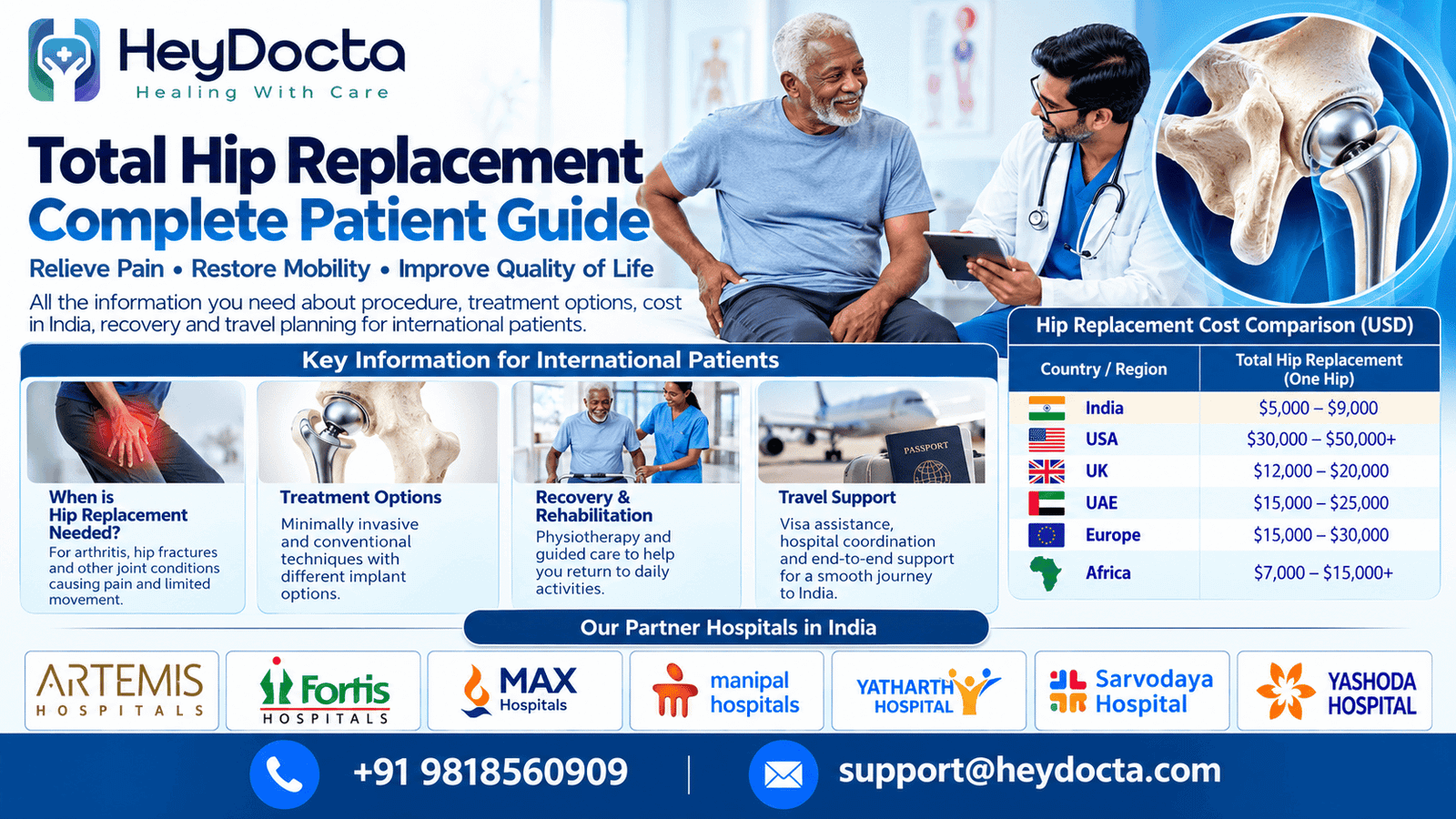
Total Hip Replacement Cost in India vs Other Countries
The total hip replacement cost varies considerably by country and treatment package. The following figures are indicative planning estimates in US dollars, not guaranteed prices or verified quotations from individual partner hospitals.
| Country or region | Estimated private treatment cost |
| India | $5,000–$9,000 |
| USA | $30,000–$50,000+ |
| UK | $12,000–$20,000 |
| UAE | $15,000–$25,000 |
| Western Europe | $15,000–$30,000 |
| Selected African destinations | $7,000–$15,000+ |
These ranges are broad comparisons rather than like-for-like quotations. Costs in African countries and Europe vary widely by destination, hospital, insurance arrangements, and whether the patient receives public or private treatment. Confirm current local pricing before making a financial decision.
What Does the Hip Replacement Package Include?
A treatment estimate may include the surgeon’s fee, anaesthesia, operating theatre, standard implant, hospital accommodation, routine medicines, and initial physiotherapy. Other expenses may be charged separately.
Ask whether the quotation covers:
- The implant brand, model, and material
- Pre-operative tests and specialist consultations
- Hospital stay and routine medication
- Physiotherapy and rehabilitation
- Management of unexpected complications
- Follow-up consultations and imaging
- Airport transfers, accommodation, and interpreter services, if needed
Why Can India Be More Affordable?
Lower overall treatment and hospital operating costs can contribute to India’s comparatively affordable private healthcare pricing. However, a low quotation should not be the only deciding factor. Implant quality, infection prevention, surgeon experience, rehabilitation, and transparent billing are important considerations.
For patients travelling from Nigeria, Kenya, Ghana, Zimbabwe, Cameroon, Guyana, Jamaica, the Middle East, the USA, or Europe, compare the complete cost of treatment and travel, not just the advertised surgery price.
Request a Personalised Cost Estimate: HeyDocta can help coordinate a hospital assessment and clarify which costs are included in the proposed treatment plan.
How the Total Hip Replacement Process Works
Step 1: Share Medical Reports
Provide recent X-rays, scan reports if available, medical history, current medication list, and information about previous treatments. The hospital may request additional tests.
Step 2: Specialist Assessment
The orthopaedic team evaluates joint damage, general health, mobility, and surgical risks. A treatment recommendation and preliminary cost estimate can then be discussed.
Step 3: Pre-operative Preparation
Before surgery, the team may assess heart and lung health, blood tests, infection risks, existing medical conditions, and medication use. Patients should tell the doctor about blood thinners, allergies, diabetes, and any recent infection.
Step 4: Surgery and Hospital Stay
The operation is performed under an appropriate anaesthetic plan. Many patients stay in hospital for several days, although the duration depends on their health, mobility, and recovery.
Step 5: Rehabilitation
Physiotherapy generally begins early, often within a day of surgery when medically appropriate. Patients learn safe walking, transfers, exercises, and precautions tailored to their operation.
Recovery After Total Hip Replacement
Recovery takes time and varies between patients. Many people use a walker or crutches initially, then gradually increase their activity as advised by the rehabilitation team.
During the first few weeks, priorities usually include wound care, pain management, safe walking, and prescribed exercises. Over the following weeks and months, strength and mobility may improve. Full recovery can take several months.
Follow the surgeon’s instructions regarding weight-bearing, sleeping positions, driving, bathing, and returning to work. Seek urgent medical attention for sudden shortness of breath, chest pain, significant calf swelling, fever, wound drainage, or rapidly worsening pain.
How Long Should International Patients Stay in India?
The required stay depends on the patient’s health, surgical approach, wound healing, mobility, and the treating team’s travel advice. Some patients may need approximately 2–4 weeks in India, including hospitalisation and initial recovery, while others require longer.
Do not book a fixed return date before discussing it with the surgeon. The treating team should confirm that the patient is medically fit to fly and advise on movement during the journey, blood-clot prevention, and any necessary precautions.
Medical Visa and Travel Assistance
International patients should check the latest Indian visa requirements applicable to their nationality and treatment. Depending on eligibility, a medical visa and accompanying attendant visa may be relevant. Requirements and documentation can change, so confirm details through official Indian government channels and the relevant embassy or consulate.
HeyDocta can assist with hospital coordination, appointment scheduling, treatment estimates, and travel-planning guidance. Visa approval remains the responsibility of the relevant authorities, and flights, accommodation, visas, and other third-party expenses are separate unless explicitly included in a written quotation.
Frequently Asked Questions
1. How much does total hip replacement cost in India?
An indicative private-treatment planning range is approximately $5,000–$9,000. The actual quotation depends on the hospital, implant, surgeon, patient complexity, and package inclusions.
2. Is hip replacement cheaper in India than in the USA or UK?
Private hip replacement is often less expensive in India than in the USA or UK. However, compare current quotations on the same basis, including the implant, hospital stay, rehabilitation, travel, and follow-up care.
3. How long does a total hip replacement last?
Many modern hip replacements function for 15–20 years or longer, but implant survival varies. Age, activity, implant design, bone health, and complications can affect longevity. No specific lifespan can be guaranteed.
4. How soon can I walk after hip replacement?
Many patients begin standing and walking with assistance within a day of surgery, if medically appropriate. The timing and amount of weight placed on the leg depend on the procedure and the surgeon’s instructions.
5. Can I travel home after hip replacement surgery?
Travel may be possible once the treating team confirms medical fitness. Patients should discuss flight timing, blood-clot prevention, movement during the journey, and access to follow-up care before booking their return.
6. What are the main risks of hip replacement?
Potential risks include infection, blood clots, dislocation, fracture, differences in leg length, implant wear, and persistent pain. Your surgeon can explain the risks relevant to your medical history.
7. Does HeyDocta charge patients for coordination?
HeyDocta provides medical tourism facilitation and coordination without an additional facilitation fee to patients. Hospital treatment, flights, accommodation, visa charges, and other third-party services remain separate unless stated otherwise in writing.
Plan Your Total Hip Replacement in India with HeyDocta
Total hip replacement can be an important option for patients whose damaged hip joint causes persistent pain and difficulty with everyday activities. Understanding the procedure, comparing complete treatment costs, selecting an appropriate hospital, and planning rehabilitation can help international patients make informed decisions.
HeyDocta supports patients from Africa, the Caribbean, the Middle East, the USA, and Europe with hospital coordination, medical opinion requests, cost estimates, and travel-planning assistance through its partner network.
Contact HeyDocta.com to request a medical opinion and personalised treatment estimate for total hip replacement in India. Treatment recommendations, final costs, and travel readiness must be confirmed by the treating medical team.