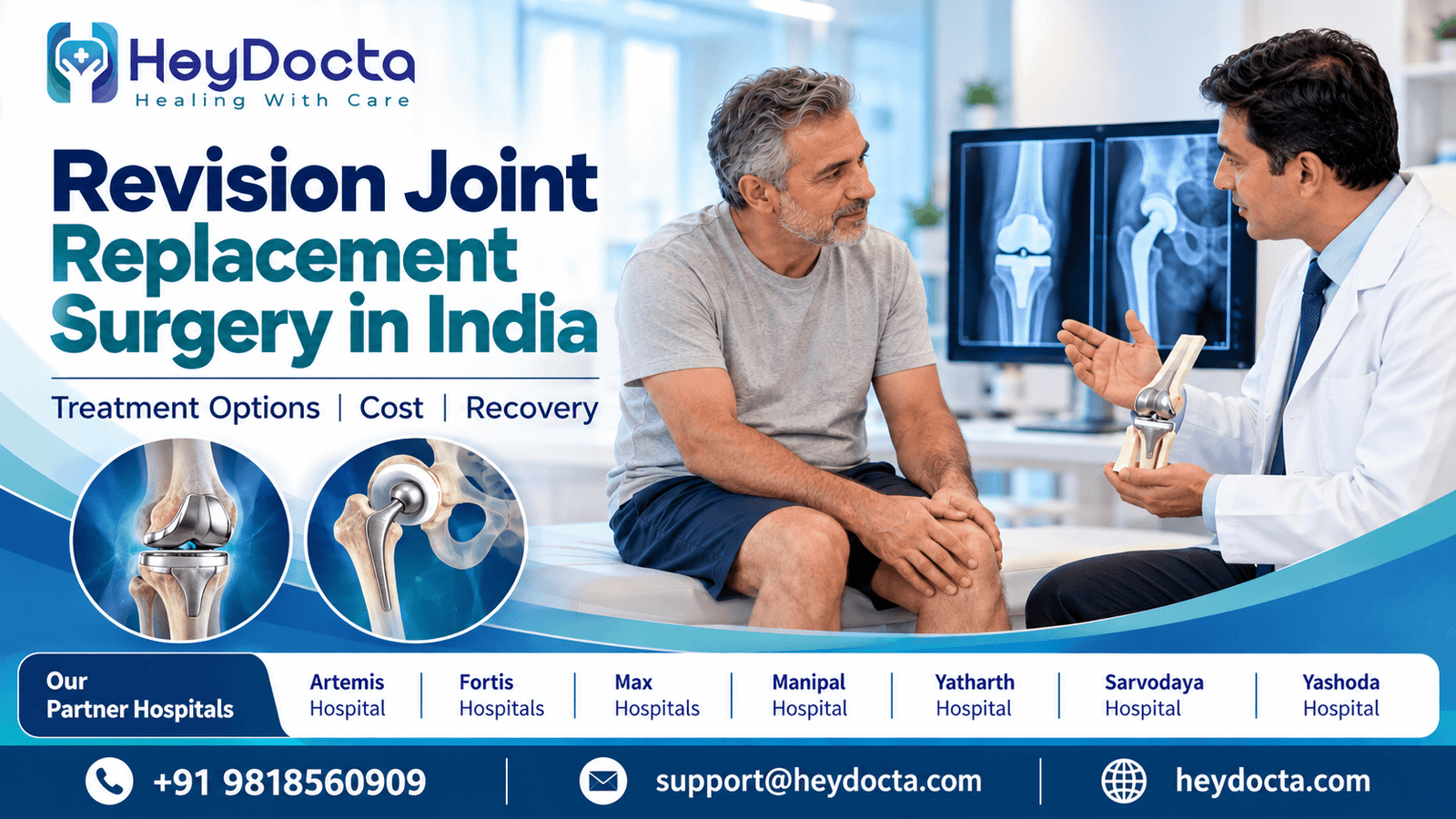
Revision joint replacement surgery is a procedure performed to repair or replace a previously implanted artificial joint, most commonly the hip or knee, when it no longer functions properly. For international patients experiencing persistent pain, implant loosening, infection, instability, or reduced mobility after an earlier operation, revision joint replacement surgery in India may offer access to experienced orthopaedic specialists and advanced hospital facilities at comparatively affordable costs.
Patients from Nigeria, Ghana, Zimbabwe, Cameroon, Kenya, Guyana, Jamaica, the USA, Europe, and the Middle East often compare treatment options abroad to understand the medical expenses, quality of care, recovery period, and travel requirements before making a decision. India is one destination worth considering because treatment costs can be substantially lower than in many Western countries, although the final expense depends on the complexity of the revision and the patient’s medical condition.
At HeyDocta, we help international patients connect with our partner hospitals in India, coordinate medical opinions, understand estimated treatment costs, and plan their medical journey.
Get a Free Medical Opinion: Contact HeyDocta to discuss your previous joint replacement, share your medical reports, and request an individualised treatment estimate from a suitable partner hospital.
What Is Revision Joint Replacement Surgery?
Revision joint replacement surgery is a second or subsequent operation performed on a joint that has already undergone replacement surgery. During the procedure, an orthopaedic surgeon assesses the existing implant and surrounding bone, removes or replaces some or all of the artificial components when necessary, and reconstructs the joint to improve stability and function.
The procedure is commonly required after total knee replacement or total hip replacement. Depending on the underlying problem, the surgeon may replace a single component or undertake a more complex reconstruction involving additional implants, bone grafts, or specialised revision components.
Revision surgery is generally more complicated than primary joint replacement because the surgeon must work around existing implants, scar tissue, and potentially weakened bone.
Why Might a Patient Need Revision Joint Replacement Surgery?
An artificial joint can function successfully for many years, but complications or normal implant wear may eventually require further treatment.
Common reasons for revision joint replacement include:
- Implant loosening: The artificial joint becomes unstable or separates from the surrounding bone.
- Infection: Bacteria affect the implant or surrounding tissue, sometimes requiring staged surgery and antibiotics.
- Persistent pain: Ongoing discomfort may result from implant problems, infection, instability, or other underlying conditions.
- Joint instability: The replaced joint repeatedly feels unstable or dislocates.
- Implant wear or damage: Artificial components deteriorate over time.
- Bone loss or fractures: Bone around the implant becomes damaged or breaks.
- Limited movement: Stiffness or other mechanical problems significantly affect everyday activities.
Not every painful joint replacement requires another operation. An orthopaedic specialist may recommend imaging, blood tests, joint fluid analysis, physiotherapy, medication, or other treatments before deciding whether revision surgery is necessary.
Who Is a Candidate for Revision Joint Replacement Surgery?
A patient may be considered for revision surgery when an existing implant causes significant pain, instability, infection, mechanical failure, or loss of function that cannot be adequately managed with less invasive treatment.
The surgeon usually reviews the patient’s previous operation records, medical history, physical examination, X-rays, and other investigations. Blood tests or joint aspiration may be needed if an infection is suspected.
The decision also depends on the patient’s general health, bone quality, activity level, and ability to participate in postoperative rehabilitation.
Patients should seek urgent medical assessment if a replaced joint becomes suddenly painful, hot, swollen, or difficult to move, particularly when accompanied by fever or wound drainage.
Types of Revision Joint Replacement Surgery Available in India
The appropriate procedure depends on which joint is affected and the cause of implant failure.
Revision Knee Replacement
Revision knee replacement involves replacing some or all components of an earlier knee implant. It may be required because of loosening, infection, instability, stiffness, or component wear. Complex cases may require specialised implants to compensate for bone loss or support joint stability.
Revision Hip Replacement
Revision hip replacement addresses problems involving a previous artificial hip joint. The surgeon may replace the socket, femoral stem, or both components, depending on their condition. Some patients require bone grafting or specialised implants to reconstruct damaged bone.
Single-Stage Revision Surgery
In selected cases, the surgeon removes the problematic components and inserts new components during the same operation. This approach may be suitable for certain mechanical failures and carefully selected infections, depending on clinical findings.
Two-Stage Revision Surgery
For some joint infections, treatment involves removing the infected implant, cleaning the joint, placing a temporary antibiotic spacer when appropriate, and administering antibiotics. A new implant may be inserted during a later operation once the infection is considered adequately controlled.
The treatment plan and time between stages vary according to the infection, test results, and the patient’s response to treatment.
Revision Joint Replacement Surgery in India: Specialists and Partner Hospitals
India offers orthopaedic services for patients requiring complex hip and knee revision procedures. The choice of surgeon and hospital should depend on experience with revision cases, infection management facilities, availability of specialised implants, rehabilitation support, and the patient’s individual medical requirements.
Dr Dhananjay Sabat at Yatharth Hospital is a specialist patients can enquire about when exploring orthopaedic treatment options through HeyDocta. Patients should confirm his current clinical role, experience with revision joint replacement, and suitability for their specific case directly with the hospital before proceeding.
For revision surgery, it is particularly important to ask whether the treating surgeon regularly manages complex implant failures, bone loss, and infected joint replacements.
HeyDocta Partner Hospitals
HeyDocta can help international patients explore suitable orthopaedic consultations through its partner hospital network, which includes:
- Artemis Hospital
- Fortis Hospitals
- Max Hospitals
- Manipal Hospital
- Yatharth Hospital
- Sarvodaya Hospital
- Yashoda Hospital
Hospital selection should be based on the patient’s diagnosis, the complexity of the proposed operation, the availability of the required implant, the treating surgeon’s expertise, and the estimated total cost. Not every hospital or surgeon will be suitable for every revision procedure.
Revision Joint Replacement Surgery Cost in India vs Other Countries
One of the main reasons international patients consider India is the potential to reduce treatment expenses compared with the USA, the UK, and other high-cost healthcare markets.
How much does revision joint replacement surgery cost in India? The answer depends on whether the procedure involves the hip or knee, whether one or both implant components need replacement, whether an infection is present, and whether specialised implants or additional reconstruction are required.
The following figures are indicative planning estimates, not confirmed quotations. They are broad ranges for budgeting purposes and should be verified with hospitals before travel.
| Country or region | Estimated cost in USD |
| India | $5,000–$12,000 |
| USA | $20,000–$50,000+ |
| UK | $15,000–$30,000+ |
| Europe | $12,000–$30,000+ |
| Middle East | $10,000–$25,000+ |
| Africa (private healthcare) | $6,000–$18,000+ |
These estimates are illustrative and vary by country, hospital, procedure, implant, and clinical complexity. They are not a verified, like-for-like price survey. Public healthcare eligibility, insurance coverage, and private hospital charges may produce substantially different costs. A two-stage revision for infection may cost considerably more than a straightforward component replacement.
What Is Usually Included in the Cost?
A hospital estimate may include some or all of the following:
- Orthopaedic consultation and preoperative assessment
- Diagnostic tests and imaging
- Surgeon and anaesthesia fees
- Operating theatre and hospital stay
- Artificial joint components and specialised revision implants
- Routine medicines and postoperative care
Additional expenses may include extended hospitalisation, intensive care, infection treatment, blood transfusions, bone grafts, physiotherapy, accommodation, flights, visa fees, and follow-up investigations.
Why Can Revision Surgery Cost More Than Primary Joint Replacement?
Revision procedures are often more demanding than first-time joint replacement. Surgeons may need to remove old components, treat infection, reconstruct bone, or use specialised implants. The operation may also require longer hospitalisation and more intensive rehabilitation.
For this reason, patients should request a written, itemised estimate rather than relying on the advertised starting price for a standard knee or hip replacement.
How International Patients Can Manage Treatment Costs in India
Careful planning can help patients understand the financial commitment before travelling.
- Obtain a medical review: Share previous surgical notes, recent X-rays, scan reports, and details of symptoms.
- Request an individual estimate: Ask for separate estimates for the proposed procedure, implant, hospital stay, and rehabilitation.
- Clarify exclusions: Confirm whether infection treatment, additional investigations, extended admission, and revision implants are included.
- Budget for travel and accommodation: Include flights, visa expenses, meals, local transport, and accommodation for an accompanying family member.
- Plan for unexpected expenses: Revision surgery can reveal additional problems that were not fully apparent before the operation.
Talk to a HeyDocta Medical Tourism Expert: Request help coordinating a medical opinion and comparing available treatment estimates from our partner hospitals in India.
Step-by-Step Process for Revision Joint Replacement Surgery in India
Step 1: Online Medical Consultation
Patients can initially share their medical history and reports with HeyDocta. The information can be coordinated with an appropriate hospital for specialist review.
Step 2: Diagnosis and Treatment Planning
The orthopaedic team assesses the implant, bone condition, possible infection, and overall health. Further investigations may be requested before confirming the surgical approach.
Step 3: Cost Estimate and Travel Planning
Once the hospital has reviewed the case, patients can discuss the proposed treatment, expected expenses, admission requirements, and likely duration of stay. Travel arrangements should be made only after receiving medical guidance.
Step 4: Hospital Admission and Surgery
The hospital conducts the necessary preoperative assessments. The surgeon then performs the planned revision procedure, with the exact approach depending on the diagnosis.
Step 5: Recovery and Rehabilitation
After surgery, the clinical team monitors pain, wound healing, mobility, and possible complications. Physiotherapy and walking assistance may begin when medically appropriate.
Step 6: Discharge and Follow-Up
Before discharge, patients receive instructions about wound care, medication, mobility, warning signs, and follow-up appointments. International patients should obtain a written discharge summary and a plan for continued care at home.
Medical Visa and Travel Assistance for International Patients
Patients travelling to India for revision joint replacement should check the current Indian medical visa requirements applicable to their nationality. Requirements and documentation may differ for citizens of Nigeria, Ghana, Zimbabwe, Cameroon, Kenya, the USA, European countries, and Middle Eastern countries.
Depending on the applicable rules, patients may need a passport, a medical visa application, documentation from the treating hospital, and supporting records. Accompanying family members should verify their own visa requirements.
HeyDocta can assist with hospital coordination, medical documentation guidance, appointment planning, treatment estimates, and travel arrangements. Visa issuance remains the decision of the relevant authorities, and patients should not make non-refundable travel plans before confirming the necessary approvals.
Recovery After Revision Joint Replacement Surgery
Recovery depends on the joint involved, the complexity of the operation, the patient’s general health, and whether infection or significant bone loss was present.
Patients undergoing a relatively straightforward revision may progress faster than those requiring complex reconstruction or multiple operations. Recovery can take several months, and improvement in strength, walking ability, and everyday function may continue over time.
During recovery, patients may need:
- Physiotherapy and supervised mobility exercises
- Walking aids such as a walker or crutches
- Regular wound checks and follow-up appointments
- Medication and monitoring for complications
- Restrictions on certain movements or weight-bearing, depending on the procedure
How Long Should International Patients Stay in India?
There is no single recommended stay for every patient. The treating surgeon should determine when it is safe to travel based on wound healing, mobility, pain control, the risk of complications, and the patient’s overall condition.
A straightforward revision may require a stay of several weeks, while complex or two-stage procedures may require a substantially longer period or more than one trip. Patients should arrange their return journey only after receiving medical clearance.
After returning home, patients should continue rehabilitation with a local physiotherapist and maintain communication with their Indian treating team. A plan for managing complications and arranging local medical care is particularly important for patients travelling long distances.
Frequently Asked Questions About Revision Joint Replacement Surgery
1. What is revision joint replacement surgery?
Revision joint replacement surgery is an operation to repair or replace some or all components of a previous artificial joint. It may be necessary because of implant loosening, infection, wear, instability, persistent pain, or bone damage.
2. What is the cost of revision joint replacement surgery in India?
Indicative planning estimates are approximately $5,000–$12,000, although the actual cost may be lower or higher depending on the procedure, implant, hospital stay, and complications. Patients should obtain a personalised written quotation from the treating hospital.
3. Is revision joint replacement surgery more complicated than the first operation?
Yes, it is often more complex because the surgeon must work around existing implants, scar tissue, and potentially weakened bone. Some patients also require infection treatment or specialised reconstruction.
4. Can an infected joint replacement be revised?
Yes. Depending on the infection and clinical findings, treatment may involve a single-stage revision or a two-stage procedure. Antibiotics, laboratory testing, and close monitoring are important parts of the treatment plan. The appropriate approach must be determined by the treating specialists.
5. Which hospitals in India can international patients consider?
HeyDocta can help patients explore consultations through its partner network, including Artemis Hospital, Fortis Hospitals, Max Hospitals, Manipal Hospital, Yatharth Hospital, Sarvodaya Hospital, and Yashoda Hospital. Suitability depends on the specific case and the services available at the selected hospital.
6. How long does recovery take after revision surgery?
Recovery varies with the complexity of the operation. Patients may need several months of rehabilitation, and more complex procedures can take longer. The surgeon will provide an individual recovery plan based on progress and medical findings.
7. Can HeyDocta help international patients arrange treatment in India?
Yes. HeyDocta can assist with coordinating medical opinions, connecting patients with partner hospitals, requesting treatment estimates, providing travel and visa documentation guidance, and helping plan hospital appointments. The final treatment decision rests with the patient and treating medical team.
Why Choose HeyDocta for Revision Joint Replacement Surgery in India?
Choosing treatment abroad involves more than comparing surgery prices. Patients need clear medical information, transparent cost estimates, suitable hospital options, and a practical plan for recovery after returning home.
HeyDocta supports international patients throughout the treatment-planning process by helping coordinate:
- Medical opinions and hospital consultations
- Treatment estimates and cost clarification
- Hospital appointment scheduling
- Medical visa documentation guidance
- Travel and accommodation planning
- Discharge documentation and follow-up coordination
Our aim is to make the process easier to understand so patients and their families can make informed decisions. Hospital charges and medical services are determined by the treating provider. HeyDocta’s coordination assistance is offered without additional facilitation charges to patients, subject to confirmation of the specific service arrangement; hospital, travel, accommodation, visa, and other third-party expenses remain separate.
Conclusion: Explore Affordable Revision Joint Replacement Surgery in India
Revision joint replacement surgery may help address problems with a previous hip or knee replacement, but the appropriate treatment depends on the cause of implant failure, bone condition, infection status, and overall health. India may offer a cost advantage for international patients, although the final expense and expected outcome vary by case.
Before travelling, obtain a specialist medical opinion, compare itemised hospital estimates, and understand the likely recovery period and follow-up requirements. Do not choose a hospital on price alone; the surgeon’s experience with complex revision procedures and the availability of appropriate postoperative care are equally important.
Get Treatment Cost from Top Indian Partner Hospitals with HeyDocta. Contact HeyDocta.com at heydocta.com to share your medical reports, request a medical opinion, and explore revision joint replacement options at our partner hospitals in India. Our team can help coordinate your treatment planning, hospital communication, and travel arrangements so you can make your next decision with greater clarity and confidence