A joint replacement can reduce pain and improve mobility, but some patients develop complications months or years after surgery. Implant loosening, infection, wear, dislocation or bone loss may make another operation necessary. This second procedure is known as Revision Joint Replacement. Many patients naturally ask: How difficult is revision joint replacement, and is it more complicated than the first surgery?
Revision surgery is generally more challenging because the surgeon must work around an existing implant, scar tissue and sometimes damaged bone or soft tissues. However, the level of difficulty varies according to the patient’s condition, the reason for revision and the type of joint involved.
For international patients from Nigeria, Ghana, Zimbabwe, Cameroon, Kenya, Guyana, Jamaica, the Middle East, Europe and the USA, India offers access to orthopaedic specialists, diagnostic facilities and revision surgery options at a range of treatment costs.
HeyDocta helps patients coordinate medical opinions, hospital appointments, treatment estimates and travel arrangements in India.
Get a Free Medical Opinion: Share your previous operation reports and latest X-rays with HeyDocta to understand your possible treatment options.
What Is Revision Joint Replacement?
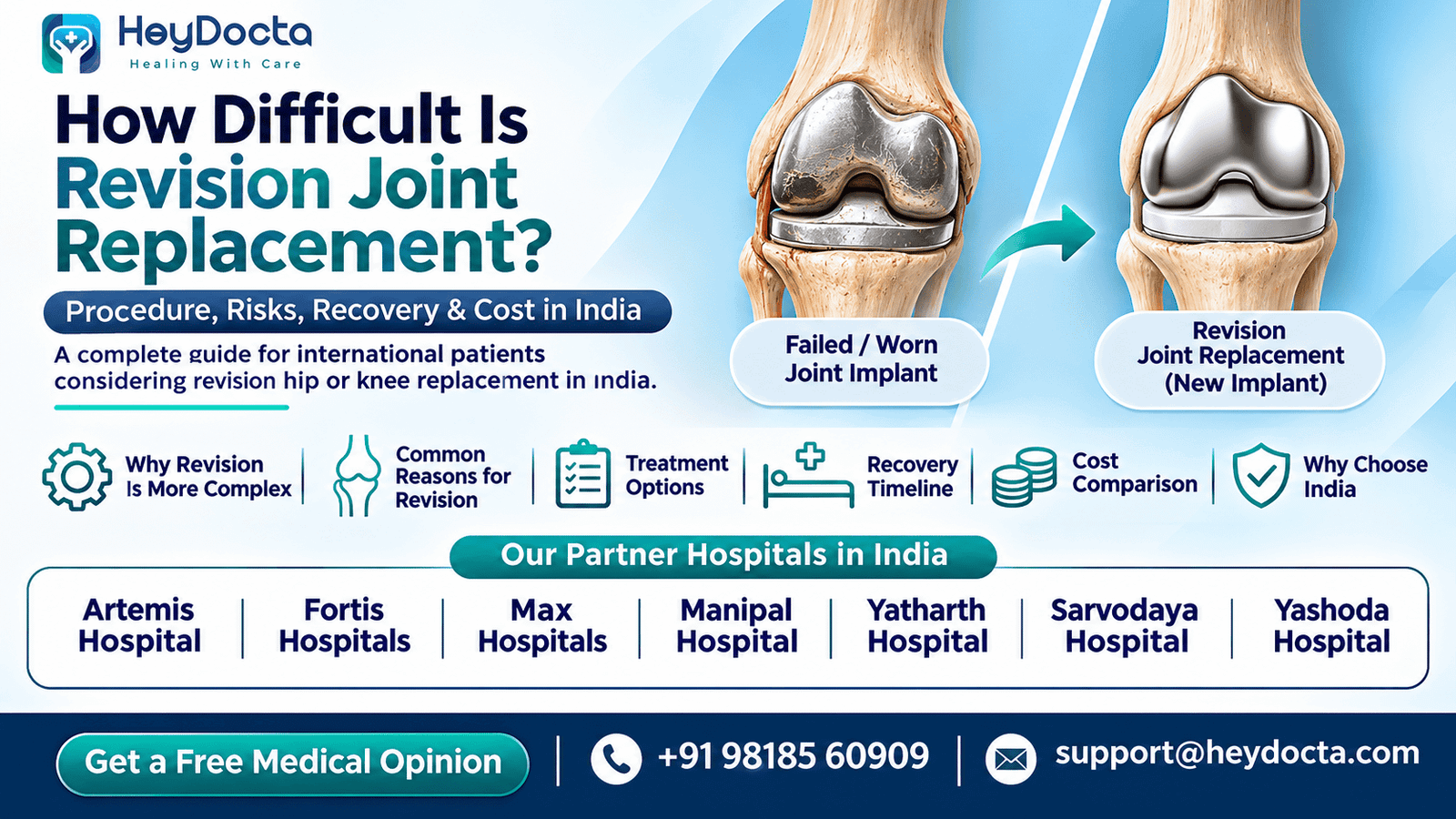
Revision joint replacement is an operation performed to repair or replace some or all components of a previous artificial joint. It is commonly required after hip or knee replacement when the original implant develops a problem that cannot be managed adequately through non-surgical treatment.
Depending on the condition, the surgeon may:
- Replace only one damaged implant component.
- Remove and replace the complete artificial joint.
- Correct implant positioning or joint alignment.
- Reconstruct bone that has been damaged or lost.
- Repair or address problems involving supporting muscles and ligaments.
- Treat infection before or during implant replacement, depending on the case.
Revision surgery is not automatically required whenever a patient experiences pain after joint replacement. A specialist must identify the cause before recommending another operation.
Why Is Revision Joint Replacement More Difficult?
Revision surgery can be more complex than primary joint replacement for several reasons.
1. Scar Tissue from Previous Surgery
The first operation creates scar tissue around the joint. During revision, the surgeon must carefully work through these tissues to reach the implant while protecting nearby nerves, blood vessels and muscles.
2. Bone Loss Around the Implant
Wear particles, loosening or infection can damage the bone supporting the artificial joint. The surgeon may need bone grafts, specialised implants or reconstruction techniques to restore stability.
3. Removal of the Old Implant
Removing an existing implant can be difficult, especially when components are firmly attached to the bone. Careful removal is important to avoid further bone damage.
4. Infection-Related Complications
If infection is present, treatment becomes more complicated. Patients may require antibiotics, surgical cleaning or staged revision surgery, in which the replacement implant is inserted during a later operation.
5. Weak Muscles and Supporting Tissues
The muscles, tendons and ligaments surrounding the joint may have weakened or become damaged. This can affect the stability of the new implant and influence the surgical plan.
6. Longer and More Complex Rehabilitation
Recovery may take longer than after the first joint replacement. Patients may need additional physiotherapy, walking support and restrictions on certain activities.
The actual complexity depends on the joint, implant condition, bone quality, infection status and overall health of the patient.
What Are the Main Types of Revision Joint Replacement?
Revision knee replacement: May be needed due to loosening, instability, infection, implant wear, stiffness or persistent pain associated with a confirmed implant problem.
Revision hip replacement: May be required because of dislocation, loosening, implant wear, bone loss, infection or fracture around the artificial joint.
Partial component revision: Only the damaged or unsuitable part is replaced when the remaining components are stable and appropriately positioned.
Complete revision: The surgeon removes and replaces most or all of the existing artificial joint components when the problem requires a more extensive reconstruction.
How Is Revision Joint Replacement Performed?
The exact procedure depends on the joint and the reason the original replacement failed. A typical treatment journey includes:
- Pre-operative assessment: The surgeon reviews medical history, previous operation notes, implant details and imaging.
- Anaesthesia and preparation: The anaesthesia team assesses the patient and plans suitable anaesthesia.
- Removal of damaged components: The surgeon exposes the joint and carefully removes the components that need replacement.
- Bone and tissue reconstruction: Bone defects may be managed using specialised metal augments, bone grafts or other reconstruction techniques.
- Insertion of revision implants: New components are positioned to improve alignment, fixation and stability.
- Post-operative monitoring: The medical team monitors pain, wound healing, movement and possible complications.
Revision knee surgery may take several hours in complex cases. Revision hip surgery can also require specialised implants and extensive planning.
What Are the Risks of Revision Joint Replacement?
Revision surgery is more complex than primary joint replacement and may carry a higher risk of complications. Possible risks include:
- Infection around the new implant.
- Blood clots in the legs or lungs.
- Dislocation or continued joint instability.
- Fracture during or after implant removal.
- Nerve or blood vessel injury.
- Implant loosening or failure.
- Delayed wound healing.
- Leg-length difference after hip revision.
The surgeon evaluates these risks based on the patient’s age, medical conditions, bone quality, infection status and previous surgical history. Revision surgery can improve pain and function, but a specific outcome cannot be guaranteed.
Revision Joint Replacement Specialist in India
Patients should look for an orthopaedic surgeon with experience in joint replacement and complex revision procedures. The surgeon’s experience should match the patient’s specific problem, such as revision hip replacement, revision knee replacement, infection or significant bone loss.
Dr. (Prof.) Dhananjay Sabat is listed as Director – Orthopaedics & Joint Replacement at Yatharth Hospital, Noida Extension. His qualifications include MBBS, MS (Orthopaedics) and DNB (Orthopaedics). His professional profile lists experience in arthroscopy, joint preservation and joint replacement.
Patients considering revision surgery should confirm directly with the hospital whether their particular revision procedure is within the surgeon’s current practice and expertise.
Revision Joint Replacement Cost in India vs Other Countries
Revision surgery is usually more expensive than primary joint replacement because it may require specialised implants, longer operating time, bone reconstruction or infection treatment.
The following figures are indicative planning estimates in USD. They are not fixed hospital packages or personalised quotations.
| Country | Revision knee replacement | Revision hip replacement |
| India | $9,000–$18,000 | $10,000–$20,000 |
| USA | $50,000–$100,000 | $55,000–$110,000 |
| UK, Germany and other European countries | Varies by provider and funding route | Varies by provider and funding route |
| Middle East | Varies by country and hospital | Varies by country and hospital |
India and USA ranges are published planning estimates for revision procedures. European and Middle Eastern prices vary substantially between public and private healthcare, insurance arrangements and hospitals; a single reliable comparable range is not available here.
What Determines the Final Cost?
The hospital’s quotation may depend on:
- Hip or knee revision and the extent of surgery.
- Partial component exchange or complete implant replacement.
- Implant brand, design and specialised revision components.
- Bone grafting or reconstruction requirements.
- Infection testing, antibiotics or staged surgery.
- Surgeon, anaesthesia and hospital charges.
- Length of stay, medicines and physiotherapy.
For example, a straightforward component exchange may cost less than a complex revision involving significant bone loss or infection. Patients should request a written, itemised estimate after the hospital reviews their reports.
Talk to a HeyDocta Medical Tourism Expert: We can help coordinate medical record reviews and request treatment estimates from our partner hospitals in India.
Why International Patients Consider India
India offers international patients access to orthopaedic specialists, diagnostic services, implant options and rehabilitation facilities. Treatment costs may be more affordable than private treatment in some other countries, depending on the complexity of the case and package inclusions.
HeyDocta coordinates patient enquiries with its partner hospitals:
- Artemis Hospital
- Fortis Hospitals
- Max Hospitals
- Manipal Hospital
- Yatharth Hospital
- Sarvodaya Hospital
- Yashoda Hospital
Hospital selection should be based on the required procedure, specialist experience, implant availability and the hospital’s ability to manage complex revision cases.
Treatment Process for International Patients
- Share medical records: Provide previous operation reports, implant details, X-rays, CT scans and recent test results.
- Specialist evaluation: The hospital reviews the case and may request additional investigations.
- Treatment planning: The surgeon explains the proposed procedure, alternatives and possible risks.
- Cost estimate: The hospital provides a personalised quotation.
- Travel coordination: HeyDocta assists with appointments, visa guidance and travel arrangements.
- Surgery and hospital care: The patient receives the recommended treatment and post-operative monitoring.
- Rehabilitation: The medical team provides physiotherapy and follow-up instructions.
Medical Visa, Recovery and Stay in India
International patients may need an Indian medical visa depending on their nationality and current immigration rules. HeyDocta can assist with hospital coordination, medical invitation letter arrangements where applicable, visa guidance, airport transfers and accommodation planning.
After revision surgery, patients generally stay in hospital for several days. Some international-patient planning estimates allow approximately 5–10 nights, but complex cases may require longer admission. Recovery can take several months and depends on bone healing, muscle strength, the type of reconstruction and overall health.
Patients should not book return flights until the treating surgeon confirms they are medically fit to travel. Continued physiotherapy and follow-up with a local orthopaedic doctor may be needed after returning home.
Frequently Asked Questions
1. Is revision joint replacement more difficult than the first surgery?
Yes. It can be more complex because of scar tissue, bone loss, implant removal, infection or damage to surrounding tissues.
2. How long does revision joint replacement surgery take?
The duration depends on the joint and complexity. Some procedures take a few hours, while complex reconstructions may take longer.
3. Is revision joint replacement a high-risk surgery?
It generally has a higher complication risk than primary replacement. The individual risk depends on the patient’s health and the reason for revision.
4. How long does recovery take?
Recovery varies. Patients may need several months of rehabilitation, and complex cases can take longer to regain their best possible function.
5. What is the cost of revision joint replacement in India?
Indicative planning estimates are $9,000–$18,000 for revision knee replacement and $10,000–$20,000 for revision hip replacement. The final cost depends on the treatment plan and hospital.
6. Can every failed joint replacement be revised?
Not necessarily. The surgeon must assess the patient’s general health, bone condition, infection status and available treatment options before deciding whether revision is suitable.
7. Can international patients travel to India for revision surgery?
Yes, subject to medical fitness and visa requirements. Patients should obtain a specialist opinion and treatment plan before arranging travel.
Choose HeyDocta for Revision Joint Replacement in India
Revision joint replacement can be challenging, but careful assessment and planning help patients understand their treatment options. The complexity varies from one patient to another, and the right approach depends on the cause of implant failure, bone condition and overall health.
HeyDocta supports international patients through medical record reviews, specialist consultations, hospital coordination, treatment estimates, visa and travel assistance, accommodation guidance and follow-up arrangements. HeyDocta does not charge patients an additional facilitation fee for its coordination support. Hospital, doctor, implant, investigation, treatment, travel and accommodation expenses remain separate and payable as applicable.
Get a Free Medical Opinion with HeyDocta.com Contact our team to share your medical reports and explore revision joint replacement options in India.