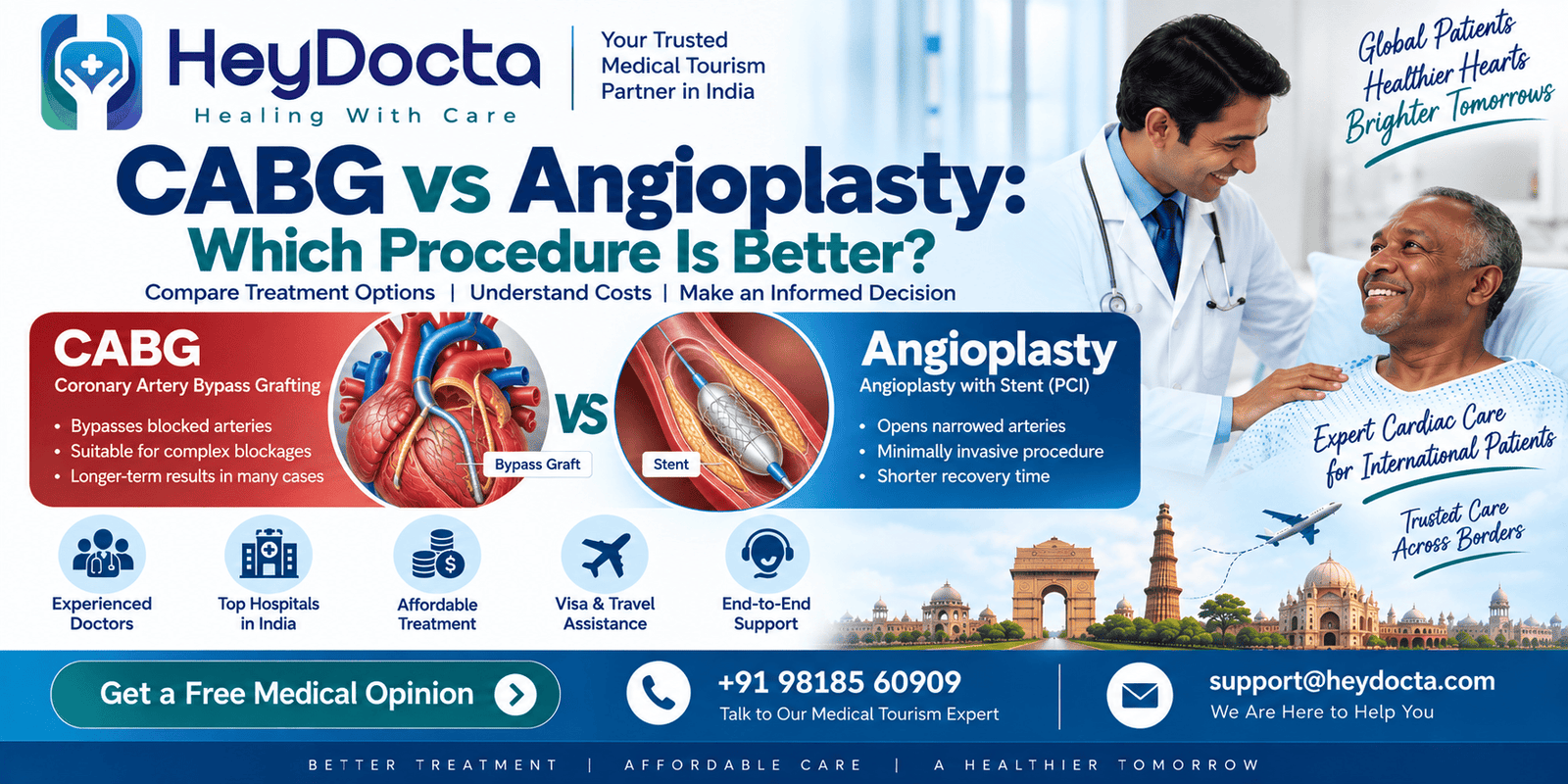
For patients diagnosed with coronary artery disease, one of the most important questions is CABG vs angioplasty: which procedure is better? The answer depends on the number and location of blockages, diabetes, heart function, symptoms, overall health, surgical risk and whether the condition is an emergency. CABG (coronary artery bypass grafting) and angioplasty, also called PCI (percutaneous coronary intervention), are both established methods of restoring blood flow to the heart, but they are not interchangeable for every patient. For international patients considering treatment in India, cost is another major consideration. Published estimates place international-patient angioplasty costs in India at roughly USD 3,800–5,500, while CABG may start around USD 4,700 at some hospitals, with the final price depending on the procedure, number of vessels, stents, hospital and patient’s medical condition.
Get a Free Medical Opinion: Share your angiography, ECG, echocardiogram and other cardiac reports with Heydocta. Our team can help coordinate a specialist review and obtain an estimated treatment plan from suitable Indian hospitals.
What Is Coronary Artery Disease?
Coronary artery disease occurs when the arteries supplying blood to the heart become narrowed or blocked, usually because of plaque buildup. Reduced blood flow can cause chest discomfort, breathlessness and reduced exercise tolerance and can increase the risk of heart attack.
Treatment depends on the severity and pattern of coronary artery disease. Some patients can be managed with medicines and lifestyle changes, while others require revascularisation with PCI/angioplasty or CABG.
Current guidelines emphasise that revascularisation decisions should be individualised. When the best strategy is uncertain, a multidisciplinary Heart Team involving interventional cardiologists and cardiac surgeons can help determine the most appropriate option.
What Is Angioplasty?
Angioplasty, or PCI, is a minimally invasive procedure used to open a narrowed or blocked coronary artery. A thin catheter is introduced through a blood vessel, commonly in the wrist or groin, and guided to the affected coronary artery.
A balloon can be inflated to widen the narrowed area, and a stent is commonly placed to help keep the artery open. Max Healthcare describes PCI as a catheter-based treatment for narrowed or blocked coronary arteries, with stent placement used when appropriate.
Angioplasty is often attractive because it avoids open-heart surgery and generally involves a shorter hospital recovery than CABG.
What Is CABG?
CABG, or Coronary Artery Bypass Grafting, is a surgical procedure in which a healthy blood vessel from another part of the body is used to create a new route around a blocked coronary artery.
Unlike angioplasty, CABG is open-heart surgery in its conventional form and generally requires a longer hospital and recovery period. It may be recommended when there are multiple significant blockages, complex coronary anatomy or other circumstances in which surgery is expected to provide better long-term results.
CABG can involve one or several bypass grafts depending on the number and location of diseased coronary arteries.
CABG vs Angioplasty: Key Differences
| Feature | Angioplasty/PCI | CABG |
| Type of treatment | Minimally invasive catheter procedure | Cardiac surgery |
| Chest incision | No large chest incision | Usually required |
| Stent | Usually used when PCI requires stenting | Not required |
| Hospital stay | Generally shorter | Generally longer |
| Initial recovery | Usually faster | Usually longer |
| Multiple complex blockages | May not be the preferred option in some cases | Often considered |
| Diabetes with complex multivessel disease | May be considered in selected patients | Often preferred when the patient is a suitable surgical candidate |
| Left-main disease | PCI may be suitable in selected anatomy | Often preferred depending on anatomy and surgical risk |
| Repeat intervention | Can be more likely in some disease patterns | Generally less repeat revascularisation than PCI in suitable complex multivessel disease |
The table is a general guide rather than a treatment recommendation. Individual coronary anatomy and clinical circumstances determine the appropriate procedure.
CABG vs Angioplasty: Which Is Better?
There is no single procedure that is better for every patient.
When Angioplasty May Be Preferred
PCI may be considered when:
- There is a suitable single-vessel or limited-vessel blockage
- The coronary anatomy is suitable for stenting
- A minimally invasive treatment is preferable
- The patient has an acute coronary syndrome requiring urgent revascularisation
- Surgical risk is high or CABG is not appropriate
- The Heart Team determines that PCI offers an appropriate balance of benefits and risks
For patients experiencing certain acute heart attacks, PCI can be particularly time-sensitive. European guidelines recommend immediate invasive management for STEMI and very-high-risk NSTE-ACS, with timely PCI playing a central role when available.
When CABG May Be Preferred
CABG may be recommended when:
- Several coronary arteries are significantly diseased
- Disease involves the left main coronary artery
- The coronary anatomy is complex
- The patient has diabetes and multivessel coronary artery disease
- There is reduced heart function in appropriate cases
- Long-term revascularisation strategy favours surgery
- PCI would be technically difficult or less durable
The American Heart Association notes that in patients with diabetes and triple-vessel disease, surgical revascularisation is generally recommended when they are appropriate candidates for surgery.
ESC chronic coronary syndrome guidance similarly reports longer overall survival after CABG than PCI in patients with complex multivessel coronary disease, particularly when diabetes is present, and notes a greater need for repeat revascularisation after PCI.
CABG vs Angioplasty Cost in India
Treatment affordability is one of the major reasons international patients consider India.
Current published estimates vary considerably by hospital and treatment package.Our Partner Hospital Max Healthcare lists angioplasty from approximately USD 3,800.
Max Healthcare currently lists CABG treatment from approximately USD 4,700. Other published international-patient estimates can be lower or higher depending on the hospital and treatment requirements.
| Treatment in India | Indicative International-Patient Cost |
| Angioplasty/PCI | Approximately USD 3,800–5,500+ |
| Angioplasty with multiple stents | Approximately USD 6,500–11,500+ |
| CABG | Approximately USD 4,700 onwards; case-specific estimates vary |
| Complex CABG | Higher depending on surgical complexity and hospital package |
These are indicative figures, not fixed quotations. For angioplasty, the number and type of stents can have a major effect on the final cost.
For CABG, costs can change according to the number of bypasses, surgical technique, ICU requirements, room category, investigations, surgeon fees and length of hospitalisation.
India vs USA, Europe and the Middle East: Cost Comparison
India is often considered by self-paying international patients because cardiac procedures can cost substantially less than comparable private treatment in high-cost healthcare markets.
One current medical-tourism comparison estimates:
| Treatment | India | Approximate USA Range |
| CABG | USD 6,000–12,000 | USD 70,000–150,000 |
| Angioplasty with stent | USD 3,000–7,000 | USD 30,000–60,000 |
These figures are broad planning ranges rather than guaranteed prices and can vary significantly by hospital, insurance status, procedure complexity and location.
For patients from Nigeria, Ghana, Kenya, Zimbabwe, Cameroon, Guyana, Jamaica, the Middle East and Europe, the potential difference in self-pay costs can make India an option worth evaluating.
However, international patients should compare like-for-like packages. A low headline price may exclude certain investigations, stents, ICU care, medicines, additional procedures or complications.
Talk to Our Medical Tourism Expert: Heydocta can help you obtain an individualised estimate from suitable Indian partner hospitals based on your cardiac reports and recommended treatment.
Factors That Affect CABG and Angioplasty Cost in India
The final cost may depend on:
- Number of blocked arteries
- Number of stents required
- Type and brand of stent
- Number of bypass grafts
- Surgical technique
- Hospital and city
- Cardiac surgeon/interventional cardiologist
- ICU requirements
- Room category
- Pre-operative investigations
- Medications and consumables
- Length of hospitalisation
- Existing conditions such as diabetes or kidney disease
- Complications requiring additional treatment
Patients should request a detailed quotation before travelling and confirm exactly what is included.
Best Hospitals and Doctors for CABG and Angioplasty in India
Heydocta’s partner hospital network includes Artemis Hospital, Fortis Hospitals, Max Hospitals, Manipal Hospitals, Yatharth Hospitals and Sarvodaya Hospital.
Artemis Hospital, Gurugram
Artemis Hospitals provides cardiac surgery and interventional cardiac services. Dr. Biswarup Purkayastha, Consultant – Heart & Lung Transplant and Vascular Surgery, is listed by Artemis as having expertise in adult cardiac surgery and coronary surgery, including coronary bypass and total arterial revascularisation. His listed services also include aortic surgery and several valve procedures.
Fortis Hospitals
Fortis has a large cardiac-care network in India. Its cardiac sciences services include bypass surgery, angioplasty, stenting, pacemaker implantation and other cardiac procedures, supported by cath labs, cardiac ICUs and hybrid operating rooms.
Max Hospitals
Max Healthcare provides both CABG and angioplasty services for international patients. Its published international pricing currently lists angioplasty from USD 3,800 and CABG from USD 4,700 onwards.
Max is part of Heydocta’s partner hospital for international-patient coordination and assistance with appointments, medical records and treatment planning.
Manipal Hospitals
Manipal Hospitals is another partner option for international patients requiring cardiac evaluation and treatment. The appropriate centre and specialist depend on the patient’s diagnosis and required procedure.
Yatharth Hospitals
Yatharth Hospitals is part of Heydocta’s partner network and can be considered for eligible international patients requiring cardiac evaluation, angioplasty or surgical treatment according to specialist assessment.
Sarvodaya Hospital
Sarvodaya Hospital is also among Heydocta’s partner hospitals. Patients can be evaluated according to their coronary disease, recommended procedure and individual medical requirements.
Treatment Process for International Patients
Step 1: Share Your Medical Reports
Send your angiography, ECG, echocardiogram, stress-test results, CT scans, blood reports, medication list and previous medical records to Heydocta.
Step 2: Specialist Review
The appropriate cardiologist or cardiac surgeon reviews the reports. If necessary, the Heart Team may compare medical treatment, PCI and CABG.
Step 3: Receive a Treatment Recommendation
The hospital explains the recommended approach and why it may be suitable for your coronary anatomy and overall health.
Step 4: Get a Cost Estimate
Heydocta coordinates with the selected hospital to obtain an estimated treatment cost and information about package inclusions.
Step 5: Medical Visa and Travel
After treatment is planned, Heydocta can assist with hospital documentation and medical-travel coordination.
Step 6: Hospital Evaluation in India
After arrival, the patient undergoes any required investigations before the final treatment decision.
Step 7: CABG or Angioplasty
The selected procedure is performed by the cardiac team.
Step 8: Recovery and Follow-Up
After treatment, the patient receives monitoring, medications, discharge instructions and follow-up recommendations.
Medical Visa and Travel Support
Eligible international patients travelling to India for medical treatment can apply for an e-Medical Visa, while eligible accompanying attendants may apply for an e-Medical Attendant Visa. India’s official e-Visa information requires relevant hospital documentation for medical visa applications.
Heydocta can assist international patients with:
- Hospital coordination
- Medical appointment scheduling
- Medical-report sharing
- Treatment-cost coordination
- Medical visa documentation support
- Accommodation coordination
- Travel assistance
- Airport/local assistance
- Communication with hospital teams
- Post-treatment follow-up coordination
Heydocta’s medical tourism facilitation is designed to support patients throughout their treatment journey without adding a separate facilitation cost to the patient.
Recovery After CABG vs Angioplasty
Recovery is one of the major differences between the two procedures.
After angioplasty, many uncomplicated patients can return to routine activities relatively quickly, although the treating cardiologist determines when normal activity and international travel are appropriate.
CABG requires a substantially longer recovery because it is major surgery. Patients generally need hospital monitoring followed by a period of gradual physical recovery and, where recommended, cardiac rehabilitation.
International patients should not book a return flight based solely on an estimated hospital stay. The treating medical team should confirm that the patient is medically fit to travel.
Frequently Asked Questions
1. Is CABG better than angioplasty?
Neither is universally better. CABG may be preferred for some patients with complex multivessel disease, left-main disease or diabetes with multivessel coronary disease, while angioplasty may be preferable in selected patients because it is less invasive and has a shorter initial recovery.
2. Is angioplasty cheaper than CABG in India?
Often, angioplasty has a lower initial cost, particularly when only one stent is required. However, multiple stents can substantially increase the cost. Published estimates show one-stent angioplasty around USD 4,500–5,500 for international patients, while CABG costs vary by hospital and surgical complexity.
3. Which is safer, CABG or angioplasty?
Safety depends on the patient’s condition and the procedure’s indication. Angioplasty is less invasive, but CABG can offer better long-term revascularisation in selected complex coronary disease. The Heart Team should evaluate the individual risks and benefits.
4. Can a patient with diabetes have angioplasty?
Yes. However, patients with diabetes and multivessel coronary artery disease may benefit more from CABG when they are suitable surgical candidates. The decision should be made after reviewing coronary anatomy and overall health.
5. How long is recovery after CABG compared with angioplasty?
Angioplasty generally has a shorter initial recovery because it is catheter-based. CABG is major surgery and usually requires a longer hospital and overall recovery period.
6. Can international patients get CABG or angioplasty in India?
Yes. Indian hospitals treat international patients from Africa, the Middle East, Europe, the USA and other regions. Patients should obtain a specialist review before travelling so that the appropriate procedure and hospital can be planned.
7. Can Heydocta help me compare CABG and angioplasty costs?
Yes. Heydocta can coordinate the sharing of your cardiac reports with suitable partner hospitals and help you understand the estimated cost, treatment plan, hospital options, visa requirements and travel arrangements.
Why Choose Heydocta for Cardiac Treatment in India?
Travelling overseas for cardiac treatment involves medical and logistical decisions that can be difficult to manage alone. Heydocta helps international patients coordinate with suitable Indian hospitals and cardiac specialists based on their medical condition and treatment requirements.
From medical-report coordination and hospital selection to cost estimates, medical visa support, travel assistance and follow-up coordination, Heydocta provides end-to-end medical tourism support.
Our international patient support is designed for patients from Nigeria, Ghana, Kenya, Zimbabwe, Cameroon and other African countries, Guyana, Jamaica, the Middle East, Europe and the USA.
Conclusion: CABG or Angioplasty — Which Is Right for You?
The answer to CABG vs angioplasty: which procedure is better? depends on the patient’s coronary anatomy, symptoms, number of blockages, diabetes status, heart function, surgical risk and whether the condition is acute or stable. Angioplasty can offer a less invasive treatment and faster initial recovery in appropriate cases, while CABG can provide important long-term advantages for selected patients with complex or multivessel coronary disease.
Cost is another important consideration for international patients. India offers comparatively affordable cardiac treatment, but the cheapest procedure is not necessarily the most appropriate one. A specialist evaluation and, where appropriate, a multidisciplinary Heart Team discussion should guide the decision.
Get Treatment Cost from Top Indian Hospitals: Contact Heydocta.com today and Share your cardiac reports to receive assistance with a medical opinion, hospital selection, CABG or angioplasty cost estimate, medical visa coordination and travel support.